Lawrence-Douglas County Public Health called it an “evolving situation,” and has been doing contact tracing as the university began a new semester this week.
by Erica Hunzinger, Kansas News Service
Students who live at five fraternities and five sororities at the University of Kansas must quarantine for 14 days, health officials said Wednesday night.
Using contact tracing, the Lawrence-Douglas County Public Health agency said people in the Greek homes were most likely to have come in close contact with some of the 200-plus students who have tested positive for the coronavirus. Chapter members who live elsewhere are not part of the order.
“This is an evolving situation,” the health agency said in a news release, noting that it had issued quarantine orders for nine Greek organizations and was working on a 10th.
The University of Kansas started its fall semester on Monday with in-person instruction, and offered free testing for students, faculty and staff. As of Tuesday, the overall positive test rate was about 1%, but 133 people in fraternities or sororities had tested positive for a rate of more than 5%.
KU Chancellor Doug Girod said in an emailed statement that health officials met with Greek organizations to talk about “health and safety strategies.” He also said the next update on the number of COVID-19 cases at KU would come Friday.
“As you’ve heard me say many times, our situation is fluid and can change rapidly,” Girod said. “We anticipate additional county-issued quarantine orders will continue to impact the KU community in the days ahead.”
Earlier in the day, the Kansas Department of Health and Environment said Kansas saw an increase of more than 1,500 cases between Monday and Wednesday for a total statewide of almost 40,000.
KDHE tracks clusters of cases, with current data showing seven active outbreaks at universities or colleges; it does not provide anything specific beyond that. But Gov. Laura Kelly said Tuesday that one college student has been hospitalized with coronavirus complications.
Earlier this month, a fraternity at Kansas State University saw 13 members test positive for the coronavirus.
More than 4,000 KU students are part of Greek life, according to the school’s official Sorority and Fraternity Life webpage, with 47 organizations and about 20% of the student population.
Erica Hunzinger is the news editor for the Kansas News Service. You can follow her on Twitter @ehunzinger. The Kansas News Service is a collaboration of KCUR, Kansas Public Radio, KMUW and High Plains Public Radio focused on health, the social determinants of health and their connection to public policy. Kansas News Service stories and photos may be republished by news media at no cost with proper attribution and a link to ksnewsservice.org.
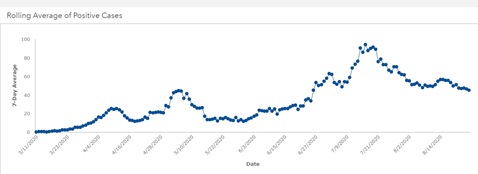
Wyandotte County reported an increase of 109 cases on Wednesday, for a total cumulative 5,746 cases, according to the Unified Government COVID-19 website. There were 113 COVID-19 deaths, an increase of two since Tuesday. (Information from UG COVID-19 website)The seven-day rolling average of positive COVID-19 cases in Wyandotte County has been declining slightly recently. (From UG COVID-19 webpage)
An effort has been launched in Wyandotte County to limit the spread of COVID-19, according to an announcement today.
Three organizations have joined together to help businesses show they are committed to fighting COVID-19. The three organizations are the Kansas City, Kansas, Convention and Visitors Bureau, the Kansas City, Kansas, Chamber of Commerce and the Wyandotte Economic Development Council.
According to a spokesman, businesses and individuals can go to KeepWYCOWell.com and pledge to follow guidelines that help combat the spread of COVID-19. The guidelines were developed based on recommendations from the Unified Government Health Department as outlined in the Wyandotte County COVID-19 Business Toolkit and from the CDC and Kansas Department of Health & Environment.
“As a nation and as a community, this pandemic has created an unprecedented public health crisis with a direct economic impact,” said Greg Kindle, president of the Wyandotte Economic Development Council. “We encourage the business community and their employees to be safe and take an active role in health and safety.”
One challenge for businesses is convincing customers that it is safe to return. This is particularly true for hospitality and tourism-related businesses.
“Kansas City, Kansas, prides itself on being a welcoming community, and now we need to be a safe one as well,” said Alan Carr, executive director of the Kansas City, Kansas, Convention and Visitors Bureau. “This program can help boost the public’s confidence that Kansas City, Kansas, is a safe place to visit and that our destination is taking precautions to keep everyone healthy and safe.”
Businesses that take the pledge agree to implement barriers, increase sanitation, promote health screening measures for employees and follow industry-specific practices outlined in the Wyandotte County COVID-19 Business Toolkit. Individuals who take the pledge agree to wear a mask, social distance, practice appropriate hygiene, monitor their health, and show kindness and patience when patronizing businesses.
“The KCK Chamber is proud to partner on this initiative to ensure our businesses remain open and our community stays safe,” said Daniel Silva, president and CEO of the KCK Chamber. “The pledge promotes collaboration and doing what is best for the common good.”
Businesses who take the pledge can access a toolkit with marketing tools including window clings and social media graphics, as well as links to resources detailing industry-specific best practices to keep both employees and customers safe.
For more information on the initiative or to take the pledge, visit KeepWYCOWell.com.
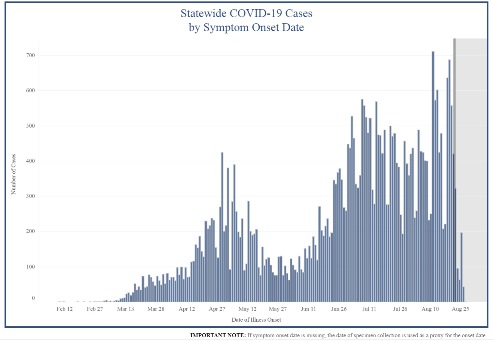
Statewide, Kansas reported an increase of more than 1,500 cases on Wednesday, as compared to Monday, according to the Kansas Department of Health and Environment. (KDHE chart)
COVID-19 cases increasing
Wyandotte County reported an increase of 109 cases on Wednesday, for a total cumulative 5,746 cases, according to the Unified Government COVID-19 website. There were 113 COVID-19 deaths, an increase of two since Tuesday.
Johnson County reported 7,682 cases on Wednesday, and Leavenworth County had 1,658, according to the KDHE.
The state of Kansas reported 39,937 cases from 105 counties with 437 deaths on Wednesday morning. It was an increase of 1,536 cases and 11 deaths since Monday, according to the KDHE. Douglas County reported 1,075 cases and Riley County, 574.
Dr. Lee Norman, Kansas secretary of health, said the Kansas case rate is 108 cases per 100,000 per week, the 16th highest in the United States.
“We have some work to do in bringing those numbers down,” he said. On the positive case rates, Kansas is the sixth highest in the United States, he said.
Thirty percent of the Kansas counties are in in the “red or yellow” areas for community spread, indicating high numbers and intermediate numbers, he said.
Fifty-three percent of new cases are related to just three counties, he said.
Kansas did 36,510 diagnostic tests last week, he said.
Eleven new clusters were reported since Monday, Dr. Norman said.
The percentage of new overall COVID-19 cases in the Midwest rose 20 percent this week, he said. As the number of cases are reducing in southern states, the Midwestern states are picking up, he added.
“Hospital use is steady but still too high,” he said. Flu season is not that far away. Deaths are less on a per capita basis than the last few months but the trend seems to be slightly increasing, he said.
Dr. Norman also discussed a Hong Kong man who tested positive twice, with the second test 4.5 months after the first infection. Scientists believe it was another infection.
It will bear watching, he said, with immunity not lasting in that individual for 4.5 months.
Seven universities had outbreaks, as well as six kindergarten to 12 schools and day cares.
Since the end of May, when the mandate for the Ad Astra plan was no longer in place, there has been a pretty steady increase, Dr. Norman said. He believes there could be some leveling off in the future. The Ad Astra statewide plan is a mandate in Wyandotte County from local health officials, with modifications.
“If this was a football game, we’re at the end of the first quarter,” Dr. Norman said. There are quite a few months ahead, there will be challenges such as schools restarting, he added.
“I think we need to be very attentive to the things we know are the reasons this virus spreads,” Dr. Norman said.
“Community spread is still active, not just in nursing homes and prisons, but in the communities as well,” he said.
There is a long way to go to get to herd immunity, which would be 90 to 95 percent, he said. Preferably, it could be achieved by vaccine, not by everyone getting the disease.
The American Red Cross tests blood donations for the COVID-19 antibody, Dr. Norman said, and only 1 percent of people are showing up with the antibody, he said. That isn’t a scientific study, but 1 percent is a fairly low number, he added. They are seeing it now that they are doing more antibody testing.
Herd immunity through natural diseases is not something that should be a goal, he said.
Dr. Norman urged people to get their flu vaccines this fall. There are still a lot of COVID-19 patients in hospitals, and in prior years, the flu season put a stress on hospitals for space, he said.
Dr. Norman said he thinks it’s a good idea that the Food and Drug Administration has granted emergency use authorization for convalescent serum. He added that it is still being studied, and anecdotal evidence shows it’s beneficial, he added.
“We are not helpless against this virus,” Dr. Norman said, adding that he would like children especially to know that. People may be getting frustrated by restrictions on movement, however.
The things that work are physical distancing, mask use, hand washing, staying home when ill, getting tested if symptomatic and being isolated when they are positive.
“Those are things within our grasp now, and they will continue to be effective, but we have to do them,” Dr. Norman said.
At the University of Kansas Health System, there were 24 COVID-19 patients in the hospital on Wednesday, an increase of one from Tuesday. There were nine COVID-19 patients in the intensive care unit, a decrease of one since Tuesday, and six patients on ventilators, an increase of three since Tuesday. There were another 33 COVID-19 patients who were past the acute infection phase.
Free testing offered
Free COVID-19 testing is planned from 10 a.m. to 1 p.m. Thursday, Aug. 27, at Quindaro Community Center, 2726 Brown Ave., Kansas City, Kansas, through Swope Health and the Health Equity Task Force.
Another pop-up COVID-19 testing site will be held from 5 p.m. to 7 p.m. Thursday, Aug. 27, at the Eighth Street Baptist Church, 1420 N. 8th St., Kansas City, Kansas, through Vibrant Health and the Health Equity Task Force.
Free testing also is offered from 9 a.m. to 3 p.m. Monday through Friday at the Unified Government Health Department parking lot at 6th and Ann, Kansas City, Kansas. For more information, call 311.
Wyandotte County is under a mandatory mask order and is in Phase 3 of the state’s reopening plan. For more information, residents may visit the UG COVID-19 website at https://alpha.wycokck.org/Coronavirus-COVID-19-Informationor call 311 for more information.
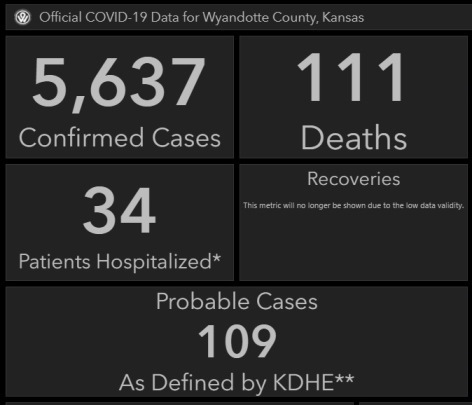
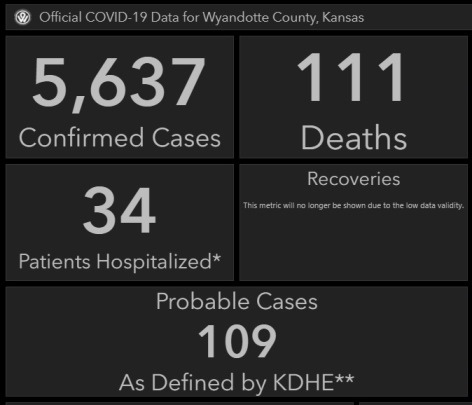
Wyandotte County reported an increase of 16 COVID-19 cases on Tuesday, for a cumulative total of 5,637, according to the Unified Government COVID-19 webpage. The number of deaths was the same as previously at 111, there were no increases. (From UG COVID-19 website)
At the University of Kansas Health System news conference on Tuesday, doctors discussed resiliency with a heart transplant patient, Carol Barnett.
She had a transplant in May, and was unable to have any visitors in the hospital, except the morning she received her heart, and one other time.
Since her transplant, she has resumed some of her activities including walking, cooking, gardening and occasional visits from the grandchildren.
She feels great and has increased her walking to four to five miles a day, she said.
“I’ve been given this whole new lease on life,” Barnett said.
“We’re lucky to live somewhere where we have a nice yard and can walk around. We make the best of the situation,” Barnett said.
Dr. Nicholas Haglund, a cardiologist, said hospitals are one of the safest places to be around, and he would advise patients to follow their doctors’ advice if they need treatment.
Dr. Matthew Danter, a transplant surgeon, said needs have not changed and patients should discuss their conditions with their physicians.
Wyandotte County reported an increase of 16 COVID-19 cases on Tuesday, for a cumulative total of 5,637, according to the Unified Government COVID-19 webpage. The number of deaths was the same as previously at 111, there were no increases.
At the University of Kansas Health Center, there were 23 acute COVID-19 patients in the hospital on Tuesday morning, including 10 in the intensive care unit and three on ventilators, according to Dr. Dana Hawkinson, medical director of infection control and prevention at KU Health. It was down two from 25 on Monday. In addition, 30 patients have done past the acute stage and are in the convalescent stage at the hospital, he said.
Free testing offered
Free COVID-19 testing is planned from 8 a.m. to 11 a.m. Wednesday, Aug. 26, at Zotung Christian Church, 5010 Parallel Parkway, Kansas City, Kansas, through Vibrant Health and the Health Equity Task Force.
Free testing also is offered from 9 a.m. to 3 p.m. Monday through Friday at the Unified Government Health Department parking lot at 6th and Ann, Kansas City, Kansas. For more information, call 311.
Wyandotte County is under a mandatory mask order and is in Phase 3 of the state’s reopening plan. For more information, residents may visit the UG COVID-19 website athttps://alpha.wycokck.org/Coronavirus-COVID-19-Informationor call 311 for more information.