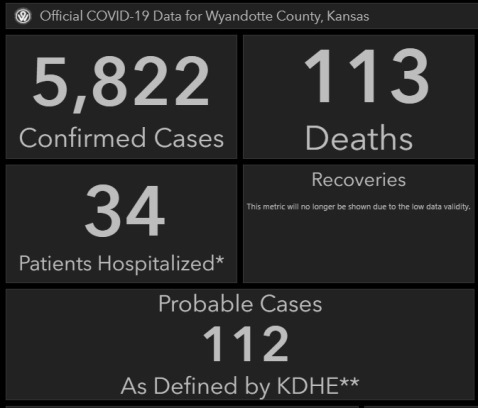
Wyandotte County had 44 new positive COVID-19 cases on Friday, with a cumulative total of 5,822, according to the UG COVID-19 website. There were no additional deaths on Friday, with a cumulative total of 113. (From UG COVID-19 webpage)
Hundreds of COVID-19 cases are cropping up in colleges and universities in Kansas, according to Dr. Lee Norman, Kansas secretary of health.
Dr. Norman made his remarks at the Aug. 28 University of Kansas Health System news conference.
At this time, kindergarten through 12th grade schools tend to be doing better than colleges, he added.
Some universities, such as KU, are doing widespread testing. At KU, 10 fraternities and sororities recently were quarantined because of COVID-19 cases, according to the doctors.
The KDHE website stated there were 16 outbreaks in colleges and universities, with 189 cases and one hospitalization.
Dr. Norman said they would start displaying data for schools and universities soon on the KDHE COVID-19 website.
He said the school and colleges would be listed by name so people have access. They will associate the fraternity and sorority houses with the university, he added.
Dr. Steve Stites said congregations, parties, fraternities, games, political rallies – it doesn’t really matter what the event is, if people don’t wear masks and socially distance.
Spreadsheets show school COVID-19 numbers
Alisha Morris, an Olathe theater teacher, has created spreadsheets that tell how much COVID-19 is in schools throughout the nation.
Her spreadsheets have become very popular, especially among teachers who are looking for more information about COVID-19 in schools. At the KU Health Systems news conference, she said she enters information from published news reports on the spreadsheets, and she has other volunteers who help.
Because there are so many hours required to collect and enter this data, Morris said she will soon be turning over the spreadsheets to the National Education Association to work on it, while she goes to teacher training to get ready for school starting.
Morris said some school district leaders have told her they used the information from the spreadsheets in order to help make decisions.
Also, the amount of COVID-19 in a school building is the kind of information a lot of parents would want to know when making the decision about whether to send their children back to school, according to Morris.
Morris’ spreadsheet for Kansas schools shows five school districts, none in Wyandotte County. The list includes the Blue Valley School District in Johnson County.
She said although school has not yet started in many areas of Kansas, some of the COVID-19 cases are from athletic practices that have started.
Dr. Steve Stites, chief medical officer at KU Health System, said the decision many parents are making on whether to go back to school in person is a private and personal one based on health and family, among other factors. One of the other factors is knowing the risk in the school and community, and the data provided by the spreadsheet may help parents with that.
The University of Kansas Health System reported 27 positive acute COVID-19 cases on Friday morning, down two from Thursday morning, according to Dr. Dana Hawkinson, medical director of infection control and prevention. There were four patients in the intensive care unit, down from 10 on Thursday, and three on ventilators, down from five on Thursday.
There were another 27 patients hospitalized at KU Health System with COVID-19 who are not in the acute infection phase any longer, with three of those on ventilators, according to Dr. Hawkinson.
Wyandotte County had 44 new positive COVID-19 cases on Friday, with a cumulative total of 5,822, according to the UG COVID-19 website. There were no additional deaths on Friday, with a cumulative total of 113.
The state of Kansas reported 41,048 COVID-19 cases with 443 deaths on Friday morning, according to the KDHE. It was an increase of 1,111 cases since Wednesday, and six more deaths since Wednesday, according to KDHE.
The KC Region COVID-19 Resource Hub reported a total cumulative 31,984 cases on Friday in a nine-county area. Kansas City, Missouri, reported 8,466 cases, according to the website.
There were 501 outbreaks in the state reported on Friday, an increase of 26 outbreaks since Wednesday, according to the KDHE.
Johnson County reported 7,920 cases on Friday, an increase of 238 cases since Wednesday, according to the KDHE.
Leavenworth County reported 1,674 cases on Friday, an increase of 16 cases since Wednesday, KDHE stated.
Sedgwick County, which includes Wichita, reported 7,093 cases, an increase of 101 cases since Wednesday, according to KDHE.
Douglas County, which includes Lawrence, reported 1,189 cases, an increase of 114 cases since Wednesday, according to KDHE. All the university students are being tested in Douglas County, and they are counted in that county’s total.
Riley County, where Manhattan is located, reported 656 cases on Friday, an increase of 82 cases since Wednesday, according to KDHE.
Shawnee County, which includes Topeka, reported 2,123 cases, an increase of 56 cases since Wednesday, according to KDHE.
Quarantines could be ahead for those who attend away football games
Quarantines for attending a University of Kansas or Kansas State University away football game?
That might be possible now that the Kansas Department of Health and Environment has issued new travel guidelines.
One of the new KDHE travel guidelines says that anyone who attends an out-of-state gathering of more than 500 people after Aug. 11 should quarantine for 14 days.
Dr. Lee Norman, Kansas secretary of health, said on Friday morning that cases are cropping up from gatherings without social distancing and mask-wearing.
“If they can’t be social distanced, then they should be quarantined upon coming back,” Dr. Norman said. ”We just know they’re going to spread more virus.”
The rule applies where anti-contagion measures including distancing and masking are not being mitigated, he added.
The local Wyandotte County health order prohibits gatherings of more than 45 and also mandates masks and social distancing.
When Dr. Deborah Birx of the White House Task Force on Coronavirus visited here recently, she advised people not to have gatherings of more than 10 people.
The state’s travel quarantine list also includes several countries, including Aruba, the UK and Ireland, as well as travel on cruise ships.
Dr. Hawkinson said that people should use both masking and social distancing at the same time for the best results. The doctors also advised people to wash their hands and stay home when ill.
State officials hope two labs in Johnson County could help Kansas boost its testing capacity dramatically for schools, nursing homes and asymptomatic people.
by Celia Llopis-Jepsen, Kansas News Service
Lenexa, Kansas — One lab has helped seven Kansas universities test tens of thousands of students, faculty and staff for COVID-19 for the fall semester. And all anyone needed to do was spit.
Saliva lab work has the potential to dramatically increase testing of asymptomatic Kansans with no known COVID-19 exposure, state health officials say. That’s a critical ingredient for stopping the pandemic.
Last week, Kansas health secretary Lee Norman suggested the state partner with labs such as Lenexa-based Clinical Reference Laboratory and a second Lenexa company that does saliva and other COVID-19 testing for major hospitals, MAWD Pathology Group.
“Anybody can spit into a tube. That would be a game changer,” Norman told a state task force. “That would really open up the floodgates.”
He suggested tapping the labs to help the state’s nursing homes and schools, and to regularly test large numbers of Kansans without symptoms, not just patients who turn up at doctor’s offices feeling sick.
Collecting saliva holds a few advantages over swabs that dip deep into one’s nasal passages. Most people can spit into a tube without help from a nurse or other medical professional decked out in protective gear.
Already, Kansas has surpassed its target of testing more than 60,000 people per month three months in a row, but Norman said “it’s not enough.” The state has focused largely on people with symptoms or exposure to known COVID-19 outbreaks — a triage level of testing that epidemiologists widely agree falls short of what’s needed.
To dramatically slow viral transmission, the Harvard Global Health Institute said last month that Kansas must more than triple the number of people tested daily to nearly 13,000, while keeping up social distancing and mask-wearing. Only five states are testing enough people to suppress the virus.
The state may already have the capacity to top that, MAWD president Samuel Caughron said. His lab can handle 10,000 to 15,000 tests daily, but doesn’t use its full capacity.
“We’ve been seeing, as other labs have, our volumes declining,” he said. “There is something of a disconnect between what could be, and what’s happening.”
The challenge for Kansas, he said, is creating a process that links organizations in need of mass testing to labs that can return results within a day or two.
Stocking up
Harvard experts have warned saliva testing could face supply shortages, too, just like tests that use nasal or throat swabs.
While waiting months for the U.S. Food And Drug Administration to authorize its tests, Lenexa’s Clinical Reference Laboratory used the time to install hard-to-get liquid-handling robots and squirrel away as many supplies as it could. Authorization came through July 30.
“Honestly, we’ve just been building inventory since the day this started,” CEO Bob Thompson said. “So we’re feeling really good about our supply chain.”
The company currently provides test results within 1-2 days.
Saliva tests (and saliva-sputum tests that require the person to cough before spitting) detect genetic material — RNA — from the coronavirus. That’s the same science used with deep nasal swabs, but collecting saliva is quicker in large populations like prisons, schools and colleges. It saves precious masks and gloves, and it’s a less unpleasant option for people who have to take the test repeatedly, such as nursing home residents, athletes and health care workers.
At the University of Kansas, saliva tests have detected more than 200 cases of COVID-19 so far, and revealed higher rates of the virus among fraternities and sororities. This week Douglas County health officials ordered residents of nine fraternity and sorority houses into two-week quarantine.
CRL in Lenexa has already processed 30,000 tests for seven Kansas schools, including KU, Emporia State University, Wichita State University, Fort Hays State University and Benedictine College — as well as 4,000 tests for four in Missouri.
The lab said it could handle several more thousand tests per day for Kansas. The company currently processes about 10,000 a day, with a focus on the Kansas and Missouri markets, and expects to reach 20,000 a day by mid-September.
It’s in talks with Kansas school districts, too, and recently inked a deal with Los Angeles Unified School District to join a bevy of labs assisting its 600,000-student school system. Minnesota is providing saliva tests (which aren’t from CRL) to all its schools, and announced this week it will spend nearly $15 million on a new lab for saliva samples.
The state lab in Topeka also plans to start processing saliva samples in-house, a Kansas Department of Health and Environment spokeswoman said Friday. It has the right equipment, but must first complete legwork to ensure its results would be valid.
For mass testing of largely asymptomatic people at places like colleges, CRL pools material from five people at a time to speed up the process. When a combined sample contains the virus, CRL then retrieves the five vials to retest each person’s saliva individually and pinpoint the source.
While CRL received FDA authorization, not all COVID-19 tests — saliva or otherwise — have that.
The backlogged agency allowed many tests onto market while awaiting review, and last week the Trump administration axed the requirement for federally regulated labs with advanced capabilities to undergo FDA scrutiny.
MAWD’s test, a variation of the Centers for Disease Control and Prevention method, does not have FDA authorization yet but the company may still pursue it.
Pittsburg State University uses Cytocheck, a lab in Parsons, but didn’t answer questions about whether the FDA has greenlighted its tests. Cytocheck wouldn’t speak to the Kansas News Service about its product.
Celia Llopis-Jepsen reports on consumer health and education for the Kansas News Service. You can follow her on Twitter @celia_LJ or email her at celia (at) kcur (dot) org. The Kansas News Service is a collaboration of KCUR, Kansas Public Radio, KMUW and High Plains Public Radio focused on health, the social determinants of health and their connection to public policy. Kansas News Service stories and photos may be republished by news media at no cost with proper attribution and a link to ksnewsservice.org. See more athttps://www.kcur.org/news/2020-08-28/saliva-is-making-it-possible-to-quickly-test-tens-of-thousands-of-kansans-for-coronavirus.
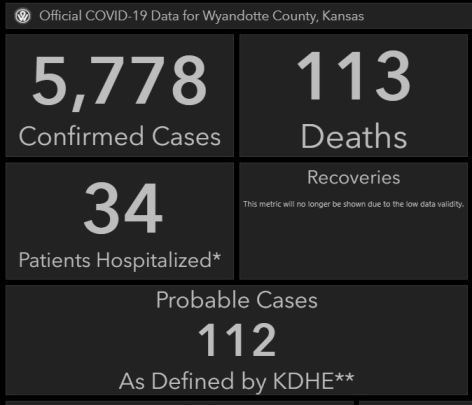
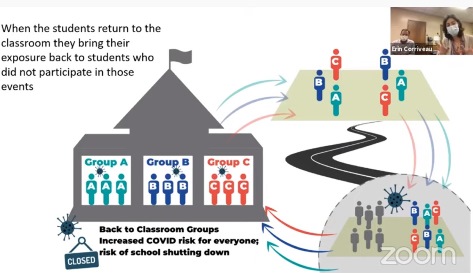
The UG COVID-19 webpage reported 141 new COVID-19 cases on Thursday, and two new deaths. (COVID-19 webpage)An illustration shown during the UG meeting showed how sports and activities could expose the athletes and other students to COVID-19, potentially. (From UG meeting)
Unified Government Health Department officials went over the sports rules for the fall at the 5 pm. Thursday Unified Government Commission meeting, but there were no changes made.
Doug Bach, UG administrator, said at the end of the discussion that there would be more evaluation and review of the situation by doctors and there could be items that come back for additional discussion later.
Commissioner Brian McKiernan was one of the elected officials who called for more discussion and communication with the health officials, commissioners and community on the topic, and some other commissioners agreed.
Commissioner McKiernan said they have given the Health Department doctors an impossible task, asking them to keep everyone healthy and productive, in the face of a virus that doesn’t care what they do. He said it was necessary to keep talking to each other to reach a middle point.
Health officials are afraid that if students go outside the county to play sports, as some have already done, they will break the cohorts at their schools and potentially expose many others to the virus.
Commissioner Mike Kane voiced the concerns of some student athletes and asked about the UG Commission having authority over the health orders.
He said that last weekend, more than 2,000 high school wrestlers gathered at the Hy-Vee Arena in Kansas City, Missouri. Also, students have been playing baseball and other sports all summer long outside of Wyandotte County, he said.
When schools agreed to follow all the guidelines, he thought that was good. Then he heard Dr. Lee Norman, state health secretary, say that the decision would be made by each school district, he added.
“We’re already going outside the county,” Commissioner Kane said. Some youth attend school outside Wyandotte County. Some adults work outside the county. The Legends Outlets is open with all kinds of shoppers there, he said.
“The teens have done what they were asked to do,” Commissioner Kane said. One fifth-grader wore a mask even though it was 92 degrees outside, he said. “When schools follow those guidelines, I don’t know why any rumor would go out there, or why we would have a presentation like this, because it sounds like you’re setting up to shut this stuff down and I don’t like that at all.”
Commissioner Kane said the doctor should not be the one to make the decision. He thought there has been a decision that the county commissioners could override the doctor, he added.
He asked a question on Aug. 13 about teams playing outside the county, and the reply was that they couldn’t control what people do outside the county.
“Somebody needs to go out there and watch these kids, paying attention and talking to them,” he said. If it wasn’t a remote meeting, the commission chambers would have been filled with students, because they feel like they’re being dictated to, he said.
“Before we do anything, we better make sure that everyone knows what’s going on and something is happening,” he said. “We need to give our kids something. We tied them up for a long time.”
“The state doctor has already said it’s OK to leave it up to the school districts, and we should leave it up to the school districts,” Commissioner Kane said.
Dr. Allen Greiner, Wyandotte County chief medical officer, said he doesn’t believe there’s anything they can do to control activities outside of Wyandotte County.
“Some of it boils down to the real clear evidence we have that stay-at-home orders work for reducing spread and reducing hospitalizations and reducing deaths,” he said. “Masks do that as well.” They are seeing a reduction in cases in the last month, and they will see fewer deaths because of mask orders, he said, unless there is another variable to increase it.
If anyone is going to engage in anything that puts them within 6 feet of someone for more than 10 minutes, they should be wearing masks, he said. They are trying to promote mask and social distancing because it reduces spread, reduces hospitalizations and saves lives, he said.
If sports can be conducted in such a way that people can wear masks and social distance, it will reduce spread, and schools won’t have to be closed at a rate as fast as they would otherwise, Dr. Greiner said.
If a school is going to have a football game in Kansas, they have to have 10 practices before the game. The Health Department wasn’t aware that practices with close contact was occurring in Wyandotte County, and they weren’t wearing masks, he said. They just heard that about a week ago and that is where the conversation on Thursday night was coming from, he added.
Commissioner Kane asked if they were going to close The Legends or the professional soccer games.
“This is a big deal,” Commissioner Kane said. “This is huge to the families. And I want everyone to be safe.
“I know they feel out in Piper that this was some sort of threat, and nobody likes that,” he said.
He said he’s never had so many phone calls and emails saying they can’t do this.
“As long as they follow those guidelines, they should play ball,” Commissioner Kane said.
Ken Moore, UG attorney, was asked for his opinion about the health orders.
Moore said the Legislature in the special session changed the statutes allowing the county commissions to override the local health orders.
He still believes the local health orders are more broad than the school board’s powers, he said.
The state’s attorney general has previously said that he thinks school boards can make the decisions about their own school district and what happens in their buildings. He also has said county commissions can overrule county health orders.
Commissioner Tom Burroughs asked about rumors that there would be a quarantine period or a 25-day trial period.
With some professional sports, there is a ton of resources being poured into the trials, with lots of testing and cohorting, Dr. Greiner said. While they’re open to creative solutions, it’s also a resource issue, of what they can do, he said.
“The real question is, are we treating our kids in a punitive manner, or is the message all wrong,” Commissioner Burroughs asked. At some point, they have to recognize the mental health aspect, he added.
They need some assistance as a community to find a result that’s not punitive, but is understandable and offers a safeguard without being heavy-handed, Commissioner Burroughs said.
Dr. Corriveau said it was a difficult time for them to think about what to do next. There were a lot of loud voices now on this issue, and also some quiet voices who are afraid, she said. They are hearing from both.
It is a fine line, and they don’t want to take hope away from the youth, Dr. Corriveau said. They have prioritized classroom learning and allow them to receive their education, she said. They have prioritized classroom learning over extracurricular activities at this point, although they realize extracurricular activities are important.
There is evidence, including the local team that had an outbreak, that close contact spreads the virus, and no evidence that it doesn’t, Mayor David Alvey said.
The measures they’re trying to put in place are always about trying to protect people, Mayor Alvey said.
All the measures are incremental, and no one thing does it all, he said.
Mayor Alvey has heard people say they are dictating, and he said that football is all about dictating and limits. “We dictate you cannot rough the passer,” he said. It’s dictating, and “that’s simply done for safety.”
In his previous role as a school administrator, Mayor Alvey said he was formerly in charge of making sure that conditions at games were safe. When a lightning detector showed that it was dangerous, they had to evacuate and cancel that game, he said.
“That was not a punishment, it is a consequence,” Mayor Alvey said. “There are natural consequences of actions and there are punishments.”
Telling people not to engage in close contact is not punitive, but simply a safety measure that is a consequence, he said.
The enemy is not the Health Department, nor the administration, it is the virus, he said.
The virus is going to do what the virus wants to do, he said. What they must do is pay attention, and decide what it is that they need to do to stop it. Every time they take their eye off it, they lose track of what they’re about, because the virus is dictating to them. Then the virus will take them where they don’t want to go, he said.
As a school administrator, he said he understands how important athletics are.
“But I would never have allowed the game to go on with lightning coming down,” he said. He was not going to be the person who did not evacuate the stands and people died, he added.
“If we do what we need to do to slow the virus, we take control and not let the virus control us,” Mayor Alvey said.
Health Department offers details about COVID-19 numbers
Much of the Health Department presentation went into detail about the fall sports order, explaining the reasoning behind it. Some contact sports were prohibited in the order.
Dr. Greiner said the Wyandotte County case rates per 100,000 were double that of Kansas City, Missouri’s rate, twice as much as the state rate and three times the Johnson County rate.
Only Kansas City, Missouri, is doing more testing than Wyandotte County, he said. “Our rate is significantly higher,” he said.
Wyandotte County has 5% of the total Kansas population, but 14% of Kansas COVID-19 cases and 26% of Kansas COVID-19 deaths, he said.
The seven-day rolling average is 45 cases a day, which is an improvement, he said Deaths are less than a half per day, but the percent positivity rate is high at 18 percent. The Health Department testing percent positivity rate is 27 percent.
Dr. Greiner said most of the decline in new cases they’ve seen since the middle of July has been due to the mask order.
While COVID-19 is still most deadly for older adults, about a fifth of the deaths are among those younger than 60, he said. In the last month, there have been slightly higher numbers of deaths, but that may decline as the effects of the mask order are seen, according to Dr. Greiner. The number of deaths in lower age groups has been increasing.
Juliann van Liew, Health Department director, said the Centers for Disease Control within the last few days has issued new guidelines against testing close contacts of positive cases. She said the Health Department believes this is largely politically motivated and the Health Department will not be adopting it.
The Health Department, however, will be recommending tests from 7 to 9 days after exposure to a positive case, a little longer than the previous 5 to 7 days, she said.
Van Liew said the Health Department is working on saliva testing validation, is near completion and they expect to finish in the next week or so. They will be moving away from the nasal swab test if it works out. Tests are free at the Health Department for those who live or work in Wyandotte County, from 9 a.m. to 3 p.m. Monday through Friday.
Wyandotte County is running the second highest in tests in the metropolitan area; however there has been a decrease in testing numbers in the past few weeks, she said. They are now testing about 65 people a day, she said. The 7-day rolling average of tests is a little under 400, she added.
A rolling average of positive test percentages has been going up, which is one of the things that worries them about school reopening and activities, she said.
Dr. Erin Corriveau, deputy chief medical officer, said COVID-19 patients admitted to the hospital have been increasing recently.
The University of Kansas Health Center on Thursday morning reported 27 COVID-19 patients in the hospital, with an additional 34 COVID-19 patients still there who are not considered acutely infectious. Usually, about a third to a half of the patients at the hospital are from Wyandotte County, Dr. Corriveau said.
The number of people admitted to the hospital locally without any other existing conditions also has been increasing, she said.
Dr. Corriveau said youth from 0 to 19 years old make up about 14.7 percent of all OVID-19 cases in Wyandotte County. People ages 60 and older make up about 14.4 percent of the Wyandotte County cases, she said.
There is a disproportionate effect on Hispanic youth, she said. Over 50 percent of youth COVID-19 patients were Hispanics.
“We’re starting to find there are long-term cardiovascular effects,” she said.
Dr. Greiner cited a study in Germany earlier this month with a group of 100 persons ages 40 to 60 who were four months out from a COVID-19 infection.
They did cardiac MRIs on the hearts and found 78 of 100 patients had persistent cardiac muscle motion deficit, he said.
“We know this virus does attack the heart in certain patients significantly,” Dr. Greiner said.
“We are constantly trying to walk a fine line between being extremely cautious and use the science and data we know we have to protect everyone, and to allow freedoms,” Dr. Greiner said. They hope to get students back in the classrooms safely, he said.
With social distancing and mask mandates, they hope to control the virus more than they did with the stay-at-home order, he added.
But it’s really tough walking that fine line, and trying to work with everyone, who have their own individual concerns that are important, he said.
“We just don’t want to see a situation where we let activities like in-class schooling start again and might have a heart issue in some patients down the line that we feel could have been avoided with more careful planning and more detailed analysis of who’s in contact with them,” Dr. Greiner said.
Dr. Corriveau said after Labor Day, many students will be returning for 50% in-class learning. The Kansas City, Kansas, Public Schools will do remote learning for the first nine weeks.
The Health Department has worked with the school districts to devise plans that use cohorting, where students are in small groups that stay together, and don’t mix with other students.
If one person gets sick, they would not compromise the other students outside their cohort, she said.
“We have become concerned, after issuing our previous order regarding sports, that many of the activities planned for students have moved outside the county,” she said. “We worry that when we allow our students to go elsewhere to compete and then return back to Wyandotte County, unfortunately we’ve broken those cohorts and we may be placing our children at risk,” she said.
It’s not just about the children, as their parents, grandparents and guardians also may be at risk, she added.
If there are two separate cohorts in one building experiencing clusters at the same time, that would be an appropriate time to close the school for fear the virus would spread, she said.
If absenteeism for in-person classes is 10% higher than last year’s average, they would consider closing the school at that time, she said. This is still under discussion, she said.
So far, there have been 10 clusters associated with sports in Kansas, according to Dr. Corriveau. She cited KDHE statistics. One of the clusters was a Kansas City, Kansas, volleyball club team, she said. Some of the sports were contact sports, but not all of them were, she added.
She said when students are allowed to practice or pay sports or other activities, it may not be with their cohorts, kids from other cohorts would get together and unfortunately, it would be compromising the cohort at that time, she said.
Additionally, busing children outside the county to participate in other activities or “away” games is a concern to the Health Department, she said.
If the kids were to become infected in that setting, they worry that they would bring the virus back and it would spread quickly through the cohort that they had laid out so carefully through the school, she said.
In many ways, Wyandotte County has been successful with its efforts to reduce the spread of COVID-19, Dr. Greiner said.
They are hoping that if people go outside the county to do activities, they would prioritize wearing masks and social distancing, he said.
“Our concern is whenever we identify something that’s happening that might involve no masks and no social distancing, how can we mitigate the spread,” he asked.
They’re aware that people may be doing all sorts of things, he said, but they hope people are trying to be careful and reduce the spread.
Wyandotte County is under a mandatory mask order and is in Phase 3 of the state’s reopening plan. For more information, residents may visit the UG COVID-19 website at https://alpha.wycokck.org/Coronavirus-COVID-19-Information or call 311 for more information.