
Doctors urge people to get flu shots

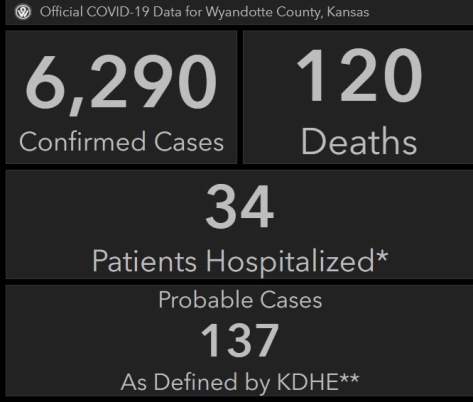
Wyandotte County reported an increase of 44 COVID-19 cases on Friday afternoon, for a cumulative total of 6,290, according to the Unified Government COVID-19 webpage. There was one additional death, for a cumulative 120. (From UG COVID-19 website)

Doctors are urging people to get flu shots this year, usually around October or when the shots become available.

If patients have COVID-19 or similar symptoms and have been isolated, they would want to wait at least 10 to 14 days or later since the start of the symptoms to get a flu shot, according to Dr. Dana Hawkinson, medical director of infection prevention and control at the University of Kansas Health System.

“If you are still suffering from a fever, it wouldn’t be a good time to get a flu shot,” said Amanda Gartner, RN, director of quality and safety at the University of Kansas Health System.

Sometimes people get mild symptoms of flu after a flu shot, and may have muscle aches, fatigue and a fever, she said.

The first 24 to 48 hours after a flu shot would be an anticipated symptom following the vaccine and not a reason to suspect you have COVID-19, she said, and so people should probably monitor it 24 to 48 hours.

Dr. Steve Stites, chief medical officer of the KU Health System, said he thinks the number of flu cases will be lower this year. He said he based his prediction on an Australian study that showed the number of flu cases declined there because of mask-wearing this year.

“We know that the mask culture here in the United States, depending on what community you live in, is a little different from others,” Dr. Hawkinson said.

The steps to mitigate the risk of COVID-19 have decreased influenza cases in other countries, he said. Masks have made a difference, and also there might have been a decrease in the number of people wanting to seek treatment, he said.

“As we can continue to endorse our message of masking, not meeting in large groups, physical distancing, that will also help decrease the spread of influenza as well,” Dr. Hawkinson said.

The doctors answered questions at their video news conference on Friday morning.

They were asked if a person who attended a sporting event with hundreds or thousands of people in attendance should quarantine.

Gartner said the Kansas Department of Health and Environment has mandatory advice if people attended a large venue.

The KDHE travel quarantine list says that those who have attended a mass gathering event out-of-state of 500 people or more, where individuals do not socially distance and wear masks, should quarantine for 14 days after they have arrived back in Kansas.

If they were able to socially distance and wear masks, they would not have to quarantine.

The doctors noted there wasn’t as much mask-wearing in the stands at the Chiefs game in the fourth quarter on Thursday night as there was at the start of the game.

The University of Kansas Health System reported 22 acute COVID-19 patients in the hospital on Friday morning, with four in the intensive care unit and two on the ventilator, according to Dr. Hawkinson. There were five patients on the ventilator who are considered to be in COVID-19 recovery status, he said, and 29 to 30 patients in active recovery status.

Wyandotte County reported an increase of 44 COVID-19 cases on Friday afternoon, for a cumulative total of 6,290, according to the Unified Government COVID-19 webpage. There was one additional death, for a cumulative 120.

On Friday, the Kansas Department of Health and Environment reported that Johnson County had the highest number of COVID-19 cases in the state, with a cumulative 9,350. It was an increase of 203 cases since Wednesday.

According to KDHE information, some of the other counties with high numbers of cases, besides Johnson and Wyandotte, included Sedgwick, 7,839; Ford, 2,486; Shawnee, 2,448; Finney, 1,835; Leavenworth, 1,819; Douglas, 1,709; Seward, 1,356; Riley, 1,120; Lyon, 911; Reno, 893; Crawford, 855; Butler, 712; Ellis, 685; and Saline, 525.

The KC Region COVID-19 Resource Hub reported 36,747 total cumulative cases in the nine-county region.

The KU doctors’ news conference is at https://www.facebook.com/kuhospital/videos/314483242962749


The UG COVID-19 webpage is at https://alpha.wycokck.org/Coronavirus-COVID-19-Information.


The KDHE active cluster list is at https://www.coronavirus.kdheks.gov/160/COVID-19-in-Kansas.

The Unified Government COVID-19 hub outbreak map is at https://wyandotte-county-covid-19-hub-unifiedgov.hub.arcgis.com/.


To see an NEA list of schools that have had COVID-19 cases, visit https://app.smartsheet.com/b/publish?EQBCT=aa3f2ede7cb2415db943fdaf45866d2f

The KC Region COVID-19 Hub dashboard is at https://marc2.org/covidhub/.

The Unified Government Health Department is collecting input on people’s experiences getting tested for COVID-19 in Wyandotte County. The survey is on the UG website at https://us.openforms.com/Form/ea97a450-3d74-4d86-8d1f-6e340d55cf7c.

The UG Health Department new school and sports guidance is online at https://alpha.wycokck.org/files/assets/public/health/documents/covid/09042020fallsportsrecommendations.pdf.


A previous UG sports order is online at https://alpha.wycokck.org/files/assets/public/health/documents/covid/08132020localhealthofficerorderregardingsports.pdf.

The Wyandotte County school start order is online at https://alpha.wycokck.org/Coronavirus-COVID-19-Information.

Wyandotte County is under a mandatory mask order and is in Phase 3 of the state’s reopening plan. For more information, residents may visit the UG COVID-19 website at https://alpha.wycokck.org/Coronavirus-COVID-19-Information or call 311 for more information.


The KDHE’s COVID-19 webpage is at https://www.coronavirus.kdheks.gov/.

The CDC’s COVID-19 webpage is at https://www.cdc.gov/coronavirus/2019-nCoV/index.html.

KCKPS students may be able to play fall sports in the spring

Kansas City, Kansas, Public School students who were hoping to play fall sports may get to play those sports next spring.

In a two-hour internet special meeting on Friday afternoon, the KCK school board voted unanimously to accept the Kansas State High School Activities Association proposal to participate in fall sports in the spring, if health conditions allow.

The district would have to meet gating criteria before any sports could take place. Those criteria include information such as the community’s positivity rate and other health information. That rate is the number of positive COVID-19 tests divided by the number of total tests. Currently, the number is over 17 percent in Wyandotte County, which is in the “red zone.”

On Sept. 8, the school board voted to allow student athletes to participate in conditioning or workouts beginning Sept. 14. That date has now been pushed back to Sept. 21 after a meeting with principals, district officials said at the board meeting.

The board’s 7-0 vote for the KSHSAA plan is not a guarantee that they will play sports, Board President Randy Lopez said at the meeting. The decision to play sports will be based on conditions closer to that time, he said. Today’s vote is giving the students an opportunity, he said.

The KCK school board had suspended fall sports and some activities because of the risk of COVID-19. The Unified Government Health Department issued an order Aug. 13 restricting fall sports in Wyandotte County and prohibiting football, volleyball, soccer and marching band events in Wyandotte County. The action was met with some student protests.

After some other local schools and clubs decided to go out of the county to play sports in other counties, the Health Department then issued more guidance on fall sports, on Sept. 4. Those who participate in sports outside of the county were asked to stay in their same “cohorts” while they are at school under the new guidelines.

Tammie Romstad, the district’s director of athletics, said that KSHSAA had offered an option of playing in the spring to schools that could not play sports in the fall. The option also would apply to schools that started sports in the fall but were unable to complete the season, she said.

Fall sports teams that are in Class 5A and 6A could compete in one class together in the spring, she said. The KSHSAA has made up a schedule that will be used in the spring if there are 50 percent or more of the schools that couldn’t compete in the fall.

If there are less than 50 percent, the district would make up its own schedule under the KSHSAA rules, she said. That could include a shortened season of perhaps five games where district schools play each other.

The school board also voted 5-2 to approve a proposal that would use the state gating criteria.

According to the proposal that was presented Sept. 8 by the district athletic director, and was discussed Sept. 11, a COVID-19 response team would evaluate the gating criteria, making a decision on Fridays for the next week, based on the previous two weeks.

The gating criteria would determine the start of the winter and spring sports, with winter sports practices scheduled to start Nov. 16, according to the proposal.

The members of the COVID-19 response team would be the district’s chief of staff, a medical specialist, a district nurse and the athletic director, according to the proposal.

Voting against the proposal were board members Dr. Valdenia Winn and Wanda Brownlee Paige.

“I’m concerned that the responsibility is not in the right hands, and the board should not be delegating, giving away its authority, so I vote no,” Dr. Winn said.

The passage of the gating criteria item takes the authority away from the school board and places it with school district personnel. Dr. Winn said the board and district have the liability for whatever happens as a result of the actions, and the committee does not.

According to Dr. Alicia Miguel, interim superintendent, the COVID-19 response team would be able to meet every Friday to discuss the gating criteria, while the school board typically does not meet every Friday. It meets every two weeks on Tuesday evenings, with special meetings added if needed.

When asked, the school board’s attorney said during the meeting that a school district committee would not be subject to the Kansas Open Meetings Act. The meetings would not be public meetings, according to the attorney. If they were school board meetings, or board committees, they would be open to the public, according to the attorney.

Janey Humphries, a board member, proposed a motion that would have at least one board member represented on the district’s COVID-19 response team, and that a report be made to the school board members after the end of each of the team’s meetings.

The vote was 4-3 to add a board member and to have a report to the board. Voting in favor were Yolanda Clark, Janey Humphries, Wanda Brownlee Paige and Dr. Valdenia Winn, and voting against it were Maxine Drew, Dr. Stacey Yeager and Randy Lopez.

Romstad also discussed some plans to help students with a “showcase” presentation that they can use to show college coaches. The showcase presentation would include information about the students’ athleticism and skills such as speed and strength. It might include some film clips from their previous years on the team. The showcase might be worked on during the conditioning sessions.

In other action, the school board also approved an update to board policies on bullying, intimidation and retaliation. The policies are online on the Sept. 11 meeting agenda at https://go.boarddocs.com/ks/kckps/Board.nsf/vpublic?open, items 2A and 2B.

CVS adds COVID-19 testing for children

CVS has announced it will add COVID-19 testing for children beginning today.

Children age 12 and older are eligible for COVID-19 testing at more than 2,000 drive-through testing sites at select CVS Pharmacy locations, according to an announcement by the company.

CVS added one new testing site at a Wyandotte County CVS pharmacy, at 4645 Shawnee Drive, Kansas City, Kansas.

Testing also is available at CVS locations at 950 Minnesota Ave., Kansas City, Kansas, and 3750 State Ave., Kansas City, Kansas, as well as at several other CVS locations in Greater Kansas City.

There are no walk-in appointments, but people are asked to make appointments at www.cvs.com. The hours of testing are listed online.

According to a CVS spokesman, it is expanding its third party lab partners and should have most results available within two to three days.

When they arrive at the testing location, patients are asked to follow the signs. Testing takes place inside the person’s vehicle, and they are handed a swab through a drive-through window or tent in the parking lot. They self-administer the test and then return it at the site.

Many of the people who are tested qualify for free tests, or have insurance that covers it.

Registration is at https://www.cvs.com/minuteclinic/covid-19-testing.