The Kansas disaster emergency declaration was extended today after a lengthy State Finance Council meeting.
The governor reported today that the Kansas death toll from COVID-19 rose by 16 deaths since Wednesday. It now totals 511. There is a cumulative total of 48,386 cases in the state, an increase of 976 cases since Wednesday.
The Republican-controlled council challenged Gov. Laura Kelly’s proposal to pass a renewal of the emergency declaration. Without the renewal, the governor said, federal assistance and also Kansas National Guard assistance in fighting COVID-19 in Kansas would end.
When asked, the governor told the council that she did not have the intention of closing any businesses. She said she would state that in a news release, but it was not necessary to add it to the emergency declaration.
State Sen Jim Denning, R-Overland Park, advocated for a clause to be inserted into the emergency declaration that the governor would not close any businesses.
Some of the legislators had been pressured by business groups in the state not to approve an extension that would allow any businesses to be closed.
But that was a moot point, according to an attorney. The governor’s attorney told the council it was not necessary to add the clause because a state law, H.B. 2016, already makes it very difficult to close any businesses, and the rare cases that businesses could be closed are laid out in detail in that statute. The statute limited the governor’s authority and was a compromise that was worked out months ago by the governor and Legislature. The governor’s attorney said putting a clause into the declaration today could cause some confusion between the law already in place and the declaration.
After hours of discussion, Gov. Kelly agreed to add a clause written by her attorney, that any restrictions regarding closure of businesses in the Kansas Emergency Management Act remain in place, and the governor does not intend to use her authority to close businesses.
House Majority Leader Dan Hawkins, a Republican from Wichita who is a member of the council, voted for the revised declaration because there might be criminals who would be let go if it wasn’t passed. Under the emergency declaration, the state courts can decide to extend deadlines for cases.
The approval of the emergency declaration also allowed Gov. Kelly to extend the emergency orders that already have been approved.
Under the agreement reached previously with legislators, the governor can only extend the emergency declaration for 30 days at a time, and it goes before the State Finance Council for approval. The state of emergency would have expired Sept. 15 without the approval.
During the discussion, Gov. Kelly told the council that she had received a call from Dr. Deborah Birx with the White House Coronavirus Task Force stating that Kansas was in the “red zone” and suggesting mitigation techniques. Kansas is ranked eighth in the nation for its high positivity rate. The positivity rate is the number of positive COVID-19 tests divided by the total number of tests. The governor and council members agreed that if they did more testing that included nonsymptomatic people, the rate might decrease in Kansas. Usually, except for university admission health testing, COVID-19 tests in the state have been limited to people with symptoms and those who have been exposed.
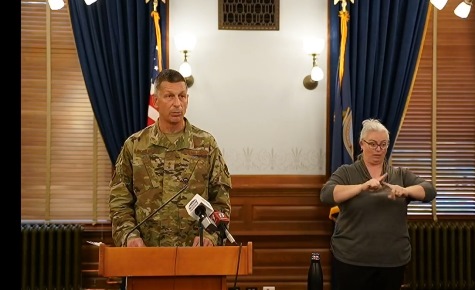
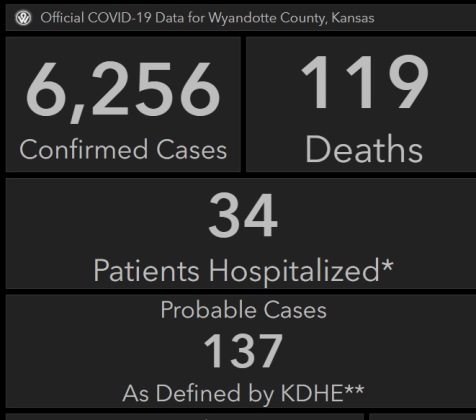
Maj. Gen. David Weishaar, director of emergency management and adjutant general for the state of Kansas, said assistance from the Kansas National Guard will come to an end on Sept. 15 if the emergency declaration is not extended. He said about 150 Kansas National Guard personnel are helping to fight COVID-19 currently in Kansas. (From Gov. Kelly’s news conference)On Thursday, Wyandotte County reported a cumulative 6,256 cases, an additional 43 cases since Wednesday, according to the Unified Government COVID-19 webpage. There were a cumulative 119 deaths, no increase since Wednesday. (From UG COVID-19 website)
Gov. Laura Kelly will ask the State Finance Council on Friday to extend the state’s emergency declaration.
The emergency declaration will expire on Sept. 15 if it is not extended, bringing an end to federal and state support in fighting COVID-19 in Kansas.
At a news conference Thursday afternoon, Gov. Kelly said if the council fails to act on extending the declaration, they would have singlehandedly prevented the state’s ability to leverage critical resources needed to respond to many aspects of COVID-19 pandemic.
The State Finance Council, made up of nine leaders of the Kansas Legislature, most recently blocked Gov. Kelly’s plan to add $100 in Kansas funds to the $300 in federal unemployment payments. The $300 is replacing the $600 in federal payments previously added to unemployment payments.
Gov. Kelly sent a letter to the State Finance Council requesting the extension of the emergency declaration.
“Livelihoods and lives are at stake, and time is of the essence,” the governor wrote in the letter.
Gov Kelly said in the news conference that extending the emergency declaration will allow the Kansas Department of Health and Environment to provide community-based testing, which will help mitigate the virus threat, allow businesses to stay open and fight future outbreaks. Community-based testing is important for underserved communities, she added.
The emergency declaration would allow the Kansas Emergency Management Agency and the Kansas National Guard to continue providing vital support to food banks and food pantries statewide, she said.
In addition, it allows the Kansas Emergency Management Agency and the National Guard to provide hospitals and first responders with front-line personal protective equipment to keep workers safe and healthy, she said.
The governor testified earlier Thursdayto a House Committee about the importance of the federal government providing states with financial aid to help recover from COVID-19, and to protect state and local governments from drastic and damaging funding cuts. She discussed the Brownback tax cutting experiment, that left the state agencies hollowed and programs unable to provide essential services, to illustrate why it is important to support states and keep the economy stable, she said.
If the federal government allocates more funding to the states, Kansas will not be able to access any of it without a state emergency declaration in place, Gov. Kelly said.
“I implore them to put public health before politics and make the right decision,” she said.
Maj. Gen. David Weishaar, director of emergency management and adjutant general for the state of Kansas, said the Kansas Division of Emergency Management activated the emergency operations center at the beginning of March as the first cases began to appear. It allowed the state’s response of uninterrupted deployment of personnel, supplies, equipment, materials and facilities.
Since March they have received more than 2,750 requests for assistance and delivered 41,000 cases of personal protective equipment throughout the state, he said.
If the declaration is not renewed, this state response effort will cease Sept. 15, he said. It would terminate the state and federal resources needed to support the response effort, he added.
Gen. Weishaar said their testing response has focused on unserved communities, and the Kansas National Guard has tested 18,000 people, including those at meatpacking plants.
Statewide, food banks and food pantries have had a lack of volunteers, and Kansas National Guard packaged 6.8 million meals to distribute across the state, he said.
The Kansas National Guard handled requests for more than 250,000 test kits, 15,000 nasal swabs and more than 2 million N95 masks to first responders and providers, he said.
The Kansas National Guard provided transportation, driving 211,000 miles across Kansas to make deliveries, and have visited all 105 counties, he said. They had 37 transports of remdesivir with partners, and the national guard transported more than 10,000 test samples, he said.
They also provided noncongregate shelters in six counties and supported universities and colleges in two counties, he said.
There were 670 guardsmen on duty on May 18, and currently, there are 150 on duty in Kansas, Gen. Weishaar said.
He said a state of disaster declaration is required for assistance through the emergency management compact. They anticipate future needs for professionals, nursing staff, doctors and shelter managers.
The state emergency shelter is currently staffed seven days a week, he said. If they don’t have a disaster declaration, it would not be staffed seven days a week.
Without a declaration, all deployments and task assignments would end, he said. He is working with state officials to extend the current disaster declaration, he added.
Gov. Kelly also said that she was on a phone conference Thursday with Dr. Deborah Birx, of the White House Task Force on Coronavirus. Dr. Birx reminded Kansans that they are in the “red zone,” with the eighth highest positivity rate in the nation, and suggested some mitigation actions.
“We have a lot of work to do,” Gov. Kelly.
On Thursday, Wyandotte County reported a cumulative 6,256 cases, an additional 43 cases since Wednesday, according to the Unified Government COVID-19 webpage. There were a cumulative 119 deaths, no increase since Wednesday.
In Wyandotte County, the Unified Government Commission extended the local emergency declaration on Sept. 3. It will go through Dec. 14.
The University of Kansas Health System reported 22 acute COVID-19 patients in the hospital on Thursday morning, wth three in the intensive care unit and one on the ventilator, according to Dr. Dana Hawkinson, medical director of infection control and prevention. There are another five patients in the recovery stage who are on ventilators, he said. There are also 30 more COVID-19 patients in the hospital who are recovering and are not in the acute stage, he said.
The KU news conference included KU doctors who treat cancer, who said that there has been a decrease in diagnoses during the last several months. It’s not that there is less illness, it’s that patients are delaying their examinations and treatments, according to the doctors. The doctors said patients can make a better recovery if they catch and treat cancer early.
The text of Gov. Kelly’s letter:
Members of the State Finance Council,
As you are aware, during the 2020 Special Session, the Legislature extended the COVID-19 state of disaster emergency through September 15, 2020. The Legislature also provided the Finance Council the ability to approve, by a vote of six legislative members of the Council, additional 30-day extensions of the state of disaster emergency beyond September 15 if needed. Such an extension is, in fact, needed. Accordingly, I have called a meeting of the Council tomorrow, September 11, 2020, at 10:00 a.m. to extend the state of disaster emergency through October 15, 2020.
The facts of the COVID-19 pandemic in Kansas are well known. More than 47,000 Kansans have tested positive, with cases in each of our 105 counties. During September, we have averaged more than twice the new cases per day our state experienced during the initial peak in May. Almost 500 Kansans have died. Unfortunately, we know more will get sick, and more will die; but we can minimize the pain and suffering this virus brings through our emergency response efforts. The emergency continues, and we must be able to deal with it effectively, as a state.
So far, our state emergency response has been essential to our efforts to mitigate the spread of COVID-19 and respond to cases and hotspots that do arise. The State Emergency Operations Center has received over 2,765 requests for emergency resources and has delivered 40,750 cases of personal protective equipment throughout our state. Emergency operations have also provided resources such as enhanced community-based testing, statewide food banks, delivery of medical supplies like Remdesivir, and non-congregate shelters. To fund such activities, we rely heavily on federal support. As you know, all of these resources and activities—and that federal support—ends if the state of disaster emergency is allowed to expire.
The state of disaster emergency also provides other essential assistance and protections for Kansans. As you know, I have issued executive orders to ease the pandemic’s burdens and threats on Kansans. Those orders include measures reducing barriers for online driver’s licenses renewals, emergency measures to protect residents in adult care homes, prohibiting COVID-related evictions and foreclosures, and requiring simple but effective protective measures like wearing masks, especially in our schools.
Each of these critical services for Kansans will end if the state of disaster emergency expires. Additionally, as you have heard from prosecutors across Kansas, our criminal justice system requires emergency flexibility to deal with the challenges of holding jury trials and speedy trial rules. If the state of disaster emergency expires, our prosecutors will be forced to dismiss charges against criminal defendants accused of serious violent crimes if they cannot try those cases before February. These are just some of the consequences that will follow if the state of disaster emergency is allowed to lapse.
I wish that I did not have to come to you asking to extend this state of disaster emergency. Like all Kansans, I want to have this pandemic behind us and move on to the ever-present challenges of improving education, opportunity, and equality for all Kansans. But COVID-19 is not behind us, nor will it be for some time.
Livelihoods and lives are at stake, and time is of the essence. I know that as legislative leaders, you have been part Kansas’s emergency response from Day One – none of this is new to you. I know you understand what’s at stake.
I look forward to our meeting tomorrow, doing the right thing for our state, and working together to keep Kansans safe and healthy during this unprecedented public health emergency.
Testing offered Friday
Testing is scheduled to take place from 9 a.m. to 3 p.m. Friday, Sept. 11, at the Health Department parking lot, 6th and Ann, Kansas City, Kansas, weather permitting.
Wyandotte County is under a mandatory mask order and is in Phase 3 of the state’s reopening plan. For more information, residents may visit the UG COVID-19 website athttps://alpha.wycokck.org/Coronavirus-COVID-19-Informationor call 311 for more information.
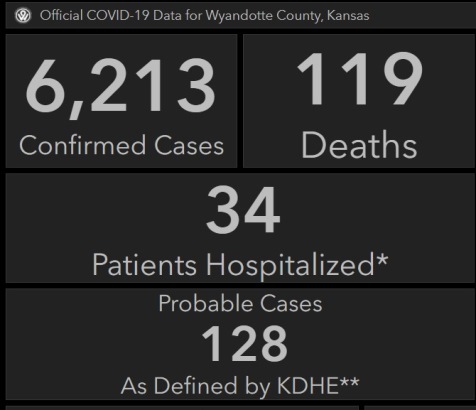
Wyandotte County reported an additional 34 COVID-19 cases on Wednesday, according to the Unified Government COVID-19 webpage. There is a cumulative total of 6,213. There was on additional death reported since Tuesday, for a total of 119 deaths, according to the webpage. (From UG COVID-19 webpage)
The University of Kansas Health System was one of several institutions affected by the temporary “pause” of the AstraZeneca vaccine trial.
KU Health System was one of several institutions participating in the clinical trials for a vaccine for COVID-19.
Doctors at the KU Health System news conference on Wednesday morning said they could not comment on the vaccine pause.
However, in general, it is not unusual for clinical trials to be paused to look into individual cases, the doctors said. The trials are making sure the medications are safe, and that is how all studies are done across the nation, Dr. Steve Stites, chief medical officer at KU Health System , said.
According to a news release from AstraZeneca, the trials were paused because of a single unexplained illness that occurred in one of the trial participants in the United Kingdom. The vaccine came from research at Oxford University.
An independent committee is reviewing the safety data of this illness, according to the news release, referring to it as a “routine action.”
“In large clinical trials, illnesses will happen by chance and must be independently reviewed,” the news release stated. “AstraZeneca is working to expedite the review of the single event to minimise any potential impact on the trial timeline. We are committed to the safety of our participants and the highest standards of conduct in our trials.”
At KU Health System, Dr. Louis Satterwhite, pulmonary and critical care physician at the health system, said there are fewer patients with acute infections in the intensive care unit as compared to several weeks ago, although there are still some.
There also are patients in the recovery stage, past the infectious stage, in the hospital, also.
He said that while it is true that COVID-19 has hit the elderly and those with other conditions hardest, they see the full spectrum of cases, including young and healthy persons with poor outocmes and elderly persons with morbidity conditions, some who have done well.
They often see patients with COVID-19 who develop chronic pulmonary conditions, severe lung diseases, scarring, who are unable to take deep breaths, he said. Some of the patients could be affected for life and never live independently again, he added.
Dr. Catherine Satterwhite, regional health administrator for the U.S. Department of Health and Human Services, said the HHS is now focused on making sure there is good testing available, that people who need testing get tested, and providing technical assistance to help schools reopen safely.
Schools are facing enormous challenges, whether in person or remote learning, across the whole spectrum, she said.
HHS also is trying to help states plan for a possible vaccine, she added. When a vaccine is approved, it will be a massive effort to get it out to the people who need it and to the people who will benefit the most from it, she said.
She said the CDC and other agencies are now working on how to define priority groups for the vaccine. People with underlying conditions, who are more likely to get severe illnesses, and older adults, as well as front-line workers, health care workers, grocery store workers and other essential workers are most likely to be on the priority lists, she said.
The states are working on how to get the vaccine to people, making sure helath care providers are enrolled in the system.
Asked whether he thought society would ever return to normal, Dr. Louis Satterwhite said where they end up may not be the same as 2017, but it would probably not be exactly where they are today. He thought COVID-19 would forever impact lives and society to some degree. Precautions today are needed now, he said. With advanced therapies, they may be able to return to some things they are not doing now, but there might be some precautions going forward.
Dr. Dana Hawkinson, medical direction of infection prevention and control, said he thought the virus would still be here in the future. But it may not be the same, as therapies and vaccines are developed. Will it become like the common cough and cold for young people in the future, he wondered. For the next six to 12 months, it will probably be similar, he said. Social norms could determine what people may do. Treatments will probably evolve, maybe to the point where it will be like a sinus infection, with medication available and feeling better in two days, he said.
Dr. Stites said, “There’s an ache in the question,” with people missing what’s normal. People wish they could be at events again, he said, and it’s important to keep wearing masks, social distancing and avoiding crowds in order to be able to participate in them again one day.
He said he thought this will pass one day, and a year from now, people may be back at the Chiefs’ games. It will be closer to where they were in the past, but may never be exactly the same, he added. It’s better today than it was four to five months ago, he added, and they are smarter about the treatment now.
At the KU Health System, there were 19 acute COVID-19 patients, with three in the intensive care unit and two on ventilators, according to Dr. Hawkinson, There were 30 COVID-19 patients in the hospital in the recovery phase.
Outbreaks in Kansas now listed on state website
COVID-19 outbreaks in Kansas now are listed on the Kansas Department of Health and Environment’s website, according to Dr. Lee Norman, who spoke at a news conference on Wednesday afternoon.
KDHE on Wednesday released the names of institutions, groups and businesses with outbreaks in Kansas, he said. Only active clusters are listed, he said. After 28 days with no new cases, the cluster will drop off the list, he added.
Groups, educational institutions or organizations that have five or more cases are listed. Businesses with 20 or more cases also are listed.
“This information is important to public health and to inform the public,” Dr. Norman said.
It allows for more transparency, he said, as they get numerous requests from people about where the clusters are. The information helps people make decisions about loved ones, including information involving schools and also nursing homes, he said.
Also, the information will empower Kansans to be more proactive about taking personal risks. If residents see locations they regularly visit on the cluster list, they can make individual decisions to reduce the risk, he said.
The Kansas Chamber of Commerce, a statewide group, on Wednesday asked the governor not to proceed with the release of the names of businesses that have COVID-19 cases.
The KDHE active cluster list is at https://www.coronavirus.kdheks.gov/160/COVID-19-in-Kansas. It lists outbreaks in groups or organizations with more than five cases. Businesses on the list have outbreaks of 20 or more cases. Several colleges and universities, along with college and university groups and sports, are on the list. The list includes 14 members of the KU football team and 11 members of the K-State football team.
On the KDHE’s active cluster location list from Wyandotte County: Amazon Fulfillment Center in Kansas City, Kansas, with 42 cases reported. We Buy BlaKCK, in Kansas City, Kansas, with nine cases. Bonner Springs Nursing and Rehabilitation Center, Bonner Springs, with 51 cases. Medicalodges Post Acute Care Center in Kansas City, Kansas, with 55 cases. Ignite Medical Resort in Kansas City, Kansas, with 18 cases. Kaw River Care and Rehabilitation, Edwardsville, with 18 cases. Dynasty Volleyball club in Kansas City, Kansas, with six cases.
Dr. Norman also said he presented a state testing strategy to the Kansas SPARKS recovery committee on Wednesday. He said his three testing proposals were viewed favorably. Testing and isolating infected individuals are critical to disease containment, he said.
He said the state would work with commercial and private labs to broaden the testing strategy and reach more people. The goal is to make sure that anyone who wants access to testing would have access, he said.
They would work throughout the state, he said, and also with colleges and nursing facilities as they expand their testing strategies, according to Dr. Norman. They would make sure there isn’t overlap or underlap around the state, he said.
“Significant important decisions are being made at schools based on gating criteria,” Dr. Norman said. It’s important to have all the processes in place and make sure the data used for gating criteria are accurate, he said.
One of the numbers used by school districts to determine the level of disease in the community is the positivity rate of cases. That is the positive cases divided by the total number of cases. As testing has often been restricted to people who have symptoms and not been widespread among the population, some observers have wondered if the positivity rate is a good indication of the actual level of disease in a community.
The gating criteria is being used by school districts to determine whether to reopen schools and whether to reopen sports.
Testing offered Thursday
Pop-up testing will be offered from 10 a.m. to 1 p.m. Thursday, Sept. 10, at Faith Deliverance Family Worship Center, 3043 State Ave., Kansas City, Kansas, through the Wyandotte County Health Equity Task Force and Swope Health.
Pop-up testing also will be held from 5 to 7 p.m. Thursday, Sept. 10, at Vibrant Health Argentine location, 1428 S. 32nd St., Kansas City, Kansas, through the Wyandotte County Health Equity Task Force and Vibrant Health.
Testing also is scheduled to take place from 9 a.m. to 3 p.m. Thursday, Sept. 10, at the Health Department parking lot, 6th and Ann, Kansas City, Kansas, weather permitting.
Wyandotte County reported an additional 34 COVID-19 cases on Wednesday, according to the Unified Government COVID-19 webpage. There is a cumulative total of 6,213. There was on additional death reported since Tuesday, for a total of 119 deaths, according to the webpage.
Kansas reported an increase of 494 cases since Monday, according to Dr. Norman, for a cumulative total of 47,410. There was an increase of 10 deaths since Monday, he said, for a cumulative 495 deaths. He added there may have been delayed reporting over the holiday weekend.
Wyandotte County is under a mandatory mask order and is in Phase 3 of the state’s reopening plan. For more information, residents may visit the UG COVID-19 website athttps://alpha.wycokck.org/Coronavirus-COVID-19-Informationor call 311 for more information.