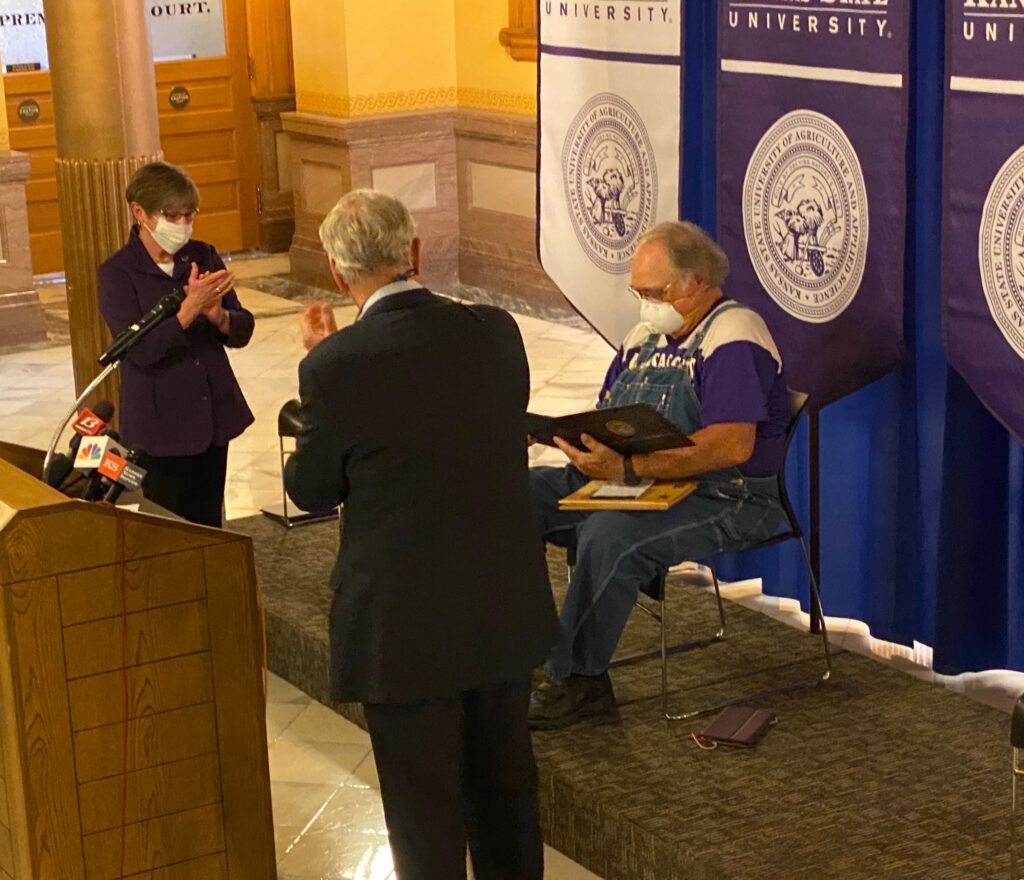
Gov. Laura Kelly, left, and K-State President Richard Myers awarded a bachelor’s degree on Tuesday to Dennis Ruhnke of Troy, Kansas, right, whose kind gesture of sending a mask to New York nurses and doctors gained national attention. (Submitted photo)
A farmer in his 70s who sent an N95 mask to New York to give to a nurse or doctor was awarded a bachelor’s degree from Kansas State University on Tuesday.
Dennis Ruhnke, Troy, Kansas, gained national headlines when he sent a mask and a letter to New York Gov. Andrew Cuomo.
Gov. Laura Kelly and Kansas State University President Richard Myers awarded a bachelor’s degree to Ruhnke on Tuesday.
Ruhnke wrote to Gov. Cuomo: “I am a retired farmer hunkered down in Northeast Kansas with my wife who has but one lung and occasional problems with her remaining lung. She also has diabetes. We are in our 70s now and frankly, I am afraid for her.
“Enclosed find a solitary N-95 mask left over from my farming days. It has never been used. If you could, would you please give this mask to a nurse or doctor in your city. I have kept four masks for my immediate family. Please keep on doing what you do so well, which is to lead.”
“Dennis’ donation, at the height of our country’s protective gear shortage, showed us the best in humanity when we needed it the most,” Governor Kelly said. “I would like to thank Dennis for the example he’s set on how to serve – and how to be thoughtful and generous in an extraordinary way.”
In 1971, Ruhnke was studying agriculture at Kansas State University when his father died. At that time, he was two credits away from earning his degree, but chose to leave school to take care of his mother and the family farm.
“After speaking with President Myers, we both agreed that Dennis perfectly encapsulates K-State’s democratic mandate to be of service to people,” Gov. Kelly said. “Which is why I am very honored that I was able to help present Dennis with his well-deserved bachelor’s degree in agriculture.”
“Along with his fantastic demonstration of kindness and generosity, Mr. Ruhnke’s academic work at K-State in his chosen field of agriculture qualifies him to receive his degree,” President Richard Myers said. “Kansas State University is proud to officially recognize Mr. Ruhnke as an alumus and valued member of the Wildcat family.”
Free COVID-19 testing is being offered from 3 to 6 p.m. Wednesday, May 6, at the South Branch Kansas City, Kansas, Public Library, 3104 Strong Ave., Kansas City, Kansas.
The tests are free to Wyandotte County residents who have symptoms of COVID-19. Residents are asked to register in advance at 913-371-9298. The tests are from Vibrant Health, El Centro, the library and the Unified Government Health Department.
On Thursday, May 7, free COVID-19 tests will be given from 3 to 6 pm. at the Frist Baptist Church and Berean Fellowship, 500 Nebraska Ave., Kansas City, Kansas. Those who live in Wyandotte County and have symptoms of COVID-19 may be tested. Residents are asked to register in advance by calling 913-371-9298.
On Friday, May 8, free COVID-19 tests will be offered from 3 to 6 p.m. at St. Patrick Catholic Church, 1086 N. 94th St., Kansas City, Kansas. Those who live in Wyandotte County and have symptoms of COVID-19 may be tested. Residents are asked to register in advance by calling 913-371-9298.
Testing also will take place from 3 to 6 p.m. Monday, May 11, at the Oak Ridge Baptist Church, 9301 Parallel Parkway, Kansas City, Kansas. Those who live in Wyandotte County and have symptoms of COVID-19 may be tested. Residents are asked to register in advance by calling 913-371-9298.
Testing also is continuing at the UG Health Department parking lot each afternoon Monday through Friday at 619 Ann Ave., Kansas City, Kansas. These tests, from 1 to 5 p.m., are drive-up or walk-up, with no appointment needed. Tests are for Wyandotte County residents who have had symptoms in the last 48 hours. Those who have questions about the tests may call 311.
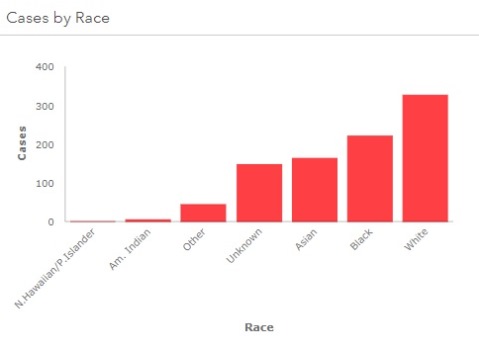
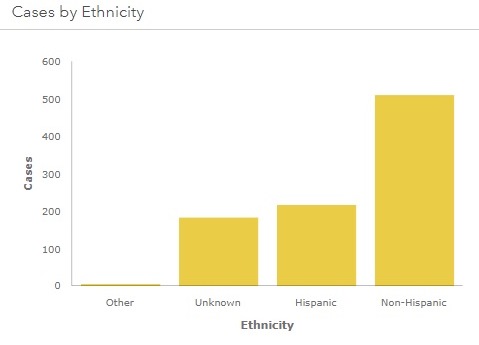
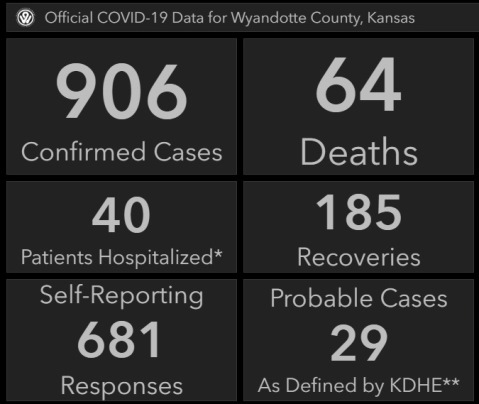
A Unified Government Health Department chart showed a comparison of COVID-19 cases in Wyandotte County among races. (UG Health Department chart)A UG Health Department chart showed the number of COVID-19 cases in Wyandotte County according to ethnicity. (UG Health Department chart)There were a total of 906 cases reported by 1:40 p.m. Wednesday in Wyandotte County, according to the UG COVID-19 website. There were no increases in deaths or hospitalizations at that time. (UG COVID-19 website)
Doctors at a news conference Wednesday morning from the University of Kansas Health System discussed disparities in race, ethnic origin and income among COVID-19 patients in Wyandotte County.
Wyandotte County reported 906 positive COVID-19 cases at 1:40 p.m. Wednesday, with 64 deaths and 40 hospitalizations, according to the UG COVID-19 website. About 185 recoveries were reported. It was an increase of 13 cases since Tuesday afternoon, and the same number of deaths and hospitalizations since Tuesday afternoon.
Wyandotte County, on many days in the past month, has had the most COVID-19 cases of any county in the state of Kansas. Around April 2, the Wyandotte County numbers passed Johnson County’s, which has a larger population. While Johnson has been flattening, the Wyandotte County numbers have been increasing, according to the doctors. Johnson County had 519 cases on Wednesday, according to the state health department.
The pandemic has unmasked a lot of health inequities in society, not just in health care, said Dr. David Lisbon, who works in emergency medicine at the University of Kansas Health System.
Throughout the nation, African-Americans and Hispanics have made up a larger number of the COVID-19 patients than their numbers in the population, he said.
Dr. Dana Hawkinson, medical director of infection prevention and control at the KU Health System, said there are general infectious disease issues with how it’s spread and where it’s spread.
“This seems to be hyper-contagious, and there have been different variables and different statistics on how easily it transfers in households,” Dr. Hawkinson said.
Playing a part in all of it are enclosed spaces, whether there are multiple generations living together at home, or in work spaces where workers are close together, he said.
Dr. Chris Brown, hospitalist at KU Health System, said the KU Health System’s inpatient totals see a lot of the same trends of greater numbers of minorities, as well as the co-morbidities associated with certain outcomes.
Dr. Brown said they have had some relatively good numbers of getting patients out of the hospital and into rehabilitation. Hospital stay and length can play a part, he said.
Dr. Allen Greiner, chief medical officer of Wyandotte County, said they have been paying attention to the data where Wyandotte County passed Johnson County some weeks ago. Some of the Wyandotte County clusters or outbreaks centered on community entities with a lot of minority involvement, including workplaces and some church clusters, he said.
Wyandotte County has launched a health equity task force to involve community leaders and is trying to ramp up testing in those groups, doing as much outreach and testing as it can across the community, he said.
Dr. Lisbon said on the issue of race, individuals may be in situations where they have other burdens where it is more difficult to get health care and maintain it, and trust that medicine is doing something for them.
He said a study in Great Britain of income and insurance status found some of the same information on individuals as has been found in the United States.
Dr. Hawkinson said there had been a lot of misinformation on social media, such as certain blood types are protected or that if one is African-American, he could not get the virus. They are fighting this misinformation, and everyone is susceptible to the disease, he said.
Dr. Brown said the inpatient population, regardless of race, boils down to a lot of economic factors and living arrangements, and the other medical conditions people have, if they have lung disease, heart disease or other illnesses. People with existing medical conditions will have worse outcomes, he said.
Dr. Greiner said Wyandotte County is a lot like other areas in the nation where one can see inequities.
He said while they are more sensitive to these issues than previously, they haven’t yet found great interventions.
Dr. Greiner said they would have to work hard, both with the rest of this pandemic, as well into the future, to try to find out how to maximize population health and address things that have a deep historical past and make achieving equity a tough challenge.
Working together and getting out there in the communities is important to find the right solution and to do it in partnership with the communities affected, he said.
Dr. Greiner said personal responsibility is a big part of what the Health Department is trying to do, educating people on socially responsible behavior.
“We need to change the social norms in society going forward,” he said, so they don’t see a big uptick in outcomes in the future.
As parts of the community prepare to reopen, the KU doctors recommended staying six feet apart, wearing a mask when in public, washing hands, using hand sanitizer, not touching your face and staying home when sick.
Dr. Brown said these basic measures are important, and COVID-19 patients would want to give a message to others of social distancing and selflessness.
“It’s not about the risk that you are willing to take within your own home and in your own personal life. It really can affect people who are at risk,” Dr. Brown said, “but also those individuals who are presumed healthy, and now are coming into our health care system and finding out they also have medical conditions not previously diagnosed with, which can potentially make their hospitalization longer.” It puts them at risk potentially for complications and for transfer to the ICU.
“They would probably say to the public, we need to be selfless, we need to be thoughtful about what we do, and how our actions can therefore affect us and others,” Dr. Brown said.