The Department of Health and Human Services has announced a grant of $5.79 million to 19 health centers to expand COVID-19 testing in Kansas.
One of the grants, for $250,279, was in Wyandotte County, and went to Turner House Clinic of Kansas City, Kansas, according to HHS documents. Turner House in 2018 merged with Silver City Health Center and KU Pediatrics Clinic at the Children’s Campus Kansas City, and is now called Vibrant Health.
The grant was made through the Health Resources and Services Administration.
The funding is part of the Paycheck Protection Program and Health Care Enhancement Act, according to a news release. The legislation provides funding for small businesses and persons financially affected by COVID-19, additional funding for small businesses and health care providers, and increased testing to track the spread and effect of the coronavirus.
Kansas is accepting applications for the Low-Income Energy Assistance Program during the coming weeks to address COVID-19 needs.
Low income-families may submit applications until 5 p.m. Friday, May 29.
Kansas energy customers can apply for LIEAP program funds on the Kansas Department for Children and Families Energy Assistance website. Applicants will need utility account numbers, proof of income and Social Security numbers for all members of their household.
“We have customers in need of help right now and are pleased funds may be available to them with reopening the LIEAP applications window,” said David Mehlhaff, BPU chief communications officer. “When we are connecting with our customers to provide helpful resources and services, sharing information about LIEAP and assisting with applications is a meaningful way to help, especially now when times are challenging for so many.”
In response to the challenging times, in March the Kansas City, Kansas, Board of Public Utilities suspended disconnects of utility service for non-payment and extended this temporary moratorium through May 31.
LIEAP is a federally funded program that helps eligible households pay a portion of their home energy costs by providing a one-time per year benefit.
Typically, LIEAP is available in the fall and winter months, but the coronavirus situation has prompted the Kansas Department for Children and Families to reopen the application window through May 29.
Normally, LIEAP provides an annual benefit to help qualifying households pay winter heating bills. Persons with disabilities, older adults and families with children are the primary groups assisted.
To qualify, applicants must be responsible for direct payment of their heating bills. The level of benefit varies according to household income, number of people living in the home, type of residence, type of heating fuel and utility rates. Eligibility is based on an applicant’s heating bill. If an applicant needs assistance covering electric costs, they need to request the benefit be split between the two utilities.
To learn more about eligibility requirements or fill out a LIEAP application, visit the Kansas Department for Children and Families website or call 1-800-432-0043. LIEAP applications on the Kansas Department for Children and Families website became available beginning May 1, 2020.
Customers are encouraged to stay current with their bills to avoid getting too far behind and if anyone has any BPU billing or customer service questions, they can call 913-573-9190 and a utility representative is available to assist.
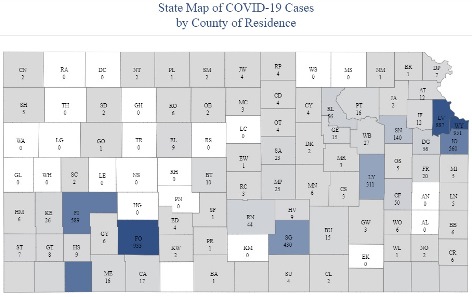
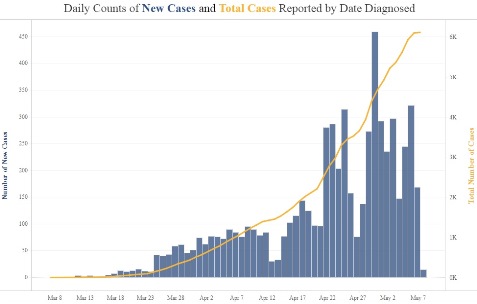
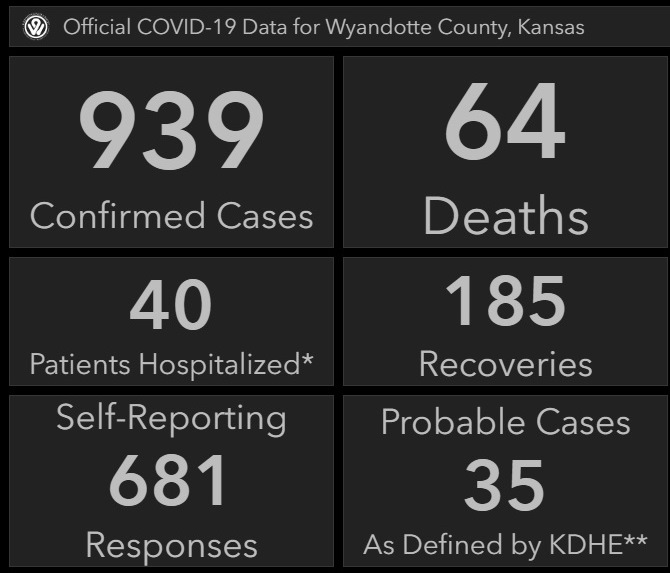
Kansas reported 6.144 confirmed and probable COVID-19 cases on Thursday, an increase of 410. (KDHE map)A state graph showed new cases in blue and total cases in yellow in Kansas. (KDHE graph)Wyandotte County reported 939 positive COVID-19 cases, an increase of 33, with the same number of deaths and hospitalizations as the previous day. (From UG COVID-19 website)
The number of positive COVID-19 cases in Wyandotte County rose to 939 at 11:05 a.m. Thursday, while there were no increases reported in deaths or hospitalizations Thursday morning, according to the Unified Government COVID-19 webpage.
It was an increase of 33 cases in Wyandotte County since the 1:40 p.m. Wednesday report.
Kansas reported an increase of 410 confirmed and probable cases on Thursday morning, to total 6,144, according to figures from the Kansas Department of Health and Environment. The state has started counting confirmed with probable causes on Thursday, a change from the previous confirmed total.
There were 147 deaths in Kansas, an increase of three, according to KDHE. Hospitalizations in Kansas increased by 16, to total 587, statewide.
On Wednesday, Dr. Lee Norman, Kansas secretary of health, stated in a news conference that it is important not to focus on one day’s numbers but to watch the overall trend lines as time goes on. Sometimes they see batch numbers from local communities come in over a few days together, not coming in the first day. There have been increases in testing recently, he said.
He said the state is monitoring 75 outbreaks.
Thirty clusters are in private companies statewide, with 339 cases and four deaths; 22 are in long-term care facilities, with 498 cases and 81 deaths; eight are in church and church-related gatherings, with 110 cases and eight deaths; six are in meatpacking plants with 985 cases and two deaths; three are in group living arrangements, with 40 cases and zero deaths; three are in correctional facilities with 479 caes and two deaths; and three are in health care facilities, with 21 cases and zero deaths.
At Lansing Correctional Facility, testing of all inmates was completed on May 5 and staff will finish testing by early next week, Dr. Norman said. Most of the staff have already been tested, he said.
He said COVID-19 cases spread quickly in prisons. It’s possible there were a certain number of cases at Lansing before it was recognized as such, he said. There was probably a number of asymptomatic people there before the numbers rose, he believes.
Gov. Kelly said there is now a system to evaluate inmates who might be released early, and they will continue to verify who is eligible and is at low risk. She also said some inmates who have been eligible have chosen not to be released, as they would be placed in house arrest, not actually released.
KDHE has loosened the guidelines for testing, with 60,000 testing kits a month available, and now anyone with symptoms can be tested, he said. Symptoms will still be required for a test, he said, such as fever, cough, chills, muscle pains and aches, malaise, headache, sore throat, lower respiratory symptoms, difficulty breathing, the loss of smell or taste, and diarrhea. Two or more of the symptoms are required through KDHE tests, while private tests require one or more symptoms, he said.
The state is now working with labs that are developing a saliva test, and a serum test is being worked on, he said. The goal is to have an antibody test that is specific to COVID-19, not the viruses that cause the common cold, he added.
The University of Kansas Health System reported 26 COVID-19 patients today, with nine in the intensive care unit. There were some discharges recently, according to Dr. Dana Hawkinson, medical director of infection prevention and control at KU Health System. He said he hopes the trend of discharges continues.
Dr. Steve Stites, chief medical officer at the KU Health System, said it feels like the numbers of cases are escalating around them, while the number of cases seems to be declining in the hospital.
Dr. Hawkinson said the experience here has been different from New York, where there were a large number of hospitalizations and critical patients. He is hoping that this area won’t have the large numbers of hospitalizations and the surge that the East Coast experienced, and that this is the new normal.
Wyandotte County is currently under the “stay-at-home” order, and may consider the first stage of reopening, the “red zone,” on May 11.
KU doctors offer advice about getting enough sleep, reducing stress
At a news conference on Thursday morning, doctors at the University of Kansas Health System offered advice about getting enough sleep and reducing stress.
Dr. Greg Nawalanic, psychiatrist with the KU Health System, said that people have been dealing with anxiety and depression through the entire lockdown, and some are having mixed feelings about the manner in which reopening is taking place. Sleep is sometimes affected. Some polarization and conflict has surfaced on social media, with some people becoming angry and anxious.
Dr. Suzanne Stevens, neurologist and director of the sleep medicine clinic at KU Health System, said that people’s experience with the pandemic could be reflected in their dreams. Dreams of health care workers may be reflecting trauma, she said. Others’ dreams may reflect financial and other difficulties, with zombies or invisible aliens attacking them in the dreams.
She said some records of Hiroshima victims showed an “invisible enemy” in the dreams, as people were worried about radiation then, and today it could be a common theme as well.
Another category of COVID-19 dreams is the lockdown dream, she said, where a person dreams he has done something wrong, can’t leave home and wants to escape.
Dr. Nawalanic said anxiety could get worse when people do not feel they can exert control. Some people feel what they have in place now is working for them, but now other people get to decide what their response will be in reopening.
People still have a wide range of appropriate practices that they can have control over, he said, including physically distancing, hygiene and putting on masks when they leave.
Dr. Nawalanic recommended maintaining a sleep routine, going to bed at the same time, keeping screens off an hour before bed and keeping the bedroom dark and cool. If waking up at night, don’t go get a drink or turn on the television, he said.
Dr. Stevens said anxiety begets anxiety. Being exposed to constant negativity during the day could influence dreams, so people can limit exposure to constant negativity.
She said being kind, having good interactions and caring interactions will boost the positive side, and getting outside and exercising could be part of that.
While at home, some people are working from home more, going to bed later and sleeping in later, she said. If they get up later, they could have more intense dreams toward the end of their sleep. Structure is important, with the same bedtime and same waking time.
When people awaken, they could go outside and get some sunlight or turn on the lights, signaling to their brain that it’s time to get up. At night, people should limit negative information, and it might be helpful to shower before bedtime, she added. That might help people relax, and a comfortable sleeping environment might be about 65 degrees.
She said if people wake during the night, they might try deep breathing, counting to three as they breathe in and out. It also might help to visualize a pleasant place, including a positive event in their past. Others write down their dreams or record them, which might help to get it off their minds.
Dr. Nawalanic said it might help to block all thoughts about not sleeping, and keep visible alarm clocks out of the bedroom. If you wake up at night, don’t scroll through the smart phone looking at messages.
Don’t try to work or watch television while in bed, he said. A person could have dreams about what they didn’t do at work if they were working in bed previously.
Also, instead of taking a catnap in the afternoon, get out and exercise, and you might be more sleepy at night, he said.
Dr. Stites said, for those who might have anxiety about going back to work, if they maintain social distance, wear a mask, wash their hands and practice good hygiene, they have a good chance of staying healthy.
Dr. Hawkinson said it is important to continue good hand hygiene, not touch your face, and stay six feet away from others, as people go back to work.
Dr. Stevens said good sleep helps the immune system, helps prevent infections, and if people do get infected, it helps lessen infections.
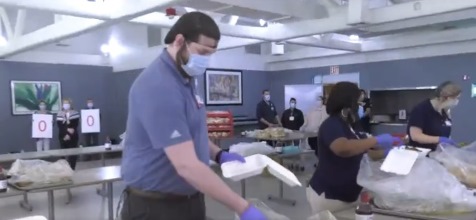
Employees at KU Health System were the recipients of a barbecue meal today from Operation Barbecue Relief. It was the 4 millionth meal served by the organization, which provides meals during disasters. (Photo from KU Health System)
State case counts in other counties
On Thursday, according to the KDHE, Leavenworth County reported a total of 887 confirmed and probable cases, showing a large increase since Monday. Testing has been going on at Lansing Correctional Facility.
Johnson County reported 560 confirmed and probable cases, according to the KDHE.
Eighty-two counties reported confirmed and probable positive cases on Thursday, according to KDHE, and some of them included: Ford County (Dodge City area), 933; Seward County (Liberal area), 647; Finney County (Garden City area), 589; Sedgwick County (Wichita area), 430; Lyon County (Emporia area), 311; and Shawnee County (Topeka area), 140.
Douglas County (Lawrence area) reported 56 cases, and Riley County (Manhattan area) reported 56 cases, according to the KDHE.