University of Kansas officials announced today they plan to resume classes in the fall, with a shortened schedule.
In a message to students, faculty and staff, Chancellor Doug Girod stated that he would like to start the fall classes on Aug. 24, and end classes before Thanksgiving. The schedule is for both the Lawrence and the Overland Park campuses.
After Thanksgiving, there would be a study week followed by final exams conducted remotely, according to the chancellor’s message. No Labor Day holiday or fall break would be in the schedule.
He also would like to move the first day of the spring semester from Jan. 19 to Feb. 1. There would be no spring break as it usually happens; instead, it would be added to the winter recess, according to the message.
The changes to the university calendar would have to be approved by the Kansas Board of Regents. Also, according to the message, plans are subject to change based on medical advice.
Changes are planned to allow more time between classes, and also to limit the density of classes. The academic day may start at 7 a.m. and end at 9 p.m., five days a week, with the day ending at 5 p.m. for most classes.
Several changes are being made to have physical distancing in residence halls and food centers, according to the Dr. Girod’s message.
In addition, KU plans testing and contact tracing through Watkins Health Services on campus, partnering with the University of Kansas Health System, Lawrence Memorial Health, the Lawrence-Douglas County Public Health and Kansas Department of Health and Environment.
Dr. Lee Norman, Kansas secretary of health and environment, said at a news conference on Monday that the KDHE has met with KU leadership and KU Health System representatives to discuss the plans.
“It is a daunting task, no question about it,” Dr. Norman said.
He said he believes it will be more favorable to hold classes early and then dismiss at Thanksgiving.
A testing strategy will be put in place, and there will be a lot of effort to keep social distancing and other health measures in place, he said.
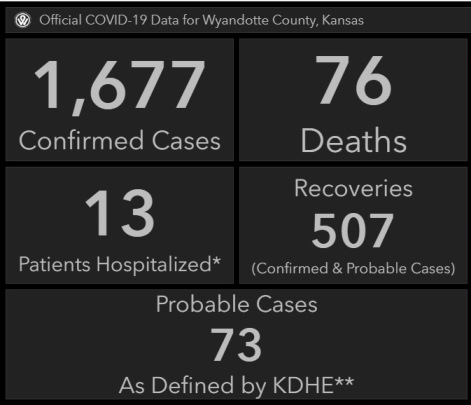
There was an increase of 17 positive COVID-19 cases in Wyandotte County from 1 p.m. Sunday to 1 p.m. Monday. (Unified Government COVID-19 website)
The University of Kansas Health System on Monday morning reported 17 positive COVID-19 patients, including eight in the intensive care unit and four on ventilators, according to Dr. Dana Hawkinson, medical director of infection prevention and control at the health. It was an increase of two cases since Friday.
He said the numbers at the health system were pretty stable over the weekend, with some discharges and some admissions. However, case numbers are climbing in the nation, he added.
Dr. Steve Stites, chief medical officer of KU Health System, noted that there was an increase last week from nine to 18 positive COVID-19 inpatients at KU Health System.
While infections are still less than 1 percent of the population, people are traveling and moving around, and may be taking COVID-19 with them, Dr. Hawkinson said.
“Everything is just a plane trip away right now in our society and in our world,” he said. Cases probably will continue to increase, but they will have to watch the rate of hospitalizations, case fatality rate and infection fatality rate, he said.
He said he hopes other health systems in other cities have done as they have done, and built up the amount of personal protective equipment, the medications and the hospital rooms, so if a surge happens they can better protect themselves.
Dr. Stites said he expected to see rolling waves, which he hoped won’t be a serious spike, unless there is a breakdown of the health measures in use.
Dr. Hawkinson said he didn’t see much mask use at the beach in Florida, where he is vacationing,, but they are wearing masks at stores. For the most part, it appears that mask-wearing is not that important to the tours, he added. He said the doctors would have to continue their messages about wearing masks, social distancing and hand hygiene.
Dr. Stites remarked that he didn’t see much mask-wearing while on vacation this past weekend in the Ozarks.
During the news conference, Justin Hoover, executive director of The Battle Within – Frontline Therapy Network said his organization is providing six free teletherapy sessions to first responders on the front lines.
Hoover is a military veteran who received two Purple Hearts. He went into marketing after leaving the military, and left a marketing job to found The Battle Within, which helps veterans and first responders develop skills to help them with healing.
He started a five-day program that is now available to military veterans, law enforcement officers, corrections officers, EMS workers and medical professionals on the front lines.
Six free therapy sessions are provided to the front-line workers. Hoover said front-line workers had no safe space, as life became difficult at work, and also at home where the workers and their families were having to restrict their contact with the outside world.
Whitney Logan , clinical director of The Battle Within, said people are reporting increased stress and anxiety. They are able to get them the help they need quickly and conveniently, she said.
Funding has been through Vets United, Blue KC and Humana, according to Hoover.
Logan said veterans often are hypervigilant, and it’s often hard to unwind when they come home. Some of the same effects can be seen in health care workers currently, she believes. They encourage people to stay safe, wear masks, continue hand washing and distance, while also showing them practices such as mindfulness, meditation, breathing, nature walks or other methods to calm down.
She said the social and emotional toll of the pandemic has been as great as the physical toll.
Dr. Greg Nawalanic, a psychologist at KU Health System, said there has been a strange flip in public behavior in the past two weeks. While he doesn’t have any real data yet, he has noticed a lot of people saying that “I did enough, this is enough and I’m going back out,” he said.
Nothing has changed in the medical situation, but it is a sort of disregard for the proverbial wolf at the door, he remarked. People who are wearing masks now are sometimes looked at as if they are the strange one currently, he added. He advised people to continue being cautious, wear masks and distance. He thought it was important to err on the side of caution.
Hoover said he saw hypervigilance in the military abroad, every time people went outside the wire. The same sort of reaction can be seen here in the civilian population, where people don’t easily turn off their hypervigilance, he said.
Logan said the emotion of fear comes up to help keep people safe. Once people have taken actions such as socially distancing, wearing a mask and washing their hands, they can them calm themselves down.
Dr. Nawalanic said it is important for families to have calm discussions about what their family plan is, and what they will do about getting together with others.
Wyandotte County today reported 1,677 positive COVID-19 cases at 1 p.m. June 15. It was an increase of 17 cases from 1 p.m. June 14. There was no change in the number of deaths.
Wyandotte County 32 new positive COVID-19 cases from Friday at 4 p.m. to Saturday at 4 p.m., according to the Unified Government’s COVID-19 website. (From UG COVID-19 website)
Positive COVID-19 case numbers continued to rise by around 32 cases on Saturday, June 13, according to the Unified Government’s COVID-19 webpage.
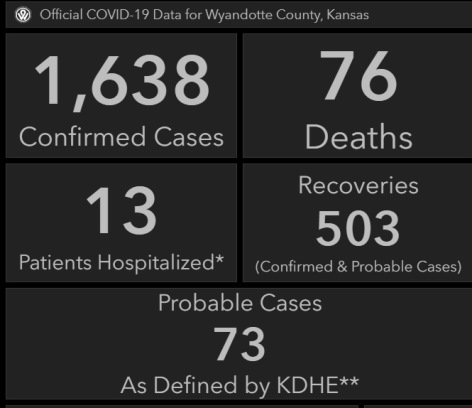
Wyandotte County reported 31 new cases from Thursday at 1:30 p.m. to Friday at 4 p.m., and 32 new cases from Friday at 4 p.m. to Saturday at 4 p.m. The number of deaths remained the same, at 76. There were 24 new cases from 4:40 p.m. Wednesday to Thursday afternoon.
Wyandotte County’s COVID-19 page reported 13 hospitalizations and 503 recoveries on Saturday. Hospitalizations are recorded by the place of the patient’s residence.
The University of Kansas Health System saw a surge from nine cases to 18 in a week. KU Health System reported 15 patients on Friday morning, a decrease of three since Thursday, according to Dr. Dana Hawkinson, director of infection prevention and control at KU Health System. Seven patients were in the intensive care unit, a decrease of one since Thursday, and three remained on ventilators.
According to doctors, it could be the first wave of patients who were exposed to COVID-19 over the Memorial Day weekend. The number of COVID-19 patients at the hospital had increased from nine patients the week before.
The state of Kansas reported 11,047 cases with 243 deaths on Friday morning, according to data from the Kansas Department of Health and Environment. It was an increase of 235 cases since Wednesday. There were three more deaths since Wednesday.
On Friday morning, Dr. Hawkinson was on a video news conference from a Florida beach. He said if this was four weeks from now, there was probably a good chance he wouldn’t be able to go on vacation, as COVID-19 cases in the United States are increasing. He said people planning to travel have to be aware of the conditions; he said he was ready to cancel his trip in case he had to, three days before he left.
Dr. Dave Lisbon, an emergency department physician at KU Health System, said on Friday that they had been seeing an increase in volume, as patients have begun to come back. During the height of COVID-19 at the hospital, the numbers of total patients had declined to levels he had never seen before, he said. Some of those who have been coming back were sicker after putting off care, he said, and more were being admitted to the hospital.
Dr. Lisbon said while the death rate from COVID-19 has slowed and the new case rate was flattening, they had not beaten the virus yet. While it’s not the same as the earlier height of the virus, there have been some spikes after Memorial Day. He advised people to avoid large gatherings and continue wearing a mask. While people may be tired of staying at home and socially distancing, he said it would result in a surge of new cases if they let up now.
Patrick Sallee, Vibrant Health CEO, said on Friday that his organization has just observed 30 years as a community health center, caring for patients in Wyandotte County, and talked about its affiliation with the University of Kansas Health System. Vibrant Health was formed from the 2018 merger of Turner House Clinic, which opened in 1990, with Silver City Health Center and KU Pediatrics Clinic at the Children’s Campus Kansas City.
According to Sallee, COVID-19 knows no boundaries and easily can spread between counties.
Vibrant Health has been offering free pop-up COVID-19 testing to Wyandotte County residents three times a week, he said. The tests are offered in conjunction with the UG Health Department. While at first there were about 100 people coming to the pop-up tests each day, that has declined to 35 to 40, he said. He is concerned that they’re not testing enough people to stay on top of the virus.
There are no appointments necessary for the free pop-up tests. The location of the pop-up test changes to different places in Wyandotte County.
Pop-up tests in the coming week, according to the UG COVID-19 website, include 10 a.m. to 1 p.m. Monday, June 15, at All Saints Catholic Church, 811 Vermont Ave.; 2 p.m. to 5 p.m. Tuesday, June 16, at Kansas City Community Church, 5901 Leavenworth Road; and 10 a.m. to 1 p.m. Thursday, June 18, at Roswell Church of Christ, 2900 Roswell Ave. More information is at https://wyandotte-county-covid-19-hub-unifiedgov.hub.arcgis.com/pages/what-to-do-if-you-think-you-have-covid-19.
There also are other test sites in Wyandotte County, listed at the UG COVID-19 website.
Sallee also said Vibrant Health has begun seeing more patients through telehealth, which eases fears about in-person visits. They also experienced a decline in patients for a few months before patients started coming back.
When discussing the financial crunch that some patients are under, Sallee said groups in Wyandotte County, including the Wyandotte County Economic Development Council, have done a lot of work to improve some of the health care and inequity issues. Studies have shown that health care is affected by income, and there are efforts going on to raise median household income in Wyandotte County, he said.
Dr. Lisbon said there often is a question of access to health care based on income. Factors that might affect a person’s decision on whether to seek health care might include regular access to health care providers, insurance, employers who let them have time off, and patients who have child care.
Dr. Hawkinson said the KU Health System provides patients with the best care and best quality possible, regardless of their income. He said if he had COVID-19, he would want to get the best treatment earlier and not wait, and the sooner the patient is diagnosed, the better.
Also at the Friday morning news conference, Dr. Hawkinson answered some questions about the safety of a couples dance, a scout campout and antibody testing.
Dr. Hawkinson said he would avoid a couples dance indoors, where 50 people are planning to gather. If people are dancing, it will be hard to keep a mask on without feeling claustrophobic or not getting enough oxygen, he said, so it’s something he would avoid. He said it reminded him of the case earlier this year where a choir practice in another city spread COVID-19.
An 8-day campout with 200 kids and adults, with a communal tent, and tents where people gathered to fill water bottles sounded pretty risky to Dr. Hawkinson. There are a lot of people together, like the recent protests, and they might be coming together a little bit for programs. The most dangerous part is a communal water source, Dr. Hawkinson said.
A communal water source is frequently identified as spreading infection, according to Dr. Hawkinson. Ways to reduce the risk as much as possible might include taking out the communal activities, he added.
On a question about antibody testing, Sallee said they are not using it currently in Wyandotte County. They are exploring and studying it, but at the present time they don’t see it as helpful to diagnosis or treatment.
Dr. Hawkinson said they have been looking at antibody testing, but it isn’t clear how it would help on an individual level. Antibody testing would be good for seeing how COVID-19 has passed through the community, he said. But unless an individual is donating convalescent plasma, he doesn’t see how it would be of much use to the individual at this point. It possibly could be used in college athletics to evaluate if an athletic has had the COVID-19 infection, and then prompt a cardiac evaluation, he added.