Sidewalk cafes, outdoor retail space now can open in Wyandotte County

Because of COVID-19, some of the rules governing restaurants and retail stores have been loosened to allow sidewalk cafes and retail space.

The Unified Government Commission approved the rules on June 4 and they went into effect on June 11, after publication.

The ordinance and resolution allows some businesses to use public rights-of-way as additional space to do business.

Businesses that are listed can offer outdoor sales on sidewalks, yards, in surplus off-street parking and in parklets, with certain restrictions. The “parklets” are parking spaces that temporarily can be turned into a sidewalk extension in order to provide more amenities and space for people using the street.

The ordinance temporarily will suspend enforcement of certain sections of existing Unified Government code of ordinances in order to provide Wyandotte County businesses trying to recover from the COVID-19 pandemic more space in which to operate in accordance with guidelines asking them to provide adequate room for proper social distancing between staff and customers.

“Recognizing Wyandotte County businesses would need assistance and flexibility as they worked to get their operations back up and running, I previously directed UG staff to identify opportunities and areas in which we might be able to help and support in that recovery process,” Mayor David Alvey stated. “This new ordinance allows businesses to temporarily create added outdoor space for retail customer sales, utilizing sidewalks, parking lot spaces, and other areas to sell their products and serve their customers, while still maintaining proper social distancing guidelines. It’s a win-win situation for residents and business owners, and a common sense approach to governing in these unique and unprecedented times.”

“In essence, the ordinance effectively legalizes sidewalk cafes, open-air markets and other retail spaces in what are normally public rights-of-way,” said Gunnar Hand, UG director of urban planning. “These common areas are the most valuable and widely used public open spaces in our community. The ordinance is a dramatic statement that allows this space to create a safer, more dynamic, and supportive environment for businesses.”

The Ordinance goes effect on June 11 and lasts until 11:50 p.m. on Dec. 31, 2020. It allows businesses within Wyandotte County to temporarily use the public right-of-way for the sale of goods as long appropriate access to services can be provided under the Americans with Disabilities Act, and that social distancing is maintained. This means maintaining a distance of at least six feet between workers, customers, and others while in public.

Businesses allowed to provide service within the public right-of-way include:

• Bars and restaurants
• Traditional retail
• Arts and crafts
• Book stores
• Jewelry stores
• Offices
• Nonprofit organizations

Businesses not covered by the ordinance include those providing any type of repair service, or any sales of appliances, electronics, or machinery.

Businesses providing alcohol sales are required to go through the normal Kansas Alcohol Beverage Control approvals process. Failing to do so will trigger an automatic review.

Other restrictions apply to businesses taking advantage of the terms of the ordinance, including:
• All temporary parklets and other temporary structures used for outdoor sales such as pop-up tents will only be allowed during regular business hours.
• Any items (such as merchandise, tables, chairs, etc.) brought into the public right-of-way are required to be stored in the associated business each night.

Unified Government Health officials caution that it’s important to continue to take precautions against the spread of COVID-19.

“COVID-19 remains a threat in our community,” said Dr. Allen Greiner, chief medical officer with the Unified Government Health Department. “While it’s exciting to see our businesses reopening, everyone needs to continue to practice safe social distancing, wear a mask when in public, stay home and seek testing if you are sick, and continue with excellent hygiene such as washing your hands frequently with soap and water, covering your cough and not touching your face with your hands. It’s the combination of these actions that has been most effective at slowing the spread of COVID-19 in our community.”

Residents or business owners with questions about this change may contact 3-1-1.

The ordinance and resolution are online at wycokck.org/Clerk/Agendas for “Special Session 6/4/20” under the “Agendas and Minutes” section. 

  • Information from Unified Government

Governor discusses new COVID-19 testing strategy

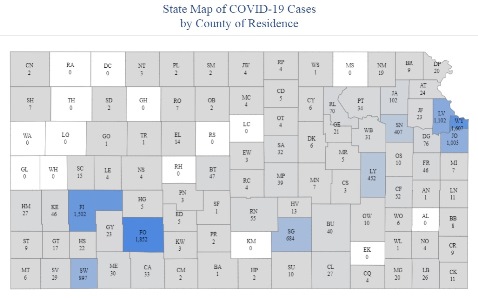
COVID-19 is in about 90 counties in Kansas. (KDHE map)

Gov. Laura Kelly today outlined a statewide testing strategy for COVID-19 that would test 60,000 people each month through the end of 2020, with the goal of 2 percent of the population.

There has been an increase in labs’ ability to run tests, she said.

“We are at a point where we can roll out a formal statewide testing strategy,” Gov. Kelly said at a 4 p.m. Thursday news conference.

Because of the early actions taken with restrictions, Kansas has half the number of COVID-19 cases and deaths as Iowa and Nebraska, she said. The past three months were filled with challenges for Kansas trying to get testing kits, supplies and equipment.

Tests through the state laboratory in most cases must meet the “patient under investigation” criteria, she said. The criteria included some symptoms or some exposure to COVID-19. In some situations, both symptomatic and asymptomatic persons may be recommended for testing, she said.

To meet the 2 percent testing goal, Kansas will receive large quantities of testing supplies from the U.S. Health and Human Services Department, she said.

The state has created a real-time map of testing locations, capacities and available testing platforms, she said. The Kansas Department of Health and Environment will assist with various local health department efforts for testing, she said.

The governor listed types of testing facilities – the KDHE lab, commercial labs, local reference labs, mobile labs and collection teams.

“Today’s announcement will continue to aid Kansas in the progress that will allow us to return to normal,” Gov. Kelly said, “but we must do so safely so that the sacrifices that all have made will not have been made in vain.”

Dr. Lee Norman, Kansas secretary of health, said the “person under investigation” criteria used for the state lab tests, are for persons who have symptoms. The tests can be given to those without symptoms if the persons are in a high prevalence area. The state usually doesn’t test people without symptoms because the molecular test only reflects the moment the test is taken, and does not indicate whether the persons could be positive the next day; the CDC and FDA do not have an approved asymptomatic test available; and it would be impractical to test 150 million Americans on a regular basis.

Dr. Norman said the KDHE will deploy a mobile testing unit to areas around the state. The test will be given to persons, and the results can be run at the site. It will be able to test both symptomatic and asymptomatic persons, if they are going to a high prevalence area, he said. The unit would be dispatched to areas with a disproportionate impact of the disease, he said.

African-Americans in Kansas as of June 1 had almost twice the positive COVID-19 case rate per 100,000 individuals, he said. The rate is about 450 per 100,000 for African-Americans, compared to about 242 per non-African-Americans, he said.

The death rate for African-Americans from COVID-19 has been almost five times higher, he said. The death rate was about 25.7 per 100,000 for African-Americans as compared to about 5.7 for non-African-Americans, he said.

The cause of disparities has not been entirely answered, but he noted that some African-Americans live in areas that are farther distances from medical facilities, causing them to be out more. Also, black Kansans are 1.6 times more likely to be uninsured, he said. In addition, there are more serious underlying conditions, more likely to have complications, he said. He also said there were economic disparities causing some to not be able to work from home, and forcing some to have more face-to-face contact.

He said the KDHE wants to work with communities of color, through local health departments and community leaders, to do community-based testing using the mobile units and other testing strategies.

“Based on state data, we want to deploy the mobile unit first to Reno and Wyandotte counties,” Dr. Norman said.

This strategy will increase the number of testing sites available, Dr. Norman said.

Also, with a more rapid deployment force, they will be able to more quickly identify a positive case, for example a positive case in a nursing facility, and test everyone. Those persons at a nursing facility or a correctional facility, for example, could be asymptomatic but because they also are in a high prevalence area, they are more likely to come back positive, he added.

Dr. Norman said there were about 40 testing sites around the state. The state lab can handle about 1,000 tests a day, with commercial labs able to handle about 2,000 tests a day, while the KU hospital lab is able to do about 700 or so tests a day.

He said testing will be more strategically deployed, to places that need it. Earlier, the state didn’t have materials and resources.

“There’s many links in the chain that had to work,” he said. Swabs, test kits, supplies and devices were needed. It wasn’t until the governor made the trip to Washington, D.C., that they could get sufficient quantities of materials, he said.

“We had to have the elements in order to really roll it out,” he said.

The state’s rules about who may get a test apply to tests sent through the state lab. Otherwise, residents may go to their doctors or clinics, and if a doctor orders a test, the tests can get sent through a commercial lab, he said.

Dr. Norman was asked about case rates declining in some areas, and he said they want to do testing to find cases early, and do contact tracing.

“Testing is where the work starts, contact tracing is really where the work is. That’s the detective work,” he said.

With broader testing strategy and geographic dispersal of the testing possibilities, it’s earlier case identification, earlier contact tracing and earlier action, he said.

From the state, there is no charge for the COVID-19 test, he said. In private testing, often there is a charge around $100, and it might be covered by insurance. Some providers have stated that there is no out-of-pocket charge to their tests because it is covered by the CARES Act.

Tests in Wyandotte County

The state’s mobile testing vehicle locations are expected to be announced in a week or two.

In Wyandotte County, according to the Unified Government Health Department’s COVID-19 webpage, testing is being held from 1 to 5 p.m. each afternoon from Monday through Friday at the Health Department’s parking lot at 6th and Ann Avenue, with no appointment necessary. The tests are free. Information is at  https://wyandotte-county-covid-19-hub-unifiedgov.hub.arcgis.com/pages/what-to-do-if-you-think-you-have-covid-19.

COVID-19 testing is being held at Swope Health at the Bethany medical office building location from 9:30 a.m. to 4 p.m. Monday through Friday at 21 N.12th St., Suite 400, Kansas City, Kansas. Those interested should call to schedule an appointment, 816-923-5800.

Pop-up tests are being held at mobile sites around Wyandotte County on three days a week, through the Health Department and Vibrant Health. The tests are free.

CVS Health announced today it would begin COVID-19 drive-through testing on Friday, June 12, at CVS Pharmacy, 950 Minnesota Ave., Kansas City, Kansas; and CVS Pharmacy, 3750 State Ave., Kansas City, Kansas. They will have self-swab tests. Registration in advance will be necessary for the tests. There are requirements on who will receive the tests. According to CVS, there is no out-of-pocket cost. Appointments can be made at https://www.cvs.com/minuteclinic/covid-19-testing.

Walmart at 10824 Parallel Parkway, Kansas City, Kansas, and at 12801 Kansas Ave., Bonner Springs, has been offering COVID-19 tests for some time. The tests are available from 7 to 9 a.m. Mondays, Wednesdays and Friday. There are eligibility requirements. According to Walmart, there is no out-of-pocket cost. Appointments are necessary and information is at DoINeedaCOVID19test.com.

The Sharon Lee Family Health Care Clinic was one of the first clinics providing COVID-19 testing in Wyandotte County. For more information on the clinic, visit http://www.swbfhc.org/.

To see the governor’s news conference, visit https://www.facebook.com/GovLauraKelly/videos/181713886602771/?v=181713886602771

The state’s COVID-19 testing page is at https://www.coronavirus.kdheks.gov/280/COVID-19-Testing

The UG’s COVID-19 information page is at https://alpha.wycokck.org/Coronavirus-COVID-19-Information.


Wyandotte County is currently under Phase 3. See covid.ks.gov.

The state plan’s frequently asked questions page is at https://covid.ks.gov/wp-content/uploads/2020/05/Reopening-FAQ_5.19.2020_Final.pdf.


Test sites are listed on the Wyandotte County website at https://wyandotte-county-covid-19-hub-unifiedgov.hub.arcgis.com/pages/what-to-do-if-you-think-you-have-covid-19.

The CDC’s COVID-19 web page is at https://www.cdc.gov/coronavirus/2019-nCoV/index.html.

COVID-19 hospitalizations increase in KCK

Wyandotte County reported 1,575 cases and 76 deaths at 1:30 p.m. Thursday, according to the Unified Government COVID-19 page. It was an increase of 24 cases since Wednesday. The number of deaths was the same. (UG COVID-19 website)

Hospitalizations of COVID-19 patients have increased from 10 to 18 in recent days at the University of Kansas Health System, according to a news conference on Thursday morning.

Dr. Dana Hawkinson said that the increase in COVID-19 patients was “pretty scary” and really concerning. Of the 18 patients, eight require critical care in the intensive care unit and three are on ventilators, he said. The hospital reported 14 COVID-19 patients on Wednesday morning and 11 on Tuesday. The increase is possibly due to Memorial Day activities.

Dr. Steve Lauer, a pediatrician at the University of Kansas Health System, said as society opens up, the numbers are going up. People have to continue to be aware of the risk that exists and to think of how to protect themselves, their children and families, he said. They will have to ask themselves what is the risk-benefit to activities.

Dr. Hawkinson, who participated in the news conference by a video link from Florida, talked about how to lessen the risks while traveling. He advocated wearing masks and goggles on planes, as well as frequent hand-washing or using hand sanitizer, and socially distancing. He said in his experience, the beaches were not dangerous as long as people were socially distancing and had space to do so. Those who are considering a trip should weigh the risks of traveling to the rewards.

He said he was not too worried about staying in a hotel or other vacation place, as there are a lot of health measures, such as extra cleaning, being taken. While the virus can live on surfaces, he said, as time goes by, the virus will break down.

Dr. Lauer said if a family is considering a trip to see relatives, parents might consider not going too far away. It is difficult to get children under age 2 to wear a mask.

If the trip involves seeing the grandparents or people who could be at risk, they might consider how important it is, he said. Also, when people return from certain parts of the country, the state could recommend that they need to be in quarantine.

He is not worried about swimming in a lake this year, any more than last year, he said. Chlorinated water in pools is effective in killing viruses. What is more of a problem is people standing in or around a pool, less than 6 feet from each other, he said.

Dr. Lauer said kids need to get their annual physicals and vaccinations this year. If they don’t they could see more cases of measles, polio and pertussis, he said.

When it comes to youth baseball, he said parents need to make sure that players stay 6 feet apart in the dugout, and that parents and families stay 6 feet apart from others in the stands. Parents need to make sure safety precautions are being followed because COVID-19 is still a risk, he said.

Wyandotte County reported 1,575 cases and 76 deaths at 1:30 p.m. Thursday, according to the Unified Government COVID-19 page. It was an increase of 24 cases since Wednesday. The number of deaths was the same.

The KU doctors’ news conference is online at https://www.facebook.com/kuhospital/.


The UG’s COVID-19 information page is at https://alpha.wycokck.org/Coronavirus-COVID-19-Information.


Wyandotte County is currently under Phase 3. See covid.ks.gov.

The state plan’s frequently asked questions page is at https://covid.ks.gov/wp-content/uploads/2020/05/Reopening-FAQ_5.19.2020_Final.pdf.


Test sites are listed at https://wyandotte-county-covid-19-hub-unifiedgov.hub.arcgis.com/pages/what-to-do-if-you-think-you-have-covid-19.

The CDC’s COVID-19 web page is at https://www.cdc.gov/coronavirus/2019-nCoV/index.html.