
Is life harder in Wyandotte County?

Window
Opinion column


by Mary Rupert

Have you ever thought that life is harder in Wyandotte County?

That thought crossed my mind after information was presented at the past two Board of Public Utilities’ meetings.

Kansas City, Kansas, customers of the BPU apparently are more likely to get their electricity disconnected than customers of utilities in other counties, according to information presented at the meetings.

While undoubtedly there are some areas where life is tougher here and other areas where it is easier, this is one area that needs to be looked at, and changed if possible. The utility disconnection can lead to higher bills for residents to get reconnected, starting a downward slide that can lead to some residents becoming homeless, and requiring the community to spend larger amounts of money to take care of them.

The BPU’s cold weather cutoff policy was the subject of a discussion at the meetings. BPU staff presented their findings that included information showing that other utilities did not make that many cutoffs during the winter months, but BPU said many more of its customers were eligible to be disconnected.
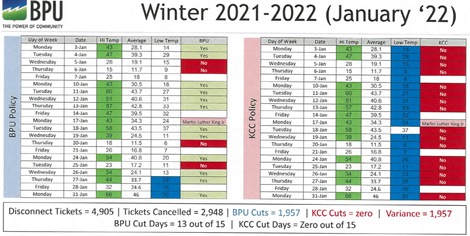
The BPU staff presented information showing several months over the past four years, and how the BPU policy allowed electric disconnections on more days than the KCC policy. This chart was for January of 2022. Information from BPU meeting presentation.

Part of the problem was that the other utilities generally had a 35-degree level for cutoffs, while BPU’s was 32 degrees. Also, there was a 48-hour weather window, with temperatures dropping below 35 in the next 48 hours for other communities, as opposed to temperatures dropping below 32 degrees for a 24-hour window for BPU customers.
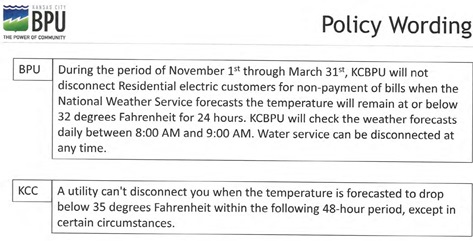
Information from BPU meeting presentation.

The issue was brought up by Jared Emmons, a resident, at a previous board meeting. The community should thank him for drawing attention to a policy that potentially leads to systemic hardships on the poor. While other community members have long complained about the cutoff policy, Emmons brought in information showing how the local policy compared to those of private utilities, which are under the Kansas Corporation Commission.
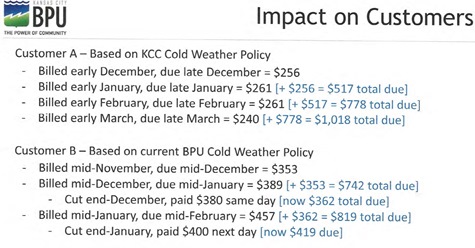
Information from BPU meeting presentation.

While some of the board members seemed to favor a change in the cutoff policy, Bob Milan Sr. pointed out that it does customers no favors to carry the debt, allowing the debt to grow higher and higher. The BPU staff also presented information showing that after the cutoffs or the cutoff notifications, many customers came forward to pay their bills and get their lights on again.

At its meeting March 2, the board discussed a committee review, getting more information, with different policies spelled out, and staff recommendations, and address the topic again at an April meeting.

One factor that makes the BPU different from private electric utility bills is that there are a number of extra charges the Unified Government places on the bills, including the payment in lieu of taxes (PILOT) fee, which is like a franchise fee, along with trash bills, sewer fees and other charges. If electric and water charges were all that was on the bill, many residents wouldn’t have trouble paying them.

While lots of BPU candidates in the past have advocated for decoupling the PILOT fee from the BPU bill, nothing has been done yet. The UG has put the PILOT fee on the bill, and can lower it if it wants, but so far, the UG has approved the PILOT fees at budget time each summer. There has been some support on the UG Commission for lowering the PILOT fee, but apparently the UG would like to keep that revenue or replace it some other way. I’ve noticed an effort by the new UG mayor and administration to go after more federal grant money this year.

The BPU has always had some customers who couldn’t pay their bills, and there have been several programs operating in the community to provide funding for these customers. However, with the pandemic’s high unemployment and the past moratorium on cutoffs, these monies were in short supply the past few years. A state program used federal funding to keep the lights on for some customers, but the program was designed in such a way that it was too difficult for many customers to access and to fill out their forms. Also, the BPU offers several ways for customers to pay their bills, including payment plans.

As BPU board members pointed out at their recent meeting, there may be another factor at work here. The weather itself has been changing in recent years. There have been more see-saw extreme weather days, with temperatures 70 degrees in the daytime, falling to 25 degrees at night, up and down over weeks in the springtime. The BPU’s policy may have worked better several years ago, when there weren’t as many ups and downs in the forecast.

BPU staff estimated that during the past four winters, if BPU had used the KCC policy guidelines, they would have been able to disconnect only on 61 days instead of on 239 days, a 75 percent reduction of days when disconnections could be made. The staff estimated it would cost the BPU almost $10 million in revenue.
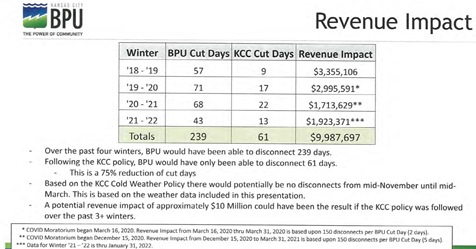
The BPU estimated a revenue impact of $10 million less over four years if it went from 239 days when it could disconnect to 61 days. Information from BPU meeting presentation.

The PILOT fees on the BPU bills, and the resulting cutoffs on electricity of those who can’t pay it, need to change. It operates like a regressive tax on the people who can least afford it. The UG needs to find another way to fund the UG government, other than the BPU bills. The BPU needs to widen its cold weather rule to 48 hours and 35 degrees, following similar policies that the KCC mandates to private utilities.

There is no reason why Wyandotte Countians should find life harder here.

To reach Mary Rupert, editor, email maryr@g3f.1db.myftpupload.com.

Gaming revenues up at Hollywood Casino

Hollywood Casino reported gaming revenues were up about 31 percent in February, according to a report at the Kansas Lottery Commission meeting Wednesday afternoon.

Gaming revenues at Hollywood Casino in Wyandotte County were $12.17 million in the month of February, according to Keith Kocher, director of program assurance and integrity for the Kansas Lottery.

That compares to gaming revenues of $9.27 million in February 2021 and $13.9 million in February 2020 at Hollywood Casino, according to state figures.

Admissions were up 20 percent in February 2022 as compared to February 2021, according to a written report by Rick Skinner, vice president and general manager of Hollywood Casino, to the Kansas Racing and Gaming Commission.

The casino has had several promotions in February, and upcoming promotions are a 10-year anniversary $200,000 drawing on March 19; a $700 every seven minutes promotion on March 26; and a Sporting KC $200,000 kick picks promotion in March, according to the report.

The casino is located at 777 Hollywood Casino Blvd.

The Unified Government receives 3 percent of the gaming revenues from the casino, and the state receives 22 percent of the gaming revenues.

Boot Hill Casino in Dodge City, Kansas, had its best February ever at $4 million, as did Kansas Crossing Casino at Pittsburg, Kansas, at $3.4 million, Kocher said.

Gaming revenues continued down at Kansas Star Casino in Mulvane, Kansas, at $12.9 million, he said. Revenues were down around 4 percent this month, and admissions were down about 8 percent.

In February 2021 the Kansas Star casino had $13.5 million in gaming revenue, and in February 2020 it reported $16.2 million.

Kocher said the Mulvane casino, which is near Wichita, has competition now from a Wyandotte Nation tribal casino in Park City, Kansas. The CrossWinds casino opened in March 2021. The two casinos are about 30 minutes apart.

In other discussion, Stephen Durrell, lottery executive director, said quarantine numbers at the four state-owned casinos had gone down dramatically in recent weeks.

Durrell said he kept hearing rumors there would be legislation introduced on sports betting, but he had not seen anything filed as of earlier today. It is possible a bill will be introduced later, according to Durrell, although he had not seen a current version of it.

KCK school board continues masking policy

A map on the CDC’s website today placed Wyandotte County, near the top right, in the high risk COVID category. (CDC map)

The Kansas City, Kansas, Board of Education, at its Tuesday night meeting, decided to let its policy on masking stand.

The current school district policy in effect is that everyone wears a mask when inside buildings, according to Tiffany Lewis, the district’s director of health services.

The CDC is lowering the mask requirement for communities that are at low risk of COVID, but Wyandotte County is classified as high risk, she said. Based on that, she recommended that the district continue the mask policy.

The policy is tied to the Centers for Disease Control, Kansas Department of Health and Environment and Unified Government Health Department recommendations, according to Superintendent Anna Stubblefield.

If the risk level here ever changed to low or medium, then the policy could change, Dr. Stubblefield said.

Lewis said as of today, the KDHE had not yet released new guidance on the issue.

The way the policy is written, the district’s policy could change without a board vote if the risk level changed to low, since it is tied to the three agencies’ recommendations, according to district officials.

Board members briefly discussed whether they wanted to have a vote before any change may be made in the future, but decided to leave the policy as is.

The risk levels are based on hospital beds in use, admissions, and total new cases in the area, according to Lewis.

If the community risk is low, it is the recommendation of the CDC that personal preference be used in masking, she said. If there is medium risk, residents should consult their providers on whether it is appropriate to mask. High-risk communities should wear a mask indoors in public and get tested if they have symptoms.

Wyandotte County has a lower vaccination rate than some other area communities. Currently 62 percent of Wyandote County residents have received first doses of the vaccine. Those receiving two doses totaled 51.9 percent. Thirty-six percent have received three doses.

Dr. Stubblefield urged the board to follow the current policy.

Board member Wanda Paige noted that everyone would like to go without masks, but the numbers here are much worse compared to other areas. With the low percentage of vaccinations, she doubted if Wyandotte County would ever get to the low risk stage.

Several other school districts in the Kansas City area have dropped mask requirements.

To see Wyandotte County on the CDC map, visit https://www.cdc.gov/coronavirus/2019-ncov/your-health/covid-by-county.html.