Mayor urges governor to veto bill that would block Safe and Welcoming ordinance

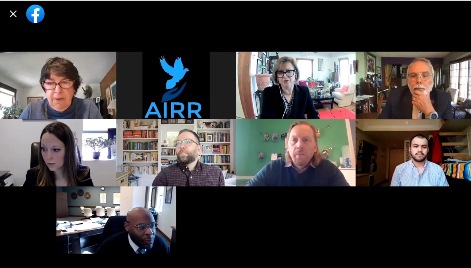
A news conference was held online on Monday morning urging Gov. Laura Kelly to veto House Bill 2717, which would nullify a Safe and Welcoming ordinance that passed in Kansas City, Kansas. (Picture from Zoom news conference)

Kansas City, Kansas, Mayor Tyrone Garner and others today urged Gov. Laura Kelly to veto a legislative bill that would nullify the Safe and Welcoming ordinance in Kansas City, Kansas.

The ordinance, approved Feb. 10 by the Unified Government Commission, outlines a process for issuing identification cards for Kansas City, Kansas, residents and it also states that UG resources cannot be used to enforce federal immigration law. It also says that the UG is an inclusive and welcoming city for immigrant members of the community. The ordinance does not apply to Bonner Springs and Edwardsville.

Mayor Garner, a former deputy police chief of Kansas City, Kansas, said this morning that the ordinance represents that Wyandotte County is a very diverse community that values its immigrants, and realizes the diversity the immigrant community brings to the cultural fabric of the community, bringing the neighborhoods together on a foundation of respect, love and understanding.

The UG ordinance guarantees that all people, including immigrants, will be able to use all UG services regardless of where the immigrants are from, he said. It also upholds the guarantees of the federal constitution protecting residents against unreasonable search and seizure, he said.

Residents who have chosen Wyandotte County to be their home need to feel safe and protected by law enforcement, and receive services, and also feel secure they will not be exposed to unreasonable immigration enforcement, he said.

He added many residents, including elderly, are indigent and some are homeless, as well as youth in foster care, and ex-offenders, who lack photo IDs. The Safe and Welcoming Act also helps them.

To feel safe, residents need to have a level of comfort where they can reach out to law enforcement, Mayor Garner said, if they fear the perception of crime, or if they are victimized by crime, without repercussions that would prevent them from receiving the level of services they need.

“We want our law enforcement apparatus in Wyandotte County to feel empowered,” he said. This ordinance encourages trust with law enforcement, he added.

Home rule in Kansas means that local communities can decide for themselves on local issues.

“I feel the (state) legislation that has been passed,” Mayor Garner said, “is politically driven and I want to make sure these political driven initiatives do not take place in Wyandotte County.”

He said he would ask Gov. Kelly to veto House Bill 2717, asking her to put people over politics.

In the online news conference from the Safe and Welcoming Coalition, several advocates appeared to support the governor’s veto of the legislative bill.

There was more than five years of discussion at the UG before the Safe and Welcoming ordinance was passed, according to advocates. There were extensive committee meetings, public hearings nad work with the UG legal department on the wording of the ordinance.

A Roeland Park City Council member, Michael Rebne, said over 200 residents of Roeland Park signed a petition for its Safe and Welcoming ordinance.

Where people live in the shadows, it is not a healthy community, he said. More than two years of discussion was held, with much research and community input, before this ordinance was passed in Roeland Park, he said.

The Rev. Rick Behrens, pastor of Grandview Park Presbyterian Church in Kansas City, Kansas, and a founding member of the Safe and Welcoming Coalition in Kansas City, Kansas, said for five years the coalition knocked on doors, worked with residents and the community to build the coalition.

He said House Bill 2717 would damage the relationship between law enforcement and communities across Kansas.

He said the House bill should be flipped, and encourage more communities to enact Safe and Welcoming legislation, that would make communities safer and more economically vibrant.

The legislative bill “damages the fabric of our community,” he said, hurting everyone and making them all less safe and less human.

Since Congress has been incapable of solving the immigration situatin for 30 years, KCK has chosen to be inclusive of those whom God has placed in their midst, Behrens said.

The news conference also heard from an immigration lawyer, representing the Missouri-Kansas Immigration Lawyers Association, who said the House bill would harm noncitizens and citizens in Kansas alike.

Ginevra Alberti said enforcement of immigration laws falls strictly under the purview of the federal government. When left to the federal government and not local government, members of the community feel safer to come out of the shadows, she said, and trust local law enforcement officers.

The House bill would erode trust and have a serious chilling effect on undocumented persons and families, she said. Some crimes may not be reported out of fear of being p icked up by immigration, particularly domestic violence cases. Also, people would be less likely to leave their homes, less likely to go shopping and to show up at parent-teacher conferences, she said.

She said federal immigration law is complicated and local police do not usually receive training in it. She cited federal laws and regulations with more than 1,000 pages. She questioned how far the state bill goes, including intrusion into the business operations of any business.

Marcus Winn, director of voter engagement at the organization More2, said the coalition was optimistic that the governor would veto the state legislative bill.

If the governor vetoes it, the coalition will move ahead with all strength to sustain the veto, he said.

Winn said an unexpected development of the legislative targeting of the movement in Wyandotte County has been overwhelming support received from around the state. Previously it was a local effort without a lot of contact from other communities, but now they are communicating, he said. The conversations need to continue, he added.

“I think you may have woken a sleeping giant, and there may be consequences for that,” Winn said.

Also involved in the news conference were the Cross-Border Network for Justice and Solidarity and the Advocates for Immigrant Rights and Reconciliation.

To view more comments from the news conference, visit the video at https://www.facebook.com/safeandwelcoming/videos/737450760957080.

See earlier story at https://wyandotteonline.com/safe-and-welcoming-ordinance-approved-in-kck/.
UG committee advances up to $270 million in bond issues for Homefield project

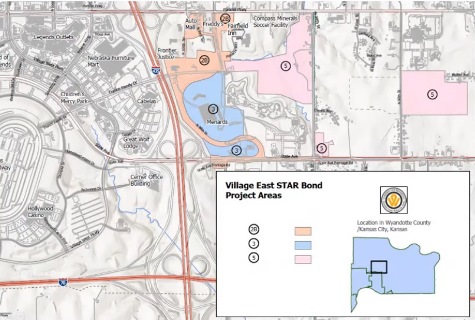
The Village East STAR bond project areas are at and near the former Schlitterbahn water park area, east of I-435. The Legends Outlets and the Kansas Speedway are to the west. (UG map)
This map shows some of the projects and buildings in the Village East area. (Map from UG committee meeting)

A Unified Government committee on Monday night advanced bond issues for the Homefield development project totaling up to $270 million.

The approval for the bonds now will go to the UG full Commission meeting on Thursday, April 7. The Homefield development is located near 90th and State Avenue, in an area including the former Schlitterbahn water park plus some surrounding land.

The three items that were approved Monday night by the Economic Development and Finance Committee include up to $160 million in STAR (sales tax revenue) bonds; industrial revenue bonds up to $65 million for the Homefield sports building, a multi-use recreational and commercial facility; and industrial revenue bonds of up to $45 million to acquire, construct and equip the Homefield baseball complex.

The $648 million project also includes a Margaritaville hotel and resort, with 250 rooms. STAR bonds will fund about $130 million of the project, with the rest from private investments by developers and their associates, according to Kathleen von Achen, UG chief financial officer.

When the project is completed, it is estimated to produce about $10 million a year in new property tax revenue, von Achen said.

The development agreement for the Homefield project was approved previously in January, according to von Achen.

The STAR bonds will refinance an $8.5 million Series 2015B STAR bond issue, from the Schlitterbahn era, that will eliminate the UG’s agreement to use revenues to cover shortfalls in sales tax revenues to repay the 2015 bonds, according to von Achen.

The Homefield building and Homefield baseball are scheduled to open by July 1, 2024, according to Katherine Carttar, UG economic development director.

The IRBs will have a 10-year payment in lieu of taxes schedule for each part of Homefield.

An outside consulting firm, PGAV, estimated that the development would have a positive effect on businesses that are in or near the Village East redevelopment area.

For example, when the development is built, Freddy’s restaurant was estimated to increase its annual sales volume by $600,000; the nearby Menard’s store was estimated to have a $235 per square foot sales volume; Frontier Justice was estimated to have an $8 million in annual sales; Camping World was estimated to have $40 million in annual sales volume; and a Jeep sport utility vehicle dealership was estimated to have annual sales of $36 million, according to PGAV figures.

For more details on this project, view the meeting video at https://www.youtube.com/watch?v=H3mrskVcxDc.

Mayor proposes half-cent sales tax, mill levy decrease

by Mary Rupert

A half-cent sales tax proposal with a mill levy decrease got a surprised and emotional response on Thursday night from the Unified Government Commission.

Mayor Tyrone Garner recommended an 8.5-mill property tax reduction, along with a change in the payment in lieu of taxes (PILOT) fee found on the Board of Public Utilities bills. The property tax would be set at the “revenue neutral” rate.

The half-cent sales tax could go before voters at the August primary election, according to the mayor’s proposal.

The mayor also proposed conducting an organizational analysis of the UG departments to find efficiencies.

Kathleen von Achen, UG chief financial officer, explained that the UG also is looking at separating the PILOT fee, which is placed on BPU bills, into separate categories, including one PILOT fee for residential and another for other classes of customers. The PILOT fee is currently 11.9 percent. If there were separate classes, there would be more flexibility for the UG Commission to decide how much to charge for the PILOT fee, she said. She said more details on this would be presented at the March 31 UG Commission meeting.

The proposed sales tax would only be for the city of Kansas City, Kansas, not for the county, she said.

The UG has two options, a special purpose sales tax or a general purpose sales tax, she said. The mayor is recommending a “temporary half-penny,” a dedicated half-cent sales tax for 10 years.

The sales tax would generate an estimated $196 million in sales and use tax revenue, with an average of $19.6 million per year, she said. In 2023, it would generate about $17 million.

Facility and road improvement projects could be funded with the sales tax, she said. Some examples of projects under consideration are fire station reconstructions; fire and police training facility; police patrol stations and existing facility improvements; police equipment and technology enhancements; parks and recreation spray parks, new recreation center and recreation facility improvements; new transit and UG services building in midtown; and street and road reconstruction projects throughout KCK, she said.

To put the sales tax on the Aug. 2 ballot, the UG needs to introduce it at the May 9 Economic Development and Finance Committee meeting, she said. The proposed timeline calls for a May 26 UG Commission ordinance approval. June 1 is the deadline to give the language to the Election Commissioner to place on the ballot. If the measure passes the primary election on Aug. 2, the tax would be collected starting Jan. 1, 2023.

The current property tax levy collects $110 million for the UG, von Achen said. The assessed value of the county is increasing about 12 percent for the next revenue year, to result in more revenue, estimated at $123 million in 2023, she said.

If the UG collects the same amount in 2023 as it does today, it would have to reduce the revenues to be at the “revenue neutral” rate, she said. About $13.6 million would be the difference, a reduction of about 8.5 mills.

The UG Commission usually has until late August to decide on its annual budget, and the initial response Thursday night pointed to a likelihood that there could be changes to the recommendations over the course of the next few months.

UG commissioners reacted to the different way of presenting the budget process. Commissioner Brian McKiernan remarked that he expected the commissioners to talk about their vision of the budget first, then to discuss specific budget details later. He said community surveys showed the most important thing to the residents was fixing the infrastructure, including streets and sidewalks.

Commissioner Mike Kane said it was his 18th budget, and he had never seen anything like it. He would rather have had the commission talk about what the commissioners wanted first. He also said he remembered last year that some commissioners wanted to lower the mill levy by one mill this year.

The 8.5 mills seemed to be a lot to some commissioners. Commissioner Kane said he was for a mill levy reduction, but he didn’t want to strap the next commission that much.

Commissioner Christian Ramirez said he felt the proposals were aggressive and fast. He thought if the UG put a sales tax on the August primary, that it wouldn’t pass. He said the UG took a community survey where residents responded with an overwhelming “no” to a question about a sales tax for parks.

The current national and world situation may be having its effect on the commission’s viewpoint, also. Talk of a recession was in national news this week, along with other challenges that may result in a commission viewpoint that is more likely to hold onto current revenues. Commissioner Ramirez said they’re still going through the effects of the pandemic, with dire situations going on in the world, including war, and they don’t know how that’s going to turn out.

Commissioner Ramirez said he wondered what would get cut and what services they would lose. He said important issues at the end of the budget discussion last year included reinforcement of the workforce and maintenance of infrastructure, and he thought they would be important this year, also.

Commissioner Andrew Davis thought the meeting was a “waste of our time.” He said there was a need for the mayor and everyone to come to the table and compromise.

Commissioner Melissa Bynum said she didn’t see how a “revenue neutral” concept would grow the community in any way, and it is a conversation they need to have later.

Commissioner Chuck Stites said he was in favor of lower taxes, but he also didn’t want to handcuff the government to the point where they can’t take care of the needs of the infrastructure. He also wanted the governing bodies including schools to meet together to discuss reducing the mill levy.

Commissioner Angela Markley said she didn’t think the UG’s guiding star should be the state’s revenue neutral concept. The UG’s goal is to grow its tax base, she said. The UG’s guiding star should be the community survey, she added.

Commissioner Tom Burroughs told the commission that the reason why Kansas has a revenue neutral law is that local governments weren’t listening to residents, so the residents went to the state Legislature. Commissioner Burroughs said he wanted to see a mill levy reduction. He wanted to advocate for taxpayers and said if the UG doesn’t lower taxes, it could see an exodus to the rural communities.

Commissioner Harold Johnson said that at a 30,000-foot level, with lowering the mill levy and increasing the sales tax, “it looks like we’re trying to rob Peter to pay Paul.” They need to have a comprehensive strategy with the various governing bodies in the county, he said.

Mayor Garner said the Thursday meeting was designed to have these robust discussions, and that the meeting was not a waste of time. He said his recommendation was based on many meetings with residents who told him their taxes and fees were too high. He had campaigned on issues including lower taxes.

“I’ve watched people on fixed incomes say they can’t take it,” he said. He also mentioned other examples of people losing their homes and developers leaving the community.

“I’m going to fight for what this community voted me into office for, and that is to give them the relief that they deserve,” Mayor Garner said.

His recommendation was only to start the discussion on the budget, he added. The proposed sales tax increase would mean that people who are here only through the workday but live elsewhere might contribute more to the tax base.

There was also a retreat-like session following the initial presentation, led by Ed O’Malley of the Kansas Leadership Center, in which the commissioners expressed their opinions about their vision for the community, and its greatest challenges.

More details can be found at the video of the meeting, online at https://www.youtube.com/watch?v=BaKuByl5EQw.