Sumner Academy was ranked as the No. 1 high school in Kansas and also in the Greater Kansas City area by U.S. News and World Report.
It is the fourth year in a row for the honor, said Superintendent Anna Stubblefield.
“Kansas City, Kansas, Public Schools is proud to celebrate Sumner Academy of Arts and Science, as the school was named the top school in Kansas for the fourth year in a row by U.S. News and World Report,” Dr. Stubblefield said during the Tuesday night KCKPS Board of Education meeting.
Sumner Academy was No. 12 among the nation’s magnet schools, and No. 32 nationally overall, she said.
Dr. Stubblefield congratulated Principal Rick Malone, teachers, staff, students and parents for their efforts to achieve acdademic excellence.
The rankings are based on factors including the number of students exposed to the Advanced Placement and International Baccalaureate opportunities, graduation rates, diversity of the students, plus the numbers who receive advice on college opportunities.
The Kansas City, Kansas, school board on Tuesday night adopted a policy that would require masks at a school building if COVID case numbers are over 5 percent at individual school buildings.
The Kansas City, Kansas, Board of Education on Tuesday night, April 26, changed its mask policy, adopting a new policy that would take effect if COVID case numbers are over 5 percent at individual school buildings.
The vote was 4-3 to approve the new policy.
Tiffany Lewis, the district’s director of health services, presented two options to the board.
The first option was to use community levels of COVID-19, and follow the most conservative recommendation from the KDHE, UG Health Department or CDC, based on the latest data.
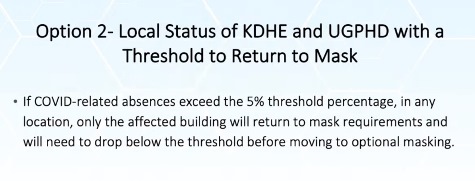
The second option was to look at each building in the district, and if COVID-related absences exceed 5 percent, then the building would return to mask requirements and would need to drop below the threshold before moving to optional masking. The board adopted this option, which would affect only individual buildings and not the entire district.
The motion to adopt the second option was made by Board President Randy Lopez. Voting no were board members Wanda Brownlee Paige, Rachel Russell and Dr. Valdenia Winn.
The school district already tracks COVID numbers in its buildings, according to Lewis, using a software program. When students call in sick, information is transferred to a nurse, who does a follow-up call and determines if it is COVID-related.
Lewis said when they look at data, they usually go with the most conservative approach, and that the board previously has gone with the most conservative recommendation from health offiials.
She said advice from the health experts at the local and state health departments was to provide some way for the district to go back to masking if the situation warranted it in the future.
Yolanda Clark, board vice president, said her yes vote speaks for not only physical, but also mental health and educational health.
Voting no on the issue, Paige said her vote has always been supporting public health.
Russell said her vote was always based on the response of the community.
Dr. Winn said she was concerned that if the district or county is in the “red” zone, at high risk, this doesn’t cross over with option 2. With option 2, if the community is at high risk but the case numbers at the individual school are under 5 percent, then the students and staff would not have to wear masks.
According to district officials, a survey was taken, including responses from parents and staff.
Forty percent favored continuing with the current mask policy; 50 percent were against it; and 10 percent were unsure, according to Lewis.
Forty-one percent of those surveyed were parents or guardians; 50 percent were school district staff; and 11 percent were both parents and district staff.
Lewis said the majority of parents was in favor of changing the mask requirement, while the majority of staff was in favor of keeping the mask requirement.
Last Monday, the board’s older policy, tied to CDC, KDHE and Unified Government Health Department numbers, determined that masks would now be optional in the district’s schools, because Wyandotte County dropped to “low” on the CDC’s county risk map. That change in the procedures was more like option 1, according to Lewis, and option 2 will be entirely new for the district.
COVID case numbers have dropped in Wyandotte County, and COVID hospitalizations also are currently low in the county.
Kansas City, Kansas, Board of Public Utilities members called for a meeting with the Unified Government, saying at Wednesday night’s meeting that the BPU wants to correct “misinformation.”
There is “misinformation” being discussed by UG committee members, according to Rose Mulvany Henry, BPU vice president.
She said that members of a UG committee recently gave a presentation to a local business group, in which the committee members gave out incorrect information about the PILOT fee on the BPU bills.
The PILOT (payment in lieu of taxes) fee is an 11.9 percent fee that the UG places on BPU customers’ bills. The BPU has no authority in approving the fee, according to board members.
“Literally, all we do is collect the PILOT fee and remit the fee to the UG,” Mulvany Henry said at the meeting.
The BPU has no say in how the funds are spent. The funds go into the city general fund of the UG, she said. The UG Commission votes on how much the PILOT fee will be every year at budget time. BPU bills are just used to collect the funds for the UG.
At a recent UG Commission meeting, a UG commissioner asked where the PILOT fee on Bonner Springs and Edwardsville residents’ bills go. Any funds collected from there would go back to Bonner Springs and Edwardsville cities, according to Bill Johnson, BPU general manager.
There was general agreement among the rest of the BPU board that the board needs to meet with the UG Commission and mayor.
Mulvany Henry said although the UG’s website describes the PILOT fee as a franchise fee, it really is not, and that needs to be corrected, also. She said it is a payment in lieu of taxes, different from a franchise fee.
According to BPU officials, the UG gets 11.9 percent of the amount that the BPU bills. If customers are slow to pay their bills, the UG will get its funds right away from the BPU, while the BPU will have to wait for the customers to pay.
According to Mulvany Henry, the UG legal department has looked into the PILOT fees and has determined that the BPU is handling them correctly.
In other discussion, the BPU heard a report about the utility’s electric supply operations. BPU board members said they hoped the BPU was protected against cyber attacks in the wake of the UG website being hit by a cyber attack last weekend. BPU officials assured them that although it could happen to anyone, the BPU is well protected against cyber attacks.