
KU hospital records highest COVID-19 inpatient numbers

Doctors at the University of Kansas Health System today reported their highest COVID-19 inpatient numbers.

According to the doctors, there were 44 active COVID-19 patients in the KU Health System in Kansas City, Kansas, on Wednesday morning, an increase of four since Tuesday morning.

Dr. Dana Hawkinson, medical director of infection prevention and control, said there were 15 COVID-19 patients in the intensive care unit and seven on ventilators. Also, there were 29 other COVID-19 inpatients who are in the COVID-19 recovery phase at the hospital, a decrease of four from Tuesday.

At HaysMed in Hays, Kansas, there were 18 COVID-19 inpatients, with 17 active and one in the recovery phase, he said.

Higher numbers in the hospitals at some point could potentially affect the hospitals’ ability to care for the patients, if there are not enough beds or not enough staff members available. The higher numbers often translate into increased deaths. Currently, they have enough capacity, according to the doctors.

Dr. Steven Stites, chief medical officer at KU Health System, said overall, COVID-19 numbers have been going up in hospitals in Greater Kansas City.

He said while they won’t know the complete effects of gatherings at Halloween until two to six weeks later, they are starting to see rises.

Dr. Hawkinson said there have been COVID-19 cases that have come out of Halloween gatherings already.

Dr. Stites said he had seen gatherings of adults on Halloween where a lot of them were not wearing masks.

Dr. Hawkinson said the shameful thing is that if younger people spread it, in two to three infections down the line, it comes to vulnerable populations, including friends and loved ones.

“Now we have the holidays coming up, and that is going to make for not very good holidays,” Dr. Hawkinson said.

The KU news conference on Wednesday morning included information about how to safely handle food at meals, especially with holidays coming up.

Dr. Stites said people may not be able to do everything they want this year at Thanksgiving. They may not be able to have large gatherings of family. However, they can have a family online gathering, he said. Think that it is different, not that it is bad, he said, and focus on things they can be grateful for.

The odds of having a much better Thanksgiving next year are pretty good, he said.

Some of the food guidelines discussed included: Keep any gatherings small. Wear masks when not eating and space guests at least six feet apart. Plate the dinner for the guests and serve it, and don’t pass bowls. Don’t share serving utensils. Discard food that has been out for more than two hours. Reheat leftovers to 165 degrees. Use refrigerated leftovers within three to four days and frozen leftovers within two to six months.

Also, people could try to seat guests separately by household, and eat outside if the weather permits. Turkey should be cooked to 165 degrees, using a meat thermometer to measure it.

At the Tuesday KU doctors’ news conference, KU Professor Donna Ginther showed her research about mask mandates. The mandates have been very effective in stopping the spread of COVID-19, according to Dr. Ginther.

Counties in Kansas that enacted mask mandates had a decrease in cases 14 days later, while non-masking counties showed a steady increase, according to her research. The counties with mask mandates had a 50 percent decrease in COVID-19 cases, she said.

Wyandotte County reported 8,508 COVID-19 cases on Tuesday, Nov. 3. It was an additional 32 cases compared to Monday. There were no additional deaths, for a cumulative total of 165.

Free COVID-19 testing available Wednesday

A free COVID-19 pop-up test will continue from 3 to 6 p.m. Wednesday, Nov. 4, at Faith Deliverance Family Worship Center, 3043 State Ave., Kansas City, Kansas.

The pop-up test is through Vibrant Health and the Wyandotte County Health Equity Task Force.

The Unified Government Health Department has moved its COVID-19 testing from the 6th and Ann location to the former Kmart at 78th and State Avenue in Kansas City, Kansas. The hours are 9 a.m. to 3 p.m. Monday through Friday.

Tests are free for those who live or work in Wyandotte County. The tests are now saliva COVID-19 tests.

The tests now are open to asymptomatic people as well as those who have symptoms or have been exposed to COVID-19. Check with the UG Health Department’s Facebook page to see if there have been any changes in the schedule because of the weather or for other reasons. Bring something that shows that you live or work in Wyandotte County, such as a utility bill.

For more information about the new testing site at the former Kmart location, visit https://alpha.wycokck.org/files/assets/public/health/documents/covid/10092020_newtestingsitewyco.pdf.

The Wednesday KU doctors’ news conference is at https://www.facebook.com/kuhospital/videos/358446335483349.

The Tuesday KU doctors’ news conference is at https://www.facebook.com/kuhospital/videos/709722956337071.

The UG COVID-19 webpage is at https://alpha.wycokck.org/Coronavirus-COVID-19-Information.

The KDHE’s COVID-19 webpage is at https://www.coronavirus.kdheks.gov/.

The KC Region COVID-19 Hub dashboard is at https://marc2.org/covidhub/.

The CDC’s COVID-19 webpage is at https://www.cdc.gov/coronavirus/2019-nCoV/index.html.
Doctors concerned about hospital capacity

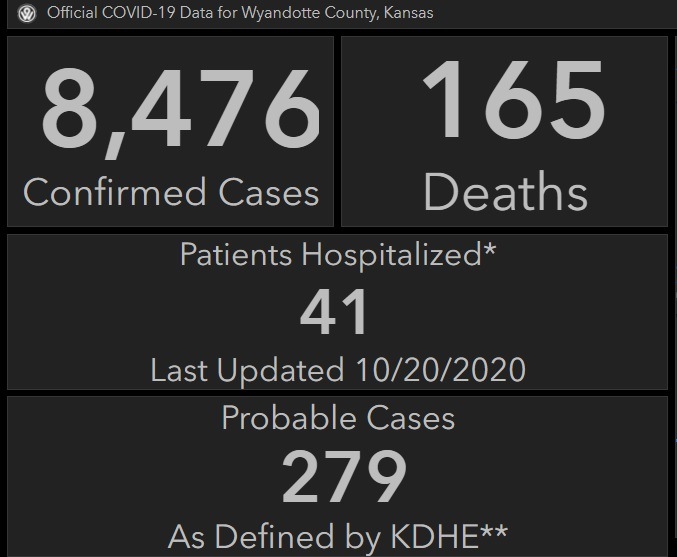
Wyandotte County reported 16 additional COVID-19 cases on Monday, for a cumulative total of 8,476, according to the Unified Government COVID-19 webpage. There were no additional deaths reported, for a cumulative total of 165. (From UG COVID-19 webpage) (https://experience.arcgis.com/experience/8781f01908d8403e9273d78e66e6219b)

Doctors from four hospitals in the Greater Kansas City area expressed concern about hospital capacity, including staffing, during a news conference on Monday morning at the University of Kansas Health System.

Doctors reported their numbers of COVID-19 patients had gone up recently.

According to the doctors, the increased number of COVID-19 patients has the potential to cause capacity problems, as sometimes hospitals are more full in the fall and winter anyway.

The doctors who participated in the news conference include Dr. Mark Steele, executive chief clinical officer, Truman Medical Centers; Dr. Raghu Adiga, chief medical officer, Liberty Hospital; and Dr. Larry Botts, Advent Health.

Liberty Hospital had increased COVID-19 patients both from long-term care facilities and from the community, as well as from rural areas to the north, according to Dr. Adiga.

Dr. Steele said the seven-day rolling average was the highest he’d seen. More infections generally result in more hospitalizations and more deaths, and he doesn’t want that to happen, he said.

He said he also was concerned about gatherings for the holidays. People should think about postponing gatherings, or keeping them very small.

Dr. Steve Stites, chief medical officer of the KU Health System, said hospitals are getting busier because it’s that time of year. With COVID-19, the hospitals are getting fuller than previously.

He mentioned he saw some large gatherings of parents of kids who were trick-or-treating on Halloween, and the parents were not wearing masks.

“We’ve bent the curve before, we can bend it again,” Dr. Stites said. To do that, people have to wear a mask, keep their distance and wash their hands, he said.

On a question about the safety of voting in person, Dr. Dana Hawkinson, medical director of infection prevention and control at KU Health System, said those who are concerned about safety might wear both a mask and goggles. That is in addition to distancing six feet and washing or sanitizing hands frequently.

Turner High School and motor vehicle office closed temporarily because of COVID-19

COVID-19 cases have caused the temporary closure of Turner High School for in-person education and the Wyandotte County motor vehicle office for in-person services.

According to a Turner School District spokesman, Turner High School students who are enrolled in the blended model will make the transition to remote learning beginning Tuesday. Then they will return to the blended model afterThanksgiving, on Nov. 30.

According to the school district, the decision was made in coordination with the Unified Government Health Department because of a continued increase in COVID-19 cases among the Turner High School students.

“We hope this closure will slow the spread of COVID-19 in our community,” the spokesman stated.

Although cases have increased, there is no evidence of spread within the high scool, according to the spokesman. During the closure, Turner High School will be thoroughly cleaned and disinfected, and students will continue to learn through live virtual instruction with their teachers.

A Health Department letter sent to Turner stated that 26 students from Turner High School had tested positive to date. There were currently 14 cohorts quarantined at home to avoid virus spread, including about 130 students and 30 staff, according to the letter.

At the UG’s motor vehicle office at the courthouse annex, 82nd and State, COVID-19 cases have resulted in a temporary closure of the office to in-person services, according to UG spokesman Mike Taylor.

Although motor vehicle services cannot be conducted in person, they can continue to be conducted online, dropped off and through mail-only service, he said. This temporary closure for in-person services will go from Nov. 2 to Nov. 13.

Other services at the courthouse annex will remain open.

More information about motor vehicle services is at https://alpha.wycokck.org/files/assets/public/health/documents/covid/10302020motorvehicleservicesannexlocation.pdf.

Cases in Wyandotte County, surrounding areas

The University of Kansas Health System reported 35 active COVID-19 patients on Monday, down from 37 on Friday, according to Dr. Dana Hawkinson, medical director of infection prevention and control. There were 14 patients in the intensive care unit, the same number as Friday, and eight patients on ventilators, an increase from five on Friday. There were 31 other patients in the hospital because of COVID-19 but out of the acute infection phase, the same as Friday. HaysMed in Hays, Kansas, reported 17 total COVID-19 inpatients on Monday, down from 19 on Friday, and one of the patients in the recovery phase.

Wyandotte County reported 16 additional COVID-19 cases on Monday, for a cumulative total of 8,476, according to the Unified Government COVID-19 webpage. There were no additional deaths reported, for a cumulative total of 165. (https://experience.arcgis.com/experience/8781f01908d8403e9273d78e66e6219b)

The MARC Kansas City Region COVID-19 hub reported 58,019 total cumulative COVID-19 cases and 996 total deaths on Monday for the nine-county Greater Kansas City area. The average daily number of cases was 346, down from 427 last week. The average daily number of COVID-19 patients in the hospital was 398, down from 401 last week. (https://marc2.org/covidhub/)

Kansas reported its largest increase ever of COVID-19 cases on Monday. There were 4,046 additional cases reported on Monday, since Friday, according to the Kansas Department of Health and Environment. There were 17 additional deaths reported statewide. In all, there were 89,227 total cumulative cases with 1,046 cumulative deaths on Monday morning, according to the KDHE.

Free COVID-19 testing available Tuesday

The Unified Government Health Department has moved its COVID-19 testing from the 6th and Ann location to the former Kmart at 78th and State Avenue in Kansas City, Kansas. The hours are 9 a.m. to 3 p.m. Monday through Friday.

Tests are free for those who live or work in Wyandotte County. The tests are now saliva COVID-19 tests.


The tests now are open to asymptomatic people as well as those who have symptoms or have been exposed to COVID-19. Check with the UG Health Department’s Facebook page to see if there have been any changes in the schedule because of the weather or for other reasons. Bring something that shows that you live or work in Wyandotte County, such as a utility bill.

For more information about the new testing site at the former Kmart location, visit https://alpha.wycokck.org/files/assets/public/health/documents/covid/10092020_newtestingsitewyco.pdf.

The KU doctors’ news conference is at https://www.facebook.com/kuhospital/videos/1321567304857986

The UG COVID-19 webpage is at https://alpha.wycokck.org/Coronavirus-COVID-19-Information.

The KDHE’s COVID-19 webpage is at https://www.coronavirus.kdheks.gov/.

The Unified Government COVID-19 hub outbreak map is at https://wyandotte-county-covid-19-hub-unifiedgov.hub.arcgis.com/.

To see an NEA list of schools that have had COVID-19 cases, visit https://app.smartsheet.com/b/publish?EQBCT=aa3f2ede7cb2415db943fdaf45866d2f.

The KC Region COVID-19 Hub dashboard is at https://marc2.org/covidhub/.

The CDC’s COVID-19 webpage is at https://www.cdc.gov/coronavirus/2019-nCoV/index.html.

Herd immunity not the answer, health officials say

Wyandotte County reported 59 additional COVID-19 cases on Sunday, for a cumulative total of 8,460, according to the Unified Government COVID-19 webpage. There were no additional deaths reported, for a cumulative total of 165. (From UG COVID-19 webpage) (https://experience.arcgis.com/experience/8781f01908d8403e9273d78e66e6219b)

Nine months into the pandemic, many in the Kansas City region and across the country are suffering from COVID-19 fatigue. Some have suggested it would be better to fully open businesses and schools without mask or social distancing requirements, letting the virus run its course in order to build herd immunity. According to local public health officials, this is an extremely risky strategy that would have catastrophic results.

“Herd immunity” is achieved when enough people (at least 80% of the population) are no longer vulnerable to infection — either because they’ve already had the disease, or they have been vaccinated against it. Diseases that used to be common in the U.S., such as measles and chicken pox, have become rare because of robust vaccination programs that support herd immunity.

“Until we have a proven safe and effective vaccine for COVID-19, we cannot safely reach herd immunity,” said Dr. Rex Archer, director of the Kansas City, Missouri, Health Department. “Natural infection in large enough numbers to achieve herd immunity would come at a huge cost of human life and health. Currently we believe only 5 to 10% of the population has been infected with COVID, at a cost of more than 224,000 lives nationwide. Now imagine the additional 1.5 to 2 million deaths that would occur before reaching at least an 80% infection rate.”

COVID-19 has a significantly higher death rate than many other viruses — about 10 times higher than influenza, for example — and the long-term effects on those who have had COVID-19 are not yet fully understood. Additionally, the virus risk isn’t the same for everyone. Vulnerable populations, including older adults, people of color and people with preexisting conditions or limited access to health care, are at higher risk of infection and death from COVID-19, according to health officials.

“COVID-19 is real, it is dangerous, and we have to take it seriously,” said Dr. Erin Corriveau, deputy health officer for the Unified Government of Wyandotte County – Kansas City, Kansas. “Until a vaccine is widely available and widely adopted, the best defense we have is to continue to wear cloth face masks in public, practice good hand hygiene and maintain social distancing of 6 feet or more from people who don’t live in our own households.”

As response to the pandemic has become more politically charged, some have attempted to discredit this science-based public health guidance, claiming that “focused protection” can build herd immunity. This theory recommends opening up schools, sports, restaurants and events for young, healthy people who are at less risk of serious illness, while encouraging older adults and others at higher risk to stay home. Supporters theorize that increasing natural infection among young, healthy people would effectively build herd immunity.

Local public health directors say this approach won’t stop the spread of disease and is wrong for our region. Separating those who are young and healthy from those who are more vulnerable is impractical, if not impossible. In addition, doctors have seen devastating health outcomes among some young and middle-aged people in the community who have been infected, including severe heart failure, stroke, chronic fatigue and even death.

“The idea that herd immunity can quickly put an end to the pandemic is wishful thinking,” Dr. Corriveau said. “Sweden tried this strategy last spring, and their state epidemiologist has since admitted it was wrong, causing thousands of deaths, especially in their older population.”

Allowing COVID-19 to spread unchecked in search of herd immunity would also strain the capacity of hospitals and health care providers across the region, especially with the winter flu season approaching.

“We all need to stay focused on what we know works best right now: wear a mask, wash your hands frequently and keep your distance from others, especially in indoor environments where others are not wearing masks,” Dr. Archer said. “Most importantly, get tested if you have symptoms or think you may have been exposed to the virus, and stay home if you are sick.”

Cases in Wyandotte County increase by 59

Wyandotte County reported 59 additional COVID-19 cases on Sunday, for a cumulative total of 8,460, according to the Unified Government COVID-19 webpage. There were no additional deaths reported, for a cumulative total of 165. (https://experience.arcgis.com/experience/8781f01908d8403e9273d78e66e6219b)

The MARC Kansas City Region COVID-19 hub reported 58,101 total cumulative COVID-19 cases and 990 total deaths on Saturday for the nine-county Greater Kansas City area. The average daily number of cases was 471, up from 402 last week. The average daily number of COVID-19 patients in the hospital was 414, up from 390 last week. (https://marc2.org/covidhub/)

Free COVID-19 testing available Monday

COVID-19 saliva testing began last Friday at the Health Department testing site at 7836 State Ave., Kansas City, Kansas. No food or drink is allowed 15 minutes before the test and no smoking is allowed 30 minute before. The sample is collected by holding a swab under the tongue for 1 minute.

The Unified Government Health Department has moved its COVID-19 testing from the 6th and Ann location to the former Kmart at 78th and State Avenue in Kansas City, Kansas. The hours are 9 a.m. to 3 p.m. Monday through Friday.

Tests are free for those who live or work in Wyandotte County.

The tests now are open to asymptomatic people as well as those who have symptoms or have been exposed to COVID-19. Check with the UG Health Department’s Facebook page to see if there have been any changes in the schedule because of the weather or for other reasons. Bring something that shows that you live or work in Wyandotte County, such as a utility bill.

For more information about the new testing site at the former Kmart location, visit https://alpha.wycokck.org/files/assets/public/health/documents/covid/10092020_newtestingsitewyco.pdf.

For more information about saliva tests, visit https://alpha.wycokck.org/files/assets/public/health/documents/covid/10302020-salivatestinginwyco.pdf

The UG COVID-19 webpage is at https://alpha.wycokck.org/Coronavirus-COVID-19-Information.

The KDHE’s COVID-19 webpage is at https://www.coronavirus.kdheks.gov/.

The Unified Government COVID-19 hub outbreak map is at https://wyandotte-county-covid-19-hub-unifiedgov.hub.arcgis.com/.

To see an NEA list of schools that have had COVID-19 cases, visit https://app.smartsheet.com/b/publish?EQBCT=aa3f2ede7cb2415db943fdaf45866d2f.

The KC Region COVID-19 Hub dashboard is at https://marc2.org/covidhub/.

The CDC’s COVID-19 webpage is at https://www.cdc.gov/coronavirus/2019-nCoV/index.html.