Nursing homes have until today to sign up for a free service linking health experts with staff at the long-term care facilities.
Project ECHO (Extension for Community Healthcare Outcomes) is offered through the University of Kansas Health System and KU Medical Center to assist long-term care facilities with information and training. Training is online.
According to Dr. Shawna Wright, licensed psychologist at KU Medical Center, about a fourth of all COVID-19 patients have been in nursing facilities, which has put a strain on already overworked staff.
This program teaches the best practices and best ways to implement rules sent out by different governing agencies. The program also has a technical support staff to help nursing facilities with broadband connection problems.
Nursing home administrators and those who work in the homes may call 913-588-2226 for information and registration. The home has to register in order for employees to participate.
Dr. Jessica Kalendar-Rich, who is one of the experts advising nursing facilities, said the facilities don’t always know how to handle all of the available information and she helps take the regulations and put them into practice to improve conditions for residents.
Dr. Kalendar-Rich, national member of the Coronavirus Commission for Safety and Quality, said the basics of infection prevention can keep residents safe but many times the problem is staff who unknowingly bring the virus into the facility from the community.
Today, several hospital officials in Greater Kansas City told metro area elected officials that they are concerned about hospital capacity, with COVID-19 numbers on the rise.
Medical and hospital executives from the University of Kansas Health System and five other hospitals in the Kansas City area met with elected officials this morning, remotely, to discuss the rising case numbers.
Hospitals are concerned about capacity, said Dr. Steve Stites, chief medical officer at KU Health System.
He said data with federal agencies about the hospital capacity in Kansas City does not reflect the true picture. While it looked like there were 2,000 open beds and 300 intensive care beds available in the Kansas City area, that figure did not reflect the realities of staffed and available hospital beds that could be used, with resources around them to take care of patients, he said.
Because of a staffing shortage, the number of available beds is different from the number of licensed beds, he said.
According to hospital officials, on Nov. 3 there were 153 non-intensive care unit beds available in a sample of 11 hospitals in the Greater Kansas City area, according to Dr. David Wild of the KU Health System. About 76 ICU beds could be staffed, he said.
There were 32 ICU beds that were physically available, with 22 that could be staffed, according to Dr. Wild.
When it comes to staffing, the hospitals can try to use temporary agencies for staffing, but they are all trying to borrow from the same pool, Dr. Stites said.
“The real crunch is there aren’t enough beds available,” he said.
Dr. Stites urged everyone to practice social distancing, mask wearing and hand washing to stop the spread of the coronavirus.
They have already had a few instances of having to turn away patients from other hospitals that are several hours away.
Hospitals do not want to have to take steps such as canceling or postponing surgeries, and the doctors said it is possible to control the virus by wearing masks, socially distancing and avoiding crowds.
Dr. Stites said the seven-day average of cases in the Greater Kansas City area was trending to 700 new patients a day. On Monday, the area hospitals surveyed had 277 COVID-19 patients in their hospitals, and by Friday, it was at 318, Dr. Stites said.
Dr. Stites said it is not the doctors’ place to tell elected officials what to do about the higher numbers, but it was their role to alert them to it, and leaders would make their own decisions.
Dr. Wild said they are not turning away patients with emergencies arriving in ambulances. At one point, however, they had to turn down some people who wanted to transfer from another hospital, because they didn’t have available beds, according to Dr. Stites.
Some rural hospitals are calling urban hospitals five to six hours away to see if they can transfer patients because they are full, according to Dr. Wild.
The hospitals are not yet at capacity, but if rising rates continue, it may reach it very soon, according to the doctors.
Dr. Stites said they are not saying it’s a crisis at this point. They are very concerned, however, about a rise in COVID-19 cases and an increased number of patients in the hospital.
The doctors did not recommend that patients postpone their own needed surgeries, because some conditions may get worse if they don’t have medical care, according to the doctors.
The doctors did not have an estimate on when the hospitals might reach capacity, as the numbers could either increase or decrease. If case numbers continue to increase, the hospitals will probably be overwhelmed, according to the doctors. It could happen within a few weeks if people don’t act to stop the spread of COVID-19 by masking and socially distancing.
On Friday morning, KU Health System reported its highest number of active COVID-19 patients, at 53. There were 18 in the intensive care unit and 10 on ventilators, said Dr. Dana Hawkinson, medical director of infection prevention and control at KU Health System. There were an additional 28 COVID-19 patients still in the hospital but not classified as active patients because they were beyond 10 days.
The number of patients at HaysMed in Has, Kansas, also was up on Friday morning, for a total of 22 patients, with 19 active and three in the recovery phase.
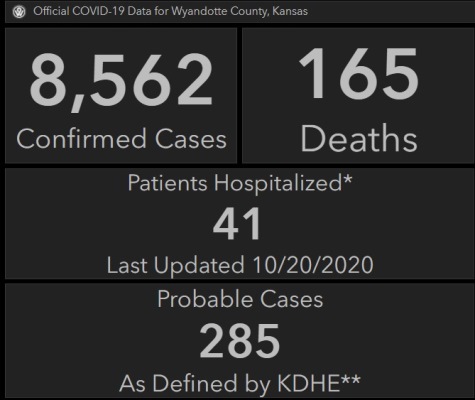
In Wyandotte County, there were an additional 54 COVID-19 cases reported on Wednesday, with a cumulative total of 8,562. No additional deaths were reported, for a cumulative 165. (From UG COVID-19 webpage)
Unfortunately, COVID-19 did not take a week off for the election, Gov. Laura Kelly said at a news conference on Wednesday.
The governor reported that since Monday, Kansas has experienced 2,988 additional COVID-19 cases and 41 new deaths. There was a cumulative total of 92,215 cases and 1,087 deaths statewide, she said.
It was an unfortunate week for COVID-19 spread, she said. Monday set a new seven-day rolling average record in the state.
Some rural area hospitals have begun to reach capacity. One hospital in the southwest part of the state learned that the closest intensive care bed was in Kansas City, she said. Wichita’s two hospitals had no ICU beds available after a significant increase in patients.
Gov. Kelly said her staff is in ongoing conversations with legislative leaders to work with community leaders to increase mask usage in the state.
She added the Republican leadership has asked for a public service campaign, which she supports wholeheartedly. She also supports a mask mandate, she added.
There is no timetable for a new mask mandate, she said, and negotiations take time.
Gov. Kelly said Kansas must flatten the curve and protect the elderly and vulnerable. The state needs to reduce the spread of COVID-19 to keep businesses and schools open.
“We know how to mitigate the spread,” Gov. Kelly said. “Wear a mask, physically distance, avoid large gatherings and practice hygiene.”
Funds available for Kansans who need rental assistance
Also, Gov. Kelly said funds are still available for Kansas residents in the Kansas Eviction Prevention Program. The fund has up to $5,000 available for individuals who are experiencing housing hardship because of COVID-19. The funds are from the federal CARES Act.
Renters and landlords need to apply together, she said. Up to nine months’ assistance, not to exceed $5,000, is available per application, for those who qualify.
In Wyandotte County, there were an additional 54 COVID-19 cases reported on Wednesday, with a cumulative total of 8,562. No additional deaths were reported, for a cumulative 165.
BPU tracking COVID-19 closely
The Board of Public Utilities reported at Wednesday night’s meeting that there were currently three positive COVID-19 cases among employees, and 13 employees in quarantine, according to BPU officials.
Officials are reminding their employees that COVID-19 case numbers in the metropolitan area are increasing, and everyone should practice good safety habits, according to an official. They are tracking COVID-19 closely, he said.
Ellsworth correctional resident dies
A second resident of Ellsworth Correctional Facility with COVID-19 has died, according to an announcement by the Kansas Department of Corrections.
The resident, who died Nov. 2, was moved Oct. 28 to the Lansing Correctional Facility COVID-19 Management Unit after testing positive for the virus. He was taken to a hospital on Oct. 29.
The 76-year-old male had underlying medical concerns that contributed to his condition, according to the announcement. He was serving a 176-month sentence for two counts of aggravated indecent solicitation of a child and aggravated endangerment of a child, according to KDOC.
South Dakota added to Kansas’ travel quarantine list
The Kansas Department of Health and Environment has added South Dakota to the list of those who must quarantine.
Those who have traveled to South Dakota, as well as the countries of Belgium and Czechia beginning Nov. 4 will be required to quarantine for 14 days, according to an announcement. Also on the list are North Dakota and the country of Andorra.
In addition, anyone who attended out-of-state mass gatherings with 500 or more where individuals do not socially distance and wear masks must quarantine for 14 days.
North Dakota has a two-week case rate 3.6 times higher than Kansas, while South Dakota’s rate is 3.2 times that of Kansas, according to KDHE.
A comprehensive list of those individuals needing to quarantine for 14 days includes visitors and Kansans who have:
• Travel to or from South Dakota on or after Nov. 4. • Travel to or from Belgium and Czechia on or after Nov. 4. • Travel to or from North Dakota on or after Oct. 21. • Travel to or from the country of Andorra on or after Oct. 21. • Attendance at any out-of-state mass gatherings of 500 or more where individuals do not socially distance (6 feet) and wear a mask. • Been on a cruise ship or river cruise on or after March 15.
Travel quarantines do not prohibit travel through Kansas. People from these locations may still travel through Kansas. If this is done, KDHE recommends limited stops, wearing a mask at rest stops or when getting gas and being 6 feet from others when doing so. If the destination is Kansas, they would be required to quarantine upon arrival to their destination.
Mass gatherings are defined as any event or convening that brings together 500 or more persons in a single room or space at the same time such as an auditorium, stadium, arena, large conference room, meeting hall, theater or any other confined indoor or outdoor space. This includes parades, fairs and festivals. Mass gatherings does not include normal operations of airports, bus and train stations, medical facilities, libraries, shopping malls and centers, or other spaces where 500 or more persons may be in transit. It also does not include typical office environments, schools, restaurants, factories or retail/grocery stores where large numbers of people are present, but it is unusual for them to be within 6 feet of one another for more than 10 minutes.
Critical infrastructure sector employees who have traveled to these destinations should contact their local health department regarding instructions for application of these quarantine orders while working. Critical infrastructure employees, such as public health, law enforcement, food supply, need to have the staffing resources to continue serving Kansans so the local health department may allow a modified quarantine. The only exemption for these quarantine mandates for critical infrastructure sector employees is work – they are not to go any other locations outside of work.
Free COVID-19 testing available Thursday
A free COVID-19 pop-up test will continue from 4 to 6 p.m. Thursday, Nov. 5, at Vibrant Health Argentine location, 1428 S. 32nd St., Kansas City, Kansas.
The pop-up test is through Vibrant Health and the Wyandotte County Health Equity Task Force.
The Unified Government Health Department has moved its COVID-19 testing from the 6th and Ann location to the former Kmart at 78th and State Avenue in Kansas City, Kansas. The hours are 9 a.m. to 3 p.m. Monday through Friday.
Tests are free for those who live or work in Wyandotte County. The tests are now saliva COVID-19 tests.
The tests now are open to asymptomatic people as well as those who have symptoms or have been exposed to COVID-19. Check with the UG Health Department’s Facebook page to see if there have been any changes in the schedule because of the weather or for other reasons. Bring something that shows that you live or work in Wyandotte County, such as a utility bill.