Contracts awarded for the Kansas COVID-19 Unified Testing Strategy initiative

Wyandotte County reported 89 additional COVID-19 cases on Thursday, with a cumulative total of 9,124, according to the Unified Government COVID-19 webpage. There were no additional deaths reported, for a cumulative total of 167. There were 86 Wyandotte County persons hospitalized with COVID-19. (From UG COVID-19 webpage)

Gov. Laura Kelly announced on Thursday that 11 contracts have been awarded in conjunction with the Kansas COVID-19 Unified Testing Strategy supported with SPARK funding.


“Kansas is at a critical point with COVID-19,” Gov. Kelly said. “Our communities are continuing to experience a significant amount of cases. Until a vaccine is widely available, one of the most important strategies to protect Kansans and ensure a promising economy is to increase testing.”


“When combined with wearing face masks, extensive testing – along with isolating those who are positive and quarantining close contacts — poses the most probable fighting opportunity to stop the COVID-19 pandemic, especially as we head into the winter months,” according to Dr. Lee Norman, secretary of the Kansas Department of Health and Environment.


The Kansas Unified Testing Strategy will allow for broader routine screening to stop community spread of the virus and will ensure coordination between public and private testing efforts, including surveillance testing, a spokesman stated. The strategy includes sourcing the testing supplies and lab capacity, identifying appropriate populations to test, getting the samples and transporting them to the lab, processing and sharing the results, and ensuring that those who test positive are able to isolate.


Each of the 11 contractors will contribute to the overall strategy through implementing specific portions of the strategic plan and testing higher risk populations, according to a spokesman. Each entity will be responsible for testing in specific populations and counties, beginning next week.
Contracts have been awarded to:
• 4M
• Clinical Reference Lab
• Freestate Logistics
• MAWD
• Medevac
• NicUSA
• Quest
• Sinochips
• University of Kansas Health System
• WellHealth
• Wichita State University

Wyandotte County cases increase by 89; average number of COVID-19 patients in nine-county area hospitals increases by 145

Wyandotte County reported 89 additional COVID-19 cases on Thursday, with a cumulative total of 9,124, according to the Unified Government COVID-19 webpage. There were no additional deaths reported, for a cumulative total of 167. There were 86 Wyandotte County persons hospitalized with COVID-19.

The MARC Kansas City Region COVID-19 Hub resource, a nine-county region, reported 68,488 cumulative total COVID-19 cases in Greater Kansas City on Thursday. There is an average of 624 new cases a day for the last seven days, down 190 cases from last week.

There were 638 average COVID-19 patients daily in hospitals in Greater Kansas City, an increase of 145 per week from last week, according to the Greater Kansas City hub.

There were an average 148 COVID-19 patients daily in the hospital intensive care units in the nine-county area, an increase of 25 from last week, according to the Greater Kansas City hub.

There were a cumulative 917 deaths in Greater Kansas City, averaging about 2 per day currently, a decrease of almost one per day from last week, according to the Greater Kansas City hub.

On Thursday morning, the total number of COVID-19 patients at the University of Kansas Health System in Kansas City, Kansas, was 93. There were 67 active COVID-19 patients, with 20 in the intensive care unit and 12 on ventilators, according to Dr. Dana Hawkinson, medical director of infection prevention and control. Twenty-six hospital inpatients with COVID-19 were in the recovery period, with three of those on ventilators. The total number was down from 114 on Wednesday.

The KU Health System announced on Thursday morning it would start limiting surgeries because of the recent rise in hospitalizations and case numbers. See https://wyandotteonline.com/ku-health-system-limiting-surgeries-because-of-rise-of-covid-19-cases/.

Free COVID-19 testing available on Friday

The Unified Government Health Department has moved its COVID-19 testing from the 6th and Ann location to the former Kmart at 78th and State Avenue in Kansas City, Kansas. The hours are 9 a.m. to 3 p.m. Monday through Friday.

Tests are free for those who live or work in Wyandotte County. The tests are now saliva COVID-19 tests.

The tests now are open to asymptomatic people as well as those who have symptoms or have been exposed to COVID-19. Check with the UG Health Department’s Facebook page to see if there have been any changes in the schedule. Bring something that shows that you live or work in Wyandotte County, such as a utility bill.

For more information about the new testing site at the former Kmart location, visit https://alpha.wycokck.org/files/assets/public/health/documents/covid/10092020_newtestingsitewyco.pdf.

The UG COVID-19 webpage is at https://alpha.wycokck.org/Coronavirus-COVID-19-Information.

The KDHE’s COVID-19 webpage is at https://www.coronavirus.kdheks.gov/.

The KC Region COVID-19 Hub dashboard is at https://marc2.org/covidhub/.

The CDC’s COVID-19 webpage is at https://www.cdc.gov/coronavirus/2019-nCoV/index.html.

The UG Health Department has a COVID-19 scorecard for Wyandotte County. This scorecard is for last week, Nov. 2-8. (From UG Health Department)

KU Health System limiting surgeries because of rise of COVID-19 cases, hospitalizations

The University of Kansas Health System now has started to limit surgeries because of the rise of COVID-19 cases.

Dr. Steve Stites, chief medical officer of the KU Health System, said at a news conference on Thursday morning that because hospital beds are starting to fill up with COVID-19 patients, the hospital is starting to defer some surgeries to a later date.

“As of today we started postponing cases,” he said.

They are asking departmental chairs to pick one or two surgery cases they felt could be postponed, that would not affect that person’s long-term health, he said. They believe they can reschedule them all, and they hope to reschedule them within two weeks, depending on the COVID-19 crisis itself, he added.

“We are deferring cases as of today, because of the lack of beds, because of the overwhelming numbers of COVID patients,” he said.

They are fortunate that they are able to staff all of their beds at KU hospital, he said, which some other places aren’t able to do. They also are concerned about increasing numbers of their staff who are out with COVID-19 cases from community acquisition.

He said the problem is there’s uncontrolled spread in the community for COVID right now, and the rapid increase is going to affect everyone, and is going to affect hospital bed capacity, he said.

In the past week, the KU Health System’s number of inpatients with COVID-19 has risen greatly. It was in the 30s some weeks ago and the total number was 114 on Wednesday. The numbers decreased on Thursday, to a total of 93.

On Thursday morning, the total number of COVID-19 patients at KU Health System in Kansas City, Kansas, was 93. There were 67 active COVID-19 patients, with 20 in the intensive care unit and 12 on ventilators, according to Dr. Dana Hawkinson, medical director of infection prevention and control. Twenty-six hospital inpatients with COVID-19 were in the recovery period, with three of those on ventilators. The total number was down from 114 on Wednesday.

COVID-19 cases in the nine-county Greater Kansas City area increased by 855 cases on Wednesday, according to the Mid-America Regional Council’s regional COVID-19 hub.

At the news conference Thursday morning, Dr. Allen Greiner, chief medical officer for Wyandotte County at the Unified Government Health Department, said most of the public health officials feel like making some changes now with rising case counts in the community and hospital capacity issues.

The changes would not be full lockdowns, Dr. Greiner said. Instead, they will be looking at changes in gathering sizes and restricting groups that they think are causing a rise in the COVID-19 rates.

Currently, Wyandotte County has a limit on gathering sizes of 45 people.

Dr. Greiner said he was on a call earlier Thursday with the Kansas City, Missouri, public health officer who is considering a list of recommendations. He said they would like to be part of that effort.

The surrounding communities have some different size limits on gatherings, and they may see some movement on reducing those numbers in the coming days, he said, perhaps to 10 or 25 or smaller.

They also may be looking at enforcement and more education, he said.

When the economy was shut down in the spring, they didn’t know the effectiveness of masks at that time, but now, they know that mask-wearing works, Dr. Greiner said. It’s not necessary to shut down the economy, but it may be necessary to make some smaller changes, including efforts to encourage more mask-wearing.

Wichita recently has limited the size of mass gatherings, according to the doctors.

Dr. Greiner said it’s possible that 2 to 3 percent of the Greater Kansas City community has COVID-19 and is potentially infectious. Ten to 12 percent of the population of Wyandotte County might have had COVID-19 in the last eight months, he said.

That’s why the idea of herd immunity by intentionally getting COVID-19 is not a good idea, he said. Hospitals are almost at capacity and herd immunity would require 70 to 80 percent of the population to get it. Any effort toward herd immunity would overwhelm hospitals and many people would not be able to get proper care.

Dr. Greiner said people need to change their behavior now, and then vaccines and therapeutics will be coming.

Dr. Hawkinson said they have seen some reinfections of COVID-19 within 60 days, which is another reason not to try to get it intentionally.

A Johnson County public health doctor said that they have fallen behind on contact tracing, and now are contacting COVID-19 patients and asking them to notify their contacts. They are still working on contact tracing, however.

Dr. Stites said the KU Health System in Kansas City, Kansas, has had to turn down transfers from other hospitals because of bed capacity.

When the pandemic started in April, they had to turn down about 40 cases from other areas, he said. In October, they turned down about 140 transfers.

Dr. Stites said capacity issues are a problem not just for COVID-19 patients, but also for anyone who has a heart attack or a stroke and can’t get transferred from a small, rural hospital.

The KU doctors’ news conference is online at https://www.facebook.com/kuhospital/videos/279494163450130.

The UG COVID-19 webpage is at https://alpha.wycokck.org/Coronavirus-COVID-19-Information.

As cases and hospitalizations rise, doctors encourage mask-wearing, distancing and avoiding groups

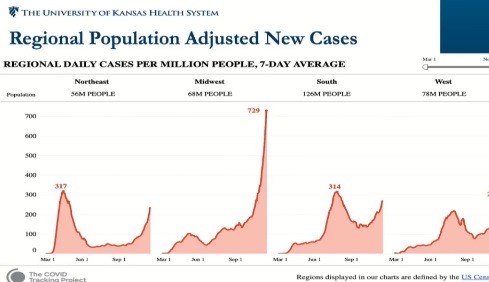
The Midwest is currently a hotspot for COVID-19 in the nation, according to Dr. David Wild of the University of Kansas Health System. He showed this graph from the COVID Tracking Project. (From KU Health System)
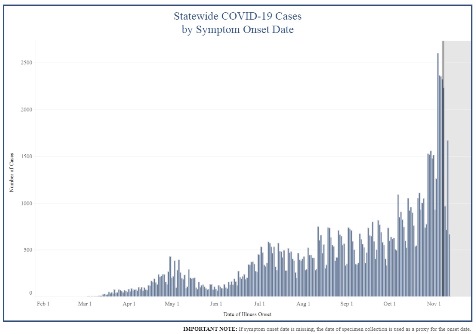
The state of Kansas reported an increase of 5,692 COVID-19 cases on Wednesday, for a cumulative total of 109,225, according to Kansas Department of Health and Environment. There were an additional 34 deaths in the two days. (From KDHE)
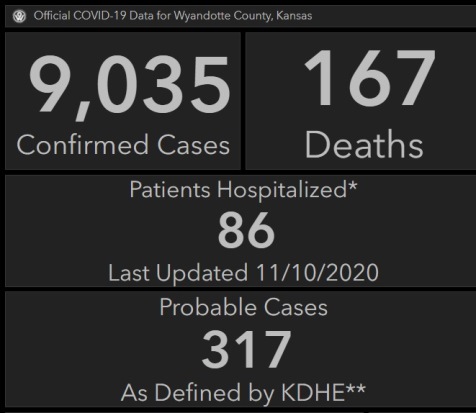
On Wednesday, Wyandotte County reported an additional 71 COVID-19 cases, for a cumulative total of 9,035, according to the Unified Government COVID-19 webpage. There were no additional deaths, for a cumulative total of 167. (From UG COVID-19 website)

COVID-19 cases and COVID-19 hospitalizations continued to rise on Wednesday.

According to Dr. David Wild, vice president of performance improvement at the University of Kansas Health System, the Midwest currently has the highest COVID-19 rates in the nation. The Midwest has an average of 729 new cases per million daily.

And COVID-19 hospitalizations at the KU Health System and other hospitals in the Kansas City area are increasing, he said.

“All of the things that we said could happen, and if they happened would scare us in March and April, are happening now,” Dr. Wild said.

Dr. Wild said the seven-day average of new cases in the Kansas City metropolitan area also continues to rise. Increased hospitalizations usually follow case rate increases, after some days or weeks.

Currently, people who have COVID-19 in the Kansas City metropolitan area are infecting one to two others, he said. In other areas of the Midwest, an infected person is infecting three to four others, he said.

“We’re on our way to that unless we change,” he said.

“We continue to ask each of you to make a difference if you can,” Dr. Wild said.

People have reduced the spread of COVID-19 before and they can help reduce the spread of COVID-19 again, he said.

Dr. Wild said there is some data that more transmission of the virus is occurring at restaurants, bars and gyms nationally, as well as family gatherings, or gatherings in homes of 10 to 40 people.

At some of these places, people are not wearing masks.

The CDC recently recommended celebrating Thanksgiving only with people in their bubble.

Dr. Dana Hawkinson, medical director of infection prevention and control, said the CDC is saying that because they know there is so much spread in the community.

In answering a question, Dr. Hawkinson said caution was needed at any Thanksgiving gatherings. One person wanted to know if it would be safe for their relatives to come over, since the relatives all tested positive in October for COVID-19. Dr. Hawkinson said it might still be possible for them to be a coronavirus carrier.

Also during the Wednesday KU Health System news conference, Dr. John Alley, a KU Health System surgeon who is a major in the Army Medical Corps, discussed working with the Kansas National Guard. Among their tasks was delivering more than 8 million meals throughout the state,he said.

Justin Hoover, founder of The Battle Within, described how COVID-19 has affected veterans, who are reaching out for more medical and mental health services. His organization now offers services to first responders and front-line medical workers, along with veterans.

Craig Crumpton, a firefighter who has gone through The Battle Within program, talked about having COVID-19. He said he liked the way people hold each other accountable in The Battle Within.

He suggested that people could connect with elderly veterans and friends who are in nursing homes through technology, such as video connections on social media. Others on the program encouraged letter writing and other ways of keeping in communication.

Dr. Hawkinson reported 78 active COVID-19 patients at KU Health System on Wednesday morning, an increase from 72 on Tuesday. It is a record high for the hospital. There were 22 patients in the intensive care unit, a decrease from 25 on Tuesday, and 14 patients on ventilators, a decrease from 16 on Tuesday.

There were an additional 36 COVID-19 patients still in the hospital in the recovery phase. The total number of COVID-19 patients was 114 on Wednesday, an increase from 108 on Tuesday.

HaysMed reported 21 total COVID-19 patients, an increase from 16 on Tuesday, and two of those patients were in the recovery phase.

On Wednesday, Wyandotte County reported an additional 71 COVID-19 cases, for a cumulative total of 9,035, according to the Unified Government COVID-19 webpage. There were no additional deaths, for a cumulative total of 167.

The state of Kansas reported an increase of 5,692 COVID-19 cases on Wednesday, for a cumulative total of 109,225, according to Kansas Department of Health and Environment. There were an additional 34 deaths in the two days.

The Greater Kansas City area, including nine counties, reported 66,174 total cumulative cases on Wednesday, according to MARC’s regional COVID-19 hub. It was an increase of 855 cases since Tuesday.

The average number of COVID-19 patients in hospitals in the nine-county metro area was 617 on Wednesday, an increase of 142 since last week, according to the MARC regional COVID-19 resource hub.

Free COVID-19 testing available on Thursday

A free COVID-19 pop-up test will continue from 4 to 6 p.m. Thursday, Nov. 12, at Vibrant Health Argentine location, 1428 S. 32nd St., Kansas City, Kansas.
The pop-up test is through Vibrant Health and the Wyandotte County Health Equity Task Force.

UG Health Department COVID-19 tests will be available on Thursday at 7836 State Ave.


The Unified Government Health Department has moved its COVID-19 testing from the 6th and Ann location to the former Kmart at 78th and State Avenue in Kansas City, Kansas. The hours are 9 a.m. to 3 p.m. Monday through Friday.
Tests are free for those who live or work in Wyandotte County. The tests are now saliva COVID-19 tests.


The tests now are open to asymptomatic people as well as those who have symptoms or have been exposed to COVID-19. Check with the UG Health Department’s Facebook page to see if there have been any changes in the schedule. Bring something that shows that you live or work in Wyandotte County, such as a utility bill.

For more information about the new testing site at the former Kmart location, visit https://alpha.wycokck.org/files/assets/public/health/documents/covid/10092020_newtestingsitewyco.pdf.

The KU doctors’ news conference is online at https://www.facebook.com/kuhospital/videos/406349237121276.

The UG COVID-19 webpage is at https://alpha.wycokck.org/Coronavirus-COVID-19-Information.

The KDHE’s COVID-19 webpage is at https://www.coronavirus.kdheks.gov/.

The KC Region COVID-19 Hub dashboard is at https://marc2.org/covidhub/.

The CDC’s COVID-19 webpage is at https://www.cdc.gov/coronavirus/2019-nCoV/index.html.