Free COVID-19 testing, free flu shots and a free turkey or chicken with the flu shot or test are available from 10 a.m. to noon Saturday, Nov. 14, at Oak Ridge Baptist Church, 9301 Parallel Parkway, Kansas City, Kansas.
According to a note on the Unified Government Health Department’s social media page, the tests and flu shots are free to all Wyandotte County residents and no appointment is needed.
The flu vaccines are available for those who are 4 to 64 years old.
COVID-19 tests are available to those with or without symptoms or exposure.
The turkeys or chickens will be available while supplies last.
The event is sponsored by the Wyandotte County Health Equity Task Force.
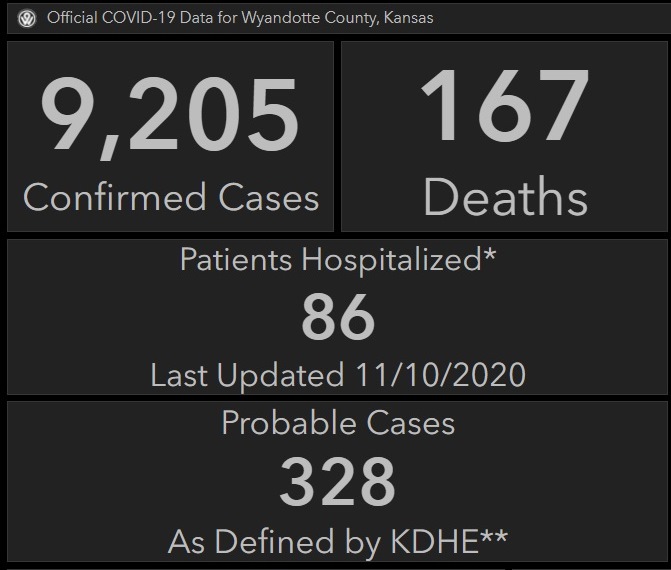
Available beds in the Kansas City metropolitan area are nearing capacity, according to local hospital medical officers. Twelve hospitals reported on Nov. 8 that there were only around 95 beds open. There were 434 beds filled by COVID-19 patients and 1,725 beds filled by non-COVID-19 patients. (Graph presented by University of Kansas Health System)On Friday, Wyandotte County reported 9,205 cumulative COVID-19 cases, an increase of 81 cases since Thursday. There were no increases in the death total, which remains at 167. (From UG COVID-19 website)
A new joint statement by Kansas City area public health directors recommending stricture measures to fight COVID-19 found support this afternoon from a group of chief medical officers of the metropolitan area’s largest hospitals.
The public health directors in the Kansas City area, including Wyandotte County, issued a joint statement on Friday with recommendations the community should take to fight the spread of COVID-19.
“COVID-19 is surging in the KC metro area,” the public health directors stated. “Along with a substantial increase in cases, there is an increased demand for testing resulting in a lag in testing turn-around time, and a strain on our public health contact tracing abilities.”
The public health directors also cited the increased hospitalization numbers, with a shortage of bed space and a shortage of health care workers in the metropolitan area.
“Hospitals have made it very clear that they need the assistance of everyone in every community to reduce the spread of the disease and improve their ability to provide life-saving medical care,” the public health directors stated in a news release.
Among the recommendations are to limit social and in-person gatherings to further reduce community spread, to continue mask wearing, to limit outdoor and indoor entertainment, to limit the number of those attending recreational and youth sports events, to require businesses and organization to enforce the 6-foot spacing in public spaces, and to require bars and restaurants to close by 10 p.m. or implement greater requirements for occupancy limits.
While local officials may be looking at implementing these suggestions in the next few days and weeks, the area public health directors urged individuals to take steps immediately themselves to reduce spread of the disease.
The steps recommended for individuals:
• Avoid in-person interactions. If you can work from home, do so. If you can conduct business virtually, do so. If you can provide curbside service to keep customers from gathering inside, do so. Remember, the safest place to stay is your home.
• Wear masks everywhere, except with your immediate household. It doesn’t matter how much you trust your friends. This is not a trust issue. It’s a kindness and safety issue.
• Avoid gatherings over 10 people. To help our residents stay connected while limiting the threat of large outbreaks, we ask everyone to identify a small group — under 10 people — that you come in regular contact with. That could be your family or perhaps another household or two that you regularly interact with. It could be close friends or colleagues. We ask that you limit your personal interactions to this group. When you see members of your group, please continue to social distance and wear masks. If any member of your group gets sick or tests positive, that person MUST alert everyone in the group, immediately, so that they can quarantine and get a test. In other words, each group must do its own contact tracing. Why? Because of the extremely high number of new cases, some local health departments must prioritize their contact tracing to focus on the most vulnerable people. That might not be you or your friends.
• Self-quarantine when participating in large gatherings. If you have participated in a gathering such as a wedding, a party or a funeral, or if you have traveled to see others, it is our strong recommendation that you immediately self-quarantine for 14 days. This will limit the risk of transmitting COVID-19 to others. No gatherings are safe. This cannot be emphasized enough. There are not enough protections that can be in place for weddings, services, events, festivals, or a party in your own backyard that will keep people you love safe from COVID-19. We ask that you go virtual with these gatherings, or wait.
• Hands, face, space. Now, more than ever, remember this: hands, face and space. Wash your hands regularly, cover your face with a mask and keep six feet of space between yourself and others.
Taking these steps now would help individuals avoid more drastic measures in the future, according to the public health directors.
Juliann Van Liew, the UG public health director, signed the statement, along with public health directors from Kansas City, Missouri; Johnson County, Kansas; Jackson County, Missouri; Platte County, Missouri; and Clay County, Missouri.
Chief medical officers of some of the largest hospitals in the Greater Kansas City area supported these public health recommendations during a Zoom news conference at 2 p.m. Friday.
Dr. Steve Stites, chief medical officer at the University of Kansas Health System in Kansas City, Kansas, said hospital beds were almost full across the city and KU Health System has started to defer a small number of surgeries.
If COVID-19 numbers continue to climb here, he said the community could end up like El Paso or New York, with high rates of COVID-19, and reduced care because hospitals could be overwhelmed.
He said the community is at a crisis, and how it reacts will define how the region does with the surge in COVID-19.
He also said that there are positive developments, including today the KU Health System received its first shipment of monoclonal antibodies, used to treat outpatients who have COVID-19; and there is good news about COVID-19 vaccine development.
“The battle against COVID will not wait for those things to arrive,” he said. “The crisis is at our doorstep.”
All of the hospital CMOs who participated in the news conference today said they have seen COVID-19 increases in their hospitals, and some of them were close to being full.
The CMOS included Dr. Elizabeth Long, acting chief medical officer, Olathe Medical Center; Dr. Raghu Adiga, chief medical officer, Liberty Hospital; Dr. Larry Botts, chief medical officer, AdventHealth Shawnee Mission; Dr. Peter Holt, vice president for medical affairs, Central Region, St. Luke’s Hospital; Dr. Mark Steele, executive chief clinical officer, Truman Medical Centers; and Dr. James Stewart, chief medical officer, North Kansas City Hospital.
For example, Dr. Larry Botts, AdventHealth Shawnee Mission (the former Shawnee Mission Hospital), said they have the highest number of COVID-19 patients now that they have had through the pandemic. They had 33 COVID-19 patients, with six in the intensive care unit and three on ventilators.
“We’re rapidly approaching our capacity,” he said.
Discussing the recommendation to limit social gatherings to reduce community spread, Dr. Botts said it is most effective to socially distance with masks.
It becomes more and more difficult as the weather gets colder and events move indoors, to do those things. Masking and social distancing will ensure that the virus is not spreading from one person to another, he said.
Dr. Holt of St. Luke’s reported 52 cases at St. Luke’s on the Plaza this morning, with 20 in the ICU. For St. Luke’s system wide, there were 164 COVID-19 patients with 47 in the ICU.
In Olathe, according to Dr. Long, the number of COVID-positive patients has doubled in the last two weeks, and just a few beds are open at this time.
Dr. Stites said COVID-19 can be reduced if people follow the rules of infection control, wear masks, socially distance, avoid groups and wash hands.
The doctors cautioned against casual gatherings at homes. Many people with COVID-19 do not have symptoms, so people should wear masks and socially distance around others who are not already part of their household, according to the doctors.
Dr. Stites and several of the doctors also supported the health officers’ recommendation about limiting hours of bars and restaurants.
“Behavior matters in whatever setting you’re in,” Dr. Stites said. “That’s what’s going to bend the curve.”
KU Health Services reported 70 acute positive COVID-19 patients and 104 total COVID-19 patients at noon Friday, according to Dr. David Wild, vice president, performance improvement. There were 34 COVID-19 patients in the recovery phase.
On Friday, Wyandotte County reported 9,205 cumulative COVID-19 cases, an increase of 81 cases since Thursday. There were no increases in the death total, which remains at 167.
The state of Kansas reported an increase of 6,282 COVID-19 cases from Wednesday to Friday, for a cumulative total of 115,507, according to the Kansas Department of Health and Environment. There were an additional 41 deaths in the two days, for a cumulative total of 1,256.
Providence Medical Center, 8929 Parallel Parkway, has seen some small increases of COVID-19 patients for the past few weeks, and capacity also has been a little tight because of staffing, according to a spokesman.
“We haven’t seen spikes (in COVID-19 patients), just increases of two to three more each week,” said Sam Allred, a spokesman for Providence. He is the regional director of business development, marketing and physician recruitment for Providence Medical Center, which is a member of Prime Healthcare.
He said the hospital is not where it was during the first wave that came through.
“We actually have plenty of bed space,” he said. “What we don’t have, which is just as important, is the staff.”
There have been some staff members out on quarantine, but it hasn’t been a lot of staff members, he added. There also have been some nurses who were set to retire in a year or two and decided to go ahead and retire now, he added.
“What we’re fighting, and we’re trying to recruit more people, is not a physical capacity, but a staff capacity,” he said. “We’re OK, but we’re tight, not because of space, necessarily.”
When the first wave of COVID-19 patients came through in the spring, the hospital converted areas of the hospital to COVID-19 units to increase its capacity, he said.
They could do that again, if necessary, but the challenge would be finding the staffing for it, he added. Available staff members are often in the same hiring pool, with many of the hospitals looking for people to hire.
They’re currently at the point where, if the trend continues, they would have to look at how to deploy staff from other units to keep up with any potential increases in dealing with COVID-19, he said.
They will be watching the data and making determinations week by week, Allred said.
The number of COVID-19 inpatients at Providence changes every day. On Thursday, the number was 13 COVID-19 positive inpatients, with another 13 inpatients who were “persons under investigation,” who may or may not have COVID-19, he said.
There were higher numbers than that in the springtime, during the first wave, Allred said.
Providence took care of some of the patients from Riverbend Post-Acute Rehabilitation Center, where there was an outbreak of over 130 COVID-19 cases and 36 deaths in the spring.
It also has received some of the patients from The Piper Assisted Living facility, on North 113th Terrace, which is listed on the Unified Government’s COVID-19 outbreak map as having had 76 COVID-19 cases and 14 deaths.
Allred said currently, COVID-19 patients aren’t as sick as they were in the first wave, and fewer of them are on ventilators.
While the intensive care unit has had more patients recently, it’s not full, Allred said.
Providence also has had some calls from small hospitals an hour and a half away, but it is not taking a lot of transfer patients, he said. It isn’t because they don’t want them, but it depends on the day and all the variables involved with the patient and what the patient needs. They are taking some transfers, but it is very limited, he added.
So far, they have not had to handle surgeries differently than usual, he said. They have policies and procedures in place to make sure the surgery is needed, to watch the data and to make sure there is enough staff, he said.
“We’re in a much different place with our PPE (personal protective equipment),” he said. With the first wave of patients, some surgeries and procedures were postponed around the nation to conserve gear and equipment.
While they are still conserving PPE, they are doing much better with supplies now, he said. They also obtained more reusable equipment as much as possible.
Allred said they are continuing to watch the COVID-19 numbers, as hospital admissions have increased two or three each week, and hope that they see a valley in the rates again.