
COVID-19 has meant changes for law enforcement

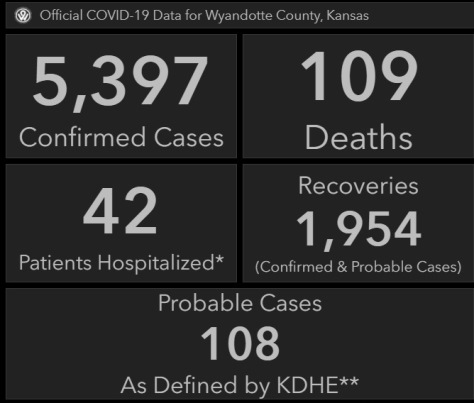
Wyandotte County reported 51 more COVID-19 cases at 4 p.m. Wednesday, a cumulative total of 5,397, according to the Unified Government COVID-19 webpage. There were 109 total deaths reported, an increase of one since Tuesday. The deaths, officials stated last week, are reported after doctors report them, and some may be several days ago. (From UG COVID-19 webpage)

Ron Miller described the changes he has seen in the U.S. Marshal Service since the start of COVID-19.

Miller, the U.S. marshal for Kansas, is a former Kansas City, Kansas, and Topeka police chief. He spoke during a Kansas Department of Health and Environment news conference on Wednesday.

Miller said most of his agency’s work is transporting prisoners to federal courts, protecting the federal judicial process, and sometimes, hunting fugitives who have warrants issued by federal courts.

Since the start of COVID-19, his agency has seen changes in transporting defendants, making sure everyone wears a mask, he said. They also have seen changes to courtrooms, such as Plexiglas barriers, he said.

When they are hunting fugitives and make arrests, sometimes contact occurs between the officer and the fugitive, and there are potential COVID-19 exposure opportunities, he said.

They try to give the deputies personal protective equipment, according to Miller, and they wear the equipment until the person is under control, then take off the PPE after they drop off the defendant at a jail.

It’s complex, trying to protect individuals, defendants, arrestees, law enforcement officers and the community at the same time, he said.

In many cases, it’s personal interaction with people who don’t always take COVID-19 seriously.

“They may not buy into it, they may think it’s some kind of conspiracy, they may just not care. It’s a problem for the officers and it could be a problem for the arrestees,” he said.

Miller said some U.S. marshals were deployed to Portland, Oregon, to protect the federal courthouse there.

“That’s an anomaly,” he said, adding they don’t usually get sent to that sort of situation.

Every county in the state has to deal with the same issues, inmate populations, and the marshals service is just a partner in the process, he said.

Miller said it’s a toug time in law enforcement right now. The pandemic is just another challenge to the profession, he said.

He asked residents and communities to continue supporting law enforcement.

Dr. Lee Norman, Kansas secretary of health, said the Kansas Department of Health and Environment has worked with local, state and federal correctional facilities. There have been some COVID-19 cases in corrections facilities.

There were nine active clusters in correctional facilities on Wednesday, according to Dr. Norman.

Also, there were five active clusters in colleges and universities on Wednesday, a new category in the KDHE cluster list, he said. It’s likely the students brought COVID-19 with them, he said, as most students have not been on campus very long.

Kansas reported an increase of 723 COVID-19 cases since Monday and six new deaths, according to Dr. Norman. There was a cumulative total of 35,890 cases from 103 counties with a total of 411 deaths on Wednesday morning.

Wyandotte County reported 51 more COVID-19 cases at 4 p.m. Wednesday, a cumulative total of 5,397, according to the Unified Government COVID-19 webpage. There were 109 total deaths reported, an increase of one since Tuesday. The deaths, officials stated last week, are reported after doctors report them, and some may be several days ago.

At the University of Kansas Health System, there were 23 COVID-19 patients in the hospital on Wednesday morning, compared to 25 on Tuesday, according to Dr. Dana Hawkinson, medical director of infection prevention and control at the health center. Seven patients were in the intensive care unit, down from 10 on Tuesday, and three were on ventilators, down from six on Tuesday. Another 23 patients in the hospital who had COVID-19 are not included in the count, as they are past the infectious stage.

Some students eager to return to school

The KU doctors’ news conference heard from a college student who was returning to college after having had COVID-19. She advised students to take COVID-19 seriously, socially distance and wear a mask. After not being in classes for seven months, everyone is eager to go back to school, she said.

Dr. Stephen Lauer, a pediatrician, said they have seen anxiety, depression and suicide among youth who have been away from school for several months. He was worried about the long-term effects and educational challenges of missing school. Some students could be a year behind their normal schooling.

According to Dr. Lauer, it is up to each family to make the decision that’s right for them about in-person or online classes.

Students are getting caught up on their vaccinations and back-to-school medical visits, he said. He encouraged everyone to get a flu shot.

Free testing offered

Free COVID-19 testing is planned from 10 a.m. to 1 p.m. Thursday, Aug. 20, at the Holy Name of Jesus Catholic Church, 16 S. Iowa St., Kansas City, Kansas, through Swope Health and the Health Equity Task Force.

Another pop-up testing site is from 5 p.m. to 7 p.m. Thursday, Aug. 20, at the Eighth Street Baptist Church, 1420 N. 8th St., Kansas City, Kansas, through Vibrant Health and the Health Equity Task Force.

Free testing also is offered from 9 a.m. to 3 p.m. Monday through Friday at the Unified Government Health Department parking lot at 6th and Ann, Kansas City, Kansas. For more information, call 311.


For more information on who may be tested and what to bring, visit https://wyandotte-county-covid-19-hub-unifiedgov.hub.arcgis.com/pages/what-to-do-if-you-think-you-have-covid-19.

The KDHE news conference is online at https://www.facebook.com/KDHEnews/videos/2680082192274634.

The KU doctors’ news conference is online at https://www.facebook.com/kuhospital.

The UG Health Department sports order is online at https://alpha.wycokck.org/files/assets/public/health/documents/covid/08132020localhealthofficerorderregardingsports.pdf.


The Wyandotte County school start order is online at https://alpha.wycokck.org/Coronavirus-COVID-19-Information.


Wyandotte County is under a mandatory mask order and is in Phase 3 of the state’s reopening plan. For more information, residents may visit the UG COVID-19 website at https://alpha.wycokck.org/Coronavirus-COVID-19-Information or call 311 for more information.


The CDC’s COVID-19 web page is at https://www.cdc.gov/coronavirus/2019-nCoV/index.html.

Applications open for $130 million in grants to businesses

Gov. Laura Kelly today encouraged Kansas businesses to participate in the application process for more than $130 million in grants to support businesses affected by the pandemic and enable companies to expand broadband access in the state. The portal to apply opened at noon Wednesday, Aug. 19.

Businesses and organizations will be able to apply for the Kansas SPARK economic development and broadband grants at kansascommerce.gov/covidrelief, according to a news release

More than $130 million in grants will be available to help those who were affected by the pandemic and for companies to expand broadband across the state, according to the news release. These federal funds were given to the state to address needs from COVID-19.

Information on SPARK economic development and connectivity grant programs can now be found online at kansascommerce.gov/covidrelief. Grant applications will be accepted beginning at noon Wednesday, Aug. 19, 2020.

Gov. Kelly encouraged business owner to apply early if the are eligible.

In addition to providing financial relief, grants will be available to businesses whose products and services will be needed in greater volume to help combat the virus and its effects. Funding is also being made available to expand broadband access both through infrastructure improvements and by partnerships with internet service providers to serve low-income households. These grants are funded through the Coronavirus Relief Fund of the federal CARES Act.

This pandemic has affected each sector differently, with industries having very different needs from one another. With this in mind, applications for grants are being made available in these categories:

• Small Business Working Capital Grants
Kansas businesses with fewer than 500 employees are eligible to apply for Small Business Working Capital grants. Funds can be used to pay working capital expenses such as payroll, rent, mortgage insurance, utilities, inventory, and more. Grants will be awarded on a rolling basis until funds are depleted.

• Securing Local Food Systems Grants
The Securing Local Food Systems grant program was created to support Kansas meat processing facilities, food processors, grocers, and food banks to address food for human consumption supply chain disruptions as a result of the COVID-19 public health emergency.

• PPE Procurement Grants
The PPE Procurement grant program will award businesses funds for the purchase of personal protective equipment (PPE), implementation of workplace redesigns, additional signage, new technology solutions for distance working, and other items to comply with COVID-19 public health guidelines on safely returning employees to work.

• PPE Manufacturing Grants
PPE Manufacturing grants will provide funding to manufacturers to reimburse certain costs to manufacture critically needed PPE. The grant funding will assist entities with creating new businesses while contributing to the fight against the current COVID-19 public health emergency.

• COVID-19 Bioscience Product Development Acceleration Grants
Kansas has a strong pipeline of bioscience-related companies developing SARS-CoV-2 diagnostic, therapeutic, and medical countermeasures. This grant program will accelerate commercialization and go-to-market strategies, allowing these Kansas companies to quickly deploy novel technology by optimizing value and reducing risk through informed decision making.

• Connectivity Emergency Response Grants
The Connectivity Emergency Response Grant (CERG) was created to address the increased need for connectivity in Kansas in response to the COVID-19 pandemic. Proposed projects should improve connectivity to unserved and underserved areas of Kansas to address the needs of telework, telehealth, distance learning, and other remote business services.

• Broadband Partnership Adoption Grants
The Broadband Partnership Adoption Grant will provide support for low-income households by partnering with ISPs to leverage their existing adoption infrastructure and assure connectivity to as many Kansans as possible.

• IT, Cybersecurity and IT Project Management Certification Training Grants
To mitigate the job losses in Kansas as a result of COVID-19, the Kansas Department of Commerce is seeking a rapid response training program that will provide training, certificate testing, and job placement assistance in the areas of IT, cybersecurity, and IT project management.

• Kansas Tech College Advanced Manufacturing Grants
This program will support the needs of the advanced manufacturing industry in Kansas. The program will focus on reskilling and upskilling individuals affected by COVID-19 to meet economic sector needs in high-demand, high-wage occupations.

Details on each category, including award amounts, proposal requirements, eligibility and more can be found at kansascommerce.gov/covidrelief.

Kansas teachers could owe their schools thousands if they quit over coronavirus concerns

by Stephan Bisaha

Wichita, Kansas — Kansas teachers who don’t feel safe going back to crowded hallways as schools reopen could take medical leave or teach online. But at the many districts that don’t have those options, teachers eye another choice: quitting.

Resigning would mean more than losing steady paychecks during a recession and insurance during a pandemic. Teachers that leave now must pay their districts thousands of dollars.

Most Kansas public teachers must retire or resign early in the summer or pay their school district to find a replacement. Unless a district or a teacher says otherwise, contracts roll over into the new year.

It’s usually a routine thing. Notably, the upcoming school year looks much the same when those contracts are signed as when kids return for the fall semester.

But heading back to school seemed a lot safer before the resignation deadlines that came a few months ago. At the deadlines, the coronavirus outbreak appeared nearly under control. Some educators now say it’s unfair to charge teachers for escaping their contracts if they no longer feel safe returning to the classroom. And forcing teachers to pay now could lead to more teachers quitting eventually.

“You can claw back as much money as you want, but if you’re not careful, then what you end up with is a district with no teachers,” said Marcus Baltzell, head of communications for the Kansas National Education Association.

May decision

In May, the worst of the pandemic in Kansas seemed over. The state reported its lowest number of new coronavirus cases in two months and businesses were slowly reopening. Before the end of the month, most Kansas schools required teachers to decide if they were coming back.

Kelly Smith, a special education teacher at Leavenworth High School, felt pretty good about returning. The state still hadn’t released guidelines for what reopening schools should look like, but a task force made up of educators and health officials were working on that.

“I was absolutely confident that with all the contributors that they would come up with the absolute best plan that they could in completely unknown waters,” Smith said.

Today, coronavirus cases have climbed back up. Several counties, like Sedgwick, began ordering bars to close and reinstated gathering size limits. Some educators are now saying reopening schools safely is not possible. Gov. Laura Kelly’s plan to delay reopening schools was overturned by the state school board, making that a local decision.

Smith said she’s now terrified. She would consider quitting, but she’d have to pay her district $2,000 dollars for resigning in August. She said that doesn’t leave her much choice other than going back to work.

“For me, that’s just shy of a month’s paycheck,” Smith said. “That would hurt.”

Penalties for backing out of a contract are meant to help districts find replacements, something that’s much harder the closer it gets to the first day of classes. By then, many teachers have already accepted jobs elsewhere.

Usually, districts ask for around $2,000, depending on how late a teacher leaves. But some schools want more. Emporia Public Schools asks for $5,000 after August. The Syracuse school district near the Colorado border asks for $10,000.

Courts have upheld these clauses, but schools must prove that they’re actually based on the cost of replacing that teacher. It can’t be an arbitrary amount just meant to punish teachers. A rural district like Syracuse can argue that it’s much harder to recruit teachers, so they need more money from a teacher who’s backing out.

Despite the potential of teachers paying thousands of dollars, teachers unions often support these clauses.

Late resignations hurt other teachers who have to pick up the slack — and extra students — until a replacement can be found. That can take a while with the long-standing national teacher shortage. And without these clauses, teachers risk losing their teaching licenses for quitting too close to the start of the school year. The contracts give them a buyout option.

“Honestly, the association sees this as protection for teachers as well,” said Erica Huggard, the president of the Emporia chapter of the National Education Association.

Uncertain year

Teachers still have plenty of questions about how their districts plan on reopening safely, like how mask requirements and daily temperature checks will be enforced.

“Teachers are planners and right now we can’t plan anything,” said Kimberly Howard, president of the United Teachers of Wichita. She said Wichita should let teachers resign without penalty.

Wichita Public Schools said retiring teachers no longer need to pay. But while the district reserves the right to waive the fee on a case-by-case basis, it generally still plans on enforcing the rule.

Other districts have a similar position. They say they’re facing plenty of uncertainty because of the pandemic, making it essential they know how many teachers they’ll have to start the school year.

“It’s one of the most important things that we deal with every year, this year in particular,” said Eryn Wright, executive director of human resources at Salina Public Schools. “Knowing how many teachers we have is fundamental.”

All the unknowns could change whether or not courts enforce the buyout clauses. Indiana University business law professor Julie Manning Magid said many of the contracts were signed nearly a year ago. So much about teaching today has changed since then that courts could decide the contracts are no longer binding.

But the coronavirus could also bolster a school district’s argument that teachers should pay even some of the highest fees. It’s easier to justify those replacement costs because it’s that much harder — and expensive — today to find someone willing to teach in a school building.

“The current pandemic situation and trying to reopen schools is a new wrinkle in a way,” Magid said, “that I’m sure these clauses have never been tested.”

Stephan Bisaha reports on education and young adult life for KMUW and the Kansas News Service. You can follow him on Twitter @stevebisaha.

The Kansas News Service is a collaboration of KCUR, Kansas Public Radio, KMUW and High Plains Public Radio focused on health, the social determinants of health and their connection to public policy. Kansas News Service stories and photos may be republished by news media at no cost with proper attribution and a link to ksnewsservice.org.
See more at https://www.kcur.org/news/2020-08-11/kansas-teachers-could-owe-their-schools-thousands-if-they-quit-over-coronavirus-concerns