Hospital chief medical officers and executives warned today about getting COVID-19 under control in the Greater Kansas City area before it spreads uncontrollably.
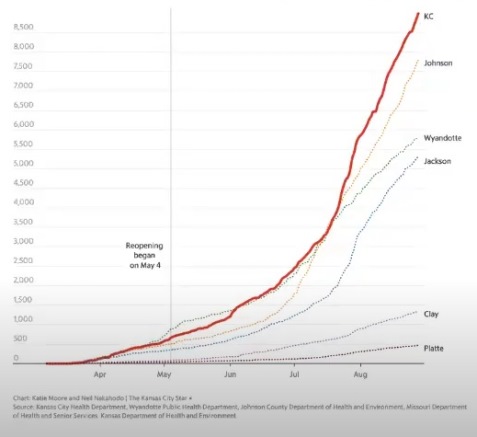
“Disease spread in many of our counties could be days away from becoming uncontainable,” warned one of the slides shown by a University of Kansas Health System executive. Although there were some signs of case growth slowing, there were concerns about transmission overall, according to the presentation.
Dr. David Wild, vice president of performance improvement at the University of Kansas Health System, said in a video news conference today the number of new COVID-19 patients every day needing hospitalization is higher now than at any point in the pandemic.
In August, they were seeing eight to 11 new patients a day, he said, compared to April, when there was the highest number of patients, when the maximum was six, he said. The numbers are balanced now by discharges, he added.
According to Dr. Wild, there is a narrow window to prevent the hospitals and clinics from becoming overwhelmed. They did a good job earlier of bending and flattening the curve, and they did a good job of it, although it was difficult, he said.
Now, the growth of new cases is approaching exponential, he said, and they are concerned about the effect on hospitals being greater than they could handle.
As growth speeds up, it becomes uncontrollable, and that’s not what anyone wants, he said.
They would have to stop offering non-COVID care to individuals who needcare for other reasons, he said.
He described some cases, including a college athlete with COVID-19 and has significant heart failure as a result of getting COVID-19, he said. Also, a woman college student with COVID-19 had to have a portion of her lung removed, he said. Another COVID-19 patient in her 50s was on the ventilator for more than 40 days, he said. He also described a healthy 60-year-old whose lungs required external ventilation, who did not survive.
He asked everyone to observe the rules of wearing masks and social distancing, to reduce the stress on hospitals.
Dr. Steve Stites, chief medical officer of KU Health, said Dr. Birx shared the message that Kansas and Missouri shouldn’t want to be like Georgia or Florida, but they are headed that way. She said she observed people here were not wearing masks the way they should be, they’re not socially distancing the way they should and group gatherings were way too large, he said. She recommended no more than 10 people in a group, wearing masks and distancing.
Dr. Raghu Adiga, chief medical officer at Liberty Hospital, Liberty, Missouri, said that children age 10 and above seem to be spreading COVID-19 as much as adults. They have seen patients in their 20s and 30s in the hospital, he said. He said people need to support their school authorities that are trying to limit the spread of COVID-19, even when the community they live in has not done so.
Dr. Mark Steele, CEO of Truman Medical Center, said social distancing and mask wearing are the two most important weapons against COVID-19.
Reports are showing that those who wear masks are protected against infection, he said. Currently, COVID-19 patients are taking up a little more than 10 percent of overall bed capacity at Truman, he said. The pandemic has disproportionately affected minority communities, and they are providing education to residents about it, he said. They also have seen some young deaths from COVID-19, one in the 20s and one in the mid-30s, he added.
Dr. James Stewart, chief medical officer of North Kansas City Hospital, said it was important for young adults and others to limit the size of gatherings and practice good hygiene. It keeps themselves and their families safe. He said they had seen a case where a son was infected and both parents were admitted to the hospital, requiring intensive care.
“The risk to family members is real,” he said. “Even if they (younger people) don’t have the disease, their family members can get disease.”
Dr. Jennifer Schrimsher, infectious disease specialist at Lawrence Memorial Hospital, said there were a couple of lessons to be learned from their experience.
They had very few cases for a long time, as people stayed home, practiced measures such as wearing masks and stayed away from others, she said.
Then an influx of people came into the community in a short period of time and they saw a sharp rise. They realized there was a “super-spreader” event related to the bars in town, she said. A mask mandate went into effect and bars were closed shortly afterward, she said.
They saw a rise in case numbers with the return of students to KU, which they expected, he said. All students were tested, and about 2 percent of them were infected as they were returning to Lawrence, she said. As they moved forward, it became more of an incident study, seeing the spread of the disease. They were able to implement testing and tracing, she added. They went to high-risk areas, tested, and got the disease spread under control, she said.
Dr. Stites said the KU campus had a 99 percent compliance rate with wearing masks. If they do it right, they can keep things open, he said.
Dr. Ahmad Batrash, chief of staff of the Kansas City VA Medical Center, said the Kansas City VA’s testing rate for veterans was consistently lower positive rate compared to Kansas and Missouri metrics. The positive rate last week was 6.5 percent for veterans at the Kansas City VA, he said.
Dr. Batrash said they implemented population health measures early,
He also was concerned about COVID-19’s effect on mental health. There have been increases in the numbers of veterans seen for mental health, and an increase in the suicide rate for area veterans, he said. He talked about the need for outreach to veterans through telemedicine and face-to-face efforts, paying special attention to mental health issues.
Dr. Larry Botts, chief medical officer at Advent Health, said the long-term consequences of COVID-19 are troubling. Most patients recover in a number of weeks, but it is unknown how it will affect patients over a period of time, he said.
COVID-19 has affected the lungs, with damage from scar tissue and long-term breathing difficulty, and also can cause lasting damage to the heart muscle, arrhythmia and heart failure, he said. The brain can also be affected, with long-term strokes and seizures, he said. It also affects blood clotting.
One patient with mild symptoms including shortness of breath was found to be positive for COVID-19 and had multiple clots in both lungs, he said. Even those with mild symptoms may develop long-term conditions, he said.
Their greatest concern is that they will experience a surge that overwhelms the health care system, and it reinforces the need to be vigilant, he said.
“If we want to keep our schools open, our businesses open, and economy thriving, we have to have a higher level of community responsibility,” said Dr. Kenny Southwick, executive director, Cooperating School Districts of Greater Kansas City. “Schools will not be able to do it by themselves.”
Joe Reardon, president of the Greater Kansas City Chamber, and a former mayor of Kansas City, Kansas, said the economy in Kansas City was hit hard by the pandemic, declining by 33 percent in the first quarter, with consumer spending falling by 35 percent in the second quarter.
Many businesses are struggling and some are closing, he said. People who are for small businesses, who want schools and businesses to be open and thriving and want the economy to continue to recover, need to take personal responsibility, he said.
That means socially distancing, washing hands frequently and wearing masks when out in the community, he said.
Dr. Kimberly Beatty, chancellor of Metropolitan Community Colleges, said since the beginning, the college has taken responsibility and understands the need to change behavior. They are currently in phase 2 of a four-phase plan that strongly encourages remote work unless the work has to be completed in person, she said. Much work went into developing policies on remote work and developing virtual classes, she said.
She said they were proud of the work that was done early to keep them in the “green zone.”
Dr. Stites said KU Health System typically has 25 to 30 acute COVID-19 patients and also has another 30 or so recovering patients, bringing the total number to about 60. Some rooms have been made private. The net impact has been a reduction of 100 beds because of COVID-19, he said. The 800-bed facility was always full, he said, and they have to still take care of people with baseline diseases. Now they are heading into the fall and winter flu season.
On Wednesday morning, KU Health System saw a drop in the number of COVID-19 patients, according to Dr. Dana Hawkinson, medical director of infection prevention and control at KU Health System. The number was 23 acute COVID-19 patients, down from 27 on Tuesday. There were seven patients in the intensive care unit, an increase of one from Tuesday, and four on ventilators, no change from Tuesday. There were 30 other patients still hospitalized from COVID-19 but considered to be out of the acute phase.
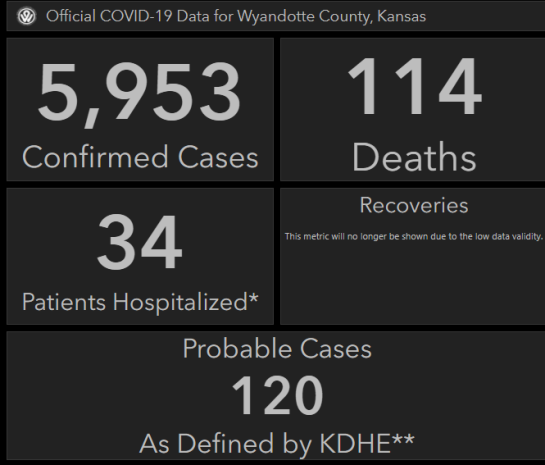
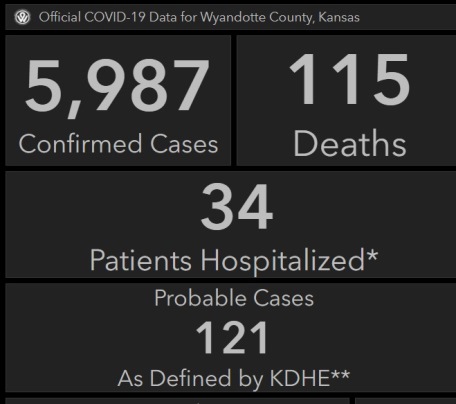
Wyandotte County reported 5,987 total cumulative cases on Wednesday afternoon, an increase of 34 cases since Tuesday, according to the UG COVID-19 website. There were 115 cumulative deaths, an increase of one since Tuesday.
State reports 1,328 new cases, 12 new deaths
The state of Kansas reported 1,328 new COVID-19 cases and 12 new deaths since Wednesday, according to Dr. Lee Norman, Kansas secretary of health. He spoke at a different news conference.
There were 43,940 cumulative cases in Kansas with 458 total deaths.
Dr. Norman reported eight new clusters since Monday, with a total of 178 active clusters in the state.
According to Dr. Norman, Kansas has the sixth highest rate in the nation for new cases, with 152 per 100,000. The U.S. average is 88 cases per 100,000, he said.
Also, Kansas has the 11th highest test positivity rate in the nation, with 9.3 percent, Dr. Norman said.
Kansas is in the “green zone” for testing per capita, at 1,550 per 100,000, he said. That compares to the FEMA HHS region, which is at 1,253, he said.
Dr. Norman said there are now 14 outbreaks and 106 cases associated with sports in Kansas. There are six college teams involving soccer, volleyball and football, he said, and six high school or club teams involving volleyball, football, baseball and basketball.
Two outbreaks were associated with sports camps, including wrestling and volleyball, he said.
Also, there were five outbreaks with 38 cases associated with elementary, junior or senior high schools, Dr. Norman said.
Most cases involved administrative personnel or staff at school meetings prior to school starting, he said. Many schools haven’t started yet.
There was only one positive case affecting a student and 37 were staff or faculty, he said.
There were 20 outbreaks with 250 cases among colleges and universities in Kansas, he said. He expected the number to be higher as more students return to school.
There were 231 cases ages 18 to 23, and 26 cases 24 years old or older, he said.
Dr. Norman said in another week, the KDHE will be listing the names of the group or organization that is having an active outbreak with more than five cases. For businesses, it would be places with more than 20 cases, he said.
Because contact tracing is lagging in some places, this may help let people know where there has been an outbreak, according to Dr. Norman, and it will help keep people safe.
Free testing offered
Free COVID-19 testing is planned from 10 a.m. to 1 p.m. Thursday, Sept. 3, at Quindaro Community Center, 2726 Brown Ave., Kansas City, Kansas.
Another pop-up test will be held from 5 to 7 p.m. Thursday, Sept. 3, at Vibrant Health Argentine, 1428 S. 32nd, Kansas City, Kansas.
The Quindaro test is through Swope Health and the Wyandotte County Health Equity Task Force, and the Vibrant Health Argentine test is through Vibrant Health and the Wyandotte County Health Equity Task Force.
Free testing also is offered for those who live and work in Wyandotte County from 9 a.m. to 3 p.m. Monday through Friday at the Unified Government Health Department parking lot at 6th and Ann, Kansas City, Kansas. For more information, call 311.
For more information on who may be tested and what to bring, visit https://wyandotte-county-covid-19-hub-unifiedgov.hub.arcgis.com/pages/what-to-do-if-you-think-you-have-covid-19.
The Greater KC Chamber and hospital medical officers news conference is at https://www.youtube.com/watch?v=hNTNcHbjoB8&feature=youtu.be.
The KDHE news conference is at https://www.facebook.com/KDHEnews/videos/2609320115952111.
To see the KU doctors’ news conference, visit https://www.facebook.com/kuhospital/videos/3295378953833111
The UG COVID-19 webpage is at https://alpha.wycokck.org/Coronavirus-COVID-19-Information.
The KC Region COVID-19 Hub dashboard is at http://marc-gis.maps.arcgis.com/apps/opsdashboard/index.html#/1c93961075454558b3bf0dfad014feae.
The Unified Government Health Department is collecting input on people’s experiences getting tested for COVID-19 in Wyandotte County. The survey is on the UG website at https://us.openforms.com/Form/ea97a450-3d74-4d86-8d1f-6e340d55cf7c.
The UG Health Department sports order is online at https://alpha.wycokck.org/files/assets/public/health/documents/covid/08132020localhealthofficerorderregardingsports.pdf.
The Wyandotte County school start order is online at https://alpha.wycokck.org/Coronavirus-COVID-19-Information.
Wyandotte County is under a mandatory mask order and is in Phase 3 of the state’s reopening plan. For more information, residents may visit the UG COVID-19 website at https://alpha.wycokck.org/Coronavirus-COVID-19-Information or call 311 for more information.
The CDC’s COVID-19 web page is at https://www.cdc.gov/coronavirus/2019-nCoV/index.html.