
UG Commission extends emergency until December because of COVID-19

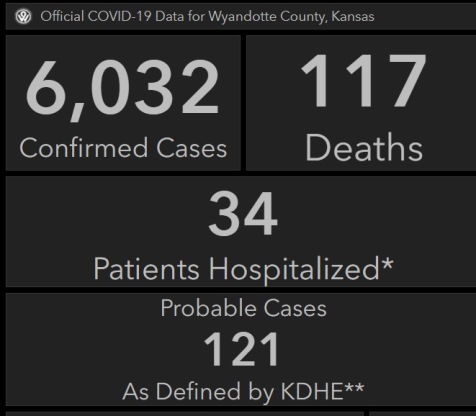
Wyandotte County on Thursday reported 6,032 cases of COVID-19, an increase of 95 cases since Wednesday, according to the UG COVID-19 website. There were 117 cumulative deaths reported, an increase of two deaths since Wednesday. (From UG COVID-19 website)

The Unified Government Commission on Thursday night extended the state of the local health emergency until Dec. 14.

There was little discussion at the meeting about extending the state of emergency.

UG Attorney Ken Moore explained that the state of emergency was originally issued in March, and was then extended from July to September. It expires Sept. 15, and the next meeting is Sept. 17. It was added to the Sept. 3 agenda at the last minute, as they did not want to lose funding, according to Moore.

The commission met in person at the fifth floor of City Hall, socially distancing and wearing masks, for less than 10 minutes at the 7 p.m. meeting. Some persons were participating by Zoom or phone. The commission also met in a closed executive session on labor and litigation at 5 p.m.

The commission approved all the items previously on the agenda with one vote. Some grant approvals included state health funding for staffing and infrastructure support and funding for expanded testing for COVID-19. Also approved was an application for a federal grant for police funding, including a comfort canine program and officer protective equipment.

COVID-19 cases increase by 95 in Wyandotte County

Wyandotte County on Thursday reported 6,032 cases of COVID-19, an increase of 95 cases since Wednesday, according to the UG COVID-19 website. There were 117 cumulative deaths reported, an increase of two deaths since Wednesday.

At the University of Kansas Health System in Kansas City, Kansas, Dr. Dana Hawkinson, medical director of infection prevention and control, said there were 23 acute COVID-19 patients hospitalized on Thursday, the same number as Wednesday. There were six patients in the intensive care, down from seven on Wednesday, with three on ventilators, down from four on Wednesday. Five other patients were also on ventilators, but were no longer in the acute infection phase.

New app can screen students, trace cases

At the KU Health System doctors’ news conference on Thursday, Brian McClendon explained how the CVKey app was designed for KU students.

Students and others on the KU campus answer a series of questions each day on the app on their phones, and then the app generates a QR code that will allow the person to enter a building on campus.

According to McClendon, a former Google vice president who also has served as a research professor in electrical engineering and computer science at KU, the app will tell people what to do if they have symptoms. That information can be entered into it by staff at the local student health center.

Technology now exists so people could be notified if they have been close to a person who is positive, according to McClendon.

McClendon also talked about the possibility of still needing to socially distance and wear masks, even after a vaccine comes out. There was discussion of a vaccine coming out in October. If the new vaccine is 50 or 70 percent effective, it doesn’t allow people to change their behavior, McClendon said. It reduces the chance of catching COVID-19, but does not negate it, he said.

Free testing offered

Free testing is offered for those who live and work in Wyandotte County from 9 a.m. to 3 p.m. Monday through Friday at the Unified Government Health Department parking lot at 6th and Ann, Kansas City, Kansas. For more information, call 311.


For more information on who may be tested and what to bring, visit https://wyandotte-county-covid-19-hub-unifiedgov.hub.arcgis.com/pages/what-to-do-if-you-think-you-have-covid-19.

Local health officials announced that anyone with symptoms and those who have been exposed to infected persons should get tested.

“Science demonstrates that people infected with COVID-19 can spread the virus to family, friends and members of their community, even if they show no symptoms,” said Juliann Van Liew, director of the Unified Government Health Department. “In order to control the pandemic, it’s incredibly important that we provide testing for everyone who has been exposed and those considered at risk,” Van Liew said in a news release.

Local health departments determined that testing criteria for COVID-19 across the metro will remain the same, despite recent changes to national testing guidance. Last week, the Centers for Disease Control and Prevention (CDC) modified its coronavirus testing guidelines to exclude people who are asymptomatic.

The incubation period for the virus that causes COVID-19 is between 2-14 days. If you get tested too early after exposure, it’s possible you could get a false-negative test. Based on the latest data, local public health experts advise people who have been exposed to COVID-19 to:


• Check with your local health department for their recommendations on when to get tested.
• Self-quarantine for 14 days after exposure, even if you test negative, as it can take that long for symptoms to appear.


To help reduce the spread, health experts also encourage everyone to protect others by practicing social distancing, washing hands often, staying at home if you are sick, wearing a cloth face mask and frequently cleaning high-touch surfaces.

To see the KU doctors’ news conference, visit https://www.facebook.com/kuhospital/videos/229606908493837.

The UG COVID-19 webpage is at https://alpha.wycokck.org/Coronavirus-COVID-19-Information.


The KC Region COVID-19 Hub dashboard is at http://marc-gis.maps.arcgis.com/apps/opsdashboard/index.html#/1c93961075454558b3bf0dfad014feae.

The Unified Government Health Department is collecting input on people’s experiences getting tested for COVID-19 in Wyandotte County. The survey is on the UG website at https://us.openforms.com/Form/ea97a450-3d74-4d86-8d1f-6e340d55cf7c.


The UG Health Department sports order is online at https://alpha.wycokck.org/files/assets/public/health/documents/covid/08132020localhealthofficerorderregardingsports.pdf.

The Wyandotte County school start order is online at https://alpha.wycokck.org/Coronavirus-COVID-19-Information.


Wyandotte County is under a mandatory mask order and is in Phase 3 of the state’s reopening plan. For more information, residents may visit the UG COVID-19 website at https://alpha.wycokck.org/Coronavirus-COVID-19-Information or call 311 for more information.


The CDC’s COVID-19 web page is at https://www.cdc.gov/coronavirus/2019-nCoV/index.html.

KCK Animal Services modifying operations because of COVID-19 exposure

The Kansas City, Kansas, Animal Services Department has modified its operations temporarily because of a potential staff exposure to COVID-19.

According to a news release, those who want to pick up, drp off an animal or access other services are being asked to schedule an appointment by leaving a message at 913-321-1440.

An animal services officers then will call back to confirm the appointment. While response times for calls for service may be delayed, animas will remain at the facility, according to the news release.

“Our first priority is always provide a safe, compassionate environment for the animals in our care,” Jennifer Stewart, director, KCK Animal Services, said. “To do that we must preserve the health of our employees. This adjustment is primarily internal as our facility remains closed to the public due to public health guidelines related to COVID-19. We anticipate a return to normal operations sometime next week and appreciate the community’s patience and understanding.”

To learn more about KCK Animal Services or search the adoptable animals, visit http://www.kckpd.org/animal-services.html or visit on Facebook @KCKAnimalServices.

Scathing federal inspection pulls curtain back on one of Kansas’ deadliest coronavirus outbreaks

Weeks into the outbreak at Riverbend in Kansas City, Kansas, inspectors still saw health workers caring for COVID-19 patients without proper protective gear.

by Celia Llopis-Jepsen, Kansas News Service

At a Kansas City, Kansas, nursing home, employees tested positive for COVID-19 and went back to work the next day.

Health workers cared for residents who had tested negative for the virus in the same gowns and masks they’d worn into the rooms of those who’d tested positive.

“I wash my hands,” a nurse told inspectors. “But I wear the samePPE.”

Now the federal inspection that documented those and other risky practices could play into 12 lawsuits brought by families against Riverbend Post-Acute Rehabilitation over the deaths of residents at the nursing home.

Dozens died of the coronavirus at Riverbend — one of the state’s deadliest nursing home outbreaks, a federal database shows.

“This report just confirms the allegations we’ve already made,” said Rachel Stahle, a lawyer representing families in seven of the lawsuits. “It certainly bolsters our position.

”

What the Centers for Medicare and Medicaid Services found at Riverbend, she said, makes clear the home wasn’t taking proper steps to control infections.

“The report is not surprising,” Stahle said. “Nonetheless, it’s still quite shocking. You have numerous employees who (were) working with symptoms.”

Riverbend argued a federal law shields it against the lawsuits, but a federal judge rejected the argument two weeks ago. That cleared the way for the families to proceed in state court in Wyandotte County.

Stahle expects discovery — an evidence-gathering stage — will start within a month.

Riverbend didn’t respond to a request for comment on what appears in the inspection report.

Federal inspection

After scouring Riverbend’s daily logs and interviewing its staff, inspectors concluded the home didn’t take vital steps to protect residents. That made it likely they would get exposed to the coronavirus, “resulting in serious harm or death.”

The inspections took place in late April and early May, when the home had about 90 residents. Inspectors found employees weren’t following key guidelines to curb the virus’ spread— like segregating residents who’d tested positive for the virus from those who hadn’t.

Inspectors saw health workers caring for COVID-19 patients without proper protection. Some were missing gloves. Others lacked eye protection or a mask.

Residents were in “immediate jeopardy,” the inspectors wrote.

That was after the virus made it into Riverbend sometime around late March, and ravaged the place. Already, 32 deaths at the facility had been attributed to it. The home’s management figured the real toll was higher because not everyone who had died had been tested.

Tallies that Riverbend later reported to the federal government say 37 residents died of COVID-19, and more than 60 residents and 30 staff tested positive.

One nurse told inspectors she’d wear a single mask for five days at a time. An aide said the building’s director of nursing told her she didn’t need one to work with coronavirus patients.

That aide ended up contracting the virus. CDC guidelines say nursing home staff should don an N95 mask when caring for anyone suspected of having the virus.

No separation

The federal team also saw COVID-19 patients leaving their rooms and eating in the same common areas that residents who had tested negative were allowed to use.

The home’s managers told inspectors that 21 residents had still tested negative as of early April. But because a large number had tested positive, it was pointless to keep them apart or have staff don fresh protective gear between rooms. They assumed everyone was actually infected.

One resident who was clearly ill was kept with a roommate who seemed healthy. Both ultimately tested positive.

CMS and the Centers for Disease Control and Prevention had already made clear by mid-March that nursing homes had to screen staff for a range of symptoms and tell anyone who was sick to quarantine at home.

Yet day after day, some employees walked into the building without anyone documenting their temperature or other symptoms. Others reported having coughs, shortness of breath or sore throats, then worked anyway.

A nurse and a medication aide both continued working in the days after they got tested and learned they were positive.

The lawsuits against Riverbend accuse it of negligence. They were filed in state court, but Riverbend argued a federal court needed to handle the matter because the Public Readiness and Emergency Preparedness Act shielded them against liability.

The PREP Act protects health care providers during health emergencies like the current pandemic against lawsuits over administering medications and other measures meant to combat a disease.

But Riverbend stands accused of failing to take measures, a federal judge found, so the PREP Act doesn’t apply and the cases will move forward in state court.

Celia Llopis-Jepsen reports on consumer health and education for the Kansas News Service. You can follow her on Twitter @celia_LJ or email her at celia (at) kcur (dot) org. The Kansas News Service is a collaboration of KCUR, Kansas Public Radio, KMUW and High Plains Public Radio focused on health, the social determinants of health and their connection to public policy.

Kansas News Service stories and photos may be republished by news media at no cost with proper attribution and a link to ksnewsservice.org.

See more at https://www.kcur.org/news/2020-09-03/scathing-federal-inspection-pulls-curtain-back-on-one-of-kansas-deadliest-coronavirus-outbreaks.