A COVID-19 outbreak has been traced to the Piper High School homecoming dance on Sept. 18, according to the Unified Government Health Department.
The Health Department stated today on social media that anyone who attended the dance should get tested for COVID-19 as soon as possible and monitor for symptoms. If they develop any symptoms, they should stay home, according to the Health Department.
COVID symptoms can include fever, cough, shortness of breath, congestion, headaches, body aches, chills, fatigue, nausea, vomiting, diarrhea or loss of taste and smell, according to the Health Department. Symptoms may be mild, and even if the symptoms are mild, individuals should stay home and get tested, according to the Health Department.
In a letter to Piper school officials, Juliann van Liew, Health Department director, stated that anyone at the dance should be tested before being allowed to return to school.
A number of Piper High students attended classes while infectious with COVID following the homecoming dance, according to the Health Department letter.
The Health Department recommended that Piper High students and staff continue to monitor for symptoms of COVID and get promptly tested if symptoms develop, according to the letter.
Any students or staff identified as contacts within the classroom setting by the school nurse should get tested five to seven days after exposure and quarantine, according to the Health Department.
The Health Department also recommended that the district have COVID testing readily available to offer students and staff. The KDHE’s statewide testing plan is available to all school districts free.
A nonprofit organization, the Learning Club, is providing tutoring and homework assistance to elementary and middle-school children in Kansas City, Kansas.
As part of the community for almost 20 years, the Learning Club is currently helping local students, especially those who live in public housing areas.
During the past year, students nationally have fallen behind in their academic progress because of the pandemic and virtual learning, according to Sharan Nagra, volunteer coordinator and communications director for the Learning Club.
Especially hard hit during the past year have been minority students, students in poverty and English language learners, especially younger students, she said. Students learning how to read in kindergarten through second grade have experienced the biggest loss nationally.
“The Learning Club is hoping to fill in the gaps and disparities, by providing an after-school program,” she said.
The program sees students twice a week, and they work on their homework during that time, she added. Students read lots of books, helping to increase their fluency and reading comprehension.
The program meets students close to where they live, going to Juniper Gardens, Chalet Manor, St. Margaret apartments, Cyrus K. Holliday apartments and other areas, Nagra said. They also have an in-school reading program, she added.
Currently, about 150 students are in the Learning Club’s after-school program, Nagra said.
Those who work with the students are largely volunteers, and more volunteers are needed, she said.
The program has about 80 high school students who are interns and help tutor the younger children, she said. The high school students also receive help with resume writing, leadership skills and money management skills, she added.
Previous teaching experience is not necessary for the volunteer tutors, she said. They just have to be willing to help kids with homework. Most of the students are in first to fifth grade, with some in sixth and seventh grades, she said.
Volunteers are needed from 4:30 p.m. to 5:30 p.m. for the after-school program and 11:30 a.m. to 1 p.m. for the in-school program, she said.
Students don’t have to pay for tutoring, Nagra said. The Learning Club program is funded through donations and nongovernment grants, she added.
All volunteers are required to have received COVID-19 vaccinations, she said. Everyone has to wear masks during tutoring, she added.
Anyone interested in becoming a volunteer tutor may call Nagra at 913-283-4555.
The Kansas City, Kansas, Public Schools are considering a change to athletic eligibility rules.
The KCK school board discussed the issue on Sept. 20, and is scheduled to consider it at tonight’s meeting starting at 5 p.m.
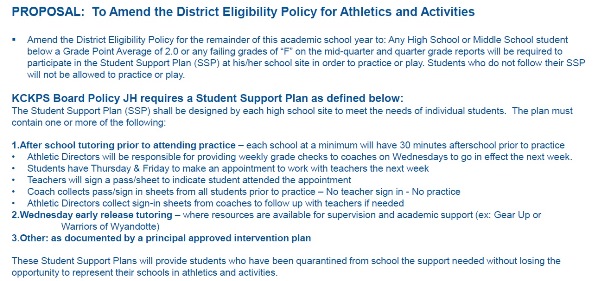
Under the proposed change, any high school or middle school student who has a grade point average below 2.0 (a C average) or any failing grades of F on the mid-quarter and quarter grade reports would be required to participate in a student support plan (SSP) at the student’s school in order to practice or play.
Students who do not follow their SSP would not be allowed to participate, according to the proposed change.
Students would attend after-school tutoring for 30 minutes before attending practice, according to the proposed change. Their grades would be checked each week. Teachers would sign off on a pass to show that the student attended an appointment to work with them. Students who didn’t have the pass could not practice.
Students also would participate in early release tutoring, where resources are available, according to the proposed policy.
According to the new policy, SSPs would provie students who have been quarantined from school the support needed without losing the opportunity to participate in athletics and activities.
Tammie Romstad, district athletic director, said at the Sept. 20 meeting that 70 percent of the lower grades had more to do with not having work turned in. She said they are trying to make arrangements for these students to have a study time before attending practice.
She said the proposal is to design a plan tailored for the student and that helps with their needs.
She said this policy creates urgency with students because they knew they were being held out of practice until they get their schoolwork done.
Wanda Paige, a school board member who is a former teacher, said she was concerned about the policy. She said it’s good to have the SSP, as students need the support, but she has an issue with suspending the current requirement.
“To me, if you don’t have your grades together, you don’t need to be participating,” she said. “I would not let them compete.”
Coaches need to be making sure that the athletes get their work in, according to Paige.
Because colleges don’t let students play unless they are academically where they need to be, Paige said she’s not sure if they’re helping students by changing this policy.
“We may be setting them up for failure,” she said.
Superintendent Anna Stubblefield did not disagree with her, but said the students today may miss practice for a week, not due to anything they did. Sometimes there is a time lag between the time the student turns in the assignment and the time it is recorded. This year, there could be delays in recording the assignments as they were absent from a quarantine.
Dr. Valdenia Winn, a board member, said she did not support suspending the requirement for the building policy because it sends the message that grades are not important and there’s no consequence for making an F or a D.
“Quarantine is not an excuse for lack of performance and responsibility,” she said.
“My generation expected performance,” she said. “They expected you to make the grade before you could go to the dance or student council.”
“We need to maintain high expectations,” Dr. Winn said.
Dr. Stacy Yeager, a board member, said it was important to recognize it’s 2021 and they are in a pandemic. Both teachers and students have been placed on quarantines.
She was in favor of showing support for students and continuing to work toward the goal.
Athletics is a way for students to get out of their situations and go to college, Dr. Yeager said.
It’s important for the board to make a decision to help insure the students can play sports and continue to work on their GPA, she said.
Changes are proposed to the KCK school district’s athletic eligibility rules. (KCK school board agenda documents)