
KCK school board changes policy on masks to individual building rule

The Kansas City, Kansas, school board on Tuesday night adopted a policy that would require masks at a school building if COVID case numbers are over 5 percent at individual school buildings.

The Kansas City, Kansas, Board of Education on Tuesday night, April 26, changed its mask policy, adopting a new policy that would take effect if COVID case numbers are over 5 percent at individual school buildings.

The vote was 4-3 to approve the new policy.

Tiffany Lewis, the district’s director of health services, presented two options to the board.


The first option was to use community levels of COVID-19, and follow the most conservative recommendation from the KDHE, UG Health Department or CDC, based on the latest data.

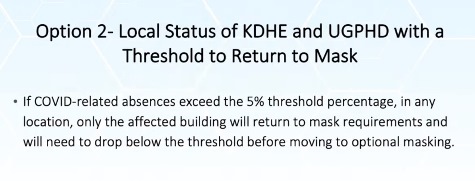
The second option was to look at each building in the district, and if COVID-related absences exceed 5 percent, then the building would return to mask requirements and would need to drop below the threshold before moving to optional masking. The board adopted this option, which would affect only individual buildings and not the entire district.

The motion to adopt the second option was made by Board President Randy Lopez. Voting no were board members Wanda Brownlee Paige, Rachel Russell and Dr. Valdenia Winn.

The school district already tracks COVID numbers in its buildings, according to Lewis, using a software program. When students call in sick, information is transferred to a nurse, who does a follow-up call and determines if it is COVID-related.

Lewis said when they look at data, they usually go with the most conservative approach, and that the board previously has gone with the most conservative recommendation from health offiials.

She said advice from the health experts at the local and state health departments was to provide some way for the district to go back to masking if the situation warranted it in the future.

Yolanda Clark, board vice president, said her yes vote speaks for not only physical, but also mental health and educational health.

Voting no on the issue, Paige said her vote has always been supporting public health.

Russell said her vote was always based on the response of the community.

Dr. Winn said she was concerned that if the district or county is in the “red” zone, at high risk, this doesn’t cross over with option 2. With option 2, if the community is at high risk but the case numbers at the individual school are under 5 percent, then the students and staff would not have to wear masks.

According to district officials, a survey was taken, including responses from parents and staff.

Forty percent favored continuing with the current mask policy; 50 percent were against it; and 10 percent were unsure, according to Lewis.

Forty-one percent of those surveyed were parents or guardians; 50 percent were school district staff; and 11 percent were both parents and district staff.

Lewis said the majority of parents was in favor of changing the mask requirement, while the majority of staff was in favor of keeping the mask requirement.

Last Monday, the board’s older policy, tied to CDC, KDHE and Unified Government Health Department numbers, determined that masks would now be optional in the district’s schools, because Wyandotte County dropped to “low” on the CDC’s county risk map. That change in the procedures was more like option 1, according to Lewis, and option 2 will be entirely new for the district.

COVID case numbers have dropped in Wyandotte County, and COVID hospitalizations also are currently low in the county.

$1.5 million awarded for internet access for students in the 3rd District

Funding awarded to five local schools or districts through the American Rescue Plan

Five school districts in the 3rd Congressional District will receive a grant from the Federal Communication Commission’s Emergency Connectivity Fund program to help students access the internet while attending school from home, according to U.S. Rep. Sharice Davids, D-3rd Dist.

The $1.5 million in federal funding, part of the American Rescue Plan, will help cover costs of laptop and tablet computers, Wi-Fi hotspots, modems, routers and broadband connectivity purchases for students and school staff, according to a spokesman.

The five schools or school districts in the 3rd Congressional District receiving funding include:

• Holy Name of Jesus Catholic School in Kansas City, Kansas: $7,971
• Kansas City, Kansas, Unified School District 500: $846,640
• Olathe Unified School District 233: $155,136
• Piper Unified School District 203: $261,293
• Turner Unified School District 202: $240,000

Rep. Davids, vice chair of the House Transportation and Infrastructure Committee, stated that 173,000 Kansans lack home broadband service and 307,000 don’t have access to reliable internet. In total, Kansas will receive $27,055,209 to help close that digital divide through the ECF program. Rep. Davids was the only member of the Kansas delegation to vote for the American Rescue Plan.

Last summer, Rep. Davids asked schools and libraries to apply for funding from the ECF program.

“Over the past two years, I have heard from many Kansas parents and teachers about children struggling in school due to unreliable or unavailable internet access,” Rep. Davids said. “As our community continues to rebound from the pandemic, and as technology becomes increasingly important to education, we must ensure every student has the tools to succeed. I am proud to have voted for the American Rescue Plan and will continue advocating for our schools and our students.”

“Technology and internet access has become increasingly important in our everyday lives. Lack of high-speed Internet access can negatively impact so many areas of our lives – economic growth, household income, educational performance, healthcare access and employment opportunities. As such, having access to high-speed, reliable internet is key for our students’ success” said Dr. Anna Stubblefield, superintendent for Kansas City, Kansas Public Schools. “The digital divide affects children’s education in ways that extend far beyond the classroom experience. Our students and families are grateful for the additional funding to help ensure they have access to technological devices and internet connectivity that keep them engaged and connected in and out the classroom.”

“The pandemic and subsequent onset of remote learning brought to the forefront what an important and powerful tool up-to-date technology is in the education of our students,” said Dr. Jessica Dain, superintendent of Piper USD 203. “Maintaining the technology needed for our students comes with a large price tag which makes staying up-to-date a financial challenge for a district of our size. We are appreciative of the financial support to ensure that our students have the resources they need to be successful in the classroom.”

“During the pandemic, teachers worked tirelessly to bring outstanding instruction into the home of each child. Providing high-quality devices to each student was a necessary step to ensure that all children had access to the content created by their teachers,” said Dr. Jason Dandoy, superintendent of Turner Unified School District 202. “Going forward, many of these classroom resources will continue to be used to intervene and enrich the educational experiences of our students. Funds provided through the FCC ECF program will allow children to continue to take learning home as a supplement to the brick-and-mortar classroom environment.”

Rep. Davids has been a strong advocate for schools and students during the COVID-19 pandemic, visiting El Centro Academy for Children and Johnson County Community College to highlight American Rescue Plan support. This support included:


• Voting to send $831 million to Kansas schools to help keep schools open safely, keep teachers on payroll, and support students through the pandemic;
• Allocating $325 million for Kansas Higher Education institutions, at least half of which must be distributed to students in the form of emergency grants to prevent hunger, homelessness, and other hardships caused by COVID-19;
• Providing $349 million in supplemental funding for child care in Kansas to help child care providers keep their doors open and reduce costs for struggling families;
• Distributing $8 million in emergency funding for Kansas Head Start to maintain access to services for children and families.

Kansas City, Kansas Public Schools district plans to use this federal funding to purchase 150 MacBook Airs and 200 Wi-Fi Hotspots for school buses.

KCK school board to meet tonight

The Kansas City, Kansas, Board of Education is scheduled to meet at 4:30 p.m. Tuesday, April 26, at the Central Office and Training Center, 2010 N. 59th St., Kansas City, Kansas.

There are many topics on the agenda. The board is scheduled to hear a report about introductory school boundary proposals, and also about the capital improvement plan.

Results of a “ThoughtExchange” survey and the mask policy are on the agenda, also.

To see the entire agenda, visit www.kckps.org and click on “Board Agendas and Minutes.”

The school board also has scheduled a special board meeting at 1 p.m. Wednesday, April 27, at the Central Office.

On the agenda for the special board meeting April 27 are an update on the boiler replacement process; a policy review for the code of conduct; discussion of the 2022-2023 budget; and a board self-evaluation.