
Kansas Regents to universities: Tone down your tuition hikes

by Stephen Koranda, Kansas News Service

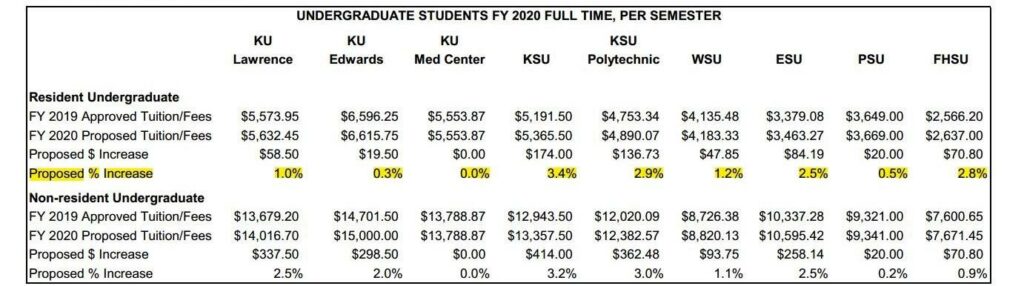
Rethink those planned tuition hikes. That’s the word from the Kansas Board of Regents, which is considering tuition proposalsfrom universities not long after lawmakers approved a state funding boost meant to hold down student costs.

Regent Mark Hutton, a former state representative himself, said lawmakers won’t be happy to see tuition rise after adding around $30 million for higher education in the state budget.

“I think they’re going to feel a little bit betrayed,” Hutton said, “that we didn’t seize an opportunity with the increased funding to channel that toward stabilizing tuition.”

Kansas State University is asking for the biggest increase, 3.1 percent. The University of Kansas is actually proposing to cut tuition at its Edwards satellite campus.

Overall, the hikes are smaller than those seen in recent years when state support was leaner. In past years, some of the increases ranged from 7 to 9 percent.

Of the nine institutions, six of them have proposed cutting tuition, keeping it flat or increasing it by 1 percent.

“I just want to keep it in perspective,” Regent Dave Murfin said. “I’d say there are six institutions that have done an outstanding job.”
Kansas Board of Regents

During recent state budget troubles, higher education experienced some cuts. Lawmakers passed a spending plan this year that would reverse the cuts and add additional funds for targeted programs and aid to the universities. The budget bill has been sent to Gov. Laura Kelly, who hasn’t yet signed it.

Regents Chairman Dennis Mullin said he told lawmakers that if they approved a $50 million increase for higher education then the board would push for flat tuition. Lawmakers were $20 million short of that mark.

But Mullin made clear what he wanted to see the universities propose for tuition hikes: “Zero.”

“I think they have to look seriously at what they’ve offered,” Mullin said in an interview, “and come back and say it’s an absolute necessity or not a necessity.”

He’d like the universities to come back with different proposals before the regents vote on tuition rates next month.

University of Kansas Chancellor Doug Girod has previously noted that higher education has faced rising costs for things such as health care during the years when state funding was tight. So colleges and universities can start catching up, the regents’ initial request to lawmakers this year was a two-year boost of $85 million.

“What they did this session was phenomenal,” Girod said. “But remind them that this was planned to be a stepwise approach.”

Regent Ann Brandau-Murguia signaled her opposition to the proposed tuition increases because of rising costs pricing out students from less affluent families.

“I just see the gap getting wider,” she said. “So, I’m a zero.”

Stephen Koranda is Statehouse reporter for Kansas Public Radio and the Kansas News Service, a collaboration of KCUR, Kansas Public Radio, KMUW and High Plains Public Radio covering health, education and politics. Follow him on Twitter @kprkoranda.
Kansas News Service stories and photos may be republished at no cost with proper attribution and a link to ksnewsservice.org.

See more at https://www.kcur.org/post/kansas-regents-universities-tone-down-your-tuition-hikes

Seven Wyandotte County students on honor rolls at MidAmerica Nazarene University

Seven Wyandotte County students have been named to the honor rolls for the spring 2019 semester at MidAmerica Nazarene University, Olathe, Kansas.

Students on the Dean’s List had a GPA of 3.5 to 3.99 for the semester, while students on the Honor Roll had a GPA of 3.2 to 3.49 for the semester. The students were taking at least 12 semester hours.

On the honor rolls from Wyandotte County:

From Bonner Springs, Kansas:

Isabella Cavanaugh, Dean’s List
Gracie Myers, Dean’s List

From Kansas City, Kansas:

Emilee Brotherton, Honor Roll
Jesse Calderon, Honor Roll
Araceli Hernandez Guerrero, Dean’s List
Lily Ledesma, Honor Roll
Rebecca Viens, Dean’s List

Kansas high schoolers can’t get enough of vaping

by Stephan Bisaha, Kansas News Service

The new reality of smoking at Kansas high schools is visible in the parking lots, where used-up Juul pods have taken the place of cigarette butts.

“You can pick up the discarded Juul cartridges all over the concrete,” Andover High School school resource officer Heath Kintzel said of the popular vaping brand. “It’s everywhere.”

Kansas school officials told the state Board of Education recently that vaping is an increasing epidemic. In 2017, about a third of Kansas high school students tried vaping at least once. Between 2017 and 2018, the number of students vaping increased by 80 percent.

That has educators looking for a solution.

“For me, it was pretty eye-opening in terms of just the amount of vaping that had occurred in a short amount of time,” David Stubblefield, the executive director of school administration for the Blue Valley Unified School District, told the board. “It really exploded exponentially in the last two or three years.”

Vaping — that is, electronic cigarettes — almost always involves nicotine, the same addictive chemical found in traditional cigarettes. It usually involves flavors that would appeal to younger smokers.

Some adults have turned to vaping to quit smoking, though the Food and Drug Administration does not approve e-cigarettes for that use. The Centers for Disease Control acknowledges that while e-cigarettes could help some smokers quit, there isn’t enough research to say how effective they are. There also hasn’t been enough research to fully understand the health consequences associated with vaping, partially because of e-cigarettes’ fast adoption.

Plus, the devices often look like pens and USB drives. Some are built into hoodie strings. They can give off little smoke. This allows them to go unnoticed, especially in schools.

“Unless you physically see a student holding it, using it, blowing the smoke from it, it is really difficult to know when kids are actually using it in a school,” said Andover principal Kristen Kuhlmann.

The main recommendation for combating e-cigarettes: education. The Kansas Department of Health and Environment said students may not know there is nicotine in their e-cigarettes.

The department also recommended lessons for teachers to better identify vaping.

But education officials are bracing themselves for a long campaign against vaping, much like the decades-long process of reducing traditional cigarette use.

“They’ve just burst upon the market,” said Mark Thompson, a consultant on health for the Kansas State Department of Education. “We’re really playing catch-up here.”

Stephan Bisaha reports on education and young adult life for KMUW in Wichita and the Kansas News Service, a collaboration of KMUW, Kansas Public Radio, KCUR and High Plains Public Radio covering health, education and politics. Follow him on @SteveBisaha.
Kansas News Service stories and photos may be republished at no cost with proper attribution and a link to ksnewsservice.org.

See more at https://www.kcur.org/post/move-over-smoking-kansas-high-schoolers-can-t-get-enough-vaping