
Local communities to receive federal stimulus funds

Local communities will receive federal stimulus funds through the state, according to an announcement on Tuesday afternoon.

According to a spokesman for the governor, a state recovery task force reviewed and approved a proposal to distribute $400 million to local governments to help address the health and economic challenges inflicted by COVID-19. The Strengthening People and Revitalizing Kansas (S.P.A.R.K.) task force executive committee met at 2 p.m. Tuesday.

“Over the last few months Kansans have faced unprecedented challenges because of COVID-19,” Gov. Laura Kelly said in a news release. “Through it all, they have shown resiliency and compassion that has served as a strong reminder that we are all in this together.

“Every region of our State has been impacted by the health and economic crisis of this pandemic. We need to provide local governments with all the resources we can to mitigate the virus and revitalize our economy. We want to make these funds available, so communities can address current challenges and jumpstart our economic recovery,” Gov. Kelly said.

This is the first action of the SPARK Taskforce, which is charged with distributing over a billion dollars in federal funds Kansas received under the Coronavirus Aid, Relief and Economic Security (CARES) Act.

“This fair, impactful and timely distribution of funds to county governments will strengthen our health, speed the reopening of our economy and help our state remain open for business,” Cheryl Harrison-Lee, executive director of the Recovery Office, said. “I’m grateful to the Executive Committee members for the swift action they took today and look forward to collaborating with them and the Steering Committee to put the remaining funds to work.”

Harrison-Lee proposed a three-phased approach to allocating the funds. The first round will focus on providing relief to county governments which had not already received funding under the CARES Act. Johnson and Sedgwick counties have already received funds because they have populations over 500,000.

Under the SPARK proposal, each county would receive funds based on the following formula:

• Population: All counties are guaranteed to receive at least $194 per person, according to the spokesman. This is the same amount awarded to Johnson and Sedgwick residents previously.

• Impact Fund: Counties will receive additional dollars based on their COVID-19 case rates and unemployment rates. The purpose of the Impact Fund is to provide additional dollars to those counties hit hardest by the virus. Johnson and Sedgwick counties will receive funds through this fund as well.

Fifty percent of each county’s share will be for reimbursement of COVID-19 related expenses and the remaining 50 percent will be direct aid for eligible expenditures under the CARES Act, according to the spokesman.

To receive funds, counties will be required to pass a resolution affirming they will allocate the funding consistent with the CARES Act and to share and allocate funds to educational and municipal entities within their counties.

Wyandotte County was listed with a population of 165,429 on July 1, 2019, according to U.S. Census estimates. If that figure is used, it would be about $32 million if $194 per person was allocated.

As youth sports starts up, teams and leagues develop new guidelines for practices

Wyandotte County reported a total cumulative 1,375 positive COVID-19 cases at 5 p.m. Tuesday, with 74 deaths and 21 patients hospitalized. (From UG COVID-19 webpage)

High schools in Kansas were allowed to start practices on Monday, and doctors at the University of Kansas Health System on Tuesday said there are new guidelines in place for them and for other young athletes to follow.

Dr. David Smith, medical director of youth sports medicine at the KU Health System, said it was exciting to see youth sports starting again, although he is concerned that they may not be able to keep going if they have an incident occur.

Each organization or league may have its own health guidelines, and the guidelines at the high school level were developed with the assistance of doctors.

Coaches may sometimes know a player’s family situation, but not always, according to the doctors. If a player has a family member at home with an illness such as a heart patient or cancer victim, it could factor into a decision on whether or not the youth should play sports, according to the doctors.

Dr. Smith said he would encourage coaches to talk to players and find out how their families are doing to help them make any decisions about playing. It is a decision that each family will have to make and weigh the risks, according to the doctors.

Dr. Smith offered six health tips for youth sports, including social and physical distancing; increasing hand washing and equipment cleaning; don’t touch – keep your hands away from your face; illness, be aware of it and watch for fever, cough and chills; please cough into your elbow; and stay home if you’re ill.

KSHSAA Executive Director Bill Faflick said best practices start with the equipment, and not sharing it. Young athletes should stay closer to home and go to places where they have good health practices in place. Student athletes should self-report any illnesses and the coach should be ready to deal with it.

If a young team member gets sick with COVID-19 during the practices or season, it could result in other team members being quarantined.

Dr. Hawkinson said most sports, such as baseball and soccer, should be able to physically distance. Football is different, he added. Players probably won’t be wearing a mask while they are active on the field, so it is important to maintain distance from each other.

Being inside a closed space could be the biggest risk factor for some youth, and outdoors is better than indoors, he said.

Faflick said as coaches, they are teaching and modeling for their students, and have a civic responsibility to take care of the greater community. Student athletes have a responsibility at home and in the community, to do the right thing, he said.

Dr. Hawkinson said it was very important for everyone to continue social distancing and hand hygiene, as well as wearing a mask.

Dr. Hawkinson said KU Health System had 17 positive COVID-19 patients on Tuesday, the same number as on Monday. Four of the patients were in the intensive care unit. KU Health System continues to have new admissions as well as recoveries, according to Dr. Hawkinson.

Wyandotte County reported a total cumulative 1,375 positive COVID-19 cases on Tuesday, with 74 deaths and 21 patients hospitalized.

The KU doctors’ news conference is online at https://www.facebook.com/kuhospital/videos/709621863122447/.

The UG’s COVID-19 information page is at https://alpha.wycokck.org/Coronavirus-COVID-19-Information.

Wyandotte County is currently under the state’s Phase 2 plan at covid.ks.gov.


The state plan’s frequently asked questions page is at https://covid.ks.gov/wp-content/uploads/2020/05/Reopening-FAQ_5.19.2020_Final.pdf.

Additional guidelines from the governor’s office about Phase 2 are at https://www.wycokck.org/WycoKCK/media/Health-Department/Documents/Communicable%20Disease/COVID19/AdAstraUpdate519.pdf.

Test sites are listed at https://wyandotte-county-covid-19-hub-unifiedgov.hub.arcgis.com/pages/what-to-do-if-you-think-you-have-covid-19.


The CDC’s COVID-19 web page is at https://www.cdc.gov/coronavirus/2019-nCoV/index.html.

Governor pledges to work toward solutions on racial inequities

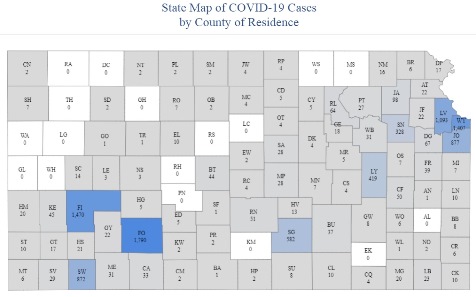
Kansas reported 10,011 cases from 88 counties with 217 deaths on Monday. It was an increase of 292 cases since Friday. There were nine more deaths since Friday. (KDHE map)

Gov. Laura Kelly today pledged to work toward developing a strategy for taking action in Kansas on racial inequities.

“Racial inequality is not new,” Gov. Kelly said at a news conference. “The outrage and protests unleashed across the nation last weekend were not sparked solely by police brutality. Institutional racism exists throughout our society, our economy and our laws.”

She said it was time for elected leaders in Kansas to acknowledge they had failed to give this problem the attention it deserves.

“It’s time that we listen to those voices in our marginalized communities, speak out against injustice, and actively address the roots of these issues in our neighborhoods, our workplaces and in our public institutions,” Gov. Kelly said.

She also said the vast majority of law enforcement officers grieve with them, and they are just as outraged by the shocking tactics used in Minneapolis. She said Kansas law enforcement is ready to work with them to create and implement solutions to make communities safer.

She said she has instructed her team to develop a strategy on how to take action in earnest in Kansas.

“I pledge to Kansans, especially Kansans of color, that I will not allow these injustices to fade into the next media cycle,” she said. “We’re going to have these tough conversations in our state, we’re going to confront these painful issues, and we’re finally going to treat this as if lives depend on it, because they do.”

Also, Gov. Kelly said that on Tuesday, the executive committee of the SPARK recovery task force will meet for the first time. They will outline priorities for the office through the end of 2020.

The task force will review the federal CARES Act, including information on the major sources of funding, federal spending guidelines and additional grant programs with funding opportunities. They will discuss allocations to local governments.

In addition, Gov. Kelly said a special Kansas Legislature session begins Wednesday. Last week she vetoed a bill that would have made changes to the Kansas Emergency Management Act. She said the bill had some sensible parts, but was “laden with problems.”

She said she is more encouraged today that they would sort things out, and there have been good-faith efforts on both sides.

At the news conference, Dr. Lee Norman, Kansas secretary of health, said Kansas passed the 10,000 mark in positive COVID-19 cases.

Kansas reported 10,011 cases from 88 counties with 217 deaths on Monday. It was an increase of 292 cases since Friday. There were nine more deaths since Friday, he said.

“We’re doing well in the state of Kansas,” Dr. Norman said.

Hospitalization and death rate per capita, along with disease spread, have improved.

Thirteen counties are not demonstrating improving trend lines, and the remainder of the counties are improving trend lines, he said.

In four counties with meatpacking plants, the rate of increases are slowing down, he said. Johnson, Wyandotte, Leavenworth and Sedgwick also are on the improving trend line, he said.

It shows if people are attentive, they will show improvement, he added.

Kansas saw its first daycare cluster, in Ford County, he said, where two persons tested positive.

The state has received a third shipment of remdesivir, he said.

Dr. Norman said during the past weekend, 300 tests were done on Lansing Correctional Facility, with a 6 percent positive rate. They were all asymptomatic, he added. Formerly, testing was running more than half positive. He said it shows COVID-19 has been brought under containment there. The case mortality rate is very low, he added.

They are closely monitoring to see any increases in clusters, he said. With parties at the Lake of the Ozarks and other parties, gatherings and protests, they will have to be very vigilant on the spread of COVID-19.

“Stay at home, wear a mask, wash hands often, practice social distancing,” Dr. Norman said.

The governor’s news conference is online at https://www.facebook.com/GovLauraKelly/videos/756923598381378/?v=756923598381378.

The UG’s COVID-19 information page is at https://alpha.wycokck.org/Coronavirus-COVID-19-Information.


Wyandotte County is currently under the state’s Phase 2 plan at covid.ks.gov.

The state plan’s frequently asked questions page is at https://covid.ks.gov/wp-content/uploads/2020/05/Reopening-FAQ_5.19.2020_Final.pdf.


Additional guidelines from the governor’s office about Phase 2 are at https://www.wycokck.org/WycoKCK/media/Health-Department/Documents/Communicable%20Disease/COVID19/AdAstraUpdate519.pdf.


Test sites are listed at https://wyandotte-county-covid-19-hub-unifiedgov.hub.arcgis.com/pages/what-to-do-if-you-think-you-have-covid-19.

The CDC’s COVID-19 web page is at https://www.cdc.gov/coronavirus/2019-nCoV/index.html.