
Governor poised to trade some emergency powers to keep her COVID orders

Gov. Laura Kelly would still be able to unilaterally delay deadlines for things such as filing taxes or renewing drivers licenses, but legislators would need to approve extensions of disaster declarations or new orders.

by Stephen Koranda, Kansas News Service

Topeka, Kansas — A deal forged by the governor and legislative leaders extends the Kansas disaster declaration in response to the coronavirus through September, for now ending what’s become a partisan conflict.

The bill lets Gov. Laura Kelly keep some of her powers to respond to the coronavirus, like delaying deadlines for things such as filing taxes or renewing drivers licenses. The plan gives legislators more control over extending the disaster declaration and reviewing new orders.

“A compromise position. A position that still allows the governor to operate,” Republican Rep. Fred Patton told the House this week. “But we also wanted to have legislative oversight.”

Some Republicans had objected to the Democratic governor closing businesses and banning large gatherings statewide this spring, even though the virus so far hasn’t been widespread in some rural counties.

The bill was passed by the House on Wednesday night, with the Senate following suit Thursday. Kelly is expected to sign the bill, which extends her disaster declaration until Sept. 15 (further extensions are possible) and preserves her executive orders for everything from letting nurses handle more patient care to allowing restaurants to sell alcohol to go.

As the rare special session began, Kelly signaled she’d support the compromise because it provides “the framework our state needs as we continue on the path to recovery.”

“There are parts of this bill that I do not support,” Kelly said in a statement. “However, my priority is and will always be the interests of Kansans first.”

She compromised on her ability to close businesses or ban large gatherings until after Sept. 15. Lawmakers said it will give the governor a chance to respond if cases surge as businesses and other facilities reopen.

“It’s before any potential second wave, we hope, any second wave would come,” Patton said.

Already, Kelly conceded such restrictions to counties last month, turning her reopening plan into recommendations. That came after lawmakers passed a bill restricting her during a nearly 24-hour-long single-day veto session. Kelly vetoed that bill.

Legislative leaders said the new plan was born in a bipartisan meeting that Kelly invited them to after the veto.

“We came to a realization very quickly that our policy differences weren’t that large,” Republican Senate Vice President Jeff Longbine told a Senate committee.

The bill is similar in some ways to the previous plan Kelly vetoed, but gives joint oversight of the $1.25 billion in federal coronavirus response funding. Initially, full authority to spend that money rested with Kelly’s office, and the bill she vetoed would have given authority fully to lawmakers.

Now, a panel made up of the governor and legislative leaders will make final decisions on federal aid. That same panel could approve additional extensions to the disaster declaration, and would need to OK future business closures of more than 15 days.

Kelly was the first governor in the country to close schools statewide for the rest of the academic year to control the spread of the virus. This bill wouldn’t let her do that again without approval of the State Board of Education.

There was some complaint about the process, after the legislation was rushed to the House floor before many lawmakers could study it. In a Senate committee, any amendments were discouraged to speed up approving the plan.

“Everybody wants to go home,” Republican Sen. Dennis Pyle said after he offered an amendment that was rejected. “I’m so sick of hearing that.”

Protections for business and flexibility for counties

How to deal with local governments has been one of the biggest divides between the governor and lawmakers. Kelly’s orders banning large gatherings and closing businesses applied to all counties, which lawmakers tried to take away.

The new bill puts some requirements on local governments that want to sidestep her orders — they can approve rules that are less restrictive than the state, but must consult with the local health officer to make sure restrictions aren’t needed to protect public health in the county.

It also gives Kansas businesses some liability protections if people get sick or if the company sells coronavirus-related protective equipment that turns out to be faulty. There are restrictions, as the protective equipment must have been ordered by the state. Businesses would be protected from claims over coronavirus infections if they’re taking recommended precautions.

The governor’s chief of staff said Kelly supports protections for health care providers so they aren’t liable for things like procedures that had to be delayed because of the coronavirus. Otherwise, Kelly is only accepting the liability protections as part of the compromise.

“This is probably the part of the bill that the governor has the most hesitation over,” Chief of Staff Will Lawrence told a committee.

Democrats in the House called the liability protections unnecessary and unsuccessfully tried to amend them.

Republican Rep. Kellie Warren said businesses need the protection from lawsuits as they reopen.

“If these businesses are exposed to what I would say in some instances would be frivolous lawsuits,” she said, “it’s just the process of defending those lawsuits that will bankrupt our businesses.”

Medicaid and court nominee stumble

While the coronavirus bill was the main focus of the special session, Democrats in the House did make a last-ditch effort to expand Medicaid. They pointed to the spike in unemployment during the pandemic and said expanding health care coverage to thousands more Kansans was critical.

“When they lost their job, they lost their health care,” Democratic Rep. Jim Ward argued on the House floor. “Medicaid expansion would help them.”

As in past attempts, the chamber’s rules blocked the consideration of expansion and there weren’t enough votes to override the rules.

In addition, lawmakers didn’t take any action to tackle a budget deficit next fiscal year topping $600 million. That could mean the governor will make unilateral budget cuts or legislators take on the deficit when they return in January.

In the Senate, lawmakers rejected the governor’s nominee for a seat on the Court of Appeals. Some senators criticized Carl Folsom, an attorney from Lawrence, for spending most of his career as a public defender and questioned whether he’d be fair on the bench.

“The nominee donated to Governor Kelly’s campaign, which is indicative of his political ideology,” Republican Senate President Susan Wagle said.

That drew a sharp response from Kelly, who said senators were rejecting a highly qualified nominee for political reasons.

“The partisanship being inserted into this process is just wrong,” she said, “and it breaks with long-standing Kansas tradition of keeping politics out of the courts.”

Stephen Koranda is the Statehouse reporter for Kansas Public Radio and the Kansas News Service. You can follow him on Twitter @kprkoranda.
The Kansas News Service is a collaboration of KCUR, Kansas Public Radio, KMUW and High Plains Public Radio focused on health, the social determinants of health and their connection to public policy. Kansas News Service stories and photos may be republished by news media at no cost with proper attribution and a link to ksnewsservice.org.

See more at https://www.kcur.org/news/2020-06-04/kansas-governor-poised-to-trade-some-emergency-powers-to-keep-her-covid-orders.
KDHE preparing to use antibody testing for COVID-19 at state labs

Kansas Department of Health and Environment Secretary Lee Norman said the KDHE is now certifying the process to use antibody testing at the state labs.

Before now, antibody tests have not been specific for COVID-19, and the tests formerly gave a positive result for the common cold as well as COVID-19. Dr. Norman made his remarks at a news conference Thursday sponsored by the University of Kansas Health System.

According to Dr. Norman, those who tested positive for COVID-19 antibodies could think they are immune, and he said that has not been proven. He also said the antibody test is not a diagnostic test. He also planned to testify about the importance of contact tracing.

Dr. Rachael Liesman, director of microbiology at the KU Health System, said the health system is about two weeks away from being ready for antibody testing. She said the current PCR, or nasal swab, is still the best way to diagnose COVID-19 and said it’s still to be determined how antibody testing will fit in.

Rick Couldry, vice president of pharmacy and health professions at KU Health System, said he expects antibody testing will be widely available. He didn’t think it’s suited for drive-through testing like the nasal swab, since it will require a finger prick or a blood draw, which is best done in a lab. He also explained how the labs, clinics and the outpatient pharmacy have changed to become much safer for patients.

The University of Kansas Health System on Thursday morning saw a slight decrease in the number of COVID-19 patients, with 13 patients are being treated for the virus, down from 16 Wednesday. There were three COVID-19 patients on ventilators. All patients have been moved to one unit, so there are none in the intensive care unit.

Children not as affected by COVID-19, according to doctors

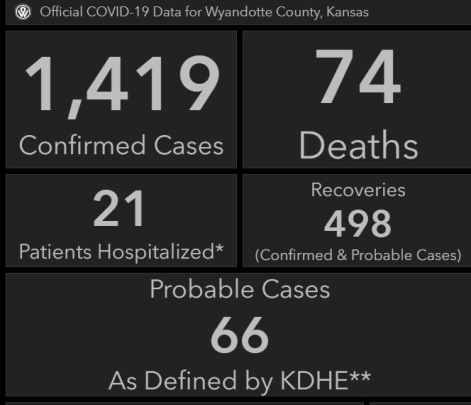
Wyandotte County reported a total cumulative 1,419 positive COVID-19 cases at 4:20 p.m. Wednesday, according to the Unified Government COVID-19 website. Wyandotte County reported a total cumulative 1,419 positive COVID-19 cases at 4:20 p.m. Wednesday, according to the Unified Government COVID-19 website.

Children have not been as affected by COVID-19 as adults, according to doctors at a news conference on Wednesday at the University of Kansas Health System.

However, the doctors still recommended that parents and children continue safe social distancing, practice hand washing and wear masks when out in public if they are over 2 years old.

Wyandotte County reported a total cumulative 1,419 positive COVID-19 cases at 4:20 p.m. Wednesday, according to the Unified Government COVID-19 website. It was an increase of 43 cases since Tuesday evening. There were 74 deaths, the same as the previous day.

Dr. Dana Hawkinson, medical director of infection prevention and control at the University of Kansas Health System, reported 16 positive COVID-19 patients currently in the hospital, down one from Tuesday. Five patients were in the intensive care unit, up from four on Tuesday. No surges or spikes have been reported in the numbers of patients since some large public gatherings were held recently.

The state of Kansas on Wednesday morning reported 10,170 total cumulative positive COVID-19 cases from 89 counties, with 222 deaths, according to figures from the Kansas Department of Health and Environment.

Some other counties’ case counts: Ford County, 1,804 cases; Finney County, 1,478 cases; Leavenworth County, 1,097 cases; Johnson County, 893 cases; Seward County, 885 cases; Sedgwick County, 598 cases; Lyon County, 425 cases; Shawnee County, 336 cases; Jackson County, Kansas, 101 cases; Douglas County, 67 cases; and Riley County, 66 cases.

At a news conference Wednesday sponsored by the University of Kansas Health System, Dr. Robert Lane, executive vice president and physician-in-chief at Children’s Mercy Hospital, said doctors are starting to see more children patients again, through both telemedicine visits and in-person visits. Families reacted positively to telemedicine, he said.

Dr. Stephen Lauer, a pediatrician with the KU Health System, said the telemedicine program at KU Health System is a positive that he would like to continue, along with in-person visits. Patients need to come back into the office, especially to keep up their vaccinations, according to Dr. Lauer.

Dr. Angela Myers, division director for infectious diseases at Children’s Mercy Hospital, said she was taking an in-depth look at the literature and trying to implement lessons learned around the country and the world from the pandemic.

It was reported that Children’s Mercy Hospital earlier had a case of multi-system inflammatory syndrome. Some children with this syndrome have been hospitalized with very severe symptoms. The East Coast has experienced more than 150 cases in children.

Dr. Myers said multi-system inflammatory syndrome, a disease which has stricken some children two to four weeks after they have had COVID-19, has been a rare inflammatory response after infection. A low proportion of COVID-19 patients have had this response.

For the most part, children do not get as sick as adults from the SarsCov2, according to Dr. Myers. Most of those who do get sick, have very mild symptoms. A few will develop more severe symptoms.

Dr. Myers said a recent study has shown that child-to-child transmission is minimal, and also, child-to-adult transmission is minimal. She cited a study of 40 children diagnosed with SarsCov2 from Switzerland in March and April. The study was published in a pediatrics journal. In only a handful of cases did the child develop symptoms first.

“The story continues to evolve as we get more and more data,” she said.

The doctors will be monitoring results of other studies as information becomes available.

Dr. Lane said he was concerned about the effect of social isolation on children’s mental heath.

Dr. Lauer said it would be a huge issue going forward, and that children respond poorly to persistent levels of stress.

Dr. Lane suggested that parents get the children outside to play, to socialize as much as possible and interact, although keeping within the guidelines of social distancing, and with small numbers.

He said families will have to thoughtfully consider how to slowly start to have social interactions again. It is possible that a downside will come with that, as well, he added.

Dr. Lauer said the presence of a consistent caring adult spending time with a child, asking questions and being involved in their life, can make the difference, especially in stressful times.

Dr. Steve Stites, chief medical officer of KU Health System, said health care is safer today than before.

“Your risks are less, we do such a better job at infection control,” he said.

Dr. Lane said everyone at Children’s Mercy who comes to work has been screened every day and their temperatures are documented.

Dr. Myers said they’ve implemented good infection control practices, including cleaning surfaces, screening everyone every day and wearing masks.

Dr. Lauer advised caution in returning to sports and school, as they are learning more every day and it is still a very dangerous situation.

To view the KU doctors’ news conference, visit https://www.facebook.com/kuhospital/videos/291974031835352/.

The UG’s COVID-19 information page is at https://alpha.wycokck.org/Coronavirus-COVID-19-Information.


Wyandotte County is currently under the state’s Phase 2 plan at covid.ks.gov.

The state plan’s frequently asked questions page is at https://covid.ks.gov/wp-content/uploads/2020/05/Reopening-FAQ_5.19.2020_Final.pdf.


Additional guidelines from the governor’s office about Phase 2 are at https://www.wycokck.org/WycoKCK/media/Health-Department/Documents/Communicable%20Disease/COVID19/AdAstraUpdate519.pdf.

Test sites are listed at https://wyandotte-county-covid-19-hub-unifiedgov.hub.arcgis.com/pages/what-to-do-if-you-think-you-have-covid-19.

The CDC’s COVID-19 web page is at https://www.cdc.gov/coronavirus/2019-nCoV/index.html.