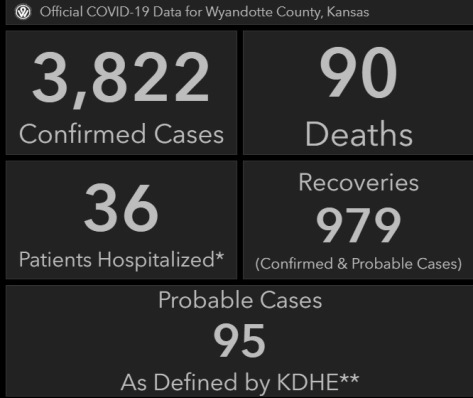
Wyandotte County had 3,822 total cumulative COVID-19 cases at 1 p.m. Wednesday, as compared to 3,750 cases at 1 p.m. Tuesday, an increase of 72 cases since Tuesday, according to the UG’s COVID-19 website. There was one more death since 1 p.m. Tuesday, with the total now at 90. (From UG COVID-19 website)
COVID-19 testing for the homeless will take place on Thursday and Friday in Wyandotte County, according to the Unified Government Health Department.
Testing will take place at two locations on Thursday and Friday:
• Frank Williams Outreach Center, 7th and Nebraska, Kansas City, Kansas, from 8 a.m. to 10 a.m. July 23 and 24;
• Cross-Lines Community Outreach, food kitchen, 7th and Shawnee, Kasnas City, Kansas, from 11:30 a.m. to 1:30 p.m. July 23 and 24.
Test results will be available at the testing locations on Monday, July 27, and Tuesday, July 28.
“We know that people experiencing homelessness are at increased risk for serious illness from Covid-19. It is vital for us as a community to help keep them safe from the virus,” said Rob Santel, director of client services with Cross-Lines Community Outreach. “Increasing access to testing opportunities for this vulnerable population is essential to stop the spread.”
“It’s important to provide testing that specifically aims to serve people experiencing homelessness, and to hold the testing events at locations where people can access other services they may need. Meeting people in the community, where they are already receiving services, allows us to identify vulnerable people who might need isolation or critical care,” said Rachel Erpelding, senior director of housing and employment services with Wyandot Center for Community Behavioral Healthcare. Frank Williams Outreach Center is a service of Wyandot Center.
“It’s not just about testing, but how do people quarantine while they wait for their results, or isolate if they test positive? That’s why we’ve partnered with a hotel in the area to provide a sheltering option for people who get tested at these events,” said Nicole Garner, COVID-19 project coordinator with the Unified Government Public Health Department. “As we continue to expand COVID-19 testing, this is not only critically important for those experiencing homelessness, but we are also exploring how this can help those who may have challenges isolating themselves from others in their household, like a large family in a small space with a shared bathroom.”
These events are done in partnership with: the Kansas Department of Health and Environment, Kansas Department of Emergency Management, Kansas Department for Children and Families, Frank Williams Center, Cross-Lines Community Outreach, Greater Kansas City Coalition to End Homelessness (GKCCEH), Care Beyond the Boulevard, Kansas City, Kansas, Police Department, the Unified Government Public Health Department, and the Wyandotte County Health Equity Task Force.
Information from UG Health Department
State COVID-19 cases increase by 770
Kansas reported 24,104 positive cases from 103 counties, with 308 deaths, on Wednesday morning, an increase of 770 cases since Monday. There was one more death since Monday.
Wyandotte County had 3,822 total cumulative COVID-19 cases at 1 p.m. Wednesday, as compared to 3,750 cases at 1 p.m. Tuesday, an increase of 72 cases since Tuesday, according to the UG’s COVID-19 website. There was one more death since 1 p.m. Tuesday, with the total now at 90.
Johnson County had the highest number of cases in Kansas, with 4,158 reported Wednesday morning, according to state figures.
The University of Kansas Health System reported the number of COVID-19 patients on Wednesday morning was 35, down one from 36 on Tuesday. There were 16 patients in the intensive care unit, the same number as Tuesday, and six on ventilators, the same as Tuesday. Five recovered patients were discharged and four patients were admitted. According to doctors, the length of stay for patients is decreasing on the average. Doctors said they believed the hospital has bed space, personal protective equipment and medications to handle 40 to 45 COVID-19 patients.
For more information about Cross-Lines Community Outreach visitcross-lines.org
For more information about COVID-19 in Wyandotte County, including the latest data and resources for residents and businesses, visit wycokck.org/COVID-19, or call 3-1-1.
Local school districts now will decide when to start school this year, following a Kansas Board of Education 5-5 vote today.
The governor’s executive order to delay the start of school until Sept. 9 to help slow the spread of COVID-19 failed on a 5-5 tied vote today at the Kansas Board of Education.
In a statement today, Gov. Laura Kelly said: “The cases of COVID-19 in Kansas are at an all-time high and continue to rise. Our decisions must be informed by public health experts, not politics. This vote puts our students, faculty, their families and our economy at risk.
“I will continue to work with our school districts to ensure the safety and well-being of our children and ask every school district to delay the start of school,” Gov. Kelly said in a statement.
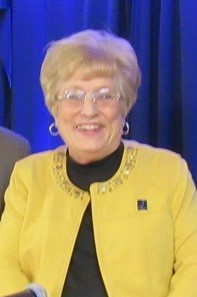
Janet Waugh
Janet Waugh, District 1 member of the state Board of Education from Kansas City, Kansas, voted to support the governor’s order. Waugh represents Wyandotte, Leavenworth, Johnson and Douglas counties on the state board. Today’s meeting was a remote online meeting.
Waugh said this issue was more controversial than the evolution issue the state Board of Education faced in 2005.
“This was frankly bigger than evolution,” Waugh said. “Evolution was pretty big, kind of a science issue. This was a health issue, impacting students and teachers, and families.”
Comments made by other state board members at the meeting today reflected a view that local school districts should have the final say about when school should reopen in their districts, not the state.
Michelle Dombrosky, District 3 member, said at the meeting she thought this should be a local decision.
Ann E. Mah, District 4 member, said she wanted to be on the right side of history on this one, and wanted to be able to say that when she had the chance to save children’s lives, she voted yes.
Jean Clifford, District 5, said conditions are not the same across the state. Districts in her area are not experiencing high numbers of cases. She said districts must be allowed to take advantage of the times in their communities when they are not experiencing rising cases.
Deena Horst, District 6, said that by approving the governor’s order, they would be stripping the elected local boards of their statutory duty to make these needed decisions. The governor’s order is problematic for her districts, she said. There is the possibility that counties that haven’t had a spike yet could experience it in the future, and they may need the school days in August if they have to delay school later because of the virus. In her district, if school is extended into June, she said some of the students are expected to help their families with planting in June.
Board members received thousands of messages and emails in the short time between the governor’s order and their meeting to vote on it, Waugh said. There were about 10,000 communications of all sorts, such as emails, phone calls, messages on social media and letters.
She said she asked superintendents in District 1 if they supported the governor’s order, and overwhelmingly, they did.
She added the superintendents said they had ordered supplies, which in many cases had not arrived yet. They also would like time to prepare and train their staff, she said.
In a normal year, they have two or three days for staff and faculty training before school starts, she said. This year they would need to train the entire staff, including teachers, bus drivers, custodians and others, on how to handle the health situation, she said.
They also need time to train the staff on how to teach remotely or to use the hybrid options of remote and in-person training, she said.
School districts face challenges as the state still requires 1,116 hours of contact time for instruction during the school year, she said. The superintendents told her if they remove in-service days from the school year, those days then could be used for student contact time and then they might be out of school by Memorial Day, she said.
The state Board of Education can’t allow a shorter school year – that is set by a law and the Legislature would have to change it, Waugh said.
Waugh said that almost all the teachers they heard from were terrified about going back to school, because of the risk of getting COVID-19.
“They desperately want to go back, they love their kids, they recognize how important the social-emotional piece is, however, they’re terrified,” Waugh said.
Some of them could have health conditions, could have a spouse or child with a health condition or could be taking care of elderly parents, and that adds to their worries about the spread of the coronavirus.
The huge number of messages receive by the board included some campaigns by teachers and also by conservatives, she said.
The messages ranged from asking to open up schools with no restrictions, to the other extreme, that some parents were terrified to send kids to school because of COVID-19, she said.
In Kansas City, Kansas, the KCK Public Schools voted on Tuesday night to delay the opening of school until after Labor Day, and the board chose remote learning.
The Shawnee Mission School District is scheduled to meet on the issue of school opening tonight, and Olathe also is planning to meet. Waugh said she expected to see a lot of special meetings coming up now that the decision is in the hands of the local boards.
“They have to make their own decisions, what will best work for their own community,” Waugh said.
Only two to three counties in Kansas’ 105 counties have no COVID-19 cases reported. The Kansas City area is in the middle of a COVID-19 hotbed, but Waugh said those hotbeds expand out, and could eventually have more of an effect on the rest of the state. People and students travel, so county lines don’t have that much effect on the spread of the virus, she added.
If schools reopen, their county health officers still have the option to shut down the schools if necessary, she said.
If a district reopens and has an outbreak or spread in one school or one classroom, Waugh said they still need to educate the children.
Waugh said she’s hoping that students didn’t fall behind last year when schools used remote learning techniques during the spring. That is something they will know when testing starts again. It may take a lot of work for those who are not at the levels they’re supposed to be, but their goal is that the students receive a good education, she added.
The state education department issued guidelines, Navigating Change, which offered several options to schools, including opening in person, conducting all education remotely and a hybrid of the two.
Some districts are expected to come up with plans such as dividing the students in half, some going Mondays, Wednesdays and Fridays and others going to school on Tuesdays and Thursdays, while studying at home on the alternate days, she said. There are other ideas for classes, such as half the students attending school in the mornings and the other half in the afternoons.
Lack of internet access at home has been a barrier for some Wyandotte County students, as well as some students in rural Kansas. Waugh said service providers worked hard this past spring to give free internet to those who didn’t have it at home.
Some areas here did not have internet service yet, and so a few districts made hot spots in their parking lots for students to go there and download the information they needed, she said. Other districts could send packets of information to students at home for their studies.
Dr. Randy Watson, Kansas education commissioner, said at today’s news conference at the University of Kansas Health System that the 1,100-page Navigating Change document produced by his office was the product of more than 1,000 people working on it.
The guidance starts with the science of the COVID-19 pandemic, and then extrapolates to how it would play out in a school system with thousands of kids in a building, he said.
The plan’s guidelines include wearing masks, physical distancing, hand-washing and temperature screening, he said.
He said some districts will return to school with students in classrooms, while others will be using a hybrid approach involving technology and distance learning.
He recommended that parents take some time to get their children used to wearing masks, distancing and washing hands or using hand sanitizer in preparation for going back to school in the future.
What triggers the decision to go back to school in person or to do remote learning are conversations with county health officials about the metrics in the community, knowing the case rates, hospital rates and the trend for 14 days, he said. If it shows the community is at low risk, they can have more on-site classes, and if not, they will have more remote classes.
When asked if the state will provide personal protective equipment to teachers and school staff, Watson said that counties are receiving grants from the CARES Act that can be used for personal protective equipment.
A spokesman for the University of Kansas Health System stated today that KU Health System has not and will not take a position on the reopening of schools and the governor’s executive order. Statements made during the health system’s news conferences are made from a health and safety perspective and were focused on when schools open, but were not taking a position on the executive order to delay opening schools, a spokesman stated.
Waugh’s statement on the issue of school reopening at the state Board of Education meeting today:
“Because I believe this is such a serious issue, I decided to get as much information as possible prior to voting. My top priority is to protect the health & safety of students & staff while providing each student with a great education.
“Here’s a few things I learned: Health professionals support not starting school until all staff members are well trained and hopefully the virus has slowed down. After schools open, it’s important for districts to stay in close contact with their County Health Departments.
“Superintendents wanted the extra time to make sure all supplies were in (apparently there are many who have not received everything they need for health & sanitation). They also wanted the extra time to insure staff members were well trained on how to handle this “new normal”. Just this morning I received an email from all Johnson County Superintendents supporting for the Governor’s Executive Order.
“Teachers desperately want to be back in their classrooms with students, but many are terrified to return. Some are creating or revising wills. Others are taking early retirement or considering changing careers.
“Educators overwhelmingly agreed a top priority is for students to be in the classroom with their friends & their teachers because of the social emotional support they receive.
“Parents shared how their children missed classmates & teachers. They also believed that being away from their schools was affecting their children’s mental health. Other parents are terrified to send their children to school because of the virus. Several parents said remote learning didn’t work well with their students.
“Local Board Members I visited with supported this order. They informed me they felt it was important for their staff members to be well trained on how to handle this situation and it also allows staff to recognize the district is doing everything possible to provide a safe & healthy environment that will protect everyone.
“Community members were everywhere from open schools normally, no restrictions, to don’t open until the virus is gone & everywhere in between.
“One of the best arguments I heard about voting against this was local control. I served on the Turner Board for almost 16 years prior to serving on the State Board and have always felt strongly about local control. I spent a lot of time visiting with many people on this issue and decided that local control was still extremely important because of the differences in our districts. I finally decided that local control shouldn’t include pandemics because the virus itself is certainly not local, in fact it’s not even statewide or nationwide, it’s worldwide.
“If we accept this order, we can allow our staff to receive the proper training to handle this crisis. Teachers were not taught to handle a pandemic when they were earning their education degrees. They were taught how to teach in a classroom, not remotely or a hybrid of both.
“Teachers could start back on the current return date, but instead of a few days of In Service before students return, they can devote that entire time to being trained on how to handle this pandemic and also be prepared to teach their subject area in various ways. In Service days during the school year can be removed and become student contact days. This would allow districts to meet the state’s requirement for 1116 contact hours for students and still have schools end by Memorial Day. This allows districts time to make sure all supplies are not only received, but the staff is trained to use them & also trained on different ways to deliver education.
“This will also give the entire staff confidence they are prepared to receive students & their districts have done everything they can to provide a safe & healthy environment.
“If we don’t accept this order, there will be many staff members without sufficient training and then we are putting our students & staff at risk.
“My vote will be based on protecting the health & safety of our students & staff while insuring they receive a great education in any way the districts offer it.”
Wyandotte County reported an increase of 49 cases on Tuesday, for a cumulative total of 3,750. There were 89 deaths, unchanged since Monday. (From UG COVID-19 webpage)
It’s up to communities to fix the problem of high numbers of COVID-19 cases, said Dr. Lee Norman, Kansas secretary of health and environment.
Dr. Norman made his remarks at a virtual news conference Tuesday sponsored by the University of Kansas Health System. The case numbers have gone up recently in the state and in the Greater Kansas City area.
“Public health cannot fix this,” Dr. Norman said. “This is what the communities have to fix. Schools will not be a safe island in an unsafe community. If you’ve got a community with bars open, people not wearing masks, mass gatherings, rodeos, county fairs, then schools will not be safe.”
People can point fingers at schools, doctors or hospitals, but that is misplaced, he said. They have got to look in their own communities, and if they see one person without a mask on, the community is failing, he said.
“There is no safe island for children in an unsafe community,” he said.
People need to work with their county health officials and fix things, he said.
“We can fix this by Sept. 10,” he said. There are at least two incubation periods, during which the case numbers can be flattened.
“Look inwardly people,” Dr. Norman said, “Fix your communities and your schools will follow as a safe haven, but not until then.”
Mitigating measures such as wearing masks, social distancing and hand washing work in hospitals and they will work in schools, Dr. Norman agreed. The community spreading of the virus will drive the safety of the schools, he added.
Dr. Norman also suggested looking at innovative methods for classrooms, not 30 children and one teacher in a classroom, but possibly staggered scheduling, with hand hygiene, masks and physical distancing. He said physical distance between students is very important. It’s also important that people who are sick stay home.
Meetings with the state Department of Education are ongoing, Dr. Norman said, with one scheduled on Wednesday.
Working toward in-person classes is desired in a community where there is a declining number of cases, he said.
Dr. Norman expanded on his remarks about bars, saying there were 150 to 200 COVID-19 cases related to three bars in Lawrence, and upwards of 100 cases related to bars in Manhattan, Kansas.
Dr. Steve Stites, chief medical officer at the KU Health System, said the hospital reopened and did not have COVID-19 spread, and also, clinics reopened without spread. If schools can follow the rules of infection control and have effective personal protective equipment, they can stay safe.
Wyandotte County reported an increase of 49 cases on Tuesday, for a cumulative total of 3,750. There were 89 deaths, unchanged since Monday.
Number of patients in ICU increases
KU Health System reported 36 COVID-19 inpatients on Tuesday, the same as Monday. There were a few discharged and a few admissions, according to Dr. Dana Hawkinson, medical director of infection prevention and control at KU Health System. Sixteen patients were in the intensive care unit, up from 10 on Monday, and six were on ventilators, the same as Monday, he said. He was concerned about the increase in patients in the ICU.
Dr. Hawkinson also said it was important for parents to get regular immunizations for their children, and to get a flu shot, also, when they are available.
Testing available
A free pop-up test for COVID-19 is available from 8 a.m. to 11 a.m. Wednesday, July 22, at Zotung Christian Church, 5010 Parallel Parkway, Kansas City, Kansas.
The pop-up tests are through the Wyandotte County Health Equity Task Force.
Free testing is also being conducted from 9 a.m. to 3 p.m. on weekdays at the Health Department, 6th and Ann, in the parking lot in Kansas City, Kansas, weather permitting.