Everyday routines changed for Dr. Chris Brown when COVID-19 hit the Kansas City area.
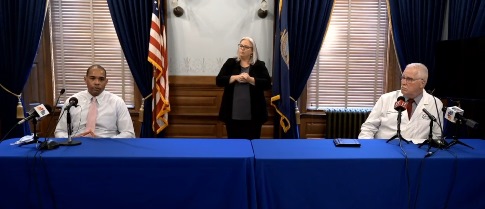
Dr. Brown is a hospitalist at the University of Kansas Health System who has cared for many COVID-19 patients in the hospital. He described his experiences during a news conference Wednesday afternoon at the Kansas Department of Health and Environment.
A doctor at KU Health System about five years, Dr. Brown said when COVID-19 first hit the Kansas City area in February and March, he worked about four weeks straight, seeing about 80 to 90 patients.
Everything changed, he said. While it was standard to clean hands when seeing patients before COVID-19 hit, it became much more difficult afterward, having to put on a gown, gloves, mask and shield each time they entered a patient room, then having to prepare again for the next patient.
After his seven-day shifts seeing COVID-19 patients, it definitely took a toll, emotionally, physically and in the mind, he said.
Before COVID-19, families could be with the patient and discuss the case with the doctor. After COVID-19, visitors weren’t allowed, and so doctors needed to get in touch with patients’ families by phone or technology.
The palliative care team got involved to help use technology and increase communication among the patient, family and health staff.
Dr. Brown said it became more difficult to work with families. In the past he didn’t have to talk with family members about their health, but with COVID-19, there were some patients’ family members at home with COVID-19 who had not met the criteria for testing, he said. He had to take care of those patients, also, and in a few instances had to tell them to call 911 and go to the hospital.
Treatment for COVID-19 has changed since March. Some of the former ways of dealing with the disease have changed, and now they are using remdesivir, steroids, anticoagulation drugs and other therapies to help the patients, he said.
He has been able to learn from their infectious disease department and also from reading journal articles.
In February and March, they knew individuals more at risk were elderly and had other illnesses including heart and lung disease. It still holds true today, but they are also starting to see a lot more young patients who are sick and hospitalized, he said.
Recently the age difference was 19 to 99 among the hospital COVID-19 patients, he said. And today, there was an 18-year-old COVID-19 patient in the hospital.
People need to remember this disease does not really depend on age, he said.
Dr. Brown said there is a lot of support staff and ancillary staff provided by the hospital to help the health care workers.
He personally finds a way to spend an hour or 30 minutes for himself every day, he said. Many days, he gets up at 4:30 a.m. and goes for a run, he said. He meets colleagues and they encourage each other to find something productive to reduce their stress and the emotional toll that working the long hours can pose on them mentally and physically, he said.
Dr. Lee Norman, Kansas secretary of health, said COVID-19 has really shown their vulnerabilities. There are still a lot of people without access to care and who delay everything to the last moment because they don’t want to have a lot of costs, he said.
Ethnic and racial disparities have shown themselves, and many low-income people do not have the opportunity to work from home, he said. Many of the low-income persons are exposed more to COVID-19. Dr. Norman said Medicaid expansion, which would provide insurance for more low-income persons, is something the state should do.
‘Not a legal question’
Dr. Norman also commented on the state attorney general’s recent opinion about local school boards having more authority on wearing masks than the health departments. It’s really a health question, he believes.
“I personally think those questions are not a legal question so much,” he said, adding he knows a legal question could be asked about it.
He said he would rather have the impact of public health guidance to guide school boards, and public health officers have provided that.
“If people have options not to wear masks because of the attorney general’s advice, I hope people still listen to guidance and do the things necessary to protect their own children,” Dr. Norman said.
Corrections cases increase
COVID-19 outbreaks have been reported at correctional facilities in Hutchinson and Sedgwick County, according to Dr. Norman. The cases have grown rapidly.
“What we’re doing is the right thing to do,” Dr. Norman said. It might have been better if they could have gotten in there a little sooner and if the facilities were newer.
The Hutchinson facility was built during the Abraham Lincoln era, he said, without airflow. They spent some time on Wednesday on strategies to cope with the outbreaks, he said.
They will make recommendations to move the inmates around so that COVID-19 patients will be confined to certain units, and those who don’t have COVID-19 will be confined to other units, he said.
According to a Kansas Department of Corrections news release, a lockdown was implemented at Hutchinson Correctional facility.
A total of 84 residents and 10 staff members at Hutchinson tested positive this week, according to KDOC. They have had 99 total residents and 17 staff who tested positive since COVID-19 began. The positive cases are asymptomatic, according to the news release.
All of the central unit Hutchinson residents will remain locked in their cells, according to the news release. They will be in cohorts. Some of the inmates will be moved to the medical unit at Lansing Correctional Facility.
A COVID-19 case also was reported Aug. 11 at Winfield Correctional Facility, and the inmate and three roommates are being moved to the Lansing Correctional Facility, according to a Kansas Department of Corrections news release.
Statewide, an increase of 816 new cases and eight new deaths were reported in Kansas from Monday to Wednesday, according to Dr. Norman.
Kansas reported 32,547 total cumulative COVID-19 cases on Wednesday, with 395 deaths, according to the Kansas Department of Health and Environment.
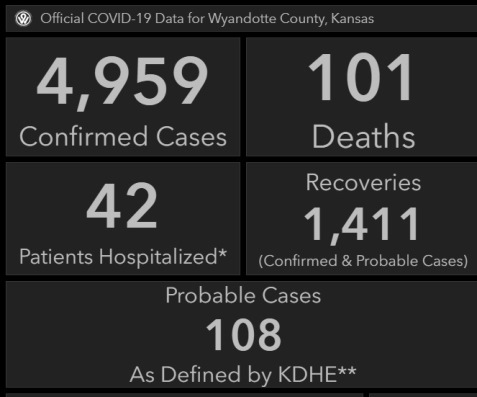
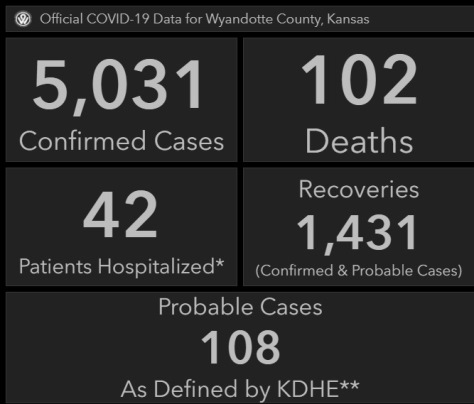
Wyandotte County reported 5,031 cumulative COVID-19 cases on Wednesday afternoon, an increase of 72 from Tuesday, according to the Unified Government COVID-19 website. There were 102 cumulative deaths, an increase of one since Tuesday.
Johnson County reported 6,120 cumulative COVID-19 cases on Wednesday, an increase of 207 cases from Monday, according to KDHE figures.
Leavenworth County reported 1,532 cumulative cases on Wednesday, an increase of 19 cases since Monday, according to KDHE statistics.
The University of Kansas Health System reported 30 COVID-19 patients on Wednesday morning, down from 39 on Tuesday morning, according to Dr. Dana Hawkinson, medical director of infection prevention and control. There were 10 patients in the intensive care unit, down from 11 on Tuesday, and seven patients were on ventilators, down from eight on Tuesday. The number of inpatients was lower because of several discharges, according to doctors.
Optimism expressed about vaccine trials
Doctors at KU Health System were optimistic on Wednesday morning about upcoming vaccine trials. They discussed it at a video news conference at the KU Health System.
The vaccine trial at KU is a week or two away from being delivered, and it will begin soon after delivery, according to Dr. Mario Castro, vice chair for clinical and translational research and pulmonologist at KU School of Medicine. He is the co-principal investigator in the trial.
Dr. Castro said he is hopeful about the effectiveness of the vaccine, after a recent study in Lancet.
About 1,250 of the 30,000 people participating in the nationwide trial will be at the KU Medical Center, he said. Two out of three participants will get the vaccine, while one-third gets a placebo, Study participants will get a booster 28 days after the first vaccine.
To participate in the trial, interested persons may contact Shelby Almo at KU Medical Center, at salmo@kumc.edu or go online to coronaviruspreventionnetwork.org, and specify KUMC as the location.
Those who are quarantined or have bene working at home probably won’t qualify for the study, according to Dr. Castro.
He said that even though everyone has had to alter their lives because of the virus, this study gives him hope for a return to normal.
Dr. Barbara Pahud, research director of pediatrics infectious diseases at Children’s Mercy Hospital, said she believes the vaccine that is being tested at KU and at Children’s Mercy is very safe for humans. She described how the vaccine worked.
Russia announced on Tuesday that it was not doing a clinical trial on its vaccine, and Dr. Pahud was very skeptical of the announcement. That’s a risky action, according to Dr. Pahud, because all the data on safety and effectiveness is not in yet, and also, skipping the trials affects public health trust.
Health institutions such as KU Health System, along with others through the nation, are moving fast on their vaccine because they know from experience how to do it without compromising safety, she said.
Free testing offered
Free COVID-19 testing is planned from 10 a.m. to 1 p.m. Thursday, Aug. 13, at the Quindaro Community Center, 2726 Brown Ave., Kansas City, Kansas, through Swope Health.
Another free COVID-19 testing location will be from 5 to 7 p.m. Thursday, Aug. 13 at Vibrant Health, Argentine location, 1428 S. 32nd St., Kansas City, Kansas.
The pop-up tests are offered through Swope Health, Vibrant Health and the Health Equity Task Force.
Free testing also is offered from 9 a.m. to 3 p.m. Monday through Friday at the Unified Government Health Department parking lot at 6th and Ann, Kansas City, Kansas. For more information, call 311.
For more information on who may be tested and what to bring, visit https://wyandotte-county-covid-19-hub-unifiedgov.hub.arcgis.com/pages/what-to-do-if-you-think-you-have-covid-19
The KDHE news conference is online at https://www.facebook.com/KDHEnews/videos/637120493592839.
The KU doctors’ news conference is online at https://www.facebook.com/kuhospital/videos/302997367678535
The Wyandotte County school start order is online at https://alpha.wycokck.org/Coronavirus-COVID-19-Information.
Wyandotte County is under a mandatory mask order and is in Phase 3 of the state’s reopening plan. For more information, residents may visit the UG COVID-19 website at https://alpha.wycokck.org/Coronavirus-COVID-19-Information or call 311 for more information.
The CDC’s COVID-19 web page is at https://www.cdc.gov/coronavirus/2019-nCoV/index.html.