KCK school board modifies school re-entry plan in case legislators mandate reopening date

The Kansas City, Kansas, Board of Education unanimously passed a school re-entry amendment on Tuesday night, March 9.

The amendment says the district, which had already passed its school re-entry plan last month, will offer a five-day-a-week in-person option beginning on March 26 if the Kansas Legislature passes Senate Bill 235.

State legislators have the local school board jumping through hoops as the district tries to anticipate what’s coming down next from Topeka and how it will affect the school reopening plan. School district officials said a remote learning option would still be available.

Last month, the board approved a four-day-a-week in-person re-entry plan with Wednesdays off for cleaning, with a remote option also available to parents. That plan would have taken effect April 5.

Dr. Stacy Yeager, a board member, said that she wanted to approve the school district’s recommendation on the five-day-a-week plan in order to give parents more time. As a parent, she said it was important to have as much advance notice as possible. Parents often have to have time to make child care arrangements.

Dr. Valdenia Winn, a school board member who also is a state legislator from the 34th District, said the bill has not passed at this time, and there was always a chance that it would be amended in the Legislature before it passes, if it does pass, or when it goes to conference committee.

Dr. Winn said the intent of the Senate bill was to bring all the students back to school in person, and to punish those districts that remain in remote learning, reducing their funding.

“The reality is, the Legislature is mad at COVID federal dollars that will come. They’re mad that KCK and Wichita have been remote. They’re just mad,” Dr. Winn said during the meeting.

If Senate Bill 235 doesn’t pass the Legislature, then the district would go back to its other plan of four days a week in person, with Wednesday off for cleaning, and also with the remote option still possible, according to district officials.

Board member Wanda Brownlee Paige, a former teacher, remarked that she would say what no one else wanted to say.

What the Legislature has done is taken away the power from the local school board, and they’ve done that to all the districts in the state, she said.

“They’re deciding what’s best for us,” Paige said. “What might work in western Kansas might not work in northeast Kansas, and that’s part of the problem.”

Paige urged everyone to write letters or messages to legislators expressing their views.

Parents are choosing whether students return in person or opt for remote learning. Lisa Garcia-Stewart, district director of student services, reported that by March 8, about 15,395 students had chosen in-person school, while 6,620 students opted for remote learning. They are still enrolling students, she added.

Now that there has been an amendment to the school re-entry plan, parents will be able to call the school district and change their students’ re-entry plan, to either in-person or remote, according to Matthew Andersen, interim assistant superintendent for teaching and learning.

Dr. Alicia Miguel, interim superintendent, said their thinking was that if Senate Bill 235 passed, it clearly stated that they need to offer an option. Now that parents know it might be five days a week, some parents may change their mind, she said.

That leaves only three days this week for parents to call the school district and let them know if they want to change to either in-person or remote learning, before spring break starts, according to Garcia-Stewart. Spring break is March 15 to March 19.

After that, parents will have Monday, March 22, to tell the district about any change in their children’s re-entry plans, according to Garcia-Stewart.

There will still be a certain level of uncertainty, however, as parents will not know right away if Senate Bill 235 will pass.

A group of students has already returned to the district’s school buildings, including those who may have had challenges connecting to their classrooms on the internet.

In other action, the Kansas City, Kansas, school board voted unanimously to lower the credits required for graduation for high school seniors this year.

The district had required 25 credits, while the state of Kansas had required only 21 credits. Seniors this year only will be allowed to graduate with the 21 credits required by the state, according to district officials.

Dr. Troy Pitsch, instructional improvement officer, recommended the change.

He said the district is seeing 10 times the number of hardship applications it usually sees for graduation. They’re seeing more than 200 applications, when usually the number is around 25, he said.

The new graduation requirements will drop one unit of math, from 4 required now to 3; a half unit of English, from 4.5 to 4 units; and two units of career and technical education to no units required, according to district officials. Electives will drop a half unit, from 6.5 to 6 units of electives.

There will be no change for science, social studies, physical education and fine arts requirements.
Old courthouse annex had long history

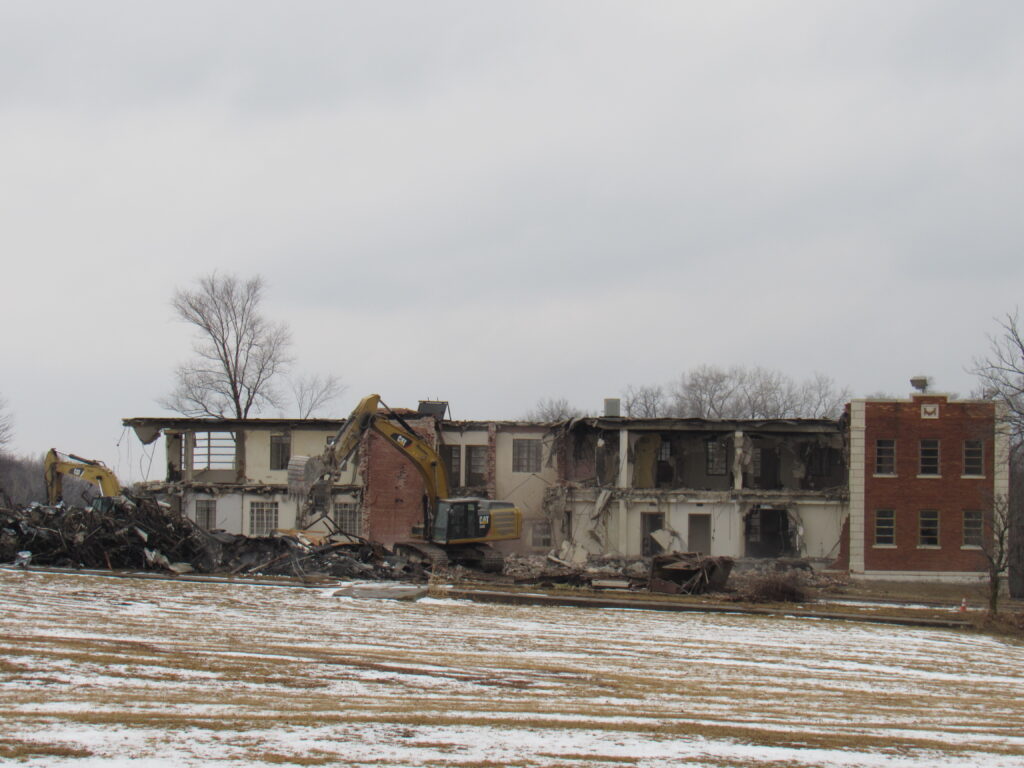
The former Wyandotte County Courthouse annex at 94th and State Avenue was being demolished to make way for new development, as shown in this photo from Feb. 21.

by Mary Rupert

As plans move forward for a new apartment complex on part of the former Schlitterbahn property on the northwest corner of 94th and State, a part of Wyandotte County history is disappearing.

The old Wyandotte County courthouse annex building at 94th and State was being demolished this past month.

While the old county annex building no longer will remain at the site, a graveyard to the north of it will not be affected by the demolition, according to Dave Reno, a spokesman for the Unified Government.

When the old county annex property transferred from the county to the Schlitterbahn water park, the old courthouse annex building was used by the water park for offices and storage. In recent years, the building showed a lot of signs of age, including broken windows.

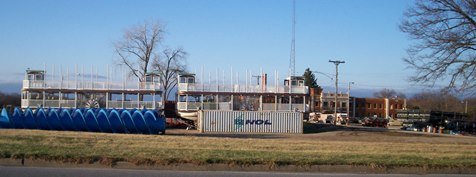
A 2009 photo showed Schlitterbahn using the property in front of the old county annex building to store items they might use in their water park. The building also was used for offices and storage. (File photo)

Before its Schlitterbahn years, the building housed local county government offices such as the election office, motor vehicle tags and Extension office.

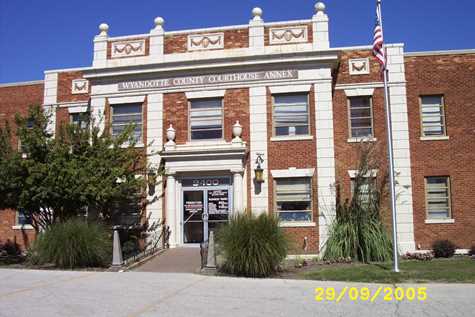
A photo of the former Wyandotte County Courthouse Annex building, 94th and State, from 2005. (Photo courtesy of Wyandotte County Museum)

County home for aged and indigent

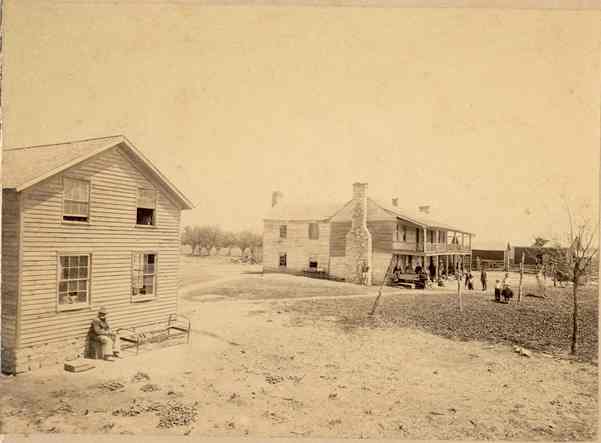
A photo from the Wyandotte County Museum archives showed buildings on the county farm home property near 94th and State. (Photo courtesy of Wyandotte County Museum)

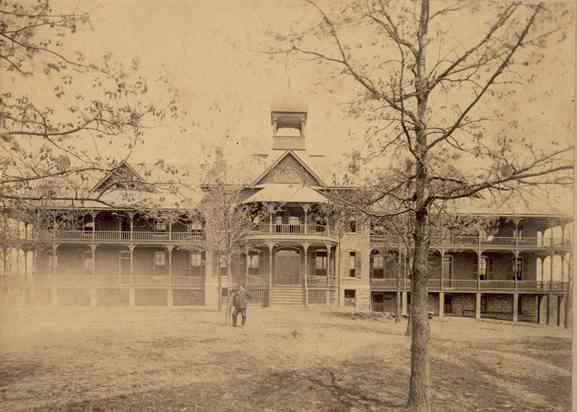
Years earlier, there was a county home for the aged and indigent on the property, which was sometimes called the “poor farm” by local residents.

Jeff Jennings of the Wyandotte County Museum said there were two buildings on the property, one which is the former county annex and the other that was called the poor house. The second building has been gone for a long time, he said.

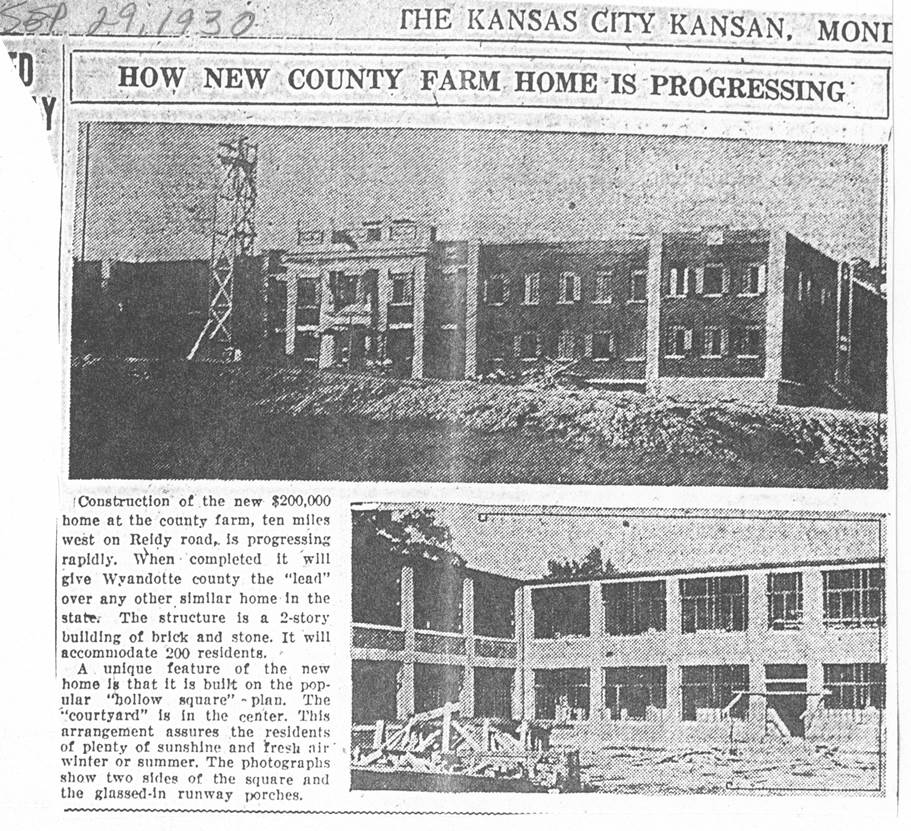
A newspaper story from the Kansas City Kansan in September 1930 detailed the progress of construction on a new home to house about 200 persons at the county farm at 94th and State. (Clipping courtesy of the Wyandotte County Museum)

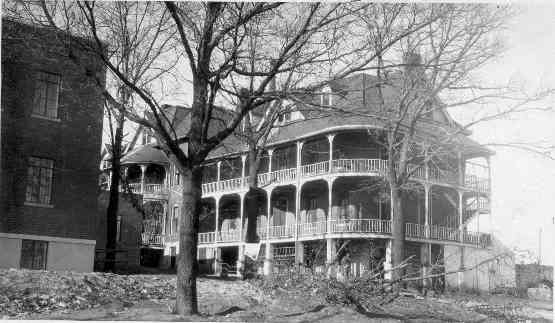
A newspaper clipping from the Kansas City Kansan, dated Sept. 29, 1930, stated that the construction of a new $200,000 home at the county farm was progressing. It was described as a two-story building of brick and stone that would house 200 residents.

The home was built on a plan that placed a courtyard in the center, allowing sunshine and fresh air for residents, according to the news story.

Another old news clipping, from February 1930, said there was a proposal for oil and gas drilling at the poor farm, with oil struck there in 1930.

A third news clipping reported there was a fire at the county home in December 1930, with 146 residents fleeing the building. The story said there already were plans to replace the building with a brick and stone structure.

Cemetery located near county home has hundreds of unmarked graves

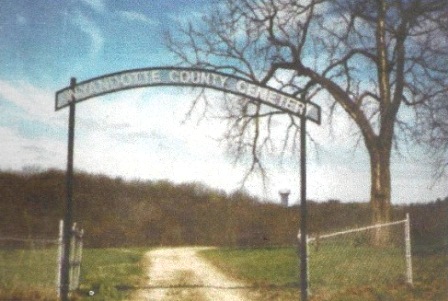
A sign and gate marked the entrance to the Wyandotte County Cemetery on 94th Street, north of State Avenue. The cemetery is to the north of the former courthouse annex.

To the north of the home for the aged and indigent was a cemetery, according to Jennings. It was sometimes called a pauper’s cemetery, and it is listed under the name Wyandotte County Cemetery in some of the records.

Besides an entrance sign identifying it as a cemetery, there are only about two marked graves, Jennings said. The cemetery contains over 500 unmarked graves, perhaps as many as 600 or 700, he said.

Jennings said he had a list of the names of the persons who were buried in the cemetery, which is located to the north of the old annex building, on the east side of the property. However, he added he didn’t know exactly where in the cemetery those persons were buried.

Jennings said the cemetery should stay in place during the construction process for the new apartment buildings.

The cemetery was the subject of a story in February 2007 in the Wyandotte West, as preparations were being made to turn the property over to Schlitterbahn.

There was an extensive investigation into the cemetery and graves in 2006, with an agreement made then that graves would not be touched. There was discussion about creating a park-like setting for the cemetery.

Investigators used metal detectors to find the perimeter of the burial grounds and noninvasive measures were used to discover the unmarked gravesites. The UG commissioned the study, with Chris Schoen of Louis Berger Group, Marion, Iowa, as the main investigator and Geoffrey Jones, geophysicist, of Minneapolis, Minnesota, as the geophysical surveyor.

A report issued by Jones in December 2006 noted that the cemetery was established in 1870 and was used until 1973. The number of total burials there was unknown, but 541 burials were recorded during the last quarter century of the cemetery’s use, the report stated.

A magnetic survey and an electrical resistance survey were completed. After testing and investigation, the researchers concluded the cemetery was limited to the interior of the road loop and to the flat hilltop between the road loop and 94th Street. Another area containing burials was on higher ground between the eastern road of the cemetery and 94th Street, according to the report.

The report is online at http://www.archaeophysics.com/pubs/wy-cem.html.

Multifamily apartment project planned for site

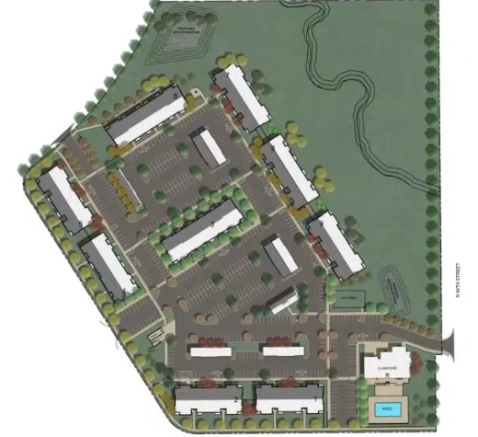
The 94th and State area will be developed into apartments, according to a UG Committee meeting on March 1. Nine apartment buildings and a clubhouse are planned. (From UG Committee meeting)
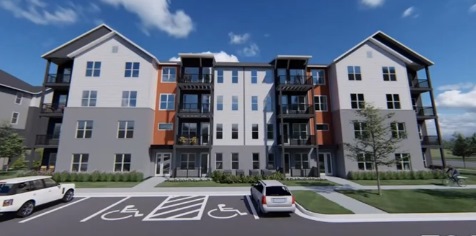
The new apartment buildings planned for 94th and State are planned to look like this drawing, which was presented at the March 1 UG Committee meeting. (From UG Committee meeting)

A multifamily apartment project planned for the site of the former county annex building at 94th and State received preliminary approval for industrial revenue bonds at the March 1 UG Economic Development and Finance Committee meeting.

IRBs not to exceed $45 million were approved for the Milhaus Properties project.

As part of the Homefield project for the former Schlitterbahn property, the project was already approved in concept earlier, according to Katherine Carttar, UG director of economic development.

The 18-acre apartment site will have 274 units, and will include a clubhouse pool, enclosed garages and surface parking, John McGurk, vice president of development for Milhaus Properties, said at the UG meeting. It will have a fitness center, lounge, coffee bar, pet park, pool with a sun deck, and fire pits. There will be nine buildings and a clubhouse, and the apartment buildings will have three stories and a basement.

According to McGurk, the project will have a trail system through the entire Homefield development.

The project is to start construction this summer, with the first units completed within 12 months, McGurk said. The project should be completed in spring 2023, according to developers.

The northeast portion of the property will remain a forested area, according to the developer.

The UG Committee meeting is online at https://www.youtube.com/watch?v=jt6BdMl46yM.

KCK school board approves 4-day-a-week return to school in April

The Kansas City, Kansas, Board of Education approved a new re-entry option for April 5 at the Tuesday night, Feb. 23, board meeting.

The board adopted a staff-recommended option for in-person school, four days a week. At this time, parents could choose either in-person school or remote learning for their children.

The district would bypass the hybrid model and move into a full in-person model for those students whose families have selected the in-person model.

Under this approved model, students would attend in-person learning on Monday, Tuesday, Thursday and Friday. On Wednesdays, there would be remote learning days. There also will be cleaning of schools on Wednesdays.

Masks will be required for all the students, teachers and staff, according to district officials. The students will have clear partitions at their desks.

At elementary schools, the Health Department has stated students could be in learning pods, according to Kristen Scott, instructional improvement officer, who presented the plans.

Dr. Alicia Miguel, acting superintendent, explained that the Unified Government Health Department has loosened some of the requirements for coming back to school. Athletes no longer need to attend all the same classes together.

She said there is some discussion going on currently around the 6-feet spacing requirement, and they are waiting for a decision from the Health Department on that, possibly later this week.

Dr. Miguel also said that about 50 percent of the students have signed up to come back in person, which will have an effect on spacing in the classrooms.

Students whose families choose remote education will livestream the classes and receive the same instruction as in-person students, according to Scott.

According to Scott, there will be a five-day window for persons who selected remote education to change their option, or for persons who selected in-person learning to change their option.

The board was asked to choose between a new hybrid option and the four-day option.

Scott said there were some drawbacks to the hybrid model of two days a week in person and three days remote attendance, including that many students have connectivity issues.

The modified hybrid model rejected on Tuesday night was that one group of students would go to the classroom in person on Mondays and Tuesdays, and another group in person on Thursdays and Fridays. The teachers would teach both groups simultaneously, as the at-home group would livestream.

Another hybrid model had been approved earlier by the board and now is being replaced by the four-day proposal.

Under the earlier hybrid model, teachers would not have taught students simultaneously, both in person and livestreaming, but these new proposals were modified so that they will teach them simultaneously.

The board voted unanimously in favor of the four-day re-entry plan.

There is an amount of uncertainty surrounding the April 5 return date, however.

The Kansas Legislature has proposed a bill, Senate Bill 235, that would mandate all public school districts return to school by March 26.

School board members asked what would happen if that bill passes. Wanda Brownlee Paige, a school board member, also asked if parents still have that other option of remote learning.

Dr. Miguel said they’re not very clear right now on how that would be enforced.

There is a lot of agreement currently on bringing kids back to school, and data has not shown that kids transmit the virus at a rate they thought they did last year, according to the superintendent. Dr. Miguel said she recommended the four-day plan because she knows three days of remote learning a week is not the best for kids.

Planning according to what they know now, parents will still have the option to choose remote learning, she said.

If the bill passes without any exemptions for remote learning, however, the board may have to push up the date for returning to school, according to officials.

Dr. Valdenia Winn, a school board member who is also a state legislator, asked how the state Legislature could kill local control of the school board.

Greg Goheen, school district attorney, said to him, local school boards have a constitutional right to operate the school districts, although the Legislature can dictate certain things as part of the legislative process. He said what the district does if the Legislature passes Senate Bill 235 will depend on the final language of the law. He said he hoped that the law, if it passes, would not treat students who are not back in school in person as truants.

“We are all in agreement if there is new legislation,” Dr. Miguel said, “we will always comply with the law and make it happen.”

If the bill does pass mandating the March 26 return date, the board may have to have another meeting to vote on another return to school plan, according to officials.

The school district brought back a group of kindergarten through fifth grade students earlier this week, on Feb. 22, because of connectivity issues. The district also brought back a select group of seniors on Monday. The board also will bring back a select group of middle school students on March 1.

In other action, the school board voted unanimously to approve a plan from Tammie Romstad, district athletic director, for the district to hold basketball substate postseason tournaments March 3 to 6.

The plan would allow two spectators per participant; currently, the UG restricts participants to 50 percent occupancy of the facility. Romstad estimated that two spectators per participant would be a crowd of 185 people. The gyms hold from 1,000 to 1,200 spectators, she added, and there would be room for social distancing.

Everyone attending would wear masks, she said.

Romstad said the plan to hold substates also depended upon whether the teams will win.

The meeting is online on YouTube at https://www.youtube.com/watch?v=7xBcb6KxV_8&feature=youtu.be.