The Unified Government Commission Thursday night rescinded some past health orders and approved a revised masking and social distancing measure.
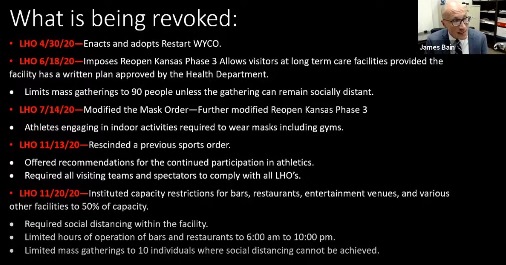
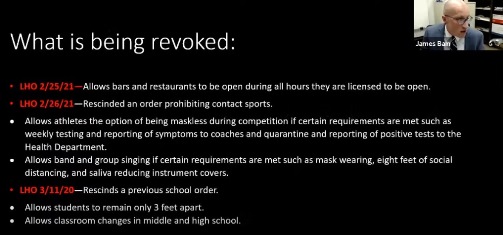
The action Thursday night revoked eight local health orders and amended a local health order on masks that originally passed June 27.
There is still a mask order in effect, and there is still social distancing of 6 feet mandated. However, the 50 percent capacity rule for buildings is no longer in effect, according to UG officials.
Like other counties throughout Kansas, Wyandotte County took the actions because Senate Bill 40, limiting the authority of the governor and of health officers, passed the Kansas Legislature earlier this week and was signed by the governor on Wednesday.
All the health orders concerning schools were revoked, because the new law specifically states that school boards alone, not health officers or counties, have authority over the public schools.
Unlike some other counties, the UG commissioners have always been supportive of the UG Health Department and its orders.
The motion to revoke the eight older health orders and amend the masking and social distancing order was approved 9-1, with Commissioner Harold Johnson voting no.
“The orders that we have put forth, I think are good, and are appropriate, given the level of disease we are seeing in our community, and the level of uptick we are seeing outside our community,” Dr. Erin Corriveau, deputy health officer for Wyandotte County, said at the 7 p.m. Thursday UG meeting.
She said throughout the pandemic, it has always been their charge to be careful and protect those who are most vulnerable in Wyandotte County.
“If not for the new statute, Dr. (Allen) Greiner (chief medical officer) and I would not want to be changing these health orders at this time.”
Dr. Erin Corriveau, deputy medical officer, Wyandotte County
“If not for the new statute, Dr. (Allen) Greiner (chief medical officer) and I would not want to be changing these health orders at this time,” Dr. Corriveau said.
Juliann Van Liew, Health Department director, pointed out that while cases here are lower than they were in November, December and January, they are still experiencing about 10 new cases a day, or 70 new cases a week, with low levels of testing. This week, the Health Department’s weekly COVID scorecard shows the overall status for Wyandotte County at medium, she said.
While the case numbers have been going down, the positivity rate has gone up slightly, and is now around 10 percent, she said. Tests per day are under what they would like to see, and hospitalizations have shown an uptick here in the past few days, she said.
Dr. Corriveau said they are watching trends around the country, where case numbers are increasing on the coasts, and the world, where there has been an uptick of cases with the variants.
“Previously during other surges in the pandemic, we’ve followed very closely behind other parts of the world and Europe,” Dr. Corriveau said.
She said the British variant has been found in the Greater Kansas City area, sampled as far back as January in wastewater in surrounding areas to Wyandotte County, which is of concern to the Health Department.
Unfortunately, she said, there is a very low vaccination rate in Wyandotte County.
“We are doing our very best,” she added about vaccinations. But under 8 percent of Wyandotte County residents have completed two doses of vaccines, she said.
Misty Brown, UG chief counsel, said Senate Bill 40, which has been signed into law, makes it very clear that any type of COVID-related health order or that pertains to schools, are under the school board’s exclusive jurisdiction.
Also, Brown said any health order that requires masks, restricts movement or affects businesses, has to be actively passed by the governmental body. In the past, health orders were signed by the local health officer, and the commission had the authority to amend or revoke them. Now these orders on masks, gatherings and movement need to be actively reviewed and approved by the commission, she said.
The new law also allows any citizen aggrieved by a health order to file an action within 30 days, receive a hearing within 72 hours and a verdict will be issued within seven days, she said. The new law said the Supreme Court could adopt emergency rules for these appeals.
Brown and James Bain, with the UG legal department, prepared the new resolutions with only a day or so’s notice. The health order resolution was a late addition to the agenda on Thursday.
Bain said the biggest change was going from 50 percent capacity to social distancing. Capacity now will be based on how many people you can manage 6 feet apart, he said.
In a similar move earlier Thursday, Johnson County also modified its health orders, keeping physical distancing and mask requirements. But Sedgwick County, the Wichita area, went further and dropped its mask mandate on Wednesday as a reaction to the new law.
Wyandotte County had already extended its state of emergency resolution on March 11.
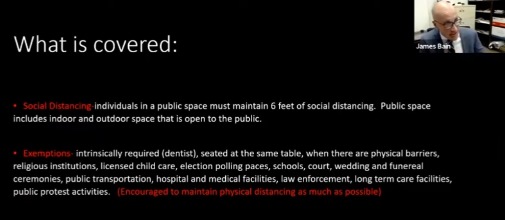
Bain said social distancing will be in effect under the new amended order, including indoor and outdoor space that is open to the public. There are several exemptions listed, including health procedures where distancing is not possible, parties sitting together at the same table at a restaurant, religious institutions, licensed child care, polling places, schools, court, wedding and funeral ceremonies, public transportation, hospital and medical facilities, law enforcement, long-term care facilities and public protest activities.
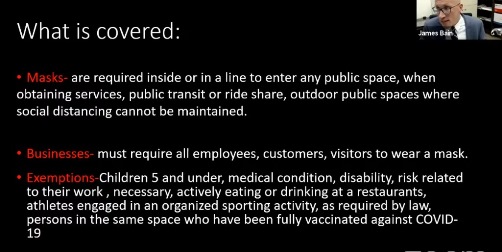
He said masks will be required inside or in a line to enter any public site, when obtaining services, public transit or ride share, and outdoor public spaces where social distancing cannot be maintained.
Businesses, under the new amended order, must require all employees, customers and visitors to wear a mask. There are certain business exceptions listed in the resolution.
Exceptions to the mask resolution include children 5 and under, medical conditions, disability, risks related to their work, actively eating or drinking at a restaurant, athletes engaged in an organized sporting activity, those required by law, persons at religious services, facilities and activities, and persons in the same space who have been fully vaccinated against COVID-19.
UG Administrator Doug Bach recommended the revocation of the eight orders and the amendment of the mask and distancing order.
“We still feel the health risk is great for our community,” he said. “We are far from getting our vaccinations done.”
“I was personally disappointed by the actions of the state Legislature.”
Mayor David Alvey
Mayor David Alvey said he was “personally disappointed by the actions of the state Legislature.”
“I do not believe we are through the pandemic yet,” Mayor Alvey said.
With an increase in cases now picking up in more than 30 states across the country, and some states questioning whether they relaxed their rules too soon, this seems to be a backward move, Mayor Alvey said.
The mayor said what really drove a decline in business activity was not government orders, but it was the fear people had of contracting the virus.
He said it is important for people to continue to take precautions. He urged people not to give up, as it is still possible to control the virus.
Commissioner Christian Ramirez agreed that the action the Legislature took was very disappointing. Every decision the Health Department has made has been based on data, health and the well-being of the community, he said. While their authority is no longer there, it doesn’t make their work less impactful in the community, he said.
The governing body has to work together a little more to get rid of the virus, he said.
“To our community, I ask that we continue to be resilient, that we continue to follow the orders,” he said. It isn’t a political issue; it is about the community moving forward and making sure everyone is safe and healthy, he said.
Commissioner Melissa Bynum asked if the new state law has taken away local control to deal with the community in the way they believe is best.
Brown said it has taken away the authority of the UG to grant this authority to the local health officer to make these types of orders.
The amended health order is more narrowly tailored, in keeping with the new law. They believe the provisions in the amended health order, as reviewed with the health officer, are the very minimum steps they could take to combat COVID in Wyandotte County, according to Brown.
Commissioner Jane Philbrook asked if it would be six months until Wyandotte County would reach a 100 percent vaccination rate.
Dr. Corriveau said that could be right, but it might be sooner.
Fortunately, the county’s vaccine supply has increased quite a bit, with a higher allocation from the state, but they’re now having a rough time convincing people to take the time and get the vaccine, she said. They will be concentrating on messaging and getting the correct information to people, encouraging them to get the vaccine.
“I do think supply is really ramping up,” Dr. Corriveau said, “if it was only as easy as the supply.”
Dr. Philbrook said most of her patients want to get the vaccination. She said people should stay positive about the change they have to make because of the state. “Just press ahead and ask people to get in and get shot, in the arm of course,” she said.
She praised the UG Health Department and UG staff for getting something done in a day, so they can do what’s right for the community.
Commissioner Tom Burroughs said that they could have 100 percent of the vaccine available, but they will be dealing with messaging and commitment for all to get vaccinated. In this community, they are seeing some people who don’t trust the vaccine, and some who don’t trust the government.
Burroughs, also a state representative, said this was a statewide and nationwide issue.
He said legislators during the discussion on the bill talked about putting authority back into elected bodies, such as the school boards and the county commissions. But he saw it as something else.
“This order that came down was nothing more than a power grab by those in the Legislature who believe they are more knowledgeable and more educated than those who have our health interests at heart.”
Commissioner Tom Burroughs
“This order that came down was nothing more than a power grab by those in the Legislature who believe they are more knowledgeable and more educated than those who have our health interests at heart,” Commissioner Burroughs said at the UG meeting.
It has been a very trying session to date, in how they deal with local control and with the pandemic in local communities, he said.
“The power grab is not only on local government, it is all the way to the governor’s office,” Burroughs said. “We’ve seen that stripped to the extent that it’s almost disrespectful to the executive office of our government in the state of Kansas.”
This new law has affected all the other communities statewide, he said, and he sees it as nothing more than a power grab.
“We have been very blessed with those who have guided us through the pandemic,” Burroughs said. “This battle is not over yet.”
Commissioner Gayle Townsend said this seemed like a very sad move backward.
“Kansas was on the forefront of doing what it could to protect its citizens and respecting home rule,” she said.
She asked what might happen if Wyandotte County just left all of its health orders in place.
Brown said there is no guidance on that, but she thinks it would leave the UG overexposed if they did not take some action.
Mayor Alvey said they don’t have to revoke the health orders, but for any health order the UG keeps, someone could bring a lawsuit and file a claim in district court to say it unnecessarily restricts their activities.
Brown said they could still be sued if they make the changes, but they will be more easily able to defend themselves if they make the changes recommended on Thursday.
According to the resolution that was approved, the amended order on masks and social distancing goes into effect upon passage at the Thursday night meeting, and remains in effect until midnight June 10.
The amended health order resolution that was passed on Thursday night is in its entirety on the UG agenda on page 38, at https://civicclerk.blob.core.windows.net/stream/WYCOKCK/fc5cb697aa.pdf?sv=2015-12-11&sr=b&sig=xZrSaDonVGmwLx2yL0GVnimcAAHXpL56lmoF1XwGtXo%3D&st=2021-03-26T03%3A03%3A39Z&se=2022-03-26T03%3A08%3A39Z&sp=r.
The UG meeting is online at https://www.youtube.com/watch?v=H7n-zXvJhvE
COVID-19 case numbers reported
The University of Kansas Health System reported 14 active COVID-19 patients on Thursday morning, a decrease of two from Wednesday, according to Dr. Dana Hawkinson. Of the 14 patients, three were in the intensive care unit, no change from Wednesday. Two patients were on a ventilator, the same as Wednesday. There were another 18 COVID-19 patients who were hospitalized but are out of the acute infection phase, no change since Wednesday. There is a total 32 patients, a decrease of two from Wednesday.
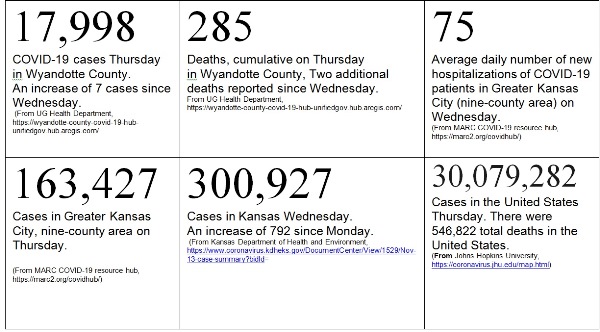
Wyandotte County reported an increase of seven COVID-19 cases on Thursday, March 25, since Wednesday, for a cumulative 17,998 cases. There was a cumulative total of 285 deaths reported, an increase of two since Wednesday.
The Mid-America Regional Council’s COVID-19 dashboard reported 163,427 cumulative COVID-19 cases on Thursday. The daily average of new hospitalizations was 75. The number of cumulative deaths was 2,319.
The state of Kansas reported 300,927 cumulative COVID-19 cases on Wednesday, March 24, an increase of 792 cases since Wednesday. There were a total cumulative 4,881 deaths reported, an increase of 31 deaths.
The Johns Hopkins University COVID-19 dashboard on Thursday night reported 30,079,282 cases in the United States, with 546,822 total deaths reported nationwide.
Vaccinations available Friday
Wyandotte County has started Phases 3 and 4 in the state’s vaccination plan.
People with certain underlying health conditions and other critical workers are in these phases. They may fill out the Health Department’s vaccine interest form at WycoVaccines.org or call 3-1-1. Appointments are needed.
Those who are ages 16 to 64 with severe medical conditions, listed in the state’s plan, are in Phase 3, and those 16 to 64 with other medical conditions are listed in Phase 4.
The list includes cancer patients, chronic kidney disease, chronic obstructive pulmonary disease, heart conditions, pregnant patients and some other categories. To view the list of the severe medical conditions in Phase 3 and other conditions in Phase 4, view the vaccine plan on the state’s website at https://www.kansasvaccine.gov/DocumentCenter/View/121/Vaccine-Prioritization-Slides-PDF.
Also in Phase 3 are “other critical workers,” according to the state plan, listed above.
Those who want to be vaccinated in Phases 3 and 4 should complete the UG Health Department’s vaccine interest form online at WycoVaccines.org or call 3-1-1, and they will be contacted to schedule appointments.
The Unified Government Health Department is still offering walk-in COVID-19 vaccines Monday through Friday for Wyandotte County residents who are 65 and older, and also for high-contact critical workers in Phases 1 and 2.
Those Wyandotte County residents who are 65 or older, and critical workers in Phases 1 and 2, can walk in and do not need an appointment from 9 a.m. to 3 p.m. Monday through Friday at the vaccination sites at the former Kmart store at 7836 State Ave., the former Best Buy store at 10500 Parallel Parkway and the Kansas National Guard Armory at 100 S. 20th (near 18th and Ridge).
Those in Phases 1 and 2 who walk in to get vaccines should bring an ID and something showing their Wyandotte County address, such as mail. Critical workers should bring a work badge or a document showing they work in Wyandotte County.
Those Wyandotte County residents who are younger than 65, or are not eligible yet, may fill out a form expressing interest in getting a vaccine at WycoVaccines.org or call 3-1-1.
For more information about vaccines at the UG Health Department, visit https://wyandotte-county-covid-19-vaccines-unifiedgov.hub.arcgis.com/.
There are also pharmacies giving COVID-19 vaccinations in Wyandotte County by appointment, when available. These include Price Chopper and Hen House pharmacy at 76th and State Avenue, and 81st and State Avenue (see https://www.ballsfoodspharmacy.com/), and Medicine Shoppe pharmacy at 65th and Parallel by appointment when available (see https://www.facebook.com/The-Medicine-Shoppe-Kansas-City-281548241870522). CVS pharmacy also has announced that it will offer COVID-19 vaccines at one of its stores in Kansas City, Kansas. Registration is at CVS.com.
COVID-19 tests scheduled Friday
Free COVID-19 tests are offered from 8 a.m. to noon Friday, March 26, at the Beatrice Lee Community Center, 1310 N. 10th St., Kansas City, Kansas.
The tests are in conjunction with the Wyandotte County Health Equity Task Force. Appointments are not necessary. Free groceries will be given to those who are tested at this site, while supplies last.
Unified Government Health Department COVID-19 testing and vaccine sites are scheduled to be open on Friday, March 26. The test site at the former Kmart building at 78th and State will be open from 9 a.m. to 3 p.m. Friday, March 26. Appointments are not needed for COVID-19 tests and vaccinations for those over 65 on Friday. There is also a UG Health Department location for COVID-19 testing and vaccinations at the former Best Buy store, 10500 Parallel Parkway, Kansas City, Kansas. A third Health Department site, for vaccinations, is at the Kansas National Guard Armory at 100 S. 20th.
More information is at https://wyandotte-county-covid-19-hub-unifiedgov.hub.arcgis.com/pages/what-to-do-if-you-think-you-have-covid-19. To see if there is any change to the schedule, visit https://www.facebook.com/UGHealthDept.
The Health Department is offering saliva COVID-19 tests to the public. Tests from the Health Department are free for those who live or work in Wyandotte County.
The tests are open to asymptomatic people as well as those who have symptoms or have been exposed to COVID-19. Check with the UG Health Department’s Facebook page to see if there have been any changes in the schedule. Bring something that shows that you live or work in Wyandotte County, such as a utility bill.
Other COVID-19 testing sites are planned Friday. To see the sites affiliated with the Wyandotte County Health Equity Task Force, visit https://wyandotte-county-covid-19-hub-unifiedgov.hub.arcgis.com/pages/what-to-do-if-you-think-you-have-covid-19.
Other testing sites, through WellHealth, are at www.gogettested.com/Kansas. The WellHealth tests need appointments. One site on this list is Lowe’s at 6920 State Ave., which will be open at 8 a.m. Friday. Appointments can be made at the website www.gogettested.com/Kansas.
The Health Department’s general contact page is at https://www.wycokck.org/Health/Contact.aspx. Their Facebook page is at https://www.facebook.com/UGHealthDept.
Testing sites are at https://wyandotte-county-covid-19-hub-unifiedgov.hub.arcgis.com/pages/what-to-do-if-you-think-you-have-covid-19.
Saliva testing is now offered at the UG Health Department. For more information, visit https://alpha.wycokck.org/files/assets/public/health/documents/covid/02042021-ugphd-saliva-testing-available.pdf.
The University of Kansas Health System COVID-19 update page is at https://www.facebook.com/kuhospital/videos/265130208445513.
A weekly vaccine report for the state of Kansas is at
https://www.kansasvaccine.gov/DocumentCenter/View/123/Vaccine-Historical-Document-22521?bidId=.
The UG COVID-19 webpage is at https://alpha.wycokck.org/Coronavirus-COVID-19-Information.
The KDHE’s COVID-19 webpage is at https://www.coronavirus.kdheks.gov/.
The KC Region COVID-19 Hub dashboard is at https://marc2.org/covidhub/.
The Wyandotte County page on the Johns Hopkins COVID-19 website is at https://bao.arcgis.com/covid-19/jhu/county/20209.html.
The Johns Hopkins Data in Motion, a presentation on critical COVID-19 data in the past 24 hours, is at https://coronavirus.jhu.edu/covid-19-daily-video.