KCK school board votes to refinance bonds, raise LOB authority to 33 percent

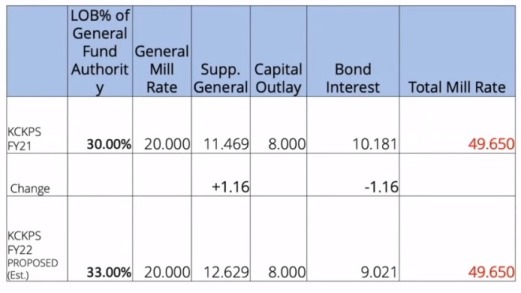
Dennis Covington, chief finance and operating officer, showed this slide about raising the local option budget authority to 33 percent. The chart showed the total mill rate staying the same at 49.650 mills. (From Kansas City, Kansas, Board of Education meeting)

The Kansas City, Kansas, Board of Education on Tuesday night refinanced bonds and raised its local option budget authority to 33 percent.

The action to raise the LOB authority from 30 to 33 percent will not cause the total district mill levy to increase, according to district officials.

While the two actions were independent of each other, they both aligned with the overall objective of improving the district’s financial picture, according to Dennis Covington, chief finance and operating officer.

Refinancing the bonds would save the district about $4 million in interest, according to Covington. The district plans to refinance $82.4 million in general obligation improvement bonds from 2016. The underwriter is Piper, Sandler and Company of Leawood, Kansas, and the bond attorneys are Gilmore and Bell.

Covington said the district has refinanced bonds on about seven different occasions, and about two years ago, it saved the district about $30 million.

Board member Valdenia Winn asked several questions about the refinancing and the increase in the LOB authority.

The district underwent a major building campaign over the past several years, with a bond issue of $235 million. Answering a question from Dr. Winn, Covington said there will also be future opportunities to refinance until they pay off the rest of the bonds.

Refinancing passed on a 4-3 vote with Yolanda Clark, Janey Humphries, Randy Lopez and Dr. Stacy Yeager voting yes, and Maxine Drew, Wanda Brownlee Paige and Dr. Winn voting no.


On increasing the LOB authority from 30 to 33 percent, Covington said the board would have the discretion of how much of that taxing authority it would choose to use. The board will decide at the time it passes the budget how much the LOB rate will be. If the final decision is 33 percent, it could generate an additional $4 million in state aid for operations, according to Covington.

Covington said although the LOB authority was increasing, it would not increase the district’s total mill rate. He said the bond and interest fund would be reduced by 1.16 mills and the supplemental general fund would increase by 1.16 mills.

Dr. Winn asked why wouldn’t taxes increase in 2022-2023, with the LOB going up to 33 percent.

Covington said taxes would not increase because of this action. The overall school district mill rate would stay at 49.650 mills, not changing, he said.

Dr. Winn said that didn’t appear logical to her.

The vote to raise the LOB authority to 33 percent was 5-2, with Yolanda Clark, Maxine Drew, Janey Humphries, Randy Lopez and Dr. Stacy Yeager voting yes.

Dr. Winn and Wanda Brownlee Paige voted no, and Paige said, “because I find this hard to believe.”

The school board has not yet approved a budget for fiscal year 2022.

Several other items also were discussed at the 5.5-hour meeting Tuesday night.
The meeting is online at https://www.youtube.com/watch?v=a3x6wQyeKls.

Not as many BPU customers signing up for state utility assistance as may be eligible

So far, BPU not receiving any payments from state program

More than 1,900 Board of Public Utilities customers are eligible to be disconnected for nonpayment, according to BPU officials at Wednesday night’s board meeting.

Bill Johnson, BPU general manager, said only about 130 BPU customers have made applications so far to the Kansas Emergency Rental Assistance (KERA) program for electric utility payment assistance, far fewer than the number of people who could be facing disconnection.

He said BPU is continuing to work with the state, and it is the second week the BPU has received a report from the program.

The BPU is still requesting customers to notify them when they have filed an application for KERA assistance, and also when they receive notification from KERA that they are approved, according to Johnson. He said the BPU wants customers to make payment arrangements.

“What they want to make sure is nobody drops through the cracks,” he said at the meeting. They’re in the process of matching the KERA weekly reports with information in the system, and if there is any information missing, they want to make sure it gets corrected, he said.

Johnson said the BPU is looking at extending the 30-day grace period or window that BPU customers receive on shutoffs when they apply for KERA assistance. The BPU has not yet received any funding from KERA on the 130 applications, he said.

Johnetta Hinson, executive director of BPU customer service, said the BPU hasn’t received any payments yet from the state for the KERA program, and no notifications of when the applicants will be told if they will receive state assistance.

There is one BPU customer whose 30-day grace period on the KERA application will be over next week, she said. She said the state is saying another three weeks to 30 days.

“We probably do need to look at another 30 days,” Hinson said.

BPU board member Rose Mulvany Henry said she knows BPU officials recognize there has been a hiccup on the front end of the state plan. She said BPU needs to reevaluate its process at BPU considering the hiccups going on at the state level. It doesn’t mean customers aren’t getting approved for the state plan, it just means they are delayed, she added. She said she probably didn’t expect the new KERA program to work within the first 30 days.

Johnson said BPU is having those conversations now about extending the grace period. Also, he said customers need to pay whatever they can. If they continue to use the services, their bill continues to build up, he said.

They are looking at another 30-day grace period, Johnson said, and he added it will be good to have reports from the state KERA program that would give them more information than what they are seeing now.

Henry said pushing out as much information to customers about the programs is important.

Johnson said they are continuing to work with the public, updating information while trying to collect more information.

Board member Mary Gonzales asked if there was any utility assistance money left from charitable funds.

Hinson said they continue to have regular utility assistance and have money from the hardship program. She is not aware of any additional dollars, but they are still getting some utility assistance from agencies making commitments. LIEAP (Low-Income Energy Assistance Program) checks are still being received, she added.

Lori Austin, BPU chief financial officer, said applications for the LIEAP program are open until May 28. Information about applying for the LIEAP program assistance is at http://www.dcf.ks.gov/services/ees/Pages/EnergyAssistance.aspx.

Johnson said there have been initiatives in Washington, D.C., for future funding on utility assistance, but it has to be passed and signed into law for that to happen.

The KERA program is funded through the federal Coronavirus Response and Relief Supplemental Appropriations Act of 2021, which provided the state of Kansas nearly $200 million in rental assistance funding. The Kansas Housing Resources Corp. (KHRC) serves as the administrator of the majority of these funds through the KERA program.

Those eligible to apply include tenants who rent their home, tenants whose 2020 household income did not exceed 80 percent of the area’s median income, households where at least one member is experiencing documented financial hardship as a result of the COVID-19 pandemic, or at least one member of the household is uncertain of where they will stay or may become homeless without housing assistance.

To apply for the program, both the tenant and their landlord must apply online via a joint application process. The landlord completes online certification and the tenant submits the online application. The landlord and tenant are then notified when the application is processed. To learn more about the Kansas Emergency Rental Assistance Program, the qualification and application process, visit the KHRC website at https://kera.kshousingcorp.org/kera.

The BPU is asking customers who receive a notice about their applications from KERA to call customer service at 913-573-9190 and also send their notice from the state to docs@bpu.com.

Anyone with any BPU billing or customer service questions can call 913-573-9190 and a utility representative is available to assist.

A BPU spokesman sent out information on Thursday about a no-charge weatherization assistance program that will help low-income customers reduce their utility costs this summer.

The program through the U.S. Department of Energy and the Kansas Weatherization Assistance Program helps cover the cost of weatherization improvements. The program is funded by DOE and LIEAP, and regulated by the Kansas Housing Resources Corp. Energy auditors will find inefficient areas of the home and then recommend improvements, that are provided free of charge in the program. For more information about the program, visit www.ECKAN.org/weatherization/ or call 785-242-6413.

Sumner Academy named top high school in Kansas, No. 6 in nation

Sumner Academy of Arts and Science has been named the top high school in Kansas and also the No. 6 high school in the nation, according to the U.S. News and World Report rankings.

Sumner Academy also is the No. 1 high school in the Kansas City metropolitan area in the rankings and is ranked No. 4 of all magnet high schools in the United States, according to Dr. Alicia Miguel, interim superintendent of the Kansas City, Kansas, Public Schools.

“We are incredibly proud of the hard work our teachers and students have done over the past year,” Dr. Miguel said at the KCKPS board meeting Tuesday night. It takes a team effort of teachers, students, staff, parents and the community.

Sumner Academy Principal Rick Malone said at the board meeting that it is the third year Sumner Academy has been ranked No. 1 in the state of Kansas on the U.S. News and World rankings. It also received first place in 2019 and 2020.

“Sumner is built on a history of excellence, beginning since Sumner High School,” Dr. Malone said at the board meeting. “There is no doubt we would not be the school we are today without the legacy before us.”

Dr. Malone said one of his goals has been to be one of the top 10 school districts in the nation, and they’re closer to that goal than ever before.

The U.S. News and World rankings are based on performance on state-required tests, graduation rates, how well prepared students are for college, the number of students in advanced placement and international baccalaureate classes, and performance in those classes, he said.

“I’m really proud of those rankings,” Dr. Malone said. “It’s a huge honor for students, staff and the whole community.”

He said Sumner Academy students continue to be academically focused, resilient, and each day they earn the honor to say they’re graduating from the top school in Kansas and the top school in the nation.

According to the U.S. News and World Report Best High Schools rankings, Blue Valley North is the No. 2 high school in Kansas, and Blue Valley West is the No. 3 high school. Other high schools on the top 10 list for Kansas included Blue Valley Northwest, No. 4; Olathe Northwest, No. 5; Shawnee Mission East, No. 6; Blue Valley, No. 7; Andover Central, No. 8; Mill Valley, No. 9; and Northeast Magnet of Bel Aire, No. 10.

According to the rankings, the No. 1 school in the nation was Thomas Jefferson High School for Science and Technology in Alexandria, Virginia.

For more information on the rankings, visit https://www.usnews.com/info/blogs/press-room/articles/2021-04-27/us-news-announces-2021-best-high-schools-rankings.