New KCK police chief sworn in

New Kansas City, Kansas, Police Chief Karl Oakman answered questions after being sworn in on Monday, June 14. His first day as police chief is today. He said it was an honor to return home to the community that had raised him and kept him safe as a child. (Staff photo by Mary Rupert)
Police Chief Karl Oakman, right, was sworn in to his new position on Monday, June 14, by Unified Government Clerk Brett Deichler, left. (Staff photo by Mary Rupert)
New Police Chief Karl Oakman said he would listen and meet with staff today to discuss challenges facing the Kansas City, Kansas, Police Department. (Staff photo by Mary Rupert)

New Kansas City, Kansas, Police Chief Karl Oakman was sworn into office on Monday morning, June 14, in a ceremony at police headquarters.

Chief Oakman, who grew up in Kansas City, Kansas, has served as deputy chief of the Kansas City, Missouri, Police Department since 2017. He has been a member of that department for 29 years.

Chief Oakman was selected from a group of four finalists on May 7, and starts his new job today.

“It’s just a very important honor to me not just as chief of police but to return home to a city that raised me and kept me safe in this community,” Chief Oakman said at the swearing-in ceremony.

He said the first thing he would do today is to listen, and to meet with senior command staff and also with all members of the agency to work on solutions to challenges the agency is facing.

Perception in the community is a challenge, he said. Even when the department does its best job, it could always do better to work on the perception in the community, he said. The department needs to spend a lot of time explaining things to the community that it does best, receiving input and addressing challenges, he said.

Chief Oakman said his 29 years in law enforcement have always been hands-on in the community as well as working with staff to do what he can to improve the community, along with career development for members of law enforcement.

“If you focus on things that make you different from others, you’ll never get anything accomplished,” he said. “What I always do is focus on what I can do, what experience, what information I can bring to improve the quality of life of the community as a whole regardless of your socio-economic status, your race, your gender. As a police chief, I’m a police chief for all members of the Kansas City, Kansas, community.”

In the audience at the swearing-in were Chief Oakman’s relatives and friends who helped him as he was growing up in Kansas City, Kansas. There were some challenges to overcome. Oakman’s father died when he was 6 and his mother died when he was 11.

“The most important thing about it is I understand Kansas City, Kansas, I understand what some people may be going through,” Chief Oakman said. “When you have personal experience, you’re able to come up with better solutions to help all that’s involved. At the time, it was tough, but it served me well throughout my life to make better decisions, to show empathy and understand how law enforcement plays a valuable role in the development of individuals’ lives.”

Mayor David Alvey said he was very pleased and excited for the community. There were four excellent finalists for the police chief position, he said.

“I’m looking forward to the perspective he brings, his experience in law enforcement, and also his roots here in KCK will be so helpful,” Mayor Alvey said.

“I’m just glad the process is over,” Unified Government Commissioner Harold Johnson said. It was a thorough process finding a candidate to lead the police department, and now he is excited to see how Chief Oakman will take command of the police department and lead it forward, he said.

Wyandotte County Sheriff Don Ash said this is an important and historic day.

“It’s one that I think will usher in a real energy and enthusiasm,” Sheriff Ash said.

School board approves plan to get more students involved in activities with new facility policy, following day of violence

In an emotional meeting following the fatal shooting of a teen earlier in the day, the Kansas City, Kansas, Board of Education on Tuesday evening approved opening the district’s facilities for limited student use and community rental.

Under the new policy proposed through the district’s “Enough Is Enough” effort, outside organizations will be able to request to rent the district’s facilities including gyms, fields, tracks and auditoriums. A new fee schedule was approved, with fees much less than those previously charged.

Board President Randy Lopez held a moment of silence during the meeting for a teen who died in a shooting earlier in the day. The teen, whose identity has not yet been released by authorities, was a school district student, he said. The teen was walking on a sidewalk near Hazel Grove Elementary School when he was shot by an unknown person in a vehicle.

Lopez made a plea for the community to come together as the district suffered its 26th student death.

“Let’s come together and find ways to love each other, to bring peace, to work together to end the violence,” Lopez said at the school board meeting. “We can’t have one more student death, especially the gun violence in our community. It hurts all of us when we lose one student, one person in our community.

“Please, let’s work together, we can’t keep doing this to our community,” he said. “We have to love each other and work to come together.

“Let’s find ways to work together, to love and end the violence,” Lopez said.

Lisa Garcia-Stewart, the district’s director of student services, said the facilities proposal was just one plan they can begin to work on in the coming months to provide more connectedness for youth.

“How heavy it is to think about another death of a student, and the family and the students and staff who are impacted in our community,” she said at the meeting.

The board had been scheduled to hear the information about the facilities on Tuesday night, and vote on it at a future meeting, according to a board member, but they decided to vote on it Tuesday night.

A rental fee will be charged to outside groups that do not provide free services to youth, under the new policy.

According to district officials, the plan would allow current coaches in the school district to hold camps or workouts for middle and high school students, with a district stipend provided to those who work with students at least six hours a week for four weeks.

Community organizations could apply to use the district’s facilities. They would pay a fee, provide proof of insurance and would have to follow all district rules, including COVID-19 guidelines, according to officials.

Exceptions to the fee would be if outside organizations holding an educational workshop or camp for district students are working with a school’s coach. In that case they wouldn’t be charged if the coach sponsors the activity.

About $172,000 was estimated as the maximum cost for this program, with coaches paid $500 for providing six hours a week for four weeks of coaching instruction, camp and workouts, according to Tammie Romstad, the district’s athletic director. The stipend program was not likely to use that much funding, according to officials.

Romstad said as many as 2,700 middle school and high school athletes could be part of this coaches’ program through the months of June and July. This did not include outside groups that might come in and present programs, she said.

Board member Wanda Brownlee Paige, who voted against the proposal, was in favor of opening school district facilities, such as gymnasiums, for free play by students. However, Dennis Covington, chief financial officer, said that would not be covered under the district’s insurance.

Coaches who hold programs at district facilities would be covered under the district’s insurance, he said.

Some of the kids who lost their lives were not athletes, Paige said, and may not have participated in these programs had they been offered. She was in favor of splitting the $172,000 and allowing open play for students. She also discussed other uses of the gyms, rooms and facilities, for example, a robotics club, STEM classes or a chess club could be considered.

“They want something to do,” Paige said. “I just want to see us open it up more for that kid.”

Paige also mentioned an incident on Saturday at Parkwood Pool, where teens jumped over a fence and went into a closed community swimming pool to swim. One teen nearly drowned.

The district could take a look at allowing some of the high school swimming pools to be used, she believes.

Garcia-Stewart said they want to expand offerings in the future, but this was just something they could do right now. They also will be partnering with some community organizations to offer some programs that might be similar to what Paige was describing. They will continue to come back and present other options to the board in the future, she said.

Romstad said some of the outside organizations that rent the gyms may not have very structured use of it, and could be similar to unstructured play, for their own groups.

Board member Maxine Drew said they’re laying the foundation, and after they get it started, more could be added later, such as swimming pools opening. Many rooms can be used, she said.

“There is a foundation of where we’re going to go so we can move up to a higher level to get our kids engaged during the summertime,” Drew said.

Dr. Alicia Miguel, interim superintendent, said this was the first step in reopening the district’s facilities. They will continue to meet with community members and reach out to different organizations, so they can come in, she said.

Paige said she thought the district itself should offer free play for students, and not depend on outside organizations to do it. She suggested a coach should let some students in the gym have free play while others are in a program at the same time.

Outside groups that want to rent space in the district’s facilities would apply to Covington, who would review the applications. They would have to have insurance, he said.

The board also approved fees for community organizations to rent facilities, including: $20 for a classroom; $25 for a computer lab; $35 for a gym; $20 for a cafeteria without kitchen services; $20 for training rooms; and $30 for a cafeteria with kitchen services. There are additional charges for security.

To rent a baseball field for 90 minutes would cost $15. There are additional charges for the type of field and lights, as well as security. A stadium could run $25 an hour for turf fields and $25 per hour for lights, plus additional for security.

The school district’s own programs, such as sports teams, would have priority in scheduling, according to district officials.

To view a video of this meeting, visit https://www.youtube.com/watch?v=UseRuODHOYw.

Expanded STAR bond district gets preliminary approval

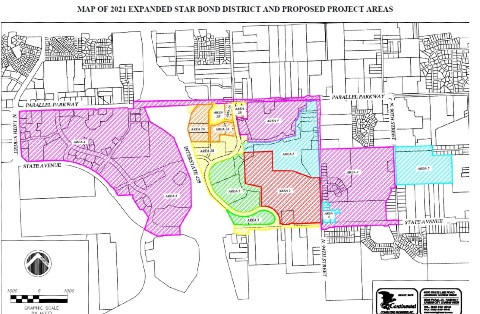
Changes to the STAR bond district in the redeveloped Schlitterbahn area received committee approval and will go to the full UG Commission for approval Thursday. (Drawing from UG agenda documents)

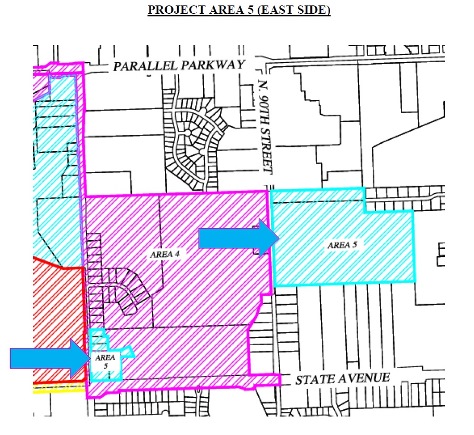
The eastern part of the STAR bond district, between State and Parallel east of 94th Street, includes project areas 4 and 5. (Drawing from UG agenda documents)

An expanded STAR bond district for the Village East area was approved at the June 7 Unified Government Economic Development and Finance Committee meeting.

The STAR bond district expansion was “fast-tracked” and added to the 7 p.m. Thursday, June 10, agenda for the full UG Commission.

According to developers for the Homefield project at the old Schlitterbahn property, a 300-acre area is being extended to 350 acres.

Some projects formerly in one part of the development are being moved to another part of the development in this amended project, according to Robb Heineman, with the Homefield development. Heineman also is the co-owner of Sporting KC.

There is an extended area east of 94th Street between Parallel and State Avenue.

According to UG Administrator Doug Bach, the developer has already spent more than $20 million in land acquisition and demolition costs so far.

He said they want to bring in a new development called Perfect Game.

Heineman said Perfect Game is a very high quality operator that runs tournaments throughout the country. He said developers were able to attract Perfect Game to the Kansas City area.

Twelve baseball fields will be built for Perfect Game events, and a 13th will be built for some events, he said. The attraction will add 75,000 room nights a year for hotels in the next 12 years, he said.

Heineman said they have closed on property for the new Fairfield Inn, a 90-room hotel.

They have signed a letter of intent with a water-themed resort-style hotel to have more than 300 rooms, he added. It would be a full-service hotel. Another hotel is possible, with around 100 rooms.

Also in the STAR bond area, two more car dealerships are slated to open in mid-2022.

According to UG officials, the STAR bonds for this project affect only sales tax. Property taxes are not affected.

The EDF Committee also approved an ordinance on the amended project plans for areas 2B, 3 and 5 within the Village East STAR Bond District. This action set a public hearing for the project on June 24.

The committee also approved a resolution authorizing the execution of a supplemental indenture with regard to an industrial revenue bond issue from 2017 for the Dairy Farmers of America project.


In other action, the Neighborhood and Community Development Committee killed a proposal for a development that would have been built with shipping containers at 3119 Strong Ave. The proposal died when no one made a motion for it. It could be brought back again later, according to commissioners.

The applicant, Oliver Tanner, wanted to use Land Bank property to build an area ringed by decorated or painted shipping containers, with an open courtyard in the middle including picnic tables. There would be a food truck, with pizza available.

The idea was held over from a past meeting so that commissioners could hear about it.

Commissioner Jim Walters said he’s not a fan of shipping containers being used for building projects in Wyandotte County. It is a prominent corner at 32nd and Strong, and it would not be the highest and best use of this land, he said.

Ramon Murguia, an attorney, told the committee he had an office across from this location. He said there had been several investments in the area in recent years, including a new library nearby. Offices and a bank are very close to the location.

He said this is not a warehouse or industrial district, where projects with shipping containers have been built, but a business district. Shipping containers are not up to the standards of the business district, he said.

Tanner said he has been looking at ways to bring up the appearance of the shipping containers. He said he wanted to work with the community. He said he would do whatever was needed to accommodate the community and keep up the professional appearance.

Jeff Bryant agreed it was more of a brick-and-mortar neighborhood and not an industrial or warehouse neighborhood. Commissioner Brian McKiernan agreed there were other places where this project would fit in better.

The details about the Village East projects are contained in the EDF Committee agenda online at https://civicclerk.blob.core.windows.net/stream/WYCOKCK/8fa4271a51.pdf?sv=2015-12-11&sr=b&sig=ewM4fqwAU0LMrwOojprGe24o60VtV1kqlTfDWkqQE80%3D&st=2021-06-08T04%3A19%3A07Z&se=2022-06-08T04%3A24%3A07Z&sp=r&rscc=no-cache&rsct=application%2Fpdf.

The EDF meeting, with more information about these projects, also is on YouTube at https://www.youtube.com/watch?v=CwLIjDiHrVI.