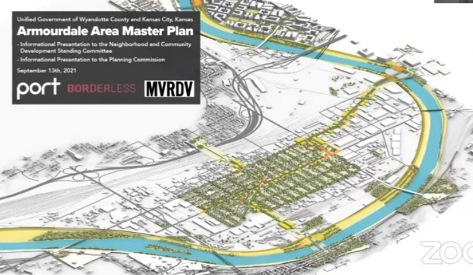
City Planning Commission approves Armourdale master plan

The Armourdale master plan passed unanimously Monday night at the City Planning Commission meeting.

by Mary Rupert

The City Planning Commission voted unanimously on Monday night to adopt the Armourdale master plan.

Andrew Moddrell, project consultant from PORT Design, whose group led the master plan project, said at the Zoom meeting that there was good response from most of the Armourdale residents that they interacted with, and the residents shared their stories and priorities.

The project hired some Armourdale residents to help gather citizen input, he said. A website, armourdalestrong.com, was created.

In answer to a question from Planning Commission Chairman Jeff Carson, Moddrell said some of the Armourdale residents wondered if the UG planners were going to be here today and gone tomorrow, but after months of work there, they gained the confidence of many.

Moddrell noticed that Armourdale residents shared stories about their everyday lives, such as some young residents letting them know they like to walk in alleys because trucks travel too fast on the streets.

Since last month’s presentation to the Planning Commission and the UG Commission, there has been an open house held Sept.21 for residents, and there have been other meetings, also, according to Moddrell.

The master plan also covered some industrial and labor history, as well as the rich Hispanic heritage, of the Armourdale neighborhood in the southeast part of Kansas City, Kansas, he said. The area received its name from the former Armour meatpacking plant and the stockyards in the bottoms. The area faced a legacy of negative developments, such as flooding, population decline, segregation, redlining and displacement, he said.

It was also isolated, as it was surrounded by rails, the river and industrial uses, he said.

With the master plan, the UG is hoping to turn the area around from disinvested, deteriorated, neglected, isolated, vulnerable and segregated to a safe, inclusive, stimulating and attractive place.

The master plan outlined five areas and different strategies. One with the longest list of strategies was the neighborhood core, where housing solutions are part of the focus, Moddrell said. Also important is to increase the capacity of Armourdale community-based organizations, he added.

Commercial corridors were discussed, including Osage Avenue and Kansas Avenue. The master plan wants to build upon the existing structure, and Osage Avenue would be the heart of the neighborhood, he said.

The plan would encourage the walkability of the area, integrate green and infrastructure upgrades and add bus stops.

The master plan also mentioned access to fresh food, public spaces, bike lanes and cultural amenities for Armourdale.

Industrial plans for the area would expand access, encourage recruitment services, bring service to Armourdale, encourage high performance industrial parcels, capture stormwater, and increase sustainable operation of industry in Armourdale.

Hit hard by the 1951 flood, as well as the 1903 and 1908 floods, Armourdale has undergone changes caused by natural disasters. Unlike a former era, building residential homes in the Armourdale area now is being encouraged. Development in the area is being spurred by a federal levee project that strengthens flood protection.
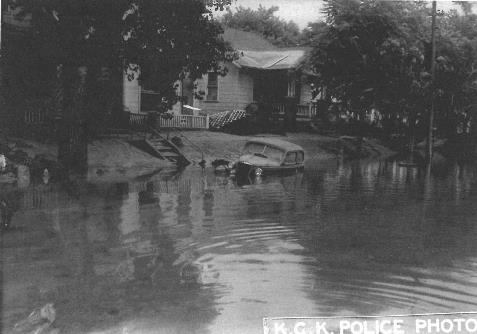
The 1951 flood prevented motor vehicles from traveling in the Armourdale community of Kansas City, Kansas. The Armourdale community was severely damaged by the flood, and many residents resettled in other areas. (File photo courtesy of the Wyandotte County Museum, originally from the Kansas City, Kansas, police department)
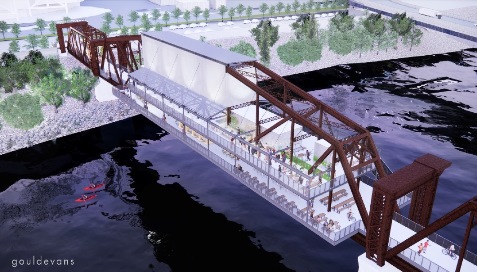
The Rock Island Bridge project being planned for an unused bridge on the Kansas River in the Armourdale area is one example of viewing the Kansas River as an asset instead of a threat. The bridge project would be a tourist destination, according to plans. (Architect’s drawing)

The Kansas River, formerly considered to be a threat from flooding, is viewed as an asset by the master plan. Currently, efforts are underway to develop areas around the river, such as the Rock Island Bridge, as destination tourist sites.

The master plan recommends that the West Bottoms have its own master plan, Moddrell said.

Among the options for the river development in the West Bottoms would be an extension of projects around HyVee Arena, a route for riverfront destination including more civic-minded development, or a logistics and industry hub.

Planning Commissioner Karen Jones said she saw the whole master plan effort as “better late than never.”

“For decades, Armourdale has languished,” she said. She hopes the area now will be moving forward.

She added community engagement of this project was great.

However, she said that some of the good-paying jobs in Armourdale, jobs paying more than $40,000 a year, are going to people who live outside of Armourdale. The average income in Armourdale is around $34,000, she added.

“For sustainability purposes, education is a big component,” Commissioner Jones said. It will take education for residents to get some of the higher-paying jobs. Currently, 50 percent of the people in the area do not have high school diplomas, she added.

Planning Commissioner Evelyn Hill said she appreciated this report, and noted the intergenerational participation it was able to obtain. She also asked if residents were concerned about air quality.

Moddrell said an appendix to the report by Clean Air Now and Beto Lugo provided an air study of Armourdale. While there were not a lot of complaints from residents, there is pollution from trains, trucks and some industries, according to Moddrell.

For the most part, industries around Armourdale currently are logistics-oriented, not big smokestacks and heavy manufacturing, he said. The Clean Air report recommends possible changes to truck routes in Armourdale, he said.

Osage Avenue doesn’t need to be a truck route, he said. At some point in the future, trucks could be routed through Kansas Avenue or Cheyenne. That would strengthen the neighborhood core and Osage could see more pedestrian traffic, he said.

Planning Commission Chair Carson added his vote of support to bring the tally to 6-0 on the master plan, which is expected to go before the Unified Government Commission for a final vote at a later date.

Planning Director Gunnar Hand said this project included a lot of community engagement. He hoped it signals a change where the community, not the planning department, is at the center of the effort. There was a lot of effort to get all UG departments engaged in it, he added.

Monica Mendez, Armourdale Renewal Association executive director, said at the meeting that it was the first time they had seen a lot of effort to get Armourdale residents involved.

Claudine Sanders, vice president of the Armourdale Renewal Association, also spoke in favor of the master plan.

The master plan also is online at https://www.armourdalestrong.com/master-plan-documents.

See earlier story at https://wyandotteonline.com/public-open-house-today-on-armourdale-master-plan/.
Turner Day celebration to be Saturday

There will be some changes this year for the Turner Day celebration on Saturday, Oct. 9.

The event will feature vendor and craft booths, a car show, inflatables and food options, according to Vicki Mullins, public relations chair for the event.

Because of construction at the new Turner middle school, the 36th annual Turner Day celebration will take place at a different venue, Mullins said. The new location is Swartz Stadium, the old football field off 51st and Swartz, she said.

Overflow parking will be available at Turner Recreation at 831 S. 55th, with shuttles available to the event, she said.

The event went from two days to one day this year, she said. Hours will be 9 a.m. to 5 p.m. Saturday. They’re hoping to return to the two-day schedule next year.

The event will not include a parade this year because there will be no parking at the middle school due to construction, she said. Also, mud volleyball will not take place this year.

The rest of the annual event is pretty much the same, Mullins added. Entertainment and the walk of fame also are listed as activities.

All of the events will be outdoors this year, Mullins said. Temperatures are expected to reach 92 degrees in the afternoon.

Turner Days did not take place last year because of COVID-19, and this year, it’s affected because of the construction at the middle school, she said.

Mullins said many of the Turner schools will have booths and activities at the annual Turner Day event.

Funds raised from Turner Day will go back to future events, with some of the funds going to Project Graduation.

Turner Day is sponsored by the Turner Recreation Commission, Turner School District, Turner PTA, Amigos, McCownGordon Construction and other community partners.

Turner Day updates can be found on Facebook at https://www.facebook.com/turnerdaysofficial/.

BPU extends moratorium on electric shutoffs to Nov. 3

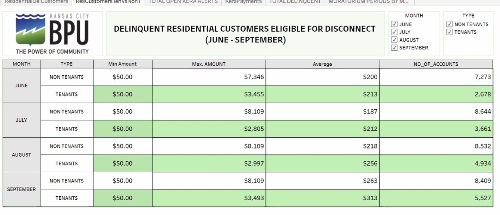
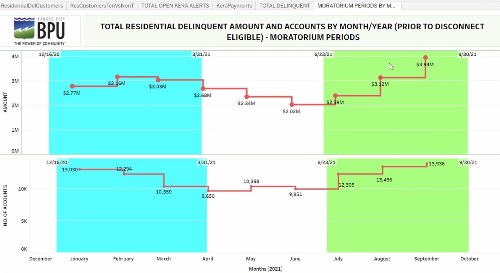
A BPU graphic displayed at the Wednesday, Oct. 6, meeting showed how the total amount of residential delinquent accounts were increasing during moratorium periods. Residential delinquent amounts rose from around $2.4 million in late June to about $3.9 million in September. Almost 14,000 residential accounts were delinquent in September, as compared to around 10,000 in June.
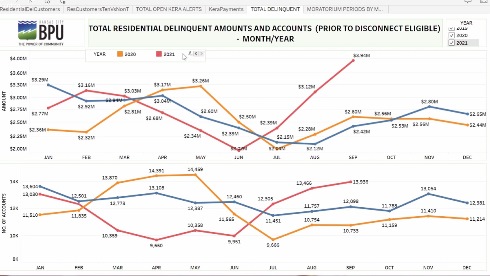
A BPU chart shown at the Wednesday, Oct. 6 meeting, showed 2021 residential delinquencies in red, 2020 residential delinquencies in yellow and 2019 delinquencies in blue. The amount owed is currently higher than in the past few years. The number of delinquent accounts was higher in May of 2020.

by Mary Rupert

The Kansas City, Kansas, Board of Public Utilities extended its moratorium on electric shutoffs for residential customers by one month at its meeting Wednesday night.

The board voted 4-2 on a motion by Rose Mulvany-Henry, with a second from Tom Groneman, to extend the moratorium on shutoffs. Board member Ryan Eidson suggested amending the motion to set a one-month firm date of Nov. 3 to end the moratorium, and it was adopted. Nov. 3 will be the BPU’s first meeting in November.

The moratorium was previously in place June 24 through Oct. 6, and BPU also had a moratorium in place in 2020 and earlier this year.

Voting no on the moratorium extension were Board President Bob Milan Sr. and board member Mary Gonzales.

Mulvany-Henry said there is a pretty big distinction between this pandemic time period and past periods of time. She said a state program, KERA, is in place not only to assist renters today, but also to assist homeowners in the near future. There is also funding allocated from the Unified Government for utility assistance from its federal funding, to be allocated through United Way and local social service agencies such as Cross-Lines Community Outreach, Catholic Charities and Avenue of Life.

“I hear the pain this is on the monthly budget, but this is a community-owned company,” Mulvany-Henry said during the Zoom meeting. “It’s a community-owned asset. I think it would be very difficult for this utility to turn its back on this community when we are still suffering the effects, particularly the marginalized people of this community, are still suffering the effects of the pandemic.”

She said there are still some difficulties that some residents are having in applying to KERA, and the BPU’s program to assist with the applications is only a month or so old. Some community events to distribute information on KERA and utility assistance were discussed at the last meeting but they haven’t had time to take place yet, she said.

“I can’t sit here and turn my back on this community and not allow some additional time to help these customers who need our help the most,” she said. “I just can’t do it.”

She also wanted more information on whether some of the BPU’s payment programs were making it harder for customers to apply for KERA funding. BPU staff said the payment programs shouldn’t make it harder to apply, but community activists said they were hearing otherwise from customers.

Milan said he didn’t agree with extending the moratorium. The BPU is still paying the 11.9 percent of the PILOT fee (payment in lieu of taxes) to the UG on the delinquent bills, he said.

“The moratorium is not the key,” Milan said. “The key is we put out more than we’ve taken in, in a short period of time. That’s my point.”

According to Lori Austin, BPU chief financial officer, the PILOT fees and other UG fees on the BPU bills are paid monthly by the BPU to the UG based on billed revenue. At the end of the year, they reconcile the numbers and adjust the funds paid to the UG for any write-offs, according to Austin.

Milan said the BPU has to start letting customers know that there will be an end to the moratorium, and they will have to pay their delinquent bills as well as their regular bills.

Johnetta Hinson, BPU executive director of customer service, presented detailed information about the number of delinquent residential accounts, including a comparison of how the numbers changed during moratorium periods.

Residential delinquent amounts rose from around $2.4 million in late June to about $3.9 million in September, according to BPU information.

Almost 14,000 residential accounts were delinquent in September, as compared to around 10,000 in June, according to BPU information.

BPU is the only utility in the Kansas City area that still has a moratorium in place, according to BPU officials.

Eidson said he was torn in both directions, on extending the moratorium. He compromised on setting an end time for the moratorium on Nov. 3, with the BPU making more of an effort to tell customers the moratorium will end Nov. 3.

“We have to give people time to prepare, let them know we’ll start turning it off in one month, and move forward,” Eidson said.

Jeff Bryant, who had supported the last moratorium, had mixed feelings about this one, and finally supported the one-month extension with a firm ending date of Nov. 3. Customers would have almost a month advance notice on the end of the moratorium, he said. Also, it gives time to get the United Way dollars from the UG in place, he said.

The board was in favor of more notification to customers, and slowly ramping up the disconnections, starting Nov. 3.

Not receiving about $4 million in cash is a lot of money to be absent, when the BPU is needing the funds for maintenance work going into the winter, Bryant said earlier in the meeting.

BPU assists customers in getting applications in for assistance programs

Patrice Townsend, BPU director of utility services, is leading the effort at the utility to help customers with their KERA applications and utility assistance.

Townsend said on Wednesday that since her program began Sept. 7, they had nine emails to the website, of which two were repeat emails and one was unrelated. They had 73 telephone hotline calls, with 15 repeat calls, and eight unrelated to the program.

She said she has reached out to 50 BPU customers through the program, and 10 were homeowners and did not qualify for KERA assistance.

The remaining 40 customer accounts had about $24,500 in unpaid utility bills, she said. The BPU assisted in helping 11 customers complete KERA applications in the last week, with a potential of $12,850 in revenue if those accounts are approved by KERA, she said.

A temporary employee has been hired and will start Oct. 10 to assist customers, she added.

Townsend said they now have established a great partnership with El Centro, helping to assist customers with debt payment, and to assist homeowners who don’t qualify for KERA. They have referred four customers to them last week, and were able to assist them.

Of the 40 customers who they reached out to, only the 11 customers who completed applications are on the “do not shut off” list, she said in answer to a question from Bryant. When the BPU receives notification of prequalification from KERA, then it puts the customer’s account on a hold.

According to Hinson, the trend has shown that more customers start paying off their delinquent bills or making payment arrangements toward the end of a moratorium period.

They saw increased amounts coming in around Oct. 1, when it was anticipated that the moratorium would end in the first week of October.

In answer to a question from Groneman, Hinson said that when KERA starts accepting homeowners for utility assistance, perhaps around the end of the year, the BPU plans to approach it in the same way, with alerts or holds placed on customers’ accounts if they have completed applications and are prequalified for assistance. The hold on the account would stop disconnections from taking place.

The BPU reported 325 alerts or holds on customers’ accounts in September, with a total of 1,173 since the start of the KERA program.

The utility assistance program, KERA, from the state of Kansas, which used federal funds to help renters, had been difficult for some customers to apply for, with a lot of documentation required. Homeowners were not eligible for the KERA program, but according to officials, plans are to expand it around the first of the year to homeowners.

The Unified Government added more than $400,000 to utility and assistance funds that will be available from its American Rescue Plan Act funding it had received from the federal government, in a program that was expected to start soon.

Some of the KERA rules have changed, and now the landlord’s application is not required for renters to receive assistance.

According to a spokesman, the BPU will work with customers who call the BPU’s customer service department at 913-573-9190 to be placed on a payment arrangement schedule.

Community activists speak in favor of moratorium extension

The BPU heard from community activists at the meeting asking them not to end the moratorium.

Louise Lynch, a Kansas City, Kansas, resident, asked the board to leave the moratorium in place. She said in speaking with United Way officials, she learned an agreement has been reached with extra utility funding available from the Unified Government, to be routed through some United Way agencies. Some of the details of implementation of the program were still being worked out, she said.

By the time people make appointments with the social service agencies in Wyandotte County, get their applications filled out, then allow time to process them, it might take over a month until people are able to use the funds, she added. She said United Way also supported extending the moratorium on shutoffs for two months.

“I’d like to see a moratorium put into place, so they can get that into place,” Lynch said. She added that the fall and winter seasons are coming.

She isn’t asking the BPU to give away anything for free, she said. The money is there for utility assistance from KERA, and from the social service agencies, through the UG’s federal funding through the United Way, she said.

The BPU board also heard from Ty Gorman, a resident, who also supported a two-month moratorium. Gorman has been active with the Sierra Club.

Beto Lugo-Martinez, executive director of Clean Air Now, also spoke in favor of the moratorium extension.

For more information on KERA assistance and more guidelines, visit https://kshousingcorp.org/emergency-rental-assistance/.

For assistance with food, housing and utilities, the United Way’s telephone number is 211.

BPU customers may call the BPU’s customer service department at 913-573-9190 to talk about their bills or make payment arrangements.

To see a past story about the BPU moratorium, visit https://wyandotteonline.com/bpu-extends-moratorium-on-utility-shutoffs-to-oct-6/

A BPU graphic shown at the Wednesday, Oct. 6, meeting showed that average delinquent residential customer bills were $263 and $313 in September, with almost 14,000 customers delinquent. Homeowner delinquencies are increasing.