
Residents urge legislative redistricting committee to keep Wyandotte, Johnson counties together

Wyandotte County residents on Tuesday evening told a legislative redistricting committee they wanted Wyandotte County to stay together with Johnson County in the 3rd Congressional District.

The legislative redistricting listening tour went to Bonner Springs and Stilwell on Tuesday evening to hear comments from residents. It was the second round of redistricting listening tour meetings. Committee members listened to comments by video from Topeka, while residents made comments from their communities.

Connie Brown Collins, a resident of the Welborn area of Kansas City, Kansas, implored the committee to “keep Wyandotte County whole.”

After census results came in, it was found the 3rd District is about 57,816 persons over the ideal population of 734,470, about 7 percent over the ideal, according to Jordan Milholland of the Kansas Legislative Research Department. The 3rd District will have to give the extra population to another district or districts in the state.

Collins, who is with the Voting Rights Network of Kansas, said that western and southern townships in Johnson County could be moved into another congressional district. Currently the 3rd District includes Wyandotte, Johnson and parts of Miami County.

Collins echoed a speaker at the Stilwell location, Amy Carter of Overland Park, who said areas including DeSoto and Louisburg might be moved into another district. The most populous parts of Johnson and Wyandotte counties should be kept together in the 3rd District, while the more rural parts of Johnson County could be moved into another district, Carter suggested.

Also speaking was Dr. Bruce Carter of Overland Park, who said the 3rd District’s diversity needs to be maintained. He noted the district was winnable by either party now. He asked that the voters be allowed to make their decisions and choose their representative; the representative should not be determined by the lines drawn by the legislative committee.

“We voters should be making that decision,” he said.

Collins said Wyandotte and Johnson counties share employment and transportation systems, and as part of the Greater Kansas City area should remain in the same district.

Henry Chamberlain, Bonner Springs, talked about diversity in Wyandotte County, and the difference between rural and urban areas. It would probably be impossible for a representative from rural Kansas to fully understand and represent his interests in an urban area, he said.

Chamberlain told the committee he had expected to be one of the people funding litigation in case the district’s boundary lines were gerrymandered. He urged the committee to keep Wyandotte and Johnson counties together in the 3rd District. He told the committee that they had the ability to avoid delay, litigation and expenditure of public resources, plus there was the opportunity to restore the faith of Kansans in their Legislature.

Alex Overman, who lives in Lenexa and works in Wyandotte County, offered several redistricting maps for the committee. One of them, for example, kept all the cities intact and together, while removing Gardner, DeSoto and Edgerton from the 3rd District.

“If we break up Johnson and Wyandotte counties, someone’s going to be misrepresented,” he said.

Mike Taylor, a retired public relations director for the Unified Government, was representing the Voter Rights Network of Wyandotte County.

He told the committee that Wyandotte and Johnson counties are not only neighbors, they have strong community interests. They share sewer systems, transportation networks, infrastructure networks, and a lot is dependent on federal funding, Taylor said. It’s important to have one federal representative to fight for that funding, he said. Twenty-two mayors in both counties meet on a monthly basis.

Taylor felt that it would be pretty easy to solve the redistricting challenges unless there is an attempt to gerrymander, and “we urge you not to do that.”

After the committee has drawn the maps, Taylor asked it to hold another round of public hearings.

Cassandra Woolworth of Johnson County said the biggest issue was keeping Wyandotte and Johnson counties together.

“We don’t want gerrymandering,” she said. “We don’t want any kind of slanted political view. Aren’t we done with that yet, don’t we already have enough partisan politics.”

She recalled the courts had to decide the issue in 2012. There had been a proposal to put Wyandotte County in with a district in western Kansas.

“I don’t want history to repeat itself,” she said.

“Gerrymandering is cheating,” she said. “We teach our children not to cheat. We can’t show them that cheating is the way to win.”

State Rep. Chris Croft, R-8th Dist., chair of the House redistricting committee, conducted the legislative redistricting listening tour.

State Rep. Tom Burroughs, D-33rd Dist., is the House redistricting committee ranking minority member.

The committee also is still taking written comments at kslegresearch.org.

The listening tour from Bonner Springs and Stilwell is online at https://www.youtube.com/watch?v=r8haWh3w7Ts.
UG commissioner comes up with his own stormwater plan

Commissioner Brian McKiernan has come up with his own solution to the community’s stormwater problems.

The UG Commission had discussed several options for stormwater management fees without really coming to a solution these past few years.

The UG has scheduled a stormwater user fee question-and-answer session at 11:30 a.m. Tuesday, Nov. 30, on Facebook live and Zoom. During a 45-minute session, residents and others who are interested may ask questions to the public works director and the public works community engagement officer. The Zoom link for Tuesday’s meeting is https://us02web.zoom.us/j/82448467061. The meeting ID number is 824 4846 7061. To access the meeting by phone, call toll-free 888-475-4499 or 877-853-5257.

At the Nov. 18 UG meeting, Commissioner McKiernan presented his own plan for stormwater fees, which he felt was fairer than some earlier plans. His model, which he has worked on for a few years, was individually calculated per property.

At the same time, the UG has another alternate tiered stormwater option it is proposing.

The UG Commission is scheduled to discuss the stormwater fees again at its meeting at 7 p.m. Thursday, Dec. 2. Simultaneously, there is a vote scheduled that day on a revolving loan from the state to use for stormwater. That loan issue was advanced from the Monday night, Nov. 29, UG Economic Development and Finance Committee meeting.

A tiered plan has been proposed by the UG that would have a low monthly rate for residential customers, and a tiered rate for all other customers, based on the size of their parking lots, impervious surfaces and paved areas. At the Nov. 18 meeting, Commissioner McKiernan voiced his opinion that a tiered plan would be inequitable across different property sizes and across different ratepayers.

He illustrated this “inequity” by describing what Tier 4 customers would pay for 49,999 square feet of impervious surfaces – $95 – as opposed to what Tier 5 customers would pay for 50,001 square feet of impervious surfaces – $375.

Also under one of the UG plans, a Tier 5 customer with 2.5 million square feet of impervious surfaces would pay the same fee, $375, as the customer with 50,001 square feet, and Commissioner McKiernan said he considered that inequitable.

His model still had a gap of $10 million to $12 million between what was needed by the county for the stormwater services and what was raised through the fees.

He suggested using ARPA (American Rescue Plan Act) funding to make up the difference, and lessen the burden on the taxpayers.

According to the UG, to qualify for funding from the WIFIA (Water Infrastructure Finance and Innovation Act) program, the UG needs to have a plan in place by the end of 2021.

Mayor David Alvey said he would prefer that the stormwater program be self-sustaining. Long-term, as a maintenance fund, it needs to generate its own funding, not pull revenues away from the general fund, he said. He also said he supported an equitable rate, adding it was a defensible solution.

McKiernan said he understood that the community had many needs that were sharpened by COVID, and there are many ways to spend those ARPA dollars besides slowing the rate of the rise of stormwater fees.

Public Works Department officials said they have different options, with or without ARPA, that they could talk through. They face deadlines for the WIFIA funding. They urged the commission to take action on one of the two options.

If action isn’t taken, it could turn into a failed system within 10 years, according to Public Works officials.

At the special session, there was support for McKiernan’s plan from some of the commissioners,

Administrator Doug Bach said there could be many different grant programs the UG could apply for, and there were different options available, not just only using ARPA funding, although that is an option.

Commissioner Harold Johnson said he was more confident knowing the UG has options. Knowing there were other means gave him confidence to support McKiernan’s proposals, he said.

Commissioner Tom Burroughs said he hadn’t voted for any of the plans moving forward. They finally have a plan in place that a majority of small and large businesses can agree on, he said.

“What concerns me greatly is all of a sudden every plan is just fantastic as long as we supplement it with ARPA funding,” Burroughs said. “We don’t know how much ARPA money we’re going to need or use, but we can’t wait to spend it. And that concerns me greatly.”

He said he voted against the plan to put ARPA dollars back into the budget, which denied the commissioners the chance to direct how to spend them.

Burroughs said the Kansas City, Kansas, Area Chamber of Commerce was supportive of the five-tiered rate structure described by Public Works officials.

He also he doesn’t believe the numbers were reflected correctly in the budget. He pointed out the roads were atrocious on the south side. And he wanted to wait until the middle of December to consider the stormwater issue.

Commissioner McKiernan said he understood the concerns about him bringing these concerns up, and whatever the commission decides to do was fine with him.

Commissioner Gayle Townsend asked if the shortfall money would solve the problem for three or four years, and then they would be back having a similar discussion about stormwater.

Bach said there was a drawdown structure with the WIFIA funds. Public Works officials said if they didn’t fill the gap immediately, there would still be some programs done. They would have five years after completion of the work to start paying for it. Some smaller projects could be cut.

Bach said adopting either McKiernan’s plan or the tiered plan would allow them to move forward.

Commissioner Townsend was concerned that the homeowners in her district would not be burdened with anything more.

“There has been an increase; I am adamant there would be no more,” she said.

The WIFIA loan, as proposed, would be around $150 million in low-interest loans, according to Public Works officials. Without it, they wouldn’t be able to do several large stormwater projects.

Commissioner Jane Philbrook said they need time to put together their proposal. They need a specific plan for their proposal due by the end of the year.

She asked if they would want to take a straw poll on how many commissioners supported McKiernan’s plan, but that was not done. Mayor Alvey said they wouldn’t vote until Dec. 2 and wouldn’t assume they would move one direction or another.

Commissioner Melissa Bynum said she was supportive of Commissioner McKiernan’s plan but wanted to know if there were opportunities to hear from the public about it. A public hearing would be required, Alvey said.

Commissioner Burroughs said in talking with the chamber members, they could accept the five-tiered plan because there was certainty built into it. He said as a fiscal conservative, he thinks the ARPA dollars should be used in a prudent manner. He wanted to make sure they could get the best return on investment if they used any of the ARPA funds.

Commissioner McKiernan’s presentation about his stormwater plan took place during the Nov. 18 special UG meeting and is online at https://www.youtube.com/watch?v=Wk0f8dSvQ2U, beginning at 39:33.

KCK mask ordinance extended through Jan. 6

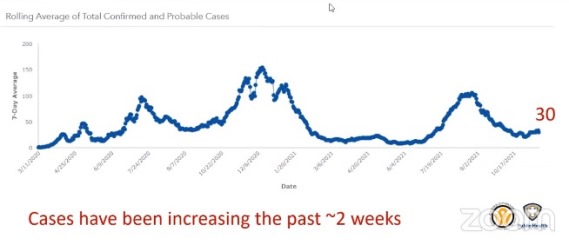
A graph from the UG Health Department showed that COVID cases have been increasing slightly in the past two weeks. (UG Health Department graph)

A mask ordinance for indoor public spaces in Kansas City, Kansas, was extended through Jan. 6 at the Thursday Unified Government Commission meeting.

The mask ordinance does not apply to Bonner Springs, Edwardsville and school districts.

The vote was 6-3. Mayor David Alvey cast the sixth vote in favor of the mask ordinance. Voting in favor of it were Commissioners Gayle Townsend, Jane Winkler Philbrook, Angela Markley, Christian Ramirez, Harold Johnson and Alvey. Voting against the mask ordinance were Commissioners Melissa Bynum, Tom Burroughs and Brian McKiernan. Not present were Commissioners Jim Walters and Mike Kane.

Dr. Erin Corriveau, deputy health officer in Wyandotte County, said the CDC still considers Wyandotte County as an area where there is uncontrolled spread of COVID, and a lot of the surrounding area also is considered high risk.

COVID cases have been increasing slightly in the past two weeks, she said.

Many Wyandotte County residents remain unvaccinated, Dr. Corriveau said.

Only 53.1 percent of Wyandotte County residents have received at least one dose, while 45.6 percent of Wyandotte County residents have completed their vaccine series, she said.

Other areas, such as Johnson County, without mask requirements, have higher vaccination rates, she said.

Dr. Allen Greiner, chief health officer for Wyandotte County, said with the winter weather starting, more people will be indoors, and that results in an upsurge of COVID cases. He also discussed COVID surges seen across the country and in Europe; children under 5 being ineligible for the vaccine; almost half of the county’s residents are unvaccinated; immunity is waning for those vaccinated more than six months ago; and hospital resources remain under pressure.

Mask wearing makes a difference for vaccinated and unvaccinated individuals because of the potential for breakthrough cases, he said. Data shows that mask-wearing also makes a difference in schools, he added.

While they are seeing a lot of kids ages 5 to 11 get vaccinated now, Health Department officials were not optimistic that enough will get vaccinated. That’s because the lowest number of adult age groups being vaccinated here are between their 20s and 40s, and that is the age of the parents who need to bring their children in to get vaccinated, according to health officials.

Besides kids, the Health Department also is seeing a lot of adults now getting their booster shots, according to health officials. They are not seeing very many coming in to get their first shots.

Commissioner Ramirez supported the mask ordinance, but said there were a lot of businesses that were not fully complying with it.

Dr. Greiner said different communities had different attitudes, and the mask ordinance was more complied with in some parts of Colorado.

Mayor Alvey said complaints were received about two large retailers not complying with the mask mandate, and an investigation found that compliance actually was relatively high there.

None of the measures they are taking against COVID is 100 percent, but like the Swiss cheese model, where several measures are taken at the same time, it all adds up, he said. Mayor Alvey said each person has a personal responsibility and personal freedom – to not get it and not give it.

Dr. Philbrook, an optometrist, said her district is 2-1 in favor of keeping the mask mandate. Only one in 20 of her patients complain about masks, and the rest are saying keep the mask on.

Commissioner Townsend, who made the motion for the extension of the mask ordinance, said she understood that people were suffering from mask fatigue, but that can’t get them beyond the pandemic. Vaccine and use of masks have been proven to protect the community, she said. The community needs to go back to education and enforcement, she said.

Commissioner Burroughs said he thought the community was fairly equally divided on the issue. Outside the community, people point at Wyandotte County as not being a healthy county because it still has a mask mandate in place, he said. He said it was time to let the mask mandate expire.

Commissioner McKiernan said that intellectually and medically he knows masking is what needs to be done, but as a practical matter, he didn’t.

He said private homes are going to be one of the places of most frequent gatherings during the upcoming holiday season, and private homes are not covered by the mask mandate. Also, at restaurants, people are allowed to take their masks off while they eat and drink. People also will gather at schools during the holidays, and the Commission has ceded its authority on masks to the school districts, he said.

“Many people who are vaccinated are very frustrated,” Commissioner McKiernan said. “They believe ‘I’ve done my part, when is everybody else going to step up and do theirs.’”

It drives people to say they’re done with it, he said. There’s a large “you ain’t the boss of me” attitude out there, he said. A lot of people are ignoring the mask mandate. He still would encourage individuals to continue to wear masks, he said.

The mask ordinance will be in effect through 11:59 p.m. Thursday, Jan. 6.