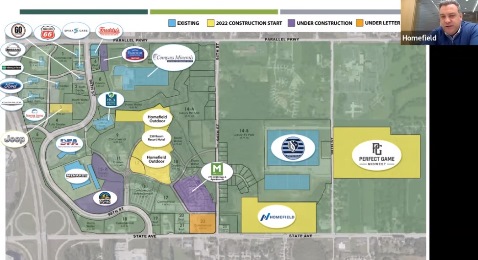
A largely expanded $150 million Homefield youth sports development, including a Margaritaville hotel and resort, was outlined at a special Unified Government committee meeting on Tuesday night.
The Homefield project was back in front of the committee because of a request to increase the overall STAR (sales tax revenue) bond request from $130 million to $150 million, and to make adjustments to the project agreements, according to UG officials.
The project now includes an increase in the baseball components of the project from $15 million to $40 million, with the addition of the Perfect Game partnership, according to developers. The baseball development focuses on high-tech data capture and analytics.
The $85 million Margaritaville hotel and resort also has been added since the project received earlier approval in November 2020, according to Katherine Carttar, UG economic development director.
The committee voted unanimously to approve the bond request and amended assignment and assumption agreement for the project, and advance it to the Thursday, Jan. 25, full UG Commission meeting.
To be built at and around the former Schlitterbahn waterpark at 94th and State Avenue, the Homefield development plans have changed since 2020, according to Robb Heineman, who is leading the project, and appeared before the committee.
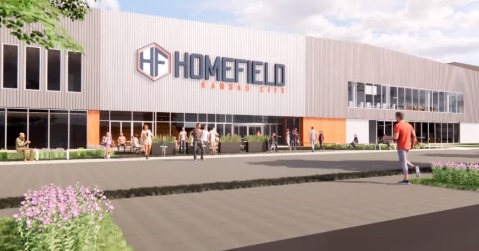
Homefield itself, now to be located on State Avenue, east of the primary resort area, is about a $60 million building that is undergoing planning, with construction to start in the spring, he said.
“We really didn’t realize what impact it could have as a catalyst moving things forward,” Heineman said.
Heineman, who is well known for his leadership and ownership roles with Sporting Club, outlined different parts of the Homefield project. Under construction today, he said, were $75 million worth of projects, including the Fairfield Inn, a $10 to $12 million project which has been under construction about 60 days; the Camping World RV retail location, a $15 million project under construction that may open this fall; and the Millhouse apartments, with 270 units, a $50 million project.
Heineman said the project team has done about $20 million in land acquisition. The Homefield building itself now has moved to the east of the original location, he said. Before they move forward with any public issuances, there is already $95 million committed to the project, he said.
“We feel like we’re making good progress,” Heineman said. “We feel very good about how things are progressing and we’re very optimistic about how things will go in the future.
“The thing that came out of the blue for us a little bit is this Margaritaville resort,” Heineman said. “It’s one of the hottest things in the United States right now.”
There are Margaritaville resorts in New York and in Orlando, he said. Also, he said there is still a lot of land left there to be developed, with other projects under consideration.
Todd LaSala, outside counsel for the UG on this project, said the projects have grown in the past few years. He said the design of the Homefield outdoor sports and entertainment complex would be partially integrated with Margaritaville.
STAR bond project details
Carttar said a STAR bond district was originally created for the Schlitterbahn project in 2005 with six different areas. In 2015, the UG issued two series of STAR bonds for the Schlitterbahn project, Series A for $72.9 million and the Series B for $12.2 million. The Series B bonds were backed by a UG annual appropriation pledge, meaning if they were not paid off by sales tax revenues, the UG would have to pay the difference, she said.
Schlitterbahn closed and sold the property to Homefield in the last year and a half.
Carttar said in November 2020, the UG entered into a development agreement with Homefield to demolish Schitterbahn and replace it with a new project.
She said the UG had three objectives: to remove Schlitterbahn and solve problems related to the closed project; to make sure the 2015 STAR bonds would pay off, especially the 2015 B bonds; and to bring a new attraction to the community to stimulate visitation and economic development activity.
With the proposed changes to the 2015 B bonds, the UG would not be on the hook for any appropriations, she said.
While the Margaritaville resort was just a hope the last time the project came before the commission, it is now a requirement of the project, she said.
Three Homefield components will be paid for with STAR bond proceeds, LaSala said. The Margaritaville Hotel is intended to be financed primarily with private dollars, he added.
Homefield Building and Homefield Baseball should open by July 2024. Homefield Outdoor and Margaritaville should open by 2025, according to LaSala.
The phasing of the two STAR bond issuances has changed. It was originally going to be $75 million in the first issuance and another $55 million. Now it has changed to $130 million for the first issuance and $20 million for the second.
Originally the bond sale was to be a private placement, but now they expect to issue the bonds in a public sale, LaSala said.
The developer has agreed that the first dollars issued from STAR bonds will be used to retire and fully pay off the 2015 B bonds, LaSala said. This will end the UG’s general appropriations pledge, he said.
Also, the UG is making sure more private money is in the deal than public money. The agreement now has a 40 percent public, 60 percent private ratio, a change from the earlier 50-50 ratio, he said.
The second issuance will have a 30 percent public and 70 percent private ratio, LaSala said.
That results in a required private investment of $195 million for the first issuance and $46.8 million for the second, he said.
LaSala said the original community improvement district for Schlitterbahn has been terminated, but this agreement contemplates that one or more additional CIDs could be used for Homefield project. Most of these are done on a pay-as-you-go basis, he added.
Those CIDs would have to come back to the UG Commission for approval, he added.
The developer will ask for a specific stand-alone CID for the Margaritaville hotel and resort, he said. It will be a 2 percent CID and they will ask to sell bonds for it, he added. That would also require UG Commission approval at a later time.
Other incentives include industrial revenue bonds for the Homefield project, he said. If they issue IRBs, the developer would receive abatement of sales tax on construction materials and labor, and the UG would agree to a payment in lieu of tax schedule to specifically say how much property tax the developer would pay over the first 10 years of the agreement, he said.
Also, 70 acres of land that the UG owns in that area originally was to be sold to the developer for $3 million. That money was never to be paid directly to the UG, but it was to go toward paying the 2015 B bonds that the UG had backed, LaSala said.
Now that the bonds are being paid in full, that payment is no longer necessary, and the UG has agreed to transfer the 70 acres of land to the developer for free, according to LaSala.
The Schlitterbahn agreement included a provision for annual donations to foundations abd nonprofits.
Those funds were allocated by the commissioners to various nonprofits. However, toward the end the donation payments were not made by Schlitterbahn, LaSala said.
The 2020 agreement required Schlitterbahn to pay what was owed to the developer at the land closing. Also, the agreement said in the future the developer will make investments in the downtown area and historically urban areas instead of making the donations to nonprofits, he said.
The amount of investments now is $4.35 million in the first three years after the agreement, as compared to the $3.75 million in the prior agreement, he said.
The UG’s goals for minority, women and local business participation are 18 percent for local construction, 15 percent for minority and 7 percent for women participation. Also for professional services, the goals are 18 percent local, 13 percent minority and 8 percent women.
If the development does not comply with the goals, there will be a 4 percent reduction in available STAR bond proceeds, LaSala said.
Carttar said because it is a STAR bond project, the state is a critical partner. They have been working with the governor and the Commerce Department to move the project forward for years, she added. The state had requested a little more time to review the details of the project before it moved forward again, she added.
Commissioners address concerns
“This project is a lot more transparent tonight than it even was six weeks ago,” Commissioner Tom Burroughs said. Many of the concerns raised earlier have been addressed, he added.
Heineman said in answer to a question from Commissioner Gayle Townsend that Perfect Game will be required to have 75,000 room nights. The events bring in 250 to 300 teams per event, with 16 players per team with a few adults per kid, he added. With running at least 35 weeks per year, they should be able to bring in those numbers, he added.
The flagship and tourney will be in Kansas City, Kansas, but they also will use other baseball fields throughout the metro area to support this, Heineman said. Championship games will be on premise, with Homefield booking the rooms. The people attending these tournaments would stay first at hotels in the Homefield area, then next at Village West, third at Kansas City, Kansas, at large, and lastly, they would stay in the state of Kansas, he said.
Commissioner Townsend also asked about the possibility of local youth being able to use the Homefield and baseball fields.
Heineman said with all components, there will be various privileges for local kids and citizens, possibly including discounted rates, free access, special events and advance access. With baseball, there will be Homefield teams including local kids who will have access to everything that is held, he said.
Homefield will run its own baseball program as well, and will look to attract metro area kids to that club, he added. They will have to work on transportation plans to breathe some life into it, he added.
Answering a question from Commissioner Andrew Davis, LaSala said the pilot payment will be $241,000 for the first year, and it grows over time to $263,855 in year 10. The baseball payment is $106,703 and it grows to $116,699.
Commissioner Davis also asked about the $4.35 million investment program. Heineman said they expected to have lots of ideas brought to them by the commissioners. They have no preconceived notion on what to do with them, but those projects that would be attractive to them would have synergies with sports, youth athletics and events, he said. They want them to be for-profit projects.
While they outlined the payments on the Homefield buildings, there will be hundreds of thousands of more property taxes eventually paid by other developments on the property, such as medical offices and retail sites, Heineman said.
Heineman said they are open to plans to work with the school districts and plan special events with them. There are tons of great amateur athletes that are probably not getting the resources they need, and they would like to change that, he said. They would like to see kids from here succeed, he added.
Elnora Jefferson asked if the investment in the downtown area and urban cores is something that would be decided by the local commission or if it was in the development agreement.
LaSala said the development agreement called for each of the inestments to be approved by the county administrator.
Commissioner Burroughs, who is also a state representative, said he had raised that question in the original agreement. He thought the commission had the authority and responsibility to advance and spend those dollars at the advice of the administrator.
The developer originally requested approval by the administrator because it streamlines the process and would move faster, according to LaSala.
Commissioner Davis’s motion was to change the agreement to state the UG Commission would have approval of the investments in the downtown and urban area, not the county administrator. The agreement was approved as amended.
Heineman said they would be willing to work with whatever the commission decided. They expect the commissioners to bring up ideas for the projects. However, they don’t want the projects to become a political hot potato, and that’s why they did them the way they did, he said.
“We just want to make sure we get this done,” he said. The timeline is only three years and they need to be efficient getting through those approvals, he said.
Previously, the UG Commission spent a lot of time deciding where individual soccer courts would go, in a previous community project associated with Sporting KC.
Sen. David Haley, a member of the EDF Committee as the BPU representative, said in the past, in the Senate, he did not support STAR bond projects in general. It seems like there has been better due diligence paid to this project than the previous projects, he said.
He liked this project as it paid off the earlier STAR bonds and it provided investments in the eastern part of the community. His past concerns have been pretty well allayed with this current Homefield project, he said.