Residents, leaders offer ideas to improve health in Wyandotte County

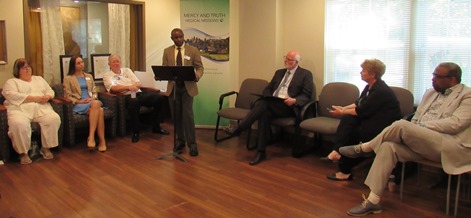
A discussion was held Thursday morning on how to improve health in Wyandotte County. The discussion was at Mercy and Truth Medical Mission, 721 N. 31st St., Kansas City, Kansas. (Staff photo by Mary Rupert)

by Mary Rupert

What’s needed to improve health in Wyandotte County?

That was the topic on Thursday morning in an informal “Muffins with the Mayor” discussion at the Mercy and Truth Medical Mission, 721 N. 31st St., Kansas City, Kansas.

Mercy and Truth is one of several safety net clinics in Wyandotte County. Some of their clients are uninsured.

Participants in the discussion touched on a number of issues, including the need to expand KanCare (Medicaid in Kansas) and cover more uninsured patients, the need to bridge a language barrier that slows down communication with patients, good jobs that would provide health insurance for employees, and a better environment including more walks or pathways for exercise.

One discussion participant, Catherine Sarensen, membership marketing team leader at Sam’s Club in Kansas City, Kansas, which provided the refreshments and also made an $1,800 donation to Mercy and Truth clinic, shared a personal story about a family member’s experience with the health care system.
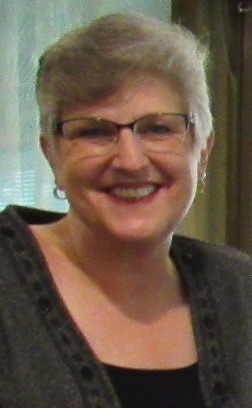
Catherine Sarensen (Staff photo)

She said the family member had an immune disease, could not work, and could not get marketplace insurance.

“We didn’t have care for her,” she said. “She’s still sick.”

It’s important to get the word out about safety net clinics, she said, as several years ago they had no idea that the clinic was here.
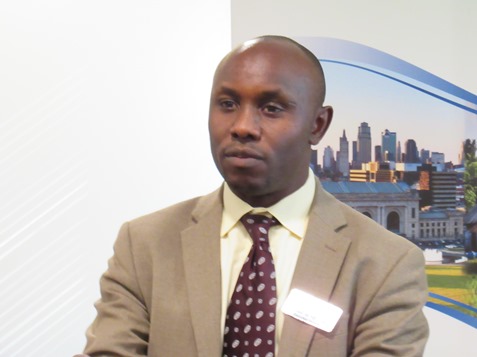
The number of patients is growing this year at Mercy and Truth Clinic, said Dr. Geofrey Kigneyi, executive director. (Staff photo by Mary Rupert)

Dr. Geofrey Kigneyi, the executive director of Mercy and Truth Clinic, told the group that when it started in 2007, Mercy and Truth in Kansas City, Kansas, was seeing 5,000 patients, by 2018 it was up to 7,000 patients, for 2019 it anticipated 9,000 patients, but already it looks like it will exceed 10,000 patients in 2019.

“Jobs are the No. 1 problem for Wyandotte County,” said Unified Government Commissioner Jane Philbrook. Jobs are necessary that have insurance with them.

She said people have to reach out to get health care for themselves and their families.
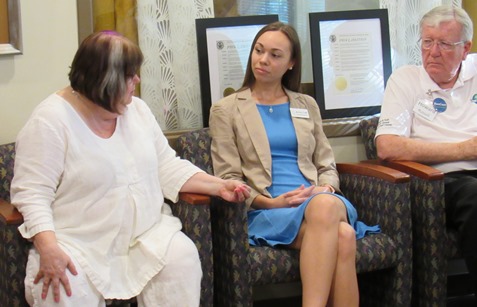
Jobs are the top concern, said UG Commissioner Jane Philbrook. (Staff photo by Mary Rupert)

Howard Russell, an ex-officio board member of Mercy and Truth Clinic, said that often, the amounts patients pay at the safety net clinics do not cover the costs of such items as blood tests and radiology.

Another participant in the discussion, from a safety net clinic, said that one of the local hospitals is not accepting referrals of patients without a Social Security number. Some of them have cancer or serious diseases.

“I think that is unacceptable,” she said. “I just think that’s preposterous.”

“We are all people and everybody deserves health care,” she said. The Mercy and Truth Clinic does not require patients to have a Social Security number.

The University of Kansas Hospital in Kansas City, Kansas, does not require patients to have Social Security numbers, according to a hospital official.

It also is a challenge for safety net clinics to address serious illnesses and complicated cases, said a participant from another safety clinic. They sometimes receive some funding from foundations to help.

“We send a lot of referrals,” Dr. Kigneyi said, “but the waiting list is long.”

Mark Schmidt, a board member at Mercy and Truth, said the specialty care is really a needed resource. Prescriptions and radiology are something that others take for granted, but they are hard to come by for the patients at the safety net clinics, and help would be appreciated.

Barry Johnson, another participant, said adding walking paths in the community and teaching people healthier habits would help improve health here.

Another participant urged the mayor and UG Commission to use their purchasing power to set an example to pay for health, not fee per service.
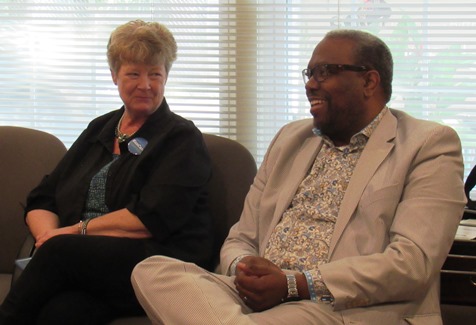
Reducing poverty will help solve some problems, including some health care problems, according to Commissioner Harold Johnson, right. Commissioner Melissa Bynum said expansion of KanCare is her top priority. (Staff photo by Mary Rupert)

UG Commissioner Harold Johnson said that jobs, affordable housing and the language barrier all are important issues, and that trying to reduce poverty in the community is important.

“We have to figure out a way to pragmatically prepare our people for jobs,” Commissioner Johnson said. A lot of times, the technology is not there and there’s a language barrier, he added.

“If you raise the income, reduce poverty, it raises all of our communities up in terms of their access to health care,” he said. “It will be that rising tide that raises all boats.”

UG Commissioner Melissa Bynum said expansion of Medicaid, or KanCare, is her top priority for health care. She added that Rep. Kathy Wolfe Moore, D-36th Dist., had led the effort in the House for KanCare expansion.

Also, affordable housing is one of the key components that could improve community health, she believes. Keeping people living in their homes and keeping it affordable is key to improving health, she said.

KanCare passed in the House, but failed in the Senate during the past session.
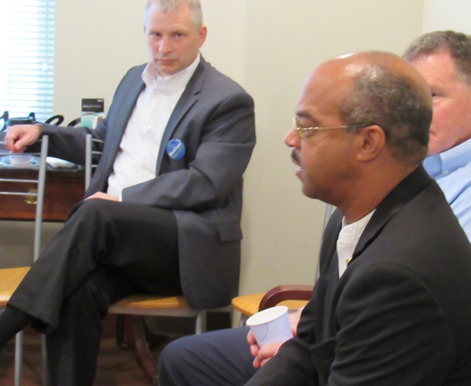
Sen. David Haley, right, is concerned about neonatal care and low birth weight in Wyandotte County. (Staff photo by Mary Rupert)

Sen. David Haley, D-4th Dist., commented on the inequities between the wealthier areas and those that were not as wealthy. He said while waiting for the bill to pass, other things might be done to help stabilize the inequities. He has supported Medicaid expansion.

He said he was concerned about neonatal care and low birth weight especially in communities of color. He said he doesn’t know the answer to this situation but he appreciated those who continue to work on it.
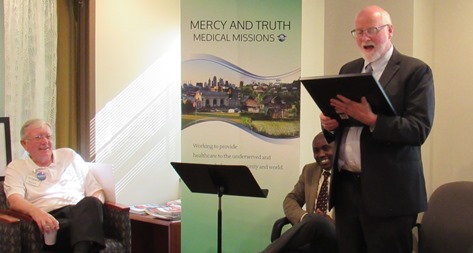
Mayor David Alvey, who read a proclamation at this event, said “Getting to know the poor is the beginning of all we do,” and would lead people to act. (Staff photo by Mary Rupert)

Mayor David Alvey said a travesty in this country is the “geographical and psychological distance that we put between ourselves and the poor.”

Mayor Alvey said that people who had direct contact in working with the poor, such as tutoring children, mentoring women, and working in the food kitchen, would be moved to serve and would have a commitment together to address the problem.

He said what the safety net clinics are doing, reaching out and serving the poor, is best.

“That, I think, would then solve the problem of KanCare, because there would be a broader and deeper commitment to make those necessary changes to serve all people,” he said.

Once people meet the poor, it moves and changes them, and then they are moved to act, he added.

“Getting to know the poor is the beginning of all we do,” he said. He also thanked Mercy and Truth and the safety net clinics for what they do.

During this event, it was announced that Mercy and Truth Clinic would be receiving 200 flu shots from the Kansas Department of Health and Environment that will be available this year.

During the event, Mayor Alvey also read a proclamation declaring Aug. 12 to 16 as Safety Net Clinic Week.
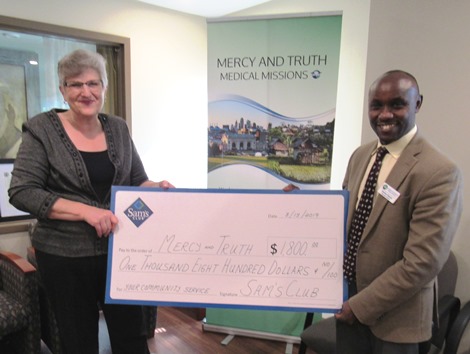
Catherine Sarensen, left, presented a check for $1,800 from Sam’s Club to the Mercy and Truth Clinic and Dr. Geofrey Kigneyi, executive director, today. (Staff photo)

KCK native leads effort to raise funds Aug. 17 for new roof on Quindaro museum

Producer Joe Macklin says he wants his son, Micah Macklin, to know the history of the Quindaro area of Kansas City, Kansas. That’s why he is leading an effort to raise funds for the Old Quindaro Museum at 3432 N. 29th St., Kansas City, Kansas. The museum needs a new roof. (Staff photo by Mary Rupert)
The Old Quindaro Museum, 3432 N. 29th St., Kansas City, Kansas, is raising funds for a new roof. (Staff photo)

by Mary Rupert

Joe Macklin recently toured the Old Quindaro Museum at 3432 N. 29th St., Kansas City, Kansas, and wondered why he hadn’t heard about local black history while he was growing up in Wyandotte County.

Macklin, a Grammy-nominated producer whose performing name is Jo Blaq, wants his young son and other youth to know the story of the early days of Quindaro, the people who figured in the town’s history and the legacy of the Underground Railroad here.

“We don’t know about our own history,” Macklin said. For his son and other young people, “I want them to know their history.”

A sign at the Old Quindaro Museum. Appointments are necessary to tour the museum at the current time. (Staff photo)

Quindaro, a pre-Civil War town on the Missouri River, was settled by Wyandot Indians, abolitionists, and African-Americans, and it’s important to learn about those who paved the way for today’s residents, he said.

A display at the Old Quindaro Museum details the Wyandot Nation and abolitionist history of the town. Anthony Hope, museum director, discussed the early history of the town. (Staff photo)

Quindaro was named after Quindaro Nancy Brown Guthrie, a member of the Wyandot Nation who married Abelard Guthrie, the founder of the town. Quindaro translates into “bundle of sticks,” which means “in unity there is strength.” In the past 50 years information has come to light about Quindaro’s role as a stop on the Underground Railroad.

One of the translations of Quindaro is “strength through unity.” (Staff photo)

When Macklin toured the museum, he said he learned a lot about local history.

“The thing that moved me most was some chains that slaves wore,” he said. “It made them hold their heads down. It moved me.”

Also, he said he was surprised to see a picture of one of his mentors, a captain in the Fire Department, in the museum.

A room in the Old Quindaro Museum is dedicated to black firefighters in Kansas City, Kansas. (Staff photo)

The Old Quindaro Museum currently needs a new roof in the worst way. In some areas, daylight can be seen through the roof. Inside the museum are artifacts and photos that tell the story of the early settlers of Quindaro, who included African-Americans, abolitionists and Wyandot Indians in the pre-Civil War era.

Producer Joe Macklin recently viewed places in the roof where work is needed. A fundraiser for a new roof will be held at 8 p.m. Saturday, Aug. 17, at Harrah’s Casino, North Kansas City, Missouri. (Staff photo by Mary Rupert)

Macklin is producing a fundraiser show that will raise funds for the roof at 8 p.m. Saturday, Aug. 17, at the Voo-Doo Lounge at Harrah’s Casino, North Kansas City, Missouri. The Old Quindaro Museum will receive part of the proceeds from the show.

They have raised about $1,000 to start, Macklin said, with a goal of reaching about $3,000.

Macklin was introduced to Anthony Hope, the museum’s director, by Kathy Hanis of EPlus, a public relations firm. Hanis believes the story of old Quindaro needs to be told, and that Joe Macklin was someone who could help tell it and help the museum survive.

Volunteers continue a labor of love

On the grounds of the Old Quindaro Museum. (Staff photo)

The Old Quindaro Museum, the only African-American museum in Wyandotte County, has been a labor of love for Anthony Hope and his late brother, Jesse Hope. Both have given a considerable amount of time to starting the museum and keeping it running.

In existence about 12 years, it was Jesse Hope’s dream, and Anthony Hope stepped up after his brother’s death to continue the museum. The Concerned Citizens for Old Quindaro, a not-for-profit, is the sponsor of the museum.

Anthony Hope pays the museum’s light bill out of his own pocket, which he says has been a strain at times. Still, he continues volunteering there, leading tours and mowing the lawn.

The city purchased the building for the museum, and after that, there has not been city funding, according to the volunteers.

The museum’s collection includes photos of early-day settlers of Quindaro and prominent residents of the area through the years.

A Western University wall is devoted to the history of the black college established in Quindaro in 1865 and continued through 1943.

Photos of Western University are displayed at the Old Quindaro Museum. (Staff photo)

Touring Old Quindaro

Anthony Hope and Corranzo Lewis give tours of the museum and the old Quindaro area by appointment, for a donation of $10.

The ruins of an old Quindaro brewery building are on a tour given by Anthony Hope. (Staff photo by Mary Rupert)
A spider’s web greeted visitors to the old brewery building. (Staff photo by Mary Rupert)

On the tour, visitors can see the museum, and then travel down Happy Hollow Road to view a partly ruined brewery building that was on the Underground Railroad.

Graves in the old Quindaro Cemetery date to the 1800s. (Staff photo by Mary Rupert)

Then they may visit the old Quindaro Cemetery, high on a hill, where there is a view of the Missouri River.

One of the oldest homes in the area is Quindaro Nancy Brown’s home. (Staff photo)
The Quindaro Overlook provides visitors with a way to see the port area of Quindaro near the Missouri River. (Staff photo)

Hope and Lewis also will tell visitors about the oldest home in the area, Quindaro Nancy Brown’s home, and visitors may go to the Quindaro Overlook to view the old port and the Missouri River.

Also on the Quindaro tour is the John Brown statue at 29th and Sewell. (Staff photo)

The John Brown statue at 29th and Sewell also is on the tour. Erected in 1911, it is the oldest statue known of John Brown.

More fundraiser details

Performers at the show on Aug. 17 at Harrah’s Casino in North Kansas City, Missouri, will include Jo Blaq, host and artist; NowDaze; Kevin Chuch Boii Johnson; Kemet The Phantom; Mae C; and Eddie Moore.

For more information about the Old Quindaro Museum and ticket information for the fundraiser, visit https://www.facebook.com/ccoqmuseum/ or call
816-820-3615.

To reach Mary Rupert, editor, email maryr@g3f.1db.myftpupload.com.

Kansas, Missouri agree to end economic ‘border war’

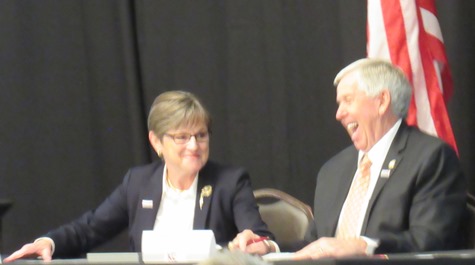
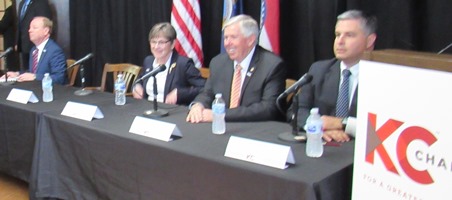
Kansas Gov. Laura Kelly, left, and Missouri Gov. Mike Parson shared a light moment after signing an agreement that will end the economic “border war” in the Kansas City area. They were at Memorial Hall in Kansas City, Kansas, on Tuesday morning. (Staff photo by Mary Rupert)

by Mary Rupert

From now on, Missouri and Kansas will work together on economic development instead of trying to lure businesses across the state line.

The governors of Kansas and Missouri announced today at a summit held at Memorial Hall in Kansas City, Kansas, that they would end the economic “border war” in the Kansas City region and quit offering incentives and tax breaks to companies that move across the state line.

Kansas Gov. Laura Kelly made ending the border war one of her campaign issues. It also was a goal of the Greater Kansas City Chamber of Commerce, led by Joe Reardon, the GKC chamber’s president.

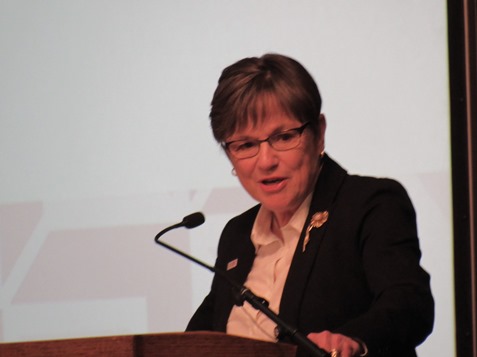
“Boundaries will no longer define the potential for progress,” Gov. Laura Kelly said Tuesday morning at Kansas City, Kansas, Memorial Hall. (Staff photo by Mary Rupert)

“The executive order I recently signed, and the bill that Governor Parson signed, ends this senseless battle,” Gov. Kelly said.

“Kansans elected me in part because they were tired of far-reaching fiscal irresponsibility in the past several years, which included inaction on the border war, one that saw hundreds of millions of dollars spent in incentives by both states in the past decade to move businesses a matter of blocks, with no economic gain to the region as a whole,” Gov. Kelly said.

The goal of the agreement will be more new jobs in the area, she said.

Gov. Kelly said they will continue to compete for businesses that want to start up or relocate, and they will use strategies that are sensible, cost effective and productive for people in both states.

“The best outcome will be substantial growth in this region. Growth where all businesses can prosper and where both states benefit from their presence. Boundaries will no longer define the potential for progress,” Gov. Kelly said.

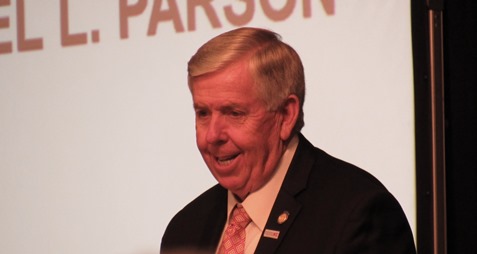
Missouri Gov. Mike Parson said it’s also important to retain the businesses they currently have. He was at Kansas City, Kansas, Memorial Hall on Tuesday morning. (Staff photo by Mary Rupert)

“Sometimes common sense does prevail,” Missouri Gov. Mike Parson said.

“We talk about bringing new businesses in, it’s also just as important to retain the businesses we have,” Gov. Parson said.

Gov. Parson said the governments could use the money they save from incentives for companies that move across the state line for improvements such as repairing the Buck O’Neil Bridge.

He also said officials in Washington, D.C., might learn something from this agreement signed by the governor of Kansas, a Democrat, and the governor of Missouri, a Republican.

According to the agreement, the states can still give incentives for projects that add net new jobs. The “net new jobs” could receive incentives from the states, and the agreement says states will share information with each other about the number of base jobs of the company that is relocating.

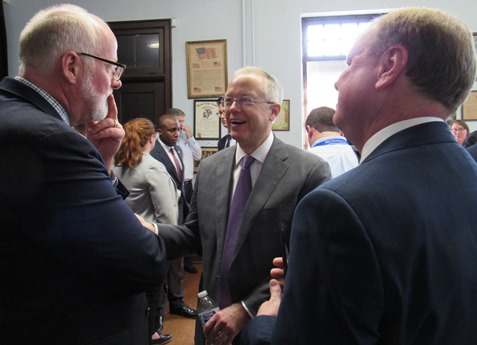
Kansas City, Kansas, Mayor David Alvey, left, talked with Don Hall, executive chairman of Hallmark Cards, center, and Joe Reardon, president of the Greater Kansas City Chamber of Commerce, right, after a news conference on Tuesday morning at Memorial Hall in Kansas City, Kansas. (Staff photo by Mary Rupert)

Kansas City, Kansas, Mayor David Alvey said he’s on board with the idea to end the border war.

Kansas City, Kansas, will work together with Kansas City, Missouri, and other cities not to use incentives for firms moving from one side of the state line to the other, he said.

The fundamental question for the city is how do they improve services, provide more services and reduce the tax burden, Alvey said.

“The only way to do that is by growing the economy,” Alvey said.

Sales tax revenue bonds (S.T.A.R. bonds), have been very productive for Wyandotte County, he said. Property tax revenues and sales tax revenues have increased in the areas with S.T.A.R. bonds, he said.

Most companies look at the work force and the communities’ amenities when they are thinking of relocating, and taxes are way down the line in the criteria they are looking at, he said.

The summit also included presentations by Amy Liu, Brookings Institute; David Toland, Kansas secretary of commerce; Rob Dixon, director of the Missouri Department of Economic Development; and Don Hall, executive chairman of Hallmark Cards.

Officials held a news conference at Memorial Hall Tuesday morning on the economic “border war.” (Staff photo by Mary Rupert)
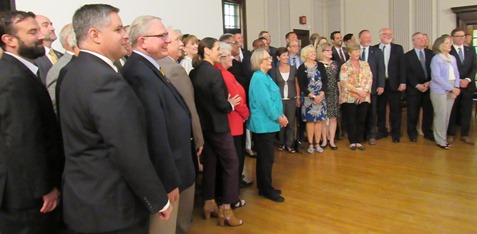
Many officials who attended the “border war” summit on Tuesday morning at Memorial Hall posed for a photo afterward. (Staff photo by Mary Rupert)
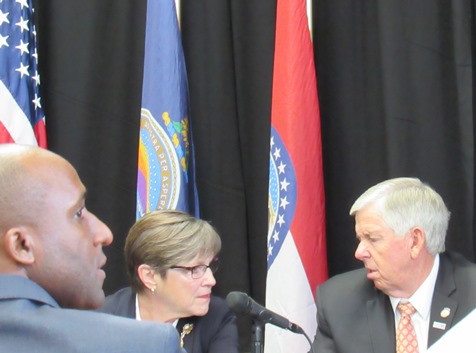
Kansas Gov. Laura Kelly, left, and Missouri Gov. Mike Parson talked a little before a news conference Tuesday morning at Memorial Hall. Kansas City, Missouri, Mayor Quinton Lucas was on the left. (Staff photo by Mary Rupert)
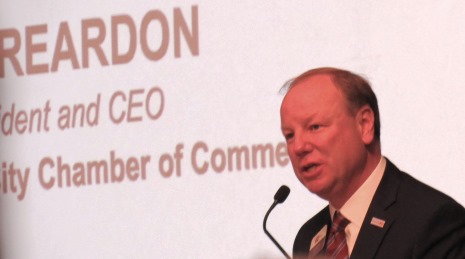
Joe Reardon, president and CEO of the Greater Kansas City Chamber of Commerce, addressed the summit on Tuesday morning at Memorial Hall. A longtime goal of the GKC Chamber has been to end the “border war.” Reardon is a former mayor of Kansas City, Kansas. (Staff photo by Mary Rupert)