
UG Commission sets maximum mill levy at same rate as last year

The Unified Government Commission voted Monday night to set the maximum mill levies for 2020 at the same rate as last year, which was the amount proposed by UG Administrator Doug Bach in his budget presentation on June 27.

On a unanimous vote, the commission set the maximum mill rate for the city of Kansas City, Kansas, at 38.138 mills and the maximum mill rate for Wyandotte County at 39.011 mills, the same as the current rate. Commissioner Brian McKiernan made the motion.

Bach’s proposed budget was $394.8 million, an increase of 2.9 percent over 2018. The commission is expected to set the final mill levy amount on July 25.

Last year, the mill levy rate was lowered. Valuations went up on average about 6.3 percent from 2018 to 2019, according to UG figures, and some taxpayers could see a slight tax increase with a flat mill levy, if their valuations increased.

Commissioner Jim Walters said if the property tax revenues are going up by more than 5 percent, he hoped the commission would have some latitude in cutting the mill levy. He said he would like to have a discussion about that.

Because the committee meetings preceding the budget meeting ran for 3.5 hours, the presentation that had been planned on tax revenues was cut short on Monday night. UG officials will return to a future budget meeting to make a presentation about sales tax revenues, which dropped in 2018 and have been fluctuating slightly. Sales and use tax revenues make up about 27 percent of the UG’s revenues, according to the budget document.

BPU member Jeff Bryant said at the Economic Development and Finance Committee meeting Monday night that since the Payment in Lieu of Taxes (PILOT) fee on BPU bills is projected to gather more than $30 million in revenue for the UG, maybe the UG could look at lowering the PILOT fee, since valuations have increased.

However, UG officials reported at the EDF meeting that sales tax revenues were down significantly. The year 2018 started with an increase in sales tax revenues and ended with a drop, UG officials said. The 2019 first-quarter reports for sales tax revenue presented Monday night shows a decrease in revenues as compared to the same time last year. UG officials plan to present more information about sales tax revenues from April through June at a future meeting.

A resident who spoke at the EDF meeting said that she felt her property taxes were “overboard.” The resident lives in the Piper area and said her taxes were more than $6,000 a year. She said she appealed her taxes and was denied.

“What can we as citizens do to get our taxes lowered?” she asked the commission. “Do we need to protest? What do we need to do to get our taxes lowered? They just keep increasing.”

Commissioner Tom Burroughs said the UG represented only two parts of her tax bill, the city and county. There were also library, school and community college taxing districts, he said.

Commissioner Gayle Townsend said that the mill levy was lowered for the city of Kansas City, Kansas, in 2013 and continued to be lowered for the city through last year. She suggested asking the assessor’s office about her valuation. She and Commissioner Burroughs suggested going to other taxing districts and asking the same question.

“This body have done all we can do and continue to do to either maintain or lower the taxes,” Commissioner Townsend said.

The UG Commission also voted unanimously to set the maximum mill levy for the Self-Supporting Municipal Improvement District, also known as the Downtown Improvement District, at 11.023 mills and the maximum mill levy for the Wyandotte County Libraries at 6.068 mills. Commissioners pointed out that these libraries include the Turner, Edwardsville and Piper areas, and this mill levy does not include the Kansas City, Kansas, Public Libraries, which are set by the Kansas City, Kansas, Board of Education.

The 2020 maximum mill levy for the SSMID is the same as the 2019 rate, and the 2020 maximum mill levy for the Wyandotte County Libraries is the same as the 2019 rate.

According to UG officials, the final mill levy amount cannot be higher than the maximum mill levy that was set Monday, but it could be lower.

The UG budget is online at the UG website, www.wycokck.org.
KCK school board to meet Thursday

The Kansas City, Kansas, Board of Education will meet at 5 p.m. Thursday, July 11, in the superintendent’s conference room at the Kansas City, Kansas, Public Schools Central Office and Training Center, 2010 N. 59th St.

The purpose of the special meeting will be to recess to a closed, executive session to discuss the human resources audit under the non-elected personnel exception to the Kansas open meetings act.

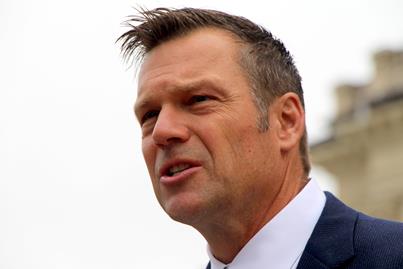
Kobach running for U.S. Senate

Kris Kobach (File photo by Scott Canon, Kansas News Service)

by Stephen Koranda, Kansas News Service

Leavenworth, Kansas — Former Kansas Secretary of State Kris Kobach, a Republican, announced Monday that he’s running for the U.S. Senate seat held by Pat Roberts.

Kobach beat then-Gov. Jeff Colyer in the primary election last year — helped partly by a last-minute endorsement from President Donald Trump — but ultimately lost the governor’s race to Democrat Laura Kelly.

Now, the politician who’s made a career battling immigration and claiming voter fraud is rampant, says he wants to take his confrontational politics to Capitol Hill.

“The Washington establishment is not going to get what they want,” Kobach said at an event in Leavenworth announcing the campaign.

Kobach is a conservative firebrand, but his gubernatorial campaign had lackluster fundraising and largely relied on money from his running mate. Some Republicans criticized Kobach’s campaign after the election loss for not focusing enough on fundraising and voter turnout.

The former secretary of state said running for Senate will not be like his campaign for governor.

“Raising money is different in a Senate campaign,” Kobach said. “I’ll be raising that money differently and I think you’ll see some surprising results.”

A filing to the federal government for a committee called Kobach for Senate initially misspelled Kobach’s first name as “Chris,” but was later corrected. Signs printed for his announcement in Leavenworth read: “Less government, more liberty” and “Build the wall.”

Kobach takes a hard line on illegal immigration, one of his signature issues, and has had close ties to Trump, who endorsed Kobach the day before the primary election last year.

“Our borders are being overrun,” he said Monday. “The calls for socialism on the left get louder and louder and they don’t stop. If not for the election of Donald Trump, I think our nation would be in a steep, downward spiral right now.”

Kobach said he had spoken with the president in recent days about immigration. In fact, he was considered a candidate to lead the Department of Homeland Security, although his reported demands for the job drew negative publicity.

“It became very clear to me that the president needs someone who will lead the charge for him in the United States Senate,” Kobach said.

The Republican field is filling with well-known contenders either exploring a race or outright running. That includes U.S. Rep. Roger Marshall of western Kansas, Kansas Attorney General Derek Schmidt, Kansas Treasurer Jake LaTurner and Senate President Susan Wagle.

Another potential candidate is the one Kobach beat in the GOP primary last year, former Gov. Jeff Colyer. Handicappers would likely mark U.S. Secretary of State Mike Pompeo, who represented Wichita in the U.S. House, a heavy favorite for the Republican nomination if he chose to get in the race.

Kansans haven’t sent a Democrat to the U.S. Senate since the 1930s. This year, former U.S. Attorney Barry Grissom and former U.S. Rep. Nancy Boyda have announced campaigns. Democrats are coming off victories last year with heightened interest in the Senate race.

While Kobach was making his announcement early Monday afternoon, the Kansas Democratic Party was already using his candidacy to raise money. “We need to do everything we can to make sure Kobach doesn’t win in 2020,” the party said in a fundraising plea.

Kobach’s conservatism has attracted a loyal following.

“He has a very devoted base of supporters,” said Emporia State political science professor Michael Smith.

The challenge, Smith said, is that Kobach’s controversial nature isn’t as appealing to general election voters as Republican primary voters.

Yet Smith notes that Kansans have a much stronger record of voting Republican in Senate races compared to races for governor.

After the criticism of a poor campaign structure and fundraising in the race for governor last year, some political watchers might think Kobach is doomed to repeat those mistakes this time around. University of Kansas political science professor Patrick Miller said don’t jump to conclusions just yet.

“No two elections are alike,” Miller said. “A Senate race is very different from a gubernatorial race.”

For one, Miller said a U.S. Senate race may attract more national attention and outside money than a state race like governor.

Even though he’s coming off a loss, Smith said Kobach wields one advantage many of Senate contenders don’t have: nearly everyone knows the name Kris Kobach.

“Kobach comes in with extremely high name recognition,” Smith said. “It absolutely shakes up the race.”

Stephen Koranda is Statehouse reporter for Kansas Public Radio and the Kansas News Service, a collaboration of KCUR, Kansas Public Radio, KMUW and High Plains Public Radio covering health, education and politics. Follow him on Twitter @kprkoranda or email skoranda (at) ku (dot) edu.
Kansas News Service stories and photos may be republished at no cost with proper attribution and a link to ksnewsservice.org.
See more at
https://www.kcur.org/post/kansas-conservative-kris-kobach-back-and-running-us-senate