
Strong economy and costly tuition stall increases in Kansas college graduates

by Stephan Bisaha, Kansas News Service

A hot job market and the increasing cost of tuition have slowed the growth in the number of Kansans earning a college education nearly to a halt.

Educators are worried that will worsen shortages of high-skilled workers and impede prosperity long term.

“It is concerning,” said Donna Ginther, an economist at the University of Kansas. “Having these types of degrees and certificates are very important for the future of economic growth in the state and the country.”

Kansas’ public colleges and universities granted 40,856 undergraduate degrees and certificates last year, according to the latest progress report from the Kansas Board of Regents. That’s virtually the same as five years ago and well short of the state’s goals.
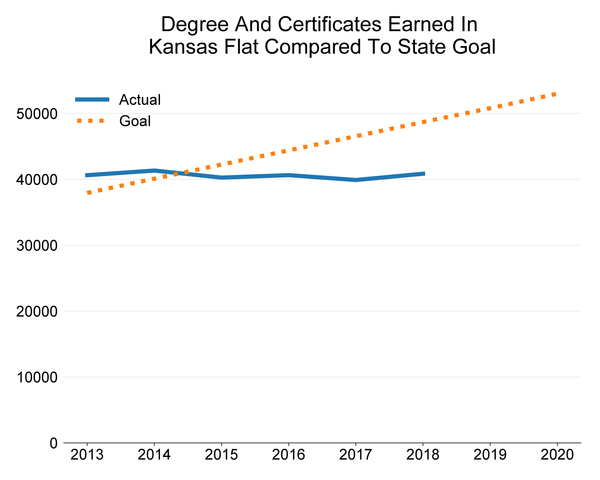
The number of undergraduate degrees and certificates earned in Kansas is well below the goal set by the Kansas Board of Regents. (Graph by Stephan Bisaha, source Kansas Board of Regents)

Kansas is nine years into the 10-year “Foresight 2020” plan designed to increase the number of Kansans getting post-secondary education and to better align state college and university programs with economic needs.

The Regents have found some success, particularly in technical education.

An initiative started in 2012 greatly increased the number of Kansans earning college credit before they graduated from high school. More than 10,000 students participated last year. And many of those students have continued technical education programs after high school, contributing to the growth of technical colleges by more than a third from 2012 to 2017.

Yet most of the state’s other colleges and universities have gone the other direction.

The headcount at community colleges shrank by 12 percent between 2012 and 2017. State universities grew less than half of a percent, with many seeing declines.

There are likely not enough students currently enrolled for the main objective in Foresight 2020 — more than 53,000 degrees and certificates earned by the end of this decade — to be achieved.

Much of the declining enrollment at Kansas colleges and universities is among white students. Their enrollment numbers have dropped 12 percent since 2010, according to data in the Foresight 2020 progress report. Enrollment by Hispanic students has grown the most, by more than 42 percent.

The progress report blames several factors outside of the Regents’ control, including the Kansas economy. The low unemployment rate means Kansans are able to find jobs without a college degree.

In the early days of the recovery from the 2008 recession, college enrollment increased in Kansas as elsewhere. Unemployed Americans decided to go back to college instead of hunting for non-existent jobs.

The reverse was true as the economy continued to improve. In 2013, enrollment in Kansas colleges plunged as the Kansas unemployment rate hit 5.3 percent.

But while more Kansans are now employed, many remain shut out of high-skill, high-paying occupations that offer a pathway to the middle class.

“A high school education is not going to cut for economic prosperity,” Ginther said.

Ginther and others also worry that high-skill industries such as aerospace manufacturing that Kansas is trying to foster will experience increasing workforce shortages without more Kansans completing a college education.

Rising tuition has also driven students away from Kansas schools.

Students have born more of the cost of their education at public universities as the state repeatedly cut over the past decade.

Higher tuition could be an outsized barrier for poorer students. The number of Pell Grant recipients at Kansas universities, students receiving grant money for college from the federal government, has been declining since 2015.

Studies have shown a link between increasing tuition and decreasing enrollment, though there are disputes over the size of the effect. What’s indisputable is the massive leap in cost colleges have seen over the years. At Kansas State University, the sticker price for a semester has increased 57 percent over the last 10 years.

“When I started at K-State in the late ’60s I paid out-of-state tuition and was able to work my way through the university with summer jobs and employment through the school year,” said Pat Bosco, the vice president for student life at Kansas State University. “That’s no longer the case now.”

Stephan Bisaha reports on education for KMUW in Wichita and the Kansas News Service, a collaboration of KMUW, Kansas Public Radio, KCUR and High Plains Public Radio covering health, education and politics. Follow him on @SteveBisaha.
Kansas News Service stories and photos may be republished at no cost with proper attribution and a link to ksnewsservice.org.

See more at https://www.kcur.org/post/strong-economy-and-costly-tuition-stall-increases-kansas-college-graduates
Tickets go on sale Friday for Concacaf Gold Cup doubleheader with U.S. Men’s National Team in KCK

Tickets for the 2019 Concacaf Gold Cup doubleheader featuring the United States Men’s National Team on June 26 at Children’s Mercy Park in Kansas City, Kansas, will go on sale to the public Friday at 10 a.m. via SeatGeek.com.

In addition, Sporting Kansas City season ticket members have access to an exclusive presale for the doubleheader and can contact their membership services representative for more information.

Children’s Mercy Park is set to be the host of the final two matches of the 2019 Concacaf Gold Cup group stage, with the United States among the four teams in Group D taking the field on June 26. The Gold Cup schedule and complete group assignments will be announced this spring when the tournament’s 16-team field is completed.

Led by newly appointed head coach Gregg Berhalter, the U.S. MNT enters 2019 as reigning Gold Cup champions and boasts a 6-0-1 record in Kansas City all-time. That mark includes four wins and a draw at Children’s Mercy Park, which will play host to Gold Cup matches for the third time following 2011 and 2015.

The U.S. MNT will compete in the Concacaf region’s continental championship as the seeded team in Group D.

Mexico (Group A), Costa Rica (Group B) and Honduras (Group C) are also seeded participants, while the remaining 12 nations from across North America, Central America and the Caribbean will learn their group placements after the conclusion of qualifying in March.

The United States, six-time Gold Cup winners, lifted the 2017 title with the help of Sporting Kansas City duo Matt Besler and Graham Zusi.

World-class Children’s Mercy Park is one of 15 venues across 13 U.S. cities that will host the 2019 Gold Cup. Select group stage matches will also take place in San Jose, Costa Rica, and a Caribbean city yet to be announced, marking the first time in tournament history that games will be played outside of the U.S., Canada and Mexico.

The Gold Cup serves as the headline competition for the U.S. MNT in 2019. The 15th edition of the competition will run from June 5 to July 7, with the final to be held at Soldier Field in Chicago.

Kansas City, a candidate host city for the 2026 FIFA World Cup in the United States, Mexico and Canada, has been host for many of soccer’s most prestigious matches at the club, college and international levels.

Other high-profile events held at Children’s Mercy Park include the 2013 MLS Cup, 2013 MLS All-Star Game, 2014 Concacaf Women’s Championship, 2015 NCAA College Cup, Concacaf Men’s Olympic Qualifying (2012, 2015), Lamar Hunt U.S. Open Cup finals (2012, 2017) and 2018 Tournament of Nations.

  • Story from Sporting KC

Labette jolts No. 4 KCKCC women, 74-67, in Jayhawk opener

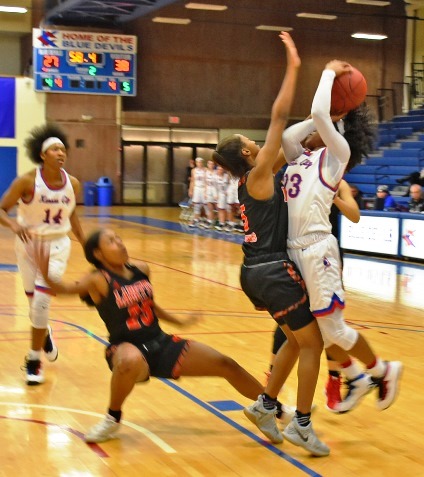
KCKCC sophomore Lillie Moore broke loose for two of her game high 25 points in the Blue Devils’ 74-67 loss to Labette Wednesday. Moore also led all rebounds with 11. (KCKCC photo by Alan Hoskins)
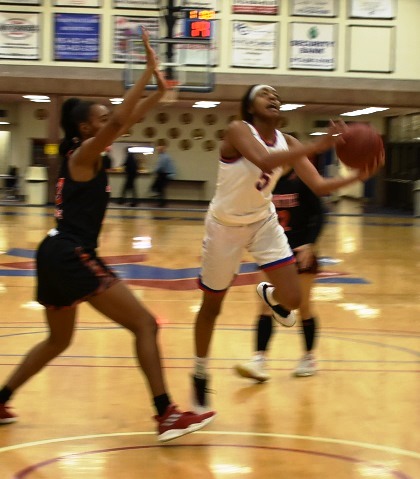
Typical of the way things went for KCKCC Wednesday, Blue Devil freshman guard Lenaejha Evans drew an offensive foul on this jump shot attempt in a 74-67 loss to Labette. (KCKCC photo by Alan Hoskins)

by Alan Hoskins, KCKCC

The toughest conference in NJCAA Division II women’s basketball got even tougher for Kansas City Kansas Community College Wednesday night.

Unranked Labette jumped off to a 6-0 lead in the first three minutes and never trailed in dealing KCKCC a 74-67 setback in the Jayhawk Conference opener for both teams.

The loss snapped an 8-game winning streak for the No. 4 ranked Blue Devils (18-3), who resume conference play at Hesston Saturday at 1 p.m.

Winning for the seventh time in the last eight games, Labette (14-7) dominated from start to finish. Leading 20-12 after one quarter and 38-27 halftime, the Cardinals opened a 23-point lead to start the fourth quarter before a 27-9 Blue Devil rally got them to within six points in the final minute.

Averaging 94 points a game, the second most in the nation in NJCAA Division II, the 67 points were a season low for the Blue Devils as well as field goal shooting (.392) and 3-point goals (4-of-14). In addition, the Blue Devils were outrebounded 47-42 and misfired on 16 of 39 free throws.

“This was our worst performance to this point of the season but credit Labette for forcing us into that situation,” KCKCC coach Joe McKinstry said. “We were not ready for their speed or intensity. They didn’t do anything we didn’t expect. We simply did not match their effort. We finessed instead of being physical.”

Closest KCKCC could get was 14-12 late in the first quarter but Labette scored the final six points of the period for 20-12 lead.

Trailing 38-27 at the half, the Blue Devils cut the deficit to 38-30 only to have the Cardinals go on an 11-0 run. Labette built its biggest lead at 63-40 to start the fourth quarter before the Blue Devils staged a furious comeback.

Despite missing five free throws in the rally, KCKCC closed to 69-63 with 1:23 only to have Labette’s Kyla McIntosh drain a 3-pointer to end the comeback.

Lillie Moore led the comeback, scoring 25 points and grabbing 11 rebounds – both game highs. Kisi Young added 10 points and eight rebounds; Nija Collier 10 points and five rebounds before fouling out but only Lenaejha Evans with two field goals and seven points had more than one field goal.

Fouled 29 times, the Blue Devils made 23 of 39 free throws but it wasn’t enough to overcome Labette’s 20 offensive rebounds nor their 17 turnovers.

“Statistically, Labette has not been a very good rebounding team but they out-rebounded us, especially offensive,” McKinstry said. “We also struggle with the simple things such as passing and dribbling far too often. Our shooting was horrible and yet when you leave 16 points on the board in a two or three possession game.”

Diamond Jones had 15 points, Kymora Westerfield 12 and Upe Atosu 11 for Labette, which had 11 players both score and grab rebounds.