
Kansas Board of Regents backs KU Cancer Center initiative

by Mike Sherry
The state board that oversees Kansas’ public colleges and universities on Wednesday endorsed an effort by the University of Kansas Cancer Center to earn the highest level of recognition from the National Cancer Institute.

The Kansas Board of Regents backed the initiative by approving a resolution that said, in part, that the cancer center “would substantially improve cancer research and treatment opportunities for Kansans” by earning the enhanced designation.

Though it did not endorse outright a proposed increase in the state excise tax on cigarettes, the resolution noted the effect an increase would have on reducing smoking rates in the state and on smoking-related cancer.

Based at the University of Kansas Medical Center campus in Kansas City, Kan., the cancer center earned the first level of recognition in July 2012 – capping a nearly decade-long drive for the designation. KU’s Richard and Annette Bloch Cancer Care Pavilion is in Westwood, Kan.

Backing by the state, including a $5 million annual appropriation from the Legislature, and by state higher education officials proved instrumental in earning the initial designation, Dr. Doug Girod, executive vice chancellor of KU Med, told the regents.

“It really took a village to make this happen,” Girod said, citing hundreds of millions of dollars in financial support from a number of quarters, including the University of Kansas Hospital, the Kansas Bioscience Authority and local sales tax proceeds.

The same type of commitment, including support for the resolution, would be just as crucial in the effort to earn the enhanced designation as a “comprehensive” cancer center, Girod said.

Pursuit of the comprehensive designation will come as part of the cancer center’s application to renew its initial five-year designation, cancer center officials said. The officials said the cancer center would submit it in September 2016, and they anticipate getting word on the application from NCI in July 2017.

According to the NCI, of the 68 NCI-designated cancer centers across the country, 41 are comprehensive cancer centers.

The NCI website says that hallmarks of first-level cancer centers include research that crosses laboratory science, clinical research and population-based topics.

Comprehensive centers, the site says, must demonstrate “reasonable depth and breadth” across those three areas in addition to proving their ability to disseminate “clinical and public health advances” to the communities they serve.

“We know we need to be deeper and broader in everything we do,” Girod told the regents.

The cancer center service area includes all of Kansas and 10 counties in western Missouri.

Girod said within that region every year there are about 26,000 new cancer diagnoses, and nearly 11,000 people die of cancer.

He said the cancer center has made tobacco cessation and prevention one of its main priorities in meeting the public outreach and cancer-reduction requirements of a comprehensive cancer center.

Tobacco-related illnesses cost the state about $1.1 billion each year, Girod said.

Health groups, which have banded together as Kansans for a Healthy Future, have endorsed Gov. Sam Brownback’s proposal to almost triple the tobacco tax, from 79 cents to $2.29 per pack, as part of his plan to close a hole in the state budget.

Girod said pricing is a key part of a comprehensive approach to reducing the use of tobacco products.

The resolution approved by the regents noted the health and fiscal effects of tobacco usage in the state, adding that the “most effective methods for demonstrating that the state is making an impact on public health and reducing tobacco use and cancer occurrence is to combine an expanded smoking cessation and prevention program and an increase in the tobacco excise tax.”

According to the resolution, Kansas ranks No. 36 in the country when it comes to its level of tobacco taxation.

The wording on the tobacco tax unsettled regent Zoe Newton of Sedan, the lone dissenter in the voice vote to approve the resolution.

“I’m very proud of the cancer center and support what they are doing,” she said afterward. “But as a matter of principle, when it comes to taxation, the language just made me very uncomfortable.”

The nonprofit KHI News Service is an editorially independent initiative of the Kansas Health Institute and a partner in the Heartland Health Monitor reporting collaboration. All stories and photos may be republished at no cost with proper attribution and a link back to KHI.org when a story is reposted online.
– See more at http://www.khi.org/news/article/kansas-board-of-regents-backs-ku-cancer-center-initiative#sthash.hkKa32aJ.dpuf
Carjacking suspect dead after chase from Bonner Springs ending in KCK

A chase that started in a residential area of Bonner Springs led police and highway patrol officers into Missouri and then back to Kansas City, Kan., finally ending with the suspect’s death.

The incident started at 8:53 a.m. Friday, Feb. 13, when Bonner Springs police received a call about a carjacking in the 400 block of South 137th Place in Bonner Springs, said Heather Brooks, spokesperson with the Bonner Springs Police Department.

The officers spoke with the victim, who said a man had arrived in a minivan, pointed a gun at him and demanded the keys to a Moxie pest control work truck, she said. It was a 2008 white Ford Ranger truck, according to the authorities.

The suspect had already left in the stolen work truck, and officers gave out a description of the truck and suspect through dispatchers, she said.

The truck was spotted on K-32 by Edwardsville police officers who attempted to stop the suspect, but the suspect fled, Brooks said. Then the Edwardsville police officer pursued the fleeing vehicle, and the Kansas Highway Patrol joined the pursuit and took over. Edwardsville police left the pursuit as it went to another city, she said.

About 9:09 a.m., according to the Kansas City, Kan., Police Department spokesman, the highway patrol joined the pursuit east on Kaw Drive, where Kansas City, Kan., police officers deployed stop sticks.

At 9:14 a.m., one Kansas City, Kan., police officer assisted the highway patrol in the pursuit eastbound on Park Drive from 34th Street, the Kansas City, Kan., police spokesman said.

The Kansas City, Kan., police spokesman said the KCK officers and highway patrol continued the pursuit onto Central Avenue, and then the suspect got on the I-670 highway entrance ramp.

The chase then led into Kansas City, Mo., Brooks said, where officers there joined in the pursuit.

When crossing into Missouri, the Kansas Highway Patrol continued that pursuit, according to the Kansas City, Kan., police spokesman.

Kansas City, Mo., police officers became involved with the pursuit in Missouri at about 9:16 a.m., the Kansas City, Kan., police spokesman said. The suspect attempted to strike a Kansas City, Mo., police officer, and the pursuit continued back into Kansas City, Kan., from I-35 onto westbound Southwest Boulevard, the Kansas City, Kan., police spokesman said.

The suspect then went northbound onto 14th Street and left the roadway at 12th Street and Ruby Avenue, according to the Kansas City, Kan., police spokesman.

According to the Kansas City, Kan., police spokesman, the suspect presented a gun, and officers from the Kansas Highway Patrol and Kansas City, Mo., Police Department then engaged the suspect, killing him.

The identity of the suspect has not yet been released.

This incident remains under investigation by the Kansas City, Kan., Police Department’s Criminal Investigations Division, which is encouraging anyone with information to call the TIPS Hotline at 816-474-TIPS (8477).

Sebelius criticizes Brownback at Dole Institute event

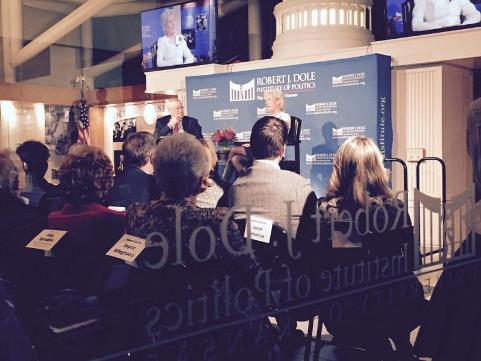
Former Kansas Gov. Kathleen Sebelius talks with Bill Lacy, director of the Dole Institute of Politics at the University of Kansas, at Thursday night's lecture on women in politics. It was one of Sebelius' first public appearances in Kansas since stepping down in June as secretary of the U.S. Department of Health and Human Services. (KHI photo by Jim McLean)
Former Kansas Gov. Kathleen Sebelius talks with Bill Lacy, director of the Dole Institute of Politics at the University of Kansas, at Thursday night’s lecture on women in politics. It was one of Sebelius’ first public appearances in Kansas since stepping down in June as secretary of the U.S. Department of Health and Human Services. (KHI photo by Jim McLean)

Former Democratic governor and HHS secretary covers wide range of topics in kickoff of institute’s 2015 lecture series

by Jim McLean

Former Kansas Gov. Kathleen Sebelius didn’t mince words when asked about the direction of Kansas politics during an event Thursday night at the Dole Institute of Politics.

Making one of her first Kansas public appearances since stepping down in June as secretary of the U.S. Department of Health and Human Services, Sebelius called the re-election of Republican Gov. Sam Brownback “a low point” in the state’s political history.

“Every time I think it can’t get any worse, it does,” Sebelius said in an apparent reference to the deepening budget crisis triggered by tax cuts and plummeting revenues. “So, I hesitate to say ‘how low can you go.’”

The Democrat, whose final months at HHS were marred by the problem-plagued rollout of the health reform law, was especially critical of Brownback’s recent decision to rescind an executive order that she issued to protect state employees from discrimination based on sexual orientation or sexual identity.

Sebelius said she signed the order in 2007 to “send a strong signal that we wanted a talented and diverse workforce.” She said she had “no idea” what compelled Brownback to repeal a policy that had been in place for eight years and “seemed to be working well.”

“It’s distressing,” she continued. “But I think we need to be clear to people around the United States, this is not Kansas. This is not what the state was founded on. This is not what we believe in. And this is not an acceptable policy going forward.”

In the statement explaining his decision, Brownback said Sebelius’ order inappropriately gave state employees protections not enjoyed by other citizens. Rescinding the order, he said, “ensures that state employees enjoy the same civil rights as all Kansans without creating additional protected classes.”

In addition, Brownback said, decisions to extend additional civil rights protections should be made by the Legislature, not “through unilateral action” by a governor.

Sebelius’ comments about Kansas politics came in response to questions from members of an overflow audience that turned out for the first in a series of lectures on women in politics at the institute on the University of Kansas campus in Lawrence. For most of the evening, the former governor chatted with Bill Lacy, the institute’s director, about her experiences as a woman in politics, her relationship with President Barack Obama and the political and executive challenges she faced during her career.

When technical problems with a microphone delayed the start of the conversation, a relaxed Sebelius quipped, “Kind of the like the website,” a reference to well-publicized troubles with the healthcare.gov website at its launch.

Sebelius said the early days of the rollout and the final days of the lobbying effort for the ACA were among her most challenging as secretary.

“We had a lot of near-death experiences,” she said of the days leading up to the vote in Congress. “There were lots of times when it seemed like it was all going down the tubes.”

Even when the bill’s prospects seemed bleak, Sebelius said, President Obama resisted calls to pare back the bill and compromise to save political face.

“He kept saying, ‘If there’s a chance for a comprehensive bill, this is the time,’” she recalled.

In a brief interview after the program, Sebelius said she believes the ACA will survive because by the time President Obama leaves office, tens of millions of Americans will have come to depend on it for health insurance. In addition, she said, it will be difficult to reverse the changes the law has made in the health care system.

“I think the framework is now kind of in the DNA of the health system in a way that will be very difficult to turn back,” she said.

While making no predictions, Sebelius said, she finds it “hard to believe” that the U.S. Supreme Court will side in an upcoming case with those who contend that Congress intended to make ACA tax credits available to consumers only in states that set up their own marketplaces.

“To have that available only to a certain portion of the population seems ludicrous,” she said.

Kansas is one of several states that declined to establish its own online marketplace, forcing consumers to use one set up by the federal government. More than 80 percent of Kansans who selected plans during the current enrollment period have qualified for tax credits that lower the cost of their premiums, according to HHS.

Finally, Sebelius said Kansas’ refusal to expand Medicaid has deprived tens of thousands of low-income Kansans of coverage they need.

“Folks who are in states not expanding Medicaid are in terrible trouble,” she said.

Brownback and GOP legislative leaders opposed to participating in expansion have said they’re concerned the federal government will not fulfill its obligation to pay 100 percent of expansion costs for three years and no less than 90 percent thereafter.

Sebelius said those concerns are unfounded.

“The bill is fully paid for even if all 50 states come in,” she said.

State officials who continue to have doubts, she said, could protect themselves by including language in their plans that automatically returns eligibility to pre-expansion levels if federal funding dips below the 90 percent threshold.

“Lots of states have said, ‘If the deal changes, we’re out,’” Sebelius said. “And we’ve said from the beginning, ‘That’s just fine.’”

The nonprofit KHI News Service is an editorially independent initiative of the Kansas Health Institute and a partner in the Heartland Health Monitor reporting collaboration. All stories and photos may be republished at no cost with proper attribution and a link back to KHI.org when a story is reposted online.
– See more at http://www.khi.org/news/article/sebelius-criticizes-brownback-at-dole-institute-event#sthash.VijJKcES.dpuf