KU Medical Center receives grant to support health equity teams and partnerships fighting COVID-19

A new grant of more than $3.5 million was announced Wednesday to the University of Kansas Medical Center to support local projects to rapidly implement COVID-19 testing strategies in areas that are disproportionately affected by the pandemic.

According to the grant announcement, KU Medical Center will partner with community efforts in Wyandotte County as well as nine other Kansas counties for health equity action teams. They will work with local health departments.

Also included are three urban counties, Johnson, Douglas and Sedgwick, and six rural counties, Crawford, Finney, Lyon, Riley, Saline and Seward.

The grant is funded by the National Institutes of Health and KU Medical Center is one of 32 institutions nationwide receiving grants through this RADx-UP program.

At a news conference today at the University of Kansas Health System, doctors discussed ongoing efforts in Wyandotte County through the Health Equity Task Force to reach underserved communities. The efforts helped to build trust with the minority communities, according to the doctors. The new grant is built upon the approach taken in Wyandotte County with the task force, and expands it to a total of 10 counties.

Broderick Crawford, president of the NBC Community Development Corp., who has been active in the Wyandotte County Health Equity Task Force, said at the news conference that the task force partnered with the Wyandotte County Health Department and community faith leaders to address the disparities that occur with COVID-19 in Wyandotte County. Crawford will be one of four persons overseeing the KU Medical Center grant.

The coronavirus has adversely affected the Hispanic and African-American community, as well as the community as a whole, he said.

The Health Equity Task Force has been successful at providing COVID-19 testing sites in church parking lots and places that are trusted by the community, and they are very happy at what they were able to accomplish, he said.

Because of the task force, Wyandotte County had a model they thought could be successful and work in other environments, said Dr. Allen Greiner, Wyandotte County Health Department chief medical officer. Dr. Greiner, also one of the persons overseeing the grant, said they put in a grant applications about six weeks ago to be one of 36 partners in the program.

Dr. Greiner said they learned through the task force that it was important to be visible in the community, interacting with the residents. In the future they may try to partner with large workplaces for testing, he added.

The Health Department also has been collecting information on problems that people who have COVID-19 are experiencing, such as food insecurity issues, and connecting them with resources, he said.

Dr. Greiner said listening to people and learning about their needs is a big part of the new grant.

A spokesman for KU Medical Center stated that the average investment per county for this project will be about $300,000. The investment in Wyandotte County will be closer to twice that, at around $600,000, according to Kay Hawes, spokesman for the medical center. That is because the efforts in Wyandotte County, including the Wyandotte County Health Equity Task Force, are serving as a model for other counties, and community leaders from Wyandotte County will be tapped as consultants to the other counties. Hawes stated.

“We know that underserved minority and rural communities have been disproportionately affected by COVID, leading to more serious illnesses and more deaths,” said Dr. Edward Ellerbeck, chair of the Department of Population Health and professor at the KU School of Medicine and one of the study’s co-principal investigators, in a news release. “The idea here is to partner with communities and local health departments to help address inequities, beginning with inequities in testing, and the vast majority of these funds will go into these counties and directly into these at-risk communities.”

Part of the NIH’s Rapid Acceleration of Diagnostics (RADx) initiative, the RADx Underserved Populations (RADx-UP) program, KU Medical Center’s $3.5 million grant will be overseen by four principal investigators: Dr. Mario Castro, vice chair for clinical and translational research in the Department of Internal Medicine and a pulmonologist at the KU School of Medicine; Broderick Crawford, president of the NBC Community Development Corporation, the outreach arm of the New Bethel Church in Kansas City, Kansas; Dr. Edward Ellerbeck, chair of the Department of Population Health and professor at the KU School of Medicine; and Dr. Allen Greiner, vice chair of the Department of Family Medicine and professor at the KU School of Medicine, and county health officer in Wyandotte County.

“It is critical that all Americans have access to rapid, accurate diagnostics for COVID-19, especially underserved and vulnerable populations who are bearing the brunt of this disease,” said the NIH director, Dr. Francis S. Collins, in a news release. “The RADx-UP program will help us better understand and alleviate the barriers to testing for those most vulnerable and reduce the burden of this disease.”

KU Medical Center researchers will conduct a needs assessment in each county and then partner with communities in each county to develop messages and strategies specific to their community, according to the news release.

Working with the Local Health Equity Action Teams, KU researchers will take their cues from the communities. “In some cases, we will support what they’re already doing. In some cases, we will complement what they’re doing,” said Mariana Ramirez, director of JUNTOS Center for Advancing Latino Health in the Department of Population Health at KU Medical Center and one of eight co-investigators on the grant. “It is critical that we listen to each community and assist them with what is needed there.”

Dr. Castro, who also directs the KU Clinical and Translational Science Institute, known as Frontiers, pointed out that this grant is unique because it relies on partnerships in the community and throughout the state.

“It is an exciting grant for KU Medical Center and for our partners because it will capitalize on the infrastructure we have built with Frontiers and community partners and help all of us work together to address disparities within our underserved communities,” Dr. Castro said. “A number of studies have shown that African-American, Hispanic and rural communities have a higher prevalence of hospitalization and deaths, and there is some evidence that the virus also is more severe in these communities, perhaps due to a higher proportion of risk factors, such as obesity and high blood pressure. And when we look at rural counties, we also see overwhelmed practitioners and no infrastructure for conducting clinical trials. With the RADx-UP resources, we think this could really be a win-win relationship with these communities.”

KU Medical Center has been working throughout the pandemic with Wyandotte County community leaders, and Dr. Greiner explained that the statewide effort will be modeled after the work of the Health Equity Task Force in Wyandotte County, according to the news release.

“We’ve had some really great community partners step up in Wyandotte County,” Dr. Greiner said. “There’s been a lot of collaboration. Throughout the pandemic, we’ve seen some really tough issues throughout the community. We think our partners can help share lessons learned, and those best practices can be valuable in advising other counties.”

While the underserved populations in each county may be different, many of the obstacles are the same. Multiple generations may be living in one household, with members of the family engaged in high-risk, essential work, perhaps in meatpacking or cleaning industries. Often, there are issues with lack of health insurance and lack of sick leave, along with lack of access to medical care and lack of COVID-19 testing.

“We saw the first COVID-19 death in Kansas in Wyandotte County, but there was no testing in Wyandotte County at that time,” Crawford said. “We determined we needed to take testing into the community.”

Crawford noted that pop-up testing sites in churches, libraries and colleges were well attended. “We put pop-up sites in places in the community where the need was greatest and also in places people trusted,” he said.

“With this grant, the idea is to be able to share the successes in Wyandotte County with the nine other counties throughout Kansas,” Crawford said. “It won’t look the same in each of these counties, but we want to provide information and lessons learned. One thing COVID has shown all of is that there has to be joint collaborative effort by all of us—researchers, community leaders, faith leaders, doctors, health offices—to fight this disease.”

“Many people in our community face difficulty accessing health care, and these disparities have become even more apparent as a result of the COVID-19 crisis,” Rep. Sharice Davids, D-3rd DIst., who helped advocate for the grant, said. “I’m glad to have played a role in securing this funding and I’m excited to see the community-informed work that has begun in Wyandotte County with the local Health Equity Task Force. I look forward to seeing this work expand to assist other regions in Kansas.”

According to a spokesman for Rep. Davids, the grant will gather information about testing among underserved populations, find out more about infection rates and outcomes, as well as make strategies aimed at lessening disparities in testing. The program will use existing community partnerships to implement strategies that will increase access for testing.
Being cautious is not being afraid, COVID-19 survivor says

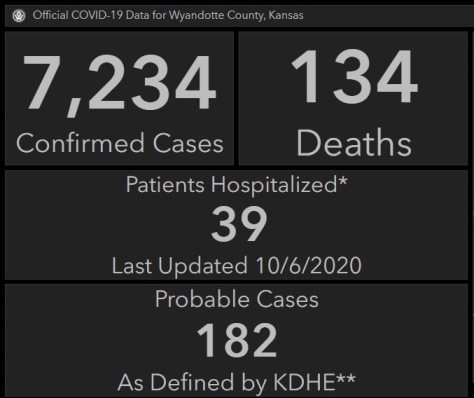
Wyandotte County reported an additional 51 COVID-19 cases on Tuesday, for a cumulative total of 7,234, according to the Unified Government COVID-19 webpage. There were no additional deaths reported; the total remained the same at 134. (From UG COVID-19 website)

Anil Gharmalker of Parsons, Kansas, who survived COVID-19 but has had some health problems as after-effects, described his trachea operation during a news conference on Tuesday morning at the University of Kansas Health System.

Gharmalker was a truck driver who believes he got the virus while out on the road. He has been hospitalized several times with severe effects from COVID-19.

This holiday season, Gharmalker said he knows his family will not be part of any large gatherings. They will just have their immediate family for dinner, and masks will be mandatory if anyone visits.

Gharmalker and the doctors reacted on Tuesday to statements from the national level about not being afraid of COVID-19. He said being cautious is not being afraid.

“If I could go back in history and go back to April and figure out where I got it, I would definitely do things differently,” Gharmalker said. “I would not live in fear, but be safe going forward.

“It’s more frightening to stare down your own mortality in minutes and hours than trying to avoid being a vector or having contact with one,” Gharmalker said.

Also at the news conference Tuesday, Linda Bunten, a nurse practitioner with KU Health System, discussed how her entire family got COVID-19 this summer.

During the news conference, she described a family social event, a graduation party, which they held outside, wearing masks and distancing, but she believes the next day the virus was spread through their family. She thinks a family member went to another event where people were not wearing masks, then returned home. Although they all got COVID-19, fortunately, her family did not experience severe illness, she said.

Dr. Steve Stites, chief medical officer at KU Health System, said people soon will be thinking about how to celebrate Thanksgiving. He said he won’t be able to invite 30 people over this year as he has in the past. Those events could become “super spreaders,” he said.

Dr. Dana Hawkinson, medical director of infection prevention and control, said any group meetings should be less than 10. He also said that it’s possible to have virtual meetings.

Another option is for everyone who will attend to quarantine 14 days before Thanksiginv Day, not going out and not meeting in groups, he said.

If the weather is nice, perhaps the gathering could be held outdoors with social distancing, Bunten said. And she advised people not to be cavalier about COVID-19.

Dr. Hawkinson encouraged people to continue being cautious, wear masks and social distance.

The University of Kansas Health System reported 31 acute COVID-19 patients in the hospital on Tuesday morning, compared to 32 on Monday, including nine in the intensive care unit, down from 11 on Monday, and six on ventilators, down from eight on Monday, according to Dr. Hawkinson. There were another 32 hospitalized COVID-19 patients who were in the recovery phase, up from 30 on Monday.

The daily numbers don’t tell the whole story, he said. While the numbers were similar to Monday, there were eight discharges and 10 admissions in the last 24 hours, which the doctors are concerned about. HaysMed in Hays, Kansas, reported 19 active COVID-19 patients, with three deaths in the past week.

Wyandotte County reported an additional 51 COVID-19 cases on Tuesday, for a cumulative total of 7,234, according to the Unified Government COVID-19 webpage. There were no additional deaths reported; the total remained the same at 134.

Free testing available on Wednesday

Free COVID-19 testing will be available from 8 a.m. to 11 a.m. Wednesday, Oct. 7, at Faith Deliverance Family Worship Center, 3043 State Ave., Kansas City, Kansas.


The pop-up tests are through the Health Equity Task Force and Vibrant Health.
Free tests also are at the UG Health Department parking lot, 619 Ann Ave., Kansas City, Kansas. They are open from 9 a.m. to 3 p.m. Monday through Friday. No appointment is needed.


The tests are for those who live or work in Wyandotte County. Participants should bring something that shows their address or their work place, such as a piece of mail or a work badge.


The pop-up tests and the Health Department tests now open to asymptomatic people as well as those who have symptoms or have been exposed to COVID-19. People now can be tested without any symptoms. Check with the UG Health Department’s Facebook page to see if there have been any changes in the schedule because of the weather or for other reasons.


More information about testing is at https://wyandotte-county-covid-19-hub-unifiedgov.hub.arcgis.com/pages/what-to-do-if-you-think-you-have-covid-19.

The KU Health System doctors’ news conference is online at https://www.facebook.com/kuhospital/videos/937412353433546/.

The KDHE’s COVID-19 webpage is at https://www.coronavirus.kdheks.gov/.

The UG COVID-19 webpage is at https://alpha.wycokck.org/Coronavirus-COVID-19-Information.

The KC Region COVID-19 Hub dashboard is at https://marc2.org/covidhub/.

The CDC’s COVID-19 webpage is at https://www.cdc.gov/coronavirus/2019-nCoV/index.html.

Kansas to receive 870,000 rapid COVID-19 tests

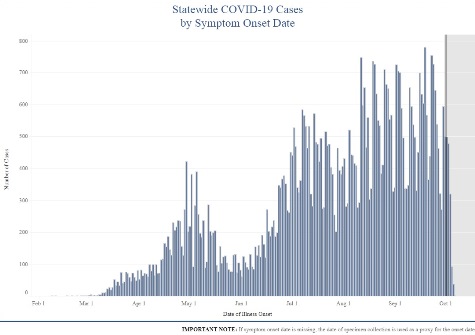
Kansas reported an additional 1,597 COVID-19 cases on Monday, for a cumulative total of 62,708, according to Gov. Laura Kelly. There was an increase of eight deaths, for a cumulative 706 deaths in the state. (KDHE chart)
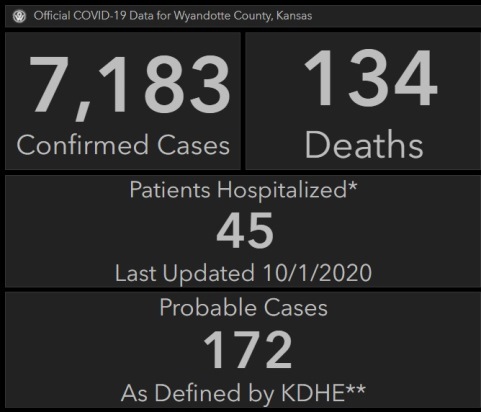
Wyandotte County reported an additional 27 COVID-19 cases on Monday, for a cumulative total of 7,183, according to the Unified Government’s COVID-19 webpage. There were no additional deaths reported, for a cumulative total of 134. (From UG COVID-19 website)

Kansas will receive 870,000 rapid COVID-19 tests, according to Gov. Laura Kelly.

The governor said the state has already received the first shipment of 57,000 rapid tests from the federal government and expected to receive the remaining tests during the next three months. She announced the tests at a news conference Friday afternoon.

The governor commended the White House for working with the state to make sure they have enough tests on hand. About 100 million tests are being distributed across the nation, she added. They are rapid nasal tests, not the PCR nasal tests.

The rapid Abbott tests will be deployed to hotspots in the state, with the first three priorities nursing homes, correctional facilities and schools, Gov. Kelly said. Areas with outbreaks, including urban and rural, may have priority.

She announced a unified testing strategy for Kansas last week.

Kansas reported an additional 1,597 COVID-19 cases on Monday, for a cumulative total of 62,708. There was an increase of eight deaths, for a cumulative 706 deaths in the state.

Gov. Kelly said as the election approaches, many people have become entrenched on political sides, and it is increasingly difficult to talk to or listen to one another.

“This virus will be spreading in our communities regardless of the election results, until we all take the threat seriously and act accordingly,” she said.

“If we all commit to wearing masks, social distancing and avoiding gatherings, we can bend the curve,” Gov. Kelly said.

Outbreaks in Wyandotte County

The KDHE’s outbreak list contained one Wyandotte County outbreak, at the Piper Assisted Living and Memory Care Center in Kansas City, Kansas, with 6 cases reported in the last 14 days. That list included sites with five or more cases with symptom onset within the last 14 days.

Wyandotte County has its own COVID-19 outbreak map online at https://wyandotte-county-covid-19-hub-unifiedgov.hub.arcgis.com/.

The UG’s outbreak map showed active outbreaks with five or more cases which have had a case within about the past month. The total number of cases can go back some months. On the UG’s outbreak map:

• Medicalodge of Kansas City, 6500 Greeley, Kansas City, Kansas, 55 cases, last known case reported Sept. 4.

• Wyandotte County Sheriff’s Office, 710 N. 7th St., Kansas City, Kansas, 26 cases, last known case reported Sept. 8; included 13 primary cases and 13 secondary cases. According to the Health Department note, primary cases work or live at the location, while secondary cases contracted it from primary cases and did not have another likely source of illness.

• Kaw River Care and Rehab, 750 Blake St., Edwardsville, Kansas, 19 cases, last known case reported Sept. 11.

• VVF, 1705 Kansas Ave., Kansas City, Kansas, 17 cases, last known case reported Sept. 9.

• BNSF Railroad, mechanical shop, 2201 Argentine Blvd., Kansas City, Kansas, 11 cases, last known case reported Sept. 19.

• UPS, 223 N. James St., Kansas City, Kansas, 9 cases, last known case, Sept 11.

• Community First Bank, 650 Kansas Ave., Kansas City, Kansas, 6 cases, last known case reported Sept. 3.

• Moose Lodge, 6621 Turner Drive, Kansas City, Kansas, 6 cases, last known case, Sept. 1.

• Empire Candle, 2925 Fairfax Trafficway, Kansas City, Kansas, 5 cases, last known case, Sept. 4.

Wyandotte County reported an additional 27 COVID-19 cases on Monday, for a cumulative total of 7,183, according to the Unified Government’s COVID-19 webpage. There were no additional deaths reported, for a cumulative total of 134.

The University of Kansas Health System reported 32 patients in the hospital on Monday morning, the same as Friday, according to Dr. Dana Hawkinson, medical director of infection prevention and control. There were 11 patients in the intensive care unit, an increase from nine on Friday, with eight patients on the ventilator, an increase from seven. The doctors are concerned about the 70 percent ventilator rate. KU Health System has an additional 30 COVID-19 patients who are no longer in the acute stage but are still hospitalized, compared to 26 on Friday. At HaysMed, there were 19 inpatients, an increase from 12 on Friday.

At the University of Kansas Health System news conference on Monday morning, Dr. Doug Girod, KU chancellor, said that students and staff are abiding by the mask mandate on campus. They are hoping for more tests to be available, while making sure those who are infected are separated and receive treatment.

Chris Wilson, vice president of system integration and innovation at the health system, said there have been a thousand cases so far on the KU campus. The campus positivity rate of 3.5 percent and 5 to 10 new cases a day is better than the city of Lawrence, he added. KU has kept its classrooms open with a combination of in-person and online classes, while some other colleges have had to go completely virtual.

Free testing available on Tuesday

Free COVID-19 testing will be available from 8 a.m. to 11 a.m. Tuesday, Oct. 6, at All Saints parish, 811 Vermont, Kansas City, Kansas.

The pop-up tests are through the Health Equity Task Force and Vibrant Health.

Free tests also are at the UG Health Department parking lot, 619 Ann Ave., Kansas City, Kansas. They are open from 9 a.m. to 3 p.m. Monday through Friday. No appointment is needed.

The tests are for those who live or work in Wyandotte County. Participants should bring something that shows their address or their work place, such as a piece of mail or a work badge.

The pop-up tests and the Health Department tests now open to asymptomatic people as well as those who have symptoms or have been exposed to COVID-19. People now can be tested without any symptoms. Check with the UG Health Department’s Facebook page to see if there have been any changes in the schedule because of the weather or for other reasons.

More information about testing is at https://wyandotte-county-covid-19-hub-unifiedgov.hub.arcgis.com/pages/what-to-do-if-you-think-you-have-covid-19,

The governor’s news conference is online at https://www.facebook.com/GovLauraKelly/videos/399547164542868.

The KU Health System news conference is at https://www.facebook.com/kuhospital/videos/395192981494594.

The KDHE’s COVID-19 webpage is at https://www.coronavirus.kdheks.gov/.

The UG COVID-19 webpage is at https://alpha.wycokck.org/Coronavirus-COVID-19-Information.

The KC Region COVID-19 Hub dashboard is at https://marc2.org/covidhub/.

The CDC’s COVID-19 webpage is at https://www.cdc.gov/coronavirus/2019-nCoV/index.html.