
State releases draft plan for distributing COVID-19 vaccines

Kansas has worked out a preliminary plan for distributing COVID-19 vaccines once they become available, according to a state health official.

The draft plan now is available on the state’s health department website, said Phil Griffin, director of disease control and prevention for the Kansas Department of Health and Environment. He discussed vaccines and the preliminary plan during a news conference Tuesday morning with the University of Kansas Health System.

The plan is currently under review with the Centers for Disease Control, and the plan will change as information becomes available, according to officials.

Griffin said they are working now to enroll providers for the vaccine, and will open a web portal next week.

Health officials are not sure exactly when COVID-19 vaccines will become available, but it was announced on Monday that one vaccine maker, Pfizer, would file for FDA authorization in mid-November. There had been speculation that the company would try to file this week or next week.

Griffin said several vaccines are in development right now. When one is approved, there will probably be a very limited amount of vaccine available immediately, he said. There are indications that production would be ramped up once the vaccines are approved.

Griffin said the draft plan calls for three phases of vaccinations in Kansas. This aspect of the plan is based on federal guidelines.

Medical professionals who are unable to work from home, who are in a hospital setting and are in contact with potential COVID-19 patients would be first to receive the vaccine in Phase 1A, Griffin said.

Phase 1B would include additional first responders, and would begin to serve high-risk populations, nursing home and long-term care staff and residents, he said.

This first phase would depend on the availability of vaccine and there would be an allocation process nationally, he said.

Phase 2’s first priority would be essential workers and those who are at risk, Griffin said.

Then, they hope to quickly go into Phase 3, full market availability for the general population, he said. They hope Phase 3 happens from the spring to the middle of next year, he added.

Providers will be enrolled, with the state first enrolling hospitals, then health departments, and after that working with partners and enrolling all types of providers, according to Griffin. On Friday, there was an announcement that the federal Health and Human Services Department has secured agreements with Walgreens and CVS as providers to long-term care facilities, he added.

If there are already relationships between long-term care facilities and other pharmacies or hospitals, they will enroll those as well, he said. They plan to use as wide a range of vaccinators as possible, he added.

By the time they get to Phase 3, they will be using a lot of private and local sources, including primary care physicians, he said.

If people are required to get two doses of the COVID-19 vaccine, they must make sure to get the same vaccine for the second dose, according to doctors.

When people get their first COVID-19 vaccine, they will receive a card noting their first dose, it will tell them when to come back for the second dose, and the card will list the vaccine they already received, according to Griffin. There is a registry for the vaccines, and providers must submit the name of the vaccine recipient with the vaccine received within a day, to be on file in the registry. The health officials hope to make sure that people get the correct second dose when they come in for their second vaccination.

Both Missouri and Kansas will be using the same platform for the registry, he said.

The state health department plans to use the same delivery system for the COVID-19 vaccine that it does for the flu vaccine, Griffin said.

There could be some challenges with some of the vaccines. For example, the Pfizer COVID-19 vaccine needs to be kept very cold, about 70 degrees below zero, in shipping.

They are developing special shipping boxes for the vaccine that will keep it cold, he said. They also are developing procedures to make sure that it is not wasted.

Griffin said he plans to get a COVID-19 vaccine as soon as it is available to him. He will base his decision on which type of vaccine to take based on what the medical studies say, he added.

Because it is possible for people to get reinfected with COVID-19, there are still some questions about how long the vaccine will last, according to the doctors.

Currently they think immunity can last from a few to six months, possibly, for a person who gets COVID-19. That’s one of the reasons not to try to get COVID-19 on purpose, since getting it once won’t prevent people from getting it again, according to the doctors.

Vaccines are only one defense against the coronavirus, Dr. Steve Stites, chief medical officer at KU Health System, said. Other defenses that work include wearing a mask, washing hands, keeping distance and not going out when sick, he said.

On Tuesday morning, Dr. Dana Hawkinson, medical direction of infection prevention and control at the KU Health System, said there were 27 active COVID-19 inpatients at KU Health System, down five since Monday, with 11 in the intensive care unit and seven on ventilators. There were another 30 COVID-19 patients in the recovery phase, he said. Also, HaysMed in Hays, Kansas, reported 16 total COVID, 19 patients, with 15 active infections and one in the recovery phase, also a decrease.

The KU doctors’ news conference is at https://www.facebook.com/kuhospital/videos/2649422155323608/.

The state’s draft plan for vaccines is at https://www.coronavirus.kdheks.gov/DocumentCenter/View/1533/DRAFT-COVID-19-Vaccination-Plan-for-Kansas-Version11-10162020.
Inmate from Wyandotte County dies from COVID-19 complications

An inmate at the Ellsworth Correctional Facility who was from Wyandotte County died Monday, Oct. 19, after fighting COVID-19 since Sept. 26, according to an announcement today from the Kansas Department of Corrections.

The inmate’s name was not released by KDOC authorities.

The inmate tested positive on Sept. 26, and then was moved to the Lansing Correctional Facility COVID-19 management unit, according to a spokesman. Three days later, he was moved from LCF to a hospital.

A spokesman stated that the resident’s family has asked his name not be released. He was a 60-year-old male with underlying medical conditions contributing to his condition, according to the spokesman.

He was serving a life sentence based on four sex crime convictions from Wyandotte County, Kansas.

It was the sixth COVID-19 related resident death in the Kansas correctional system, and the first at Ellsworth Correctional Facility, according to a spokesman. The Ellsworth Correctional Facility’s Central Unit provides housing for 820 multi-custody residents and the East Unit provides housing for 95 minimum-custody residents.

Ellsworth is located in central Kansas, about 26 miles southwest of Salina.

Doctors hope mask-wearing is taking hold

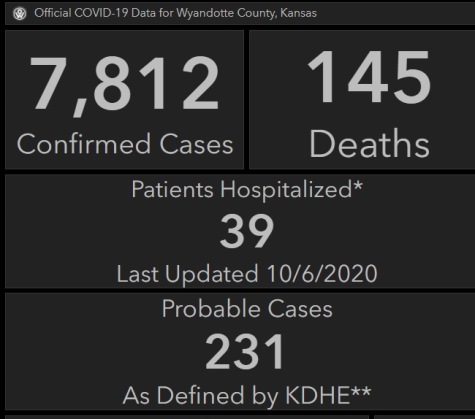
Wyandotte County reported an additional 19 COVID-19 cases on Monday afternoon, for a cumulative total of 7,812, according to the Unified Government COVID-19 webpage. There were no additional deaths reported, for a cumulative total of 145. (From UG COVID-19 webpage)

When it comes to masks, the Kansas City area seems to be doing a better job than previously, according to University of Kansas Health System doctors.

Discussing mask-wearing at the Monday morning news conference, Dr. Steve Stites, chief medical officer, remarked that when he went shopping recently in Kansas City, Missouri, he saw a lot of people wearing masks, even when they were outdoors walking around. Not too many were not wearing masks.

That was a positive development, considering that case numbers were higher during the past few weeks in Greater Kansas City.

Mask-weearing is much better than a few months ago, Dr. Stites added. Also, people seem to be wearing their masks right, he said.

He said he shared the frustration of a resident who went someplace where masks were not being worn.

“We know mask-wearing is the single most important barrier you could provide,” he said.

Masks are better than face shields, he said, because particles can still come out with shields.

Dr. Stites advised residents when it freezes, to go outside with a member of your group, take a look at your breath and see where it goes.

“It’s just ridiculous that people still want to politicize something that saves lives,” he said.

Dr. Joseph LeMaster, Johnson County public health officer, said that he agreed, and that it was unnecessary that it has become divisive. They hear comments every week from people at public meetings who feel that wearing a mask is a violation of their rights, he said.

All the agencies have been doing the same kind of public health work for the past 60 years, he said.

More than 200,000 people nationally have died as a result of the pandemic, and this is not something that people should be divided over, he said, nor should it be politicized.

Dr. LeMaster said the increase in cases in the Greater Kansas City area has been caused by people not wearing masks and not socially distancing.

Mask-wearing is mandatory in Wyandotte and Johnson counties when in public places, and when around others who are not in your household. Not wearing a mask can be reported, he said.

Also at the news conference, Dr. Jessica Kalendar-Rich, a specialist in geriatrics who is on the national Coronavirus Commission for Safety and Quality, discussed how nursing homes are starting to allow visits from patients’ relatives. However, the visits are limited in time, and they are not allowed as frequently as before the pandemic.

Under federal guidelines, there must be a certain amount of distance for the visits, a limit on time, and a record is kept of the visitors. There are now federal mandates on testing workers at nursing homes, she said, depending on case rates in the community.

Wyandotte County reported an additional 19 COVID-19 cases on Monday afternoon, for a cumulative total of 7,812, according to the Unified Government COVID-19 webpage. There were no additional deaths reported, for a cumulative total of 145.

Kansas reported an additional 2,113 COVID-19 cases from Friday to Monday, with 13 additional deaths reported, for a cumulative total of 72,968 cases and 872 deaths, according to the Kansas Department of Health and Environment COVID-19 webpage

According to KDHE figures, Johnson County reported an increase of 292 cases since Friday for a cumulative 13,702; Leavenworth County reported an increase of 47 since Friday for a cumulative 2,534; Shawnee County (Topeka area) reported an increase of 83 since Friday for accumulative 3,318; and Sedgwick County (Wichita area) reported an increase of 350 since Friday for a cumulative 10,927.

Dr. Dana Hawkinson, medical director of infection prevention and control at the KU Health System, reported a slight increase in COVID-19 patients at the hospital. There were 32 acute COVID-19 patients hospitalized, an increase from 26 on Friday, with 11 patients in the intensive care unit, the same as Friday, and eight on ventilators, the same as Friday. At one point this past weekend, there were 37 COVID-19 patients in the hospital. There are another 32 patients still hospitalized from COVID-19 but in the recovery stage, a decrease from 35 on Friday. HaysMed in Hays, Kansas, reported 16 COVID-19 patients on Monday, a decrease from 19 on Friday, with two of the patients in the recovery phase.

Free testing offered

A free COVID-19 pop-up test will continue from 8 a.m. to 11 a.m. Tuesday, Oct. 20, at All Saints parish, 811 Vermont, Kansas City, Kansas. The pop-up test is through Vibrant Health and the Wyandotte County Health Equity Task Force.

The Unified Government Health Department moved its COVID-19 testing Monday from the 6th and Ann location to the former Kmart at 78th and State Avenue in Kansas City, Kansas. The hours are 9 a.m. to 3 p.m. Monday through Friday.

Tests are free for those who live or work in Wyandotte County.

The tests now are open to asymptomatic people as well as those who have symptoms or have been exposed to COVID-19. Check with the UG Health Department’s Facebook page to see if there have been any changes in the schedule because of the weather or for other reasons. Bring something that shows that you live or work in Wyandotte County, such as a utility bill.

For more information about the new testing site at the former Kmart location, visit https://alpha.wycokck.org/files/assets/public/health/documents/covid/10092020_newtestingsitewyco.pdf.

The KU doctors’ news conference is at https://www.facebook.com/kuhospital/videos/813748172732305/.

The KDHE’s COVID-19 webpage is at https://www.coronavirus.kdheks.gov/.

The UG COVID-19 webpage is at https://alpha.wycokck.org/Coronavirus-COVID-19-Information.

The Unified Government COVID-19 hub outbreak map is at https://wyandotte-county-covid-19-hub-unifiedgov.hub.arcgis.com/.

To see an NEA list of schools that have had COVID-19 cases, visit https://app.smartsheet.com/b/publish?EQBCT=aa3f2ede7cb2415db943fdaf45866d2f.

The KC Region COVID-19 Hub dashboard is at https://marc2.org/covidhub/.

The CDC’s COVID-19 webpage is at https://www.cdc.gov/coronavirus/2019-nCoV/index.html.