The Kansas Department of Health and Environment on Wednesday reported 82,045 total cases with 1,007 deaths. There were an additional 3,369 cases and an additional 31 deaths in Kansas since Monday, according to the KDHE. (KDHE graph)
Gov. Laura Kelly today ordered flags in Kansas to be lowered to half-staff throughout the state immediately through sundown on Friday, Oct. 30, in honor of more than 1,000 Kansans who have lost their lives to COVID-19.
Kansas surpassed 1,000 deaths due to COVID-19 on Wednesday.
“It is with deep sadness that I announce the passing of 1,007 Kansans who lost their lives to COVID-19,” Gov. Kelly said. “One of the many terrible impacts of this virus has been that families are unable to hold in-person services to mourn the passing of their loved ones. Each one of these Kansans was someone’s child, parent, or grandparent. They were part of a community. Today, I’m directing that flags be lowered to half-staff, so that we may honor and remember them.”
The Kansas Department of Health and Environment on Wednesday reported 82,045 total cases with 1,007 deaths. There were an additional 3,369 cases and an additional 31 deaths in Kansas since Monday, according to the KDHE.
The KDHE’s EpiTrax disease surveillance system updated figures that were previously done manually over the weekend, adding 300 cases with the update on Monday and about 1,500 cases today, according to KDHE.
Wyandotte County reported an additional eight COVID-19 cases on Tuesday afternoon, for a cumulative total of 8,133. There were no additional deaths, for a cumulative total of 164, according to the UG COVID-19 website at https://alpha.wycokck.org/Coronavirus-COVID-19-Information. (From UG COVID-19 webpage)
With the number of COVID-19 cases increasing both nationally and in the Greater Kansas City area, doctors at the University of Kansas Health System discussed the importance of keeping masks on and socially distancing at this time.
While KU Health System admitted its 1,000th COVID-19 patient, cases in the nation have increased from 30 to 40 percent in the two-week rolling average recently, according to Dr. Steve Stites, chief medical officer for the KU Health System. This is the time to keep your guard up.
Dr. Stites said people in bars and restaurants, for example, need to keep their masks on except for when they’re actually eating and drinking. Some people may feel they can take the masks off for the entire time they’re inside, but that’s not recommended.
Although a vaccine may be coming in the future, they don’t really know yet when they will be able to get back to normal, according to Dr. Stites. It may be a year from now, but life will probably get better a little at a time, not all at once, he said.
With rising numbers of cases, people are probably at a bump in the road, but it will be a question of not whether they will handle it, but how they will handle it, according to Dr. Stites. By following the doctors’ guidelines of wearing a mask, socially distancing, washing hands and staying home when sick, they can beat COVID-19, he said.
Dr. Dana Hawkinson, medical director of infection prevention and control at KU Health System, did not agree that the numbers were up only because more testing is being done.
He said the amount of testing didn’t matter, in this sense, because the disease is still out there and people will still get sick.
The new CDC guidelines on cumulative exposure mean that the more you’re close to others, the more risk you have, he said. Masks work when they cover both nose and mouth, and are worn properly, he added.
Also at the news conference Tuesday, KU Health System respiratory therapists discussed the extra work and preparations they have undergone this year with the COVID-19 pandemic.
The KU Health System reported 36 acute COVID-19 patients in the hospital on Tuesday, an increase from 29 on Monday, according to Dr. Hawkinson. There were 14 patients in the intensive care unit, an increase from nine on Monday, and eight patients on ventilators, compared to four Monday. There were 41 other patients at the hospital from COVID-19 who are not in the acute phase now, an increase from 37 on Monday. HaysMed in Hays, Kansas, reported 20 total COVID-19 patienets on Tuesday, up from 17 on Monday, with four patients in the recovery phase.
Bed availability is a concern with the doctors, who are worried the hospital may not be able to accept as many transfer patients if the numbers keep rising.
Wyandotte County reported an additional eight COVID-19 cases on Tuesday afternoon, for a cumulative total of 8,133. There were no additional deaths, for a cumulative total of 164, according to the UG COVID-19 website at https://alpha.wycokck.org/Coronavirus-COVID-19-Information.
The Kansas City Regional COVID-19 Hub on Tuesday reported 54,608 total COVID-19 cases for the nine-county Kansas City area. Total deaths were at 781. While the case rates and the number of tests was down, the hospitalizations were up, going from 381 last week to 408 this week, according to the hub, which is at https://marc2.org/covidhub/.
Johns Hopkins University on Tuesday night reported 8,777,038 COVID-19 cases in the United States, with 226,673 deaths in the nation. On Oct. 27, there were 66,784 new cases and 477 new deaths in the United States, according to the Johns Hopkins website at https://coronavirus.jhu.edu/.
Hutchinson inmate who had COVID-19 dies
A Hutchinson Correctional Facility resident who died Tuesday, Oct. 27, had tested positive for COVID-19, according to a spokesman for the Kansas Department of Corrections. This is the seventh KDOC resident death related to COVID-19.
The resident tested positive for the virus on Oct. 13 and was transferred to the hospital on Oct. 16. The resident’s family has asked that his name not be released, according to a spokesman.
He was a 66-year old male with underlying medical concerns that contributed to his condition, according to the spokesman.
The resident was serving an indeterminate life sentence for aggravated sodomy. He had been imprisoned with the Kansas Department of Corrections (KDOC) since August 1988.
Hutchinson is currently experiencing an outbreak. According to an Oct. 21 chart from KDOC, there were 253 resident COVID-19 cases and 26 staff member cases at the Hutchinson facility.
Free COVID-19 testing available Wednesday
A free COVID-19 pop-up test will continue from 8 a.m. to 11 a.m. Wednesday, Oct. 28, at Faith Deliverance Family Worship Center, 3043 State Ave., Kansas City, Kansas.
The pop-up test is through Vibrant Health and the Wyandotte County Health Equity Task Force.
The Unified Government Health Department has moved its COVID-19 testing from the 6th and Ann location to the former Kmart at 78th and State Avenue in Kansas City, Kansas. The hours are 9 a.m. to 3 p.m. Monday through Friday. Tests are free for those who live or work in Wyandotte County.
The tests now are open to asymptomatic people as well as those who have symptoms or have been exposed to COVID-19. Check with the UG Health Department’s Facebook page to see if there have been any changes in the schedule because of the weather or for other reasons. Bring something that shows that you live or work in Wyandotte County, such as a utility bill.
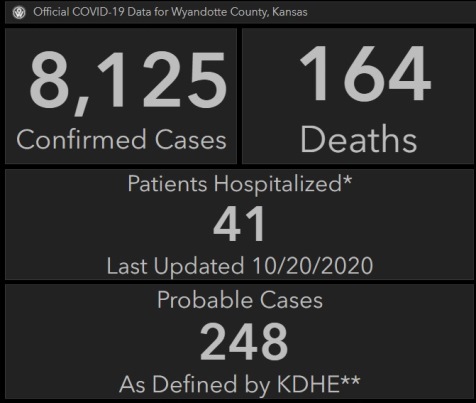
Wyandotte County reported an additional 89 COVID-19 cases on Monday, for a cumulative total of 8,125, according to the UG COVID-19 webpage. There were no additional deaths reported, with a cumulative total of 164. (From UG COVID-19 webpage)
A Unified Government committee on Monday night gave preliminary approval to mandatory reporting of influenza.
Juliann VanLiew, UG Health Department director, requested an ordinance be passed requiring health care providers such as hospitals, clinics, doctors and laboratories in Wyandotte County to report flu cases to the Health Department.
Currently, it’s not a reportable illness to the Kansas Department of Health and Environment. Measles, tuberculosis, chicken pox, polio and COVID-19, and many other illnesses, are reported to the state health department.
COVID-19 has some symptoms in common with the flu, including a fever, cough, sore throat and runny nose, although not everyone has all these symptoms. One of the differences between the two seems to be that people with COVID-19 sometimes lose their sense of smell and taste, and COVID-19 sometimes leads to more serious illnesses, according to the CDC website.
The current state rules in Kansas require flu to be reported only when it is involved with the death of a child, VanLiew said. Kansas City, Missouri, currently requires flu cases to be reported to health officials, she said.
VanLiew said this change could make a big difference at the local level. The Health Department wants to better understand the difference of flu and COVID-19 and its spread, and how it affects the population, she said. It would allow the department to monitor and respond to both influenza and COVID-19.
The proposed ordinance requires lab-confirmed flu cases to be reported to the Health Department within seven calendar days, and it would use a simple form, she said.
Also, she said the Health Department is not collecting protected personal information about flu cases, but more general information, such as date of diagnosis, age, and Zip Code.
The proposed ordinance says violation would be a misdemeanor. Repeated patterns of failure to report could be reported to licensing boards, according to the proposed ordinance.
The UG Administration and Human Services Committee voted unanimously Monday night to send the ordinance on to the full UG Commission on Nov. 5.
The Health Department stated recently that it plans to offer flu shots this year.
Wyandotte County reported an additional 89 COVID-19 cases on Monday, for a cumulative total of 8,125, according to the UG COVID-19 webpage. There were no additional deaths reported, with a cumulative total of 164.
The state of Kansas reported an additional 2,446 cases since Friday, for a cumulative total of 78,676, according to the Kansas Department of Health and Environment. There was one additional death, for a cumulative total of 976. According to the KDHE, during the weekend, the KDHE disease surveillance system, EpiTrax, received an update, automating a process that was previously done manually. About 300 cases from today’s update are attributed to that review, according to KDHE.
At the University of Kansas Health System, there were 29 active COVID-19 patients in the hospital, down from 30 on Friday, with nine patients in the intensive care unit, the same as Friday, and four patients on ventilators, down from six on Friday, according to Dr. Dana Hawkinson, medical director of infection prevention and control at KU Health System. There were 37 other patients hospitalized because of COVID-19 but in the recovery phase, an increase from 30 on Friday. HaysMed in Hays, Kansas, reported 17 COVID-19 patients, an increase from 16 on Friday, and four of those are in the recovery phase.
Dr. Steve Stites, chief medical officer at KU Health System, at the KU Health System news conference Monday morning was concerned about the rise in COVID-19 cases in the nation and in the Kansas City area, especially with the flu season near. Dr. Stites noted there has been a reported 35 percent increase in COVID-19 positive rates in the two-week rolling average nationally. He encouraged everyone to get a flu shot and to remember to observe the rules of infection control, wear a mask, wash hands and socially distance.
Vaccine development
Dr. Hawkinson said COVID-19 patients in the hospital are in a wide age range, some without symptoms and others had a lot of symptoms.
Dr. Hawkinson said a culture change is necessary, and the pillars of infection prevention must become part of the culture change to beat the virus.
Dr. Matthias Salathe, chair of internal medicine, said the AstraZeneca vaccine trial is back on at KU. The vaccine trial had paused after doctors investigated an incident with a patient in England. The FDA has approved the restart of the trial here.
Some of the trials have reported a 30 percent effectiveness rate, and the doctors are waiting to see the data from the results before making recommendations, he said. They don’t expect a COVID-19 vaccine to be like the measles vaccine, which was 99 percent effective. But any protection is better than nothing, he said. If it turns out not to be highly effective, all the masking and distancing probably won’t go away, but it will be safer with it.
Dr. Akinlolu Ojo, executive dean of the KU School of Medicine, said it was possible that a significant portion of the population could get a COVID-19 vaccine by the end of the first quarter of 2021. He said the trials might have enough information by the end of the year to determine whether each of the different vaccines would be effective.
Production is already underway and information in the public domain indicated 100 million doses could be available by December, Dr. Ojo said. The CDC has already started preparations with public health departments throughout the nation to make plans for distribution, he added.
Dr. Stites offered some tips for coping, from the University of Wisconsin: • Accept that life will continue to be difficult for a while. • Look for activities new and old that continue to fulfill you. • Expect less from yourself–cut yourself some slack and give yourself some grace. • Choose to move: Make physical activity a priority. • Avoid “doom scrolling”—limit social media exposure and be mindful of the types of news you consume.
Free COVID-19 testing available
A free COVID-19 pop-up test will continue from 8 a.m. to 11 a.m. Tuesday, Oct. 27, at All Saints parish, 811 Vermont, Kansas City, Kansas.
The pop-up test is through Vibrant Health and the Wyandotte County Health Equity Task Force.
The Unified Government Health Department has moved its COVID-19 testing from the 6th and Ann location to the former Kmart at 78th and State Avenue in Kansas City, Kansas. The hours are 9 a.m. to 3 p.m. Monday through Friday. Tests are free for those who live or work in Wyandotte County.
The tests now are open to asymptomatic people as well as those who have symptoms or have been exposed to COVID-19. Check with the UG Health Department’s Facebook page to see if there have been any changes in the schedule because of the weather or for other reasons. Bring something that shows that you live or work in Wyandotte County, such as a utility bill.