Wyandotte County doesn’t plan any drastic enforcement of the new mask order, but it will emphasize education, as it did earlier in the stay-at-home orders, according to a Unified Government Health Department spokesman.
With cases of COVID-19 rising in Kansas and in Wyandotte County recently, both the county and the state have issued mask orders. Both orders mandate people to wear masks in public places, including outdoors and indoors, with some exceptions.
The Wyandotte County mask order is now in effect and will be in effect until the governor’s mask order goes into effect at 12:01 a.m. Friday, July 2, said Janell Friesen, Health Department spokesman. If anything would happen to the governor’s order, the Wyandotte County order on masks would still be in effect.
“Most of the requirements in the state order and the Wyandotte County order are very similar,” Friesen said.
One difference she has noticed is that in the governor’s order, there is more responsibility on businesses to implement the mask order. Businesses are required to make their employees wear masks, as well as to require patrons to wear masks.
The Health Department currently is comparing the two orders, to see the differences, but the orders are very similar, she said.
“For the most part, when you’re in doubt, you probably need to wear a mask,” she said. Ther are exceptions for health and safety reasons, for people who can’t wear a mask, which is a relatively small number of people, for those who have breathing problems and those unable to remove masks without assistance, as well as for young children under 5.
For businesses, the governor’s order may require them to have signs, she said. The Health Department will be working on signs that businesses can use.
Friesen said the Health Department will offer education and resources if they are seeing places that don’t follow the new masking order.
“This is not about punishment, it’s about keeping people safe,” she said. They will make sure a business knows about the order and can implement it.
She said the Health Department also will be working on providing police officers with information materials so that as they go about their day, they can provide that information to people and educate them about what is covered by the order.
If the Health Department has supplies available, such as donated masks, it could make that available to people, and perhaps officers could hand them out, she said.
While the orders include some wording about enforcement, the focus right now is making sure everyone knows about the mask order and is able to take the steps to wear a mask, she said. They don’t anticipate having to do any drastic enforcement such as arrests. The state’s attorney general earlier today issued a memo that said he doesn’t think arrests can be made for violating health orders, after the Legislature passed a law, HB 2016, making violations a civil matter.
Friesen said law enforcement played a role of providing education and helping to be a resource in the past health orders.
Both orders exempt the deaf and hard-of-hearing, as they may need to read lips, and those under 5, as well as people who have medical conditions such as COPD, along with those who have a disability where they can’t remove their masks. Masks should not be worn by children under 2, according to health experts.
The governor’s order has some exemptions for legislative events and also for the courts that the local order didn’t include.
The governor’s mask order also uses a little different language in discussing exemptions to wearing masks in restaurants, however, in general, the orders are similar and Wyandotte Countians need to be wearing masks in spaces indoors and outdoors, she said.
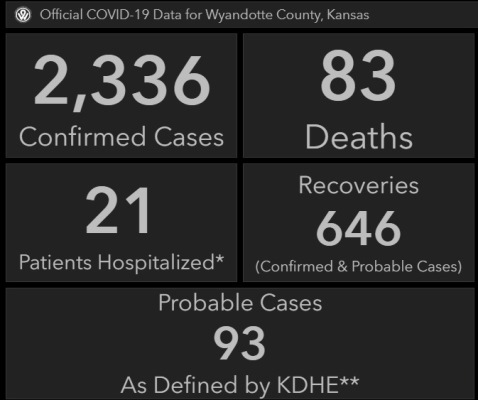
Wyandotte County reported 2,336 positive cumulative COVID-19 cases at 1 p.m. July 2, according to the UG COVID-19 webpage, with 83 cumulative deaths. There were 2,312 cases at 1 p.m. July 1, for an increase of 24 cases. There were no new deaths reported from Wednesday. (From UG COVID-19 website)
Doctors at the University of Kansas Health System today supported mask-wearing as a way to prevent the spread of COVID-19.
A statewide order mandating masks from Gov. Laura Kelly goes into effect at 12:01 a.m. Friday, July 3. Gov. Kelly signed the order on Thursday morning. Wyandotte County’s mandatory mask order went into effect at 5 p.m. Tuesday. The Johnson County Commission was meeting today to discuss the issue, and reportedly have passed a directive to follow the governor’s order, with the possibility of discussing it further next week.
Wearing a mask is one of the best ways to help reduce the spread of COVID-19, according to Dr. Dana Hawkinson, medical director of infection prevention and control at The University of Kansas Health System, who talked about masks at the Thursday morning video news conference.
Kansas reported 14,990 positive cumulative COVID-19 cases on Wednesday, and 272 deaths, according to Gov. Kelly. The case numbers have increased recently in Kansas.
“The last few months have presented many new challenges for Kansans, and all of us want to return to our normal lives and routines,” Gov. Kelly said in a statement. “Unfortunately, we have seen a spike in the number of COVID-19 cases, hospitalizations, and deaths across our state and our country. We must act.”
Under the order, Kansans are required to wear masks when inside any public space – including their workplace – or in situations where social distancing of 6 feet cannot be maintained, according to the governor’s statement. Guidance regarding specific places or situations in which masks are required is outlined within the order.
Kansans under 5 years of age, those with medical conditions, deaf and mentally challenged persons, those who have a disability that prevents wearing a mask, and others specifically outlined in the governor’s order are exempt from these requirements.
Also, if local, state or federal regulators or workplace safety guidelines say that wearing a mask would be a risk to a person at work, they will be exempt, the governor’s order stated.
While persons are eating or drinking in a restaurant or establishment, they do not have to wear a mask, but must maintain a 6-foot distance from people who do not live in their household, the governor’s order stated.
Athletes in organized sports that allow a 6-foot distance from others do not have to wear masks in that situation, under the governor’s order.
Also under the governor’s order, meetings of the Kansas Legislature are exempt from the mask rule.
The governor’s order stated that local governments have the authority to issue and enforce equally or more restrictive orders or provisions.
AG says can’t arrest individuals for violations of mask order; says his office will not bring any actions for not wearing a mask
Attorney General Derek Schmidt today sent out a memo to law enforcement agencies and prosecutors about how to enforce the governor’s executive order.
Schmidt noted that the Legislature changed violations from a Class A misdemeanor to a civil violation, which could be enforced by a lawsuit filed by the county or district attorney.
Law enforcement officers may no longer arrest or detain individuals for violations of an emergency order, Schmidt stated.
Schmidt also stated that counties could adopt provisions “less stringent” than the governor’s order.
“If an individual county has done so, then the governor’s emergency order may not be enforced in that county, even by a civil lawsuit,” Schmidt stated in a news release.
While the law allows the attorney general to bring enforcement actions, Schmidt stated his office will defer to the local county and district attorneys and has no plans to bring its own enforcement actions for not wearing a mask.
“I think the better approach is to leave any enforcement to local authorities who know their communities best and to give Kansans information and encouragement and trust them to make wise decisions,” Schmidt said in the news release. “So here’s what I encourage: Be safe on this Independence Day weekend, use common sense and caution to keep yourself and others healthy, heed the advice of the CDC and other public health experts, and wear a mask for now whenever you’re in a public setting and cannot maintain a safe distance from other people.”
The Wyandotte County frequently-asked-questions page on the local mask order stated that it did not know yet whether the local order will supersede the governor’s order, but nevertheless, both orders mandate wearing masks in public places here.
Doctors: Wear masks to lessen spread of COVID-19
At the KU doctors’ news conference, Dr. Hawkinson supported the governor’s order to wear masks. He said there were good medical reports recommending universal masking.
In Colorado, there is a good mask culture, where people are wearing masks and using hand sanitizer, he said. The KU Health System recommends wearing masks, he added, and it will lessen the spread of the virus.
The cloth masks will be able to block some of the droplets that might otherwise enter the air. It makes a barrier to prevent virus spread, especially in asymptomatic and presymptomatic patients, he said. They are effective when people are coughing, talking loudly or sneezing. They offer a protection to the wearer of the mask as well as a barrier for someone who is ill, he said.
Masks will play a role in stopping the spread of COVID-19, health experts believe, to keep people healthy and not have to close down businesses.
Wearing masks, physical distancing and hand hygiene together will reduce the spread of COVID-19, he said.
Dr. Hawkinson said the mandatory mask orders address the majority of the population. There are those who are very young, deaf, hard of hearing and with severe medical conditions who can’t wear the mask, he added.
The exceptions for the deaf have been made so they can continue lip-reading when communicating with each other.
Exemptions are in place for young children because it is difficult for them to have a mask on.
Also, those with COPD and breathing problems also are exempt and may have trouble with wearing masks.
Dr. Jessica Kalender-Rich said there are benefits to the entire community from everyone wearing masks, and risks and benefits for each person. There is a small subset of persons, including young children and those with breathing problems, for whom the risks outweigh the benefits, and it is a very small portion, she said.
Dr. Kalender-Rich said mandatory mask-wearing is something that has been needed and continues to be needed.
She said nursing facilities have had mandatory mask-wearing now for three months. Mandatory masking can protect the residents in the facilities as well as people who come into contact with them.
Dr. Kalender-Rich, a member of the Wyandotte County task force on COVID-19 and nursing facilities, also has been appointed to the national Coronavirus Commission for Safety and Quality in Nursing Homes.
On Thursday morning, there were 17 patients at the University of Kansas Health System, with six in the intensive care unit and two on ventilators. On Wednesday, there were 16 COVID-19 inpatients, with the same number in the ICU and one fewer on ventilators.
Wyandotte County reported 2,336 positive cumulative COVID-19 cases at 1 p.m. July 2, according to the UG COVID-19 webpage, with 83 cumulative deaths. There were 2,312 cases at 1 p.m. July 1, for an increase of 24 cases. There were no new deaths reported from Wednesday.
Wyandotte County now has posted an application for nonprofits, government agencies, school districts and businesses in Wyandotte County that want to apply for CARES Act funding. The web address is https://us.openforms.com/Form/6273fe80-8bba-4c18-b4e7-e551096d8a83.
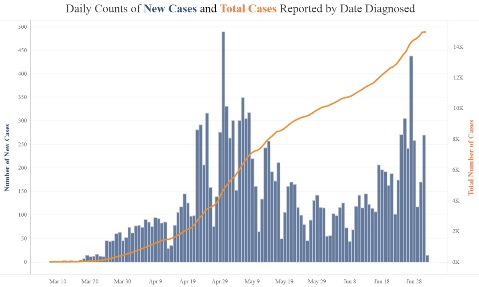
COVID-19 cases in Kansas have recently increased. This graph shows new cases by day in blue and total cumulative cases in yellow. (KDHE graph)
Kansas Health Secretary Lee Norman said on Wednesday afternoon that decisions that have been made – particularly by the state Legislature – have contributed to the upswing of positive COVID-19 cases in Kansas.
Dr. Norman, at a news conference, showed a chart of case numbers rising in Kansas and said that the increases are not random, but are predictable.
In the past 10 days, there have been 2,500 additional cases in Kansas, he said. As the state approaches the Fourth of July holiday, he is concerned about cases increasing more.
Kansas reduced the disease spread on March 16, when schools closed, and on March 30, when a stay-at-home order was put in place, he said.
Twenty-two days later, two incubation periods, the state reached its peak at the end of April, he said.
On May 4, the state entered the first phase of the reopening plan.
Then a phase 1.5 was begun, with a continued good decrease, he said.
“This is where things started going sideways,” Dr. Norman said.
On May 27, a bill was passed in the state Legislature resulting in the state opening plan becoming guidance and not a mandated plan, he said.
Ideally, Dr. Norman said he would have liked to see the numbers gradually taper off until July 1, to have time to build up supplies of personal protective equipment for the expected autumn and winter onslaught of cases.
Instead, by the state plan becoming guidance, many counties opened up and returned to business as usual, he said. Particularly, mass gatherings opened up, he said.
Kansas is still in Phase 3, which allows no more than 45 people, but it is merely guidance at this point, Dr. Norman said.
On Memorial Day, around May 31, they saw mass gatherings throughout the state, he said.
As counties were free to make their own decisions, some were adhered to the Ad Astra plan while others had their own plans, some of which were more stringent, and others did not adopt any plan.
Wyandotte County has its own health orders in place that have mandated Phase 3 of the Ad Astra plan here.
On June 4, a special session of the Legislature passed a bill, HB 2016, that included impedimenets to doing contact tracing, he said.
The legislators were concerned about privacy, but the Kansas Department of Health and Environment had no plans for electronic tracing, he said. Dr. Norman said the bill changed the way they can contact people. The bill includes provisions about third parties that would interfere with contact tracing, according to Dr. Norman.
Dr. Norman predicted that the trend line of cases will steepen, and that it would be more difficult to do contact tracing.
The KDHE’s mobile testing van went out for the first time and visited Wyandotte County on Saturday, and tested about 250 people at the Mercy and Truth Clinic.
Of those, about 13 percent tested positive for the virus, Dr. Norman said.
He said the state has about 4,033 cases that are related to active clusters, or outbreaks, in the state. It shows the virus is not gone, nor does it plan to take a break over the holiday weekend,he said.
Monday, the KDHE visited the state hospital, where it tested 250 people, with results yet to be determined, he said.
He said the essential approaches of winning the battle with COVID-19 are antiviral medications and vaccine, and they don’t have either one yet.
Lacking those, they are trying to stop the spread of the disease through adequate testing capacity, rapid case investigation, aggressive contact tracing, and isolation and quarantinehe said.
Since there isn’t yet a cure, the solution is prevention, mask wearing, good hygiene and social distancing, he said.
Three-fourths of the time, when there are clusters of cases, someone comes to work or goes to a party or a funeral, when they are ill, he said. “So stay home when you’re ill,” he added.
He asked everyone to remain vigilant over the Fourth of July holiday.
Outbreaks
There were 221 clusters or outbreaks in Kansas, with 108 still active, according to the KDHE. They accounted for 6,484 cases and 205 deaths.
Dr. Norman said a new cluster area today is sports, which has reported four clusters in Kansas, with 29 total cases.
Statewide outbreaks, or clusters of cases, were reported by the KDHE in these areas on Wednesday:
Wyandotte County now has posted an application for nonprofits, government agencies, school districts and businesses in Wyandotte County that want to apply for CARES Act funding. The web address is https://us.openforms.com/Form/6273fe80-8bba-4c18-b4e7-e551096d8a83.