The Unified Government Commission on Tuesday evening passed a way to fund Wyandotte County District Attorney Mark Dupree’s old records digitization project that may be used in a continuing investigation of past cases by former KCK detective Roger Golubski.
A combination of federal ARPA funding, debt financing and cash, was proposed by UG Budget Director Reginald Lindsey.
Golubski was indicted on several felonies by the federal government, and community and outside community pressure has been applied for a complete review of all his cases. He also worked with the Edwardsville Police Department after retiring from the Kansas City, Kansas, Police Department.
The paper files were stored in about 4,000 boxes in an old city jail cell, and the digitization will allow them to be searched electronically to identify the cases that are needed. Other cases not relating to Golubski also may be used in the future by the DA’s office and police department to review other cold cases, according to Dupree.
Alan Howze, acting interim county administrator, said there had been overwhelming commission support last week to fund the project. UG staff came up with funding for project costs.
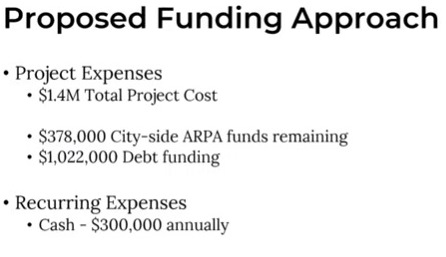
The records storage and digitization will cost $1.4 million, according to the UG.
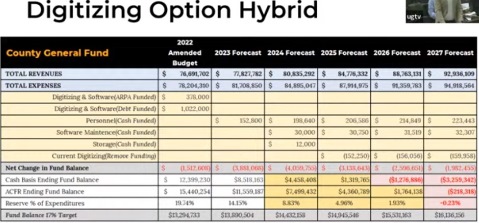
Recurring costs of this program also will include $200,000 annually for personnel, an attorney and victims’ advocate, plus $30,000 annually for software maintenance.
According to Howze, the DA has unrestricted authority to spend the appropriated funds at his choosing, and is not required to follow UG procurement rules.
Howze said the DA’s office follows its own procurement rules as outlined in statutes.
Lindsey said the financing for this project did include some other commitments made for the sheriff’s department in the numbers.
Lindsey outlined some possible effects on the budget. There could be a $1.2 million cash fund basis that is negative in 2026, according to Lindsey.
Misty Brown, UG chief legal counsel, said the resolution calls for $378,000 in city ARPA funds for one-time use and digitization costs, $1.022 million in county debt funding and $300,000 in cash recurring expenses annually.
In answer to a question from Commissioner Melissa Bynum, UG officials said it is possible that they can further analyze the funding mechanisms in a future meeting, while still raising the same total amount.
According to the commissioners, they received four proposed financing resolutions in their email before the meeting, and two were identical.
Commissioner Tom Burroughs suggested looking into whether the UG was receiving an anticipated $3 million opioid case settlement, where funds could be used.
Burroughs said he would give his district’s portion of the $155,000 recently passed at a budget meeting back to the UG funds because of these expenditures. Commissioner Andrew Davis, who proposed the commission district allocations at the budget meeting, said he would not. Neighborhoods need to have events to connect them to each other, according to Davis. Later, Mayor Tyrone Garner said neighborhood business revitalization groups already received funding for bringing neighborhoods together.
Commissioner Mike Kane called for a quarterly report on where the money has been spent for this for the digitization project. If it ever happens again, he would like to have the DA meet with three commissioners at a time, which is not a public meeting, to understand it so it doesn’t have to be hurried through as it did this time. The “three-on-three” meetings the UG has done for decades are private, not open to the public, because they fall in the loophole to the Kansas Open Meetings Act that allows elected officials to meet with administrators without public scrutiny if they have less than the number of officials present to require an official meeting.
Dupree said he would continue to let the full commission know where the project stands. However, he is not required by state law to do so.
Dupree said this situation with the review of cases was something that came up unexpectedly this year. When Golubski was indicted, they had to move expeditiously to make the software review happen, he said.
Dupree said justice can’t be served without the software review, and part of his statutory duty was to bring about justice and pursue justice.
Without the extra funding, his office would not be able to properly bring off cases because he is not able to as it is right now, he said.
Since 2018, when Dupree was denied the necessary software funding by the commission, he has been doing what he could, he said.
In order to do his job and bring about justice for the community, he needs to digitize, he said.
Dupree said the software review program will also help the KCK police department’s cold case review.
Commissioner Bynum, who has worked with the ARPA funding program’s strict guidelines, asked if the pandemic affected the DA office’s ability to digitize.
Dupree said the pandemic did affect it because the Kansas Supreme Court shut down the courthouse and they were not able to get to files in some time until the courts allowed them back. Also, personnel hired for the temporary scanning process were reduced from four to one at times because of COVID fears or illnesses, he said, so it greatly affected their ability to do the work.
Mayor Garner, who spent his career in the KCK Police Department, said no one wanted these allegations that are before them, but it’s where they’re at. They are not just files hidden in cabinets, waiting to be digitized, the files are reports and are considered evidence, he said.
Evidence can deteriorate if they don’t act, and could further compromise any investigations that need to move forward, he said.
He also said he was alarmed that people suggested auditing the DA’s office and wondering how he spent the money when part of his task is to oversee how things are done.
“I support all our public safety offices, including our DA,” Garner said.
“The DA is asking for investigation to bring, truth, reconciliation and justice to individuals asking this matter to be brought forth,” he said.
He said whatever is done, it should be done equitably and everyone treated with the same level of regard when they make decisions.
For more information, view the meeting at https://www.youtube.com/watch?v=b83mFD9k-aA.