
Opinion: Another senseless tragedy should inspire wide condemnation

Window on the West
Opinion column

by Mary Rupert

Not too long ago, in 2015, I wrote an opinion column deploring a shooting tragedy at a church in South Carolina, where the assailant was reportedly a white supremacist.

Here we are with another tragedy last weekend, this time involving a white supremacists’ rally in Virginia. It was an act of domestic terrorism when a vehicle was driven by a white supremacist sympathizer into a crowd of people protesting against neo-Nazis, killing one and injuring many more, according to news reports.

This incident again is one that should be widely condemned in America. If members of the public are afraid to speak out about their opposition to the white supremacists’ violence, some leaders may assume the public has no opinion or they are in favor of the discrimination and hatred represented by this group.

In the background of this incident last weekend were attempts to take down statues of Confederate soldiers and officials in Virginia. Such changes are up to the community and state – and they reflect a changing society. In the Kansas City area, community leaders ought to consider changing the name of Johnson County, Kansas – a county named after a founder who held slaves – and all the accompanying institutions and the street named after Thomas Johnson.

A few important points after watching the news about violence and a death in Charlottesville, Va., following a white supremacists’ rally:

• I am appalled by the violence that took place at a white supremacists’ rally over the weekend in Virginia, in which a woman died after a car ran into a crowd of protesters.

• I do not support any of the positions or actions of white supremacists, including neo-Nazis and KKK. Discrimination and hate are wrong.

• I believe the vast majority of Americans, of all backgrounds, do not support them, either. Our multicultural society can work if we work at it.

• I support the rights of all persons in America for equal opportunity, justice, and the right to live a life free from persecution.

• I, and many of you, had relatives who fought for the United States against Nazis in World War II, and these relatives were on the morally correct side.

• I have seen a historically preserved Nazi death camp in Germany, and it represents the low point of humanity. Never again should we knowingly let white supremacists rise to political power.

• People should speak out against the white supremacists, including rallies, letters and public statements, but they should not use violence in their responses. The original White House statement and some later statements were not strong enough against this group.

• More efforts should be made to make sure teens and young adults find their place in society so they are not attracted to violent fringe groups.

• This is a good time to look inward and try to do away with any hate directed toward any individual or group.

To reach Mary Rupert, editor, email maryr@g3f.1db.myftpupload.com.
Opinion column: College needs to look past problems

Views
Opinion column

by Murrel Bland

During the past few weeks, several persons have asked me what is going on at Kansas City Kansas Community College. I had known for some time that there had been personnel issues at the school, including those in senior administrative positions.

That all came to a head when the college’s Board of Trustees voted 6-1 on Friday, July 14, to place its president, Doris Givens, on administrative leave with pay. Givens, the first woman and black person to be president at the college, has been at the school for about six years. Her present contract, which calls for her to receive nearly $200,000 a year in salary plus benefits, expires in 2019.

The board, on advice of its lawyer, Greg Goheen, isn’t talking except for Wendell Maddox. Maddox, whose term expires at the end of the year and is not seeking re-election, was critical of J.D. Rios, the president of the board, who initiated an internal investigation. Maddox, according to an article in The Kansas City Star, said Givens didn’t have a chance to tell her side of the story.

In the meantime, the board has hired Jackie Vietti as acting president. In a prepared news release, the board said Vietti was chosen because of her extensive experience, having served as president of Butler County Community College, El Dorado, and as interim president of Emporia State University. Those who follow college administrators report Vietti is very qualified.

Rios has said that Vietti will serve until a permanent successor can be found; he said the board will conduct a national search. Rios is not seeking another term as a trustee; however, he is a candidate for Unified Government Commission.

I have been a close observer of the college for some 45 years. Over the years, I have seen various conflicts and disagreements between college administrators and the
trustees. That was particularly the case in the mid-1970s when Alton Davies (a senior administrator who later became president) and the president, Jack Flint, wrote undated letters of resignation and filed them away; I recall Davies telling me that writing those letters gave him a real sense of relief. The letters were never presented formally to the trustees; however the board was aware they had been written.

At times, conflicts among board members became public during trustee meetings, particularly between Ron Mears and Cliff Nesselrode. In some of these cases, it was the college president who was the “referee.”

Fast-forward to the present. The college has grown during the past several years, playing a very important role in providing a much needed, well-trained workforce. And the college continues to provide a very cost-effective way for traditional students to receive the first two years of a four-year college education.

Thanks to foresight, the college has built a Technical Center in a building that was a former Walmart. A major concern however, is that often students from the Kansas City, Kansas, School District, are not prepared for college-level work and must take remedial classes in such basic subjects as reading and mathematics. That forces the college to pay for training that should have happened in high school or earlier. The college must accept anyone with a high school diploma.

There are plenty of good-paying jobs awaiting those who successfully complete technical training in such career fields as machinist, welder and diesel mechanic. It is not unusual for such jobs to command a starting pay of $40,000 a year. The college has worked closely with the Wyandotte Economic Development Council to determine workforce needs. Despite this effort, there are still critical shortages of qualified workers.

In looking at the public notice published July 27 in The Wyandotte Echo, I find that the trustees approved a budget for the coming year that totals more than $72.2 million. That compares to actual expenditures of about $67.2 million for the current year. About one-fifth of a typical residential tax bill in Wyandotte County goes to the community college.

The trustees should conduct a national search for a new president. Despite its challenges in recent years, it will offer an opportunity for the right person to lead an excellent community institution.

Murrel Bland is the former editor of The Wyandotte West and The Piper Press. He is the executive director of Business West.

Opinion: Next question in the mayoral contest concerns endorsements

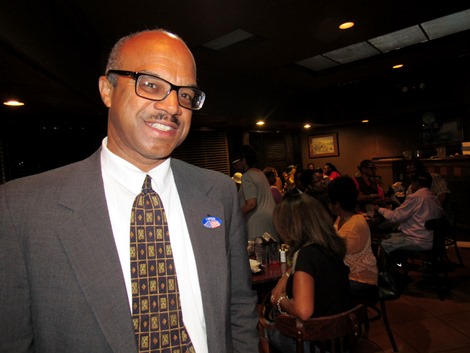
State Sen. David Haley, seen at his campaign watch party Aug. 1 at Gates restaurant at 10th and State Avenue, hoped the primary campaign changed the focus of the election to more economic development for the eastern part of Wyandotte County. His endorsement could be important in the general election. (Staff photo)

Window on the West
Opinion column

by Mary Rupert

While state Sen. David Haley did not make it through the primary election for mayor of Kansas City, Kansas, on Aug. 1, he may still wield a lot of influence, if he chooses to endorse another candidate.

Candidate endorsements may play a role in the general election. Incumbent Mayor Mark Holland received the endorsement of the MainStream Coalition before the primary, and he also was supported by some prominent leaders of the local Democratic Party. Challenger David Alvey received the pre-primary endorsement of the police and firefighter political action committees. Alvey also may have some Board of Public Utilities individuals’ support, and some support from former county government employees.

Endorsements may not be all that is needed, however. During the mayoral election four years ago, Nathan Barnes’ gave his endorsement to Ann Murguia, but it was not enough to win the election.

Despite being underfunded and entering the primary campaign late, Sen. Haley still received 18.5 percent of the vote, compared to 40 percent for Holland and 31.6 percent for Alvey. Janice Witt received 7.4 percent of the vote, and D. Keith Jordan, 2.37 percent.

On the day before the primary election, Sen. Haley said he heard during his campaigning from a lot of people concerned about high property taxes. That was one of Haley’s campaign themes, along with a pledge to expand economic development to the eastern part of the county. At different times, other mayoral candidates expressed the same positions.

Campaign spending

According to Haley, Holland raised about 15 to 1 in campaign dollars in the primary compared to him, and Holland reported around twice as much as Alvey.

Haley said he raised about $4,000, and spent about $3,500. Haley quipped that he would probably receive more votes per his campaign expenditures than the other candidates.

The mayor’s contest was a bit hard to predict for some observers because three candidates, Holland, Alvey and Haley, had good name recognition from running for office in the past, and some of them had well-known family members who were on the ballot in past years, as well.

Holland remarked at his election night watch party that it was the fourth time he had run county-wide. Having a campaign team of volunteers in place county-wide made a difference, and apparently, the funds available to send out mailers to voters.

Alvey said at his election night watch party that he intended to expose Holland’s statements that everything was going well in Wyandotte County. He also said he favored development in other parts of the county.

At his election night watch party, Haley wanted it known that his campaign had shifted the focus to other parts of Wyandotte County, and he was in favor of developing and helping small businesses in other parts of the county.

While the candidates usually don’t oppose Village West or the developments near it, they often have said during the campaign that they want new developments in other parts of the community.

Turnout was key

Voter turnout was one of the keys to the Aug. 1 primary. There is speculation that some voters were so disillusioned with national politics that they didn’t vote in the primary. The turnout showed that candidates were able to get voters to the polls despite some misgivings on citizens’ part. While Haley sometimes drew attention to areas that needed improvement during the campaign, he also said there were a lot of good things to report on the local level.

Haley, a Democrat who plans to keep serving in the state Senate, said although the municipal elections are nonpartisan, he believed that he and Alvey were competing for the Republican votes in the county.

Briefly glancing around some of the watch parties on election night, I observed some past and present leaders of the local Democrats at Holland’s party, with some others also at Haley’s.

Haley’s opinion was that the highly contested Sheriff’s contest, where five people were running, might help turn out Republican voters, who then might either vote for Haley or Alvey. An old maxim is that low turnouts favor incumbents.

Turnout here was 17.87 percent of registered voters, according to the election office, and that is considered good compared to other large counties’ primary elections on Aug. 1. Several candidate forums were held to increase voter awareness, some mailers were sent out by candidates, and the election office sent out postcards with information about voting.

There have been some comments about a low turnout, but it was pretty good or normal compared to other primary elections in the past. If we want to see turnouts of 80 or 90 percent, perhaps we’d better invent a secure way of voting from home via television or phone, or schedule elections on Sunday afternoon, providing free transportation.

Correction

In my story of July 30 about the Sheriff’s contest, Celisha Towers was listed as a Sheriff’s office employee. That is incorrect. She was a Sheriff’s Department employee in 2016, but not in 2017. (I had checked it on a UG personnel list at https://wycokck.nextrequest.com/requests/17-373, but a change had been made in employment since the list was made.)

To reach Mary Rupert, editor, email maryr@g3f.1db.myftpupload.com.