
Letter to the editor

(Editor’s note: Rose Mulvany-Henry, newly elected member of the Board of Public Utilities, will take office on Wednesday, Jan. 8. The following is an open letter to Mulvany-Henry from her general election opponent, State Sen. David Haley, who lost the general election for the BPU at-large, position 3, seat by 37 votes.)

Dear editor,

With the nail-biting finish of November’s citywide general election decidedly in 2019’s rearview mirror (which asserted Rose Mulvany-Henry for BPU’s campaign bested David Haley for BPU’s campaign by a mere 37 votes; just ¼ of one percent of the 14,356 votes cast that were counted), many of us greet your new, never-before-elected service at BPU in 2020 with genuine optimism.

After all, six of us, including the one-term incumbent who was president of the Board of Public Utilities, vied in the at-large BPU August primary which resulted in my 1st place, your 2nd place and his 3rd place finishes. As you and I alone moved forward towards the general, an oft articulated awareness of public concerns for BPU’s policies and practices was regularly cited.

Your campaign, endorsed by a few of our fledgling primary opponents and generously funded by some of the same special interests that lost that incumbent in the primary, picked up major steam immediately. Bolstered too by public yard sign displays alongside a respected established candidate for another countywide office, the Mulvany-Henry campaign just ran a stellar race.

The muted Haley for BPU campaign had one mission alone; to provide one voice (ostensibly, my own) on the six-member board that’d put public concerns about BPU policies and practices back before the Board of Public Utilities. As a decades-long elected officeholder, I ran only on a well-established integrity for being ever accessible and of doing what I said I will once elected.

Constantly questioned, let me reiterate. Haley for BPU raised and spent less than $1,000. in both the primary and the general election. Though outspent 10-1 by your campaign, only low voter turnout, ironically 33 percent lower from precincts really needing a responsive voice before BPU’s syndicate, led to that 37-vote deficit and won the crucial race for you this time … instead.

Our campaigns expressed approaches to better, more transparent governance of the utility but differed. Mine, which I will continue to pursue in Topeka as a state senator, simply advocates comparing concerns and policies with opinions on other Kansas utilities issued by the Kansas Corporation Commission (kcc.ks.gov.) while yours purports to rely on internal drivers to change.

As you join the board, I for one take heart in believing you do hold the requisite skills, intellect and awareness to leverage influence on an established and entrenched machine; tone deaf to pleas for parity by the public due to senility, obliviousness and even corruption. Where so many others have understood, pledged, won and failed us, you, Rose Mulvany-Henry, can succeed.
Godspeed.

David Haley
35+ year ratepayer / consumer of the Kansas City, Kansas – Board of Public Utilities
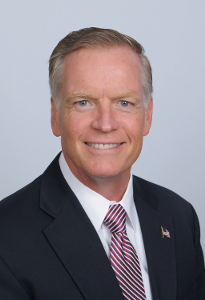
Senator discusses legislative issues

State Sen. Kevin Braun

Views
Opinion column

by Murrel Bland

About 50 persons gathered in The Meeting Room of the Bonner Springs Public Library Saturday morning, Jan. 4, to hear State Sen. Kevin Braun, R- 5th Dist., speak about legislative matters.

The senator discussed budget matters and other issues that will probably come up as the Kansas Legislature prepares to start its 2020 session Monday, Jan.13.

Sen. Braun used information including a flier produced by the Kansas Legislative Research Department with a pie-chart that showed where the state’s money comes from and where it goes for fiscal year 2019. He said that nearly half of the income, or about 47.6 percent, came from individual income; about 39.5 percent came from sales or use tax. About 5.6 percent came from corporate and financial income. The balance came from other sources including the tobacco tax.

State government spent slightly more than $17 billion in fiscal year 2019. Of that, more than $8 billion was spent on education and more than $5.7 billion went to human services. Transportation received slightly more than $1 billion and public safety received $645.7 million. Agricultural and natural resources received slightly more than $220 million. The rest, about $1.2 billion, went to general government.

Sen. Braun said that Kansas law requires the state to have a balanced budget. He said it is important not only to meet the letter of that law, but to abide by the spirit of the law. He said he does not believe in taking on long-term debt to pay for current-day operational spending.

Sen. Braun said he favors a constitutional amendment that would require that “no court, including the Kansas Supreme Court, has the authority to create for itself discretion of how state funds are allocated.”

Sen. Braun said he is a “compassionate conservative” when it comes to caring for the elderly and disabled. However, he said he is concerned about the possible burden which expanded Medicaid could have on taxpayers. He said that currently 92 percent of Kansans have private insurance, Medicare or Medicaid. He said he does not want to put this 92 percent at risk in order to provide coverage for the 8 percent who are able-bodied persons who are not willing to work.

Jeff Colyer, who was governor in the fall of 2018, appointed Braun to the Kansas Senate. He was nominated by Republican precinct committeemen and committeewomen from Wyandotte and Leavenworth counties. He was an unsuccessful candidate to the Kansas House and the Kansas City, Kansas, Board of Public Utilities. He and his wife live in the Piper community.

Sen. Braun succeeded Sen. Steve Fitzgerald, who resigned after losing in the primary election for U.S. representative.

After Sen. Braun was chosen, he was quoted in a story in The Leavenworth Times that he will have the same driving conservative principles as Fitzgerald. However, Sen. Braun said he will “have a little softer approach.”

The 5th Senate District includes the cities of Lansing, Leavenworth, Bonner Springs, Edwardsville and the Piper community.

Murrel Bland is the former editor of The Wyandotte West and The Piper Press. He is the executive director of Business West.

Congresswoman reports on legislation

Views

Opinion column

by Murrel Bland

U.S. Rep. Sharice Davids (D-3rd Dist.) originally was expected to attend the monthly meeting of the Congressional Forum Friday, Dec. 20, at Children’s Mercy Park. However, the rush of yearend business in Washington, D.C., meant that she communicated with forum members via a video screen. The Kansas City, Kansas, Area Chamber of Commerce sponsors the forum.

Rep. Davids said she was pleased to vote in favor of The Lower Drug Costs Act. This legislation gives Medicare the power to negotiate with drug companies for lower drug prices and makes those lower prices available even to those with private insurance. Information from the non-partisan Congressional Budget Office indicates taxpayers would save $456 billion from 2023 through 2029. The law also provides for vision, dental and hearing benefits.

Rep. Davids said she also voted for improvements to the United States-Mexico and Canada Agreement (USMCA.) She said the act should bolster the Kansas economy and assure a strong, fair trade agreement.

Rep. Davids said, after a long deliberation, she voted for two articles of impeachment of President Donald J. Trump.

A panel of four Kansas state legislators from Wyandotte County then discussed the upcoming session which begins early next year. The panelists were State Reps. Pam Curtis, Kathy Wolfe Moore, Tom Burroughs, all Democrats, and State Sen. Kevin Braun, a Republican. Rep. Curtis is chairwoman of the Wyandotte County delegation.

One of the issues that panelists discussed was property tax relief. A recent national survey indicated that Kansas was one of the least desirable states for retired persons, citing high taxes as one reason.

The panel indicated that one possible solution to high property taxes could be the Local Ad Valorem Tax Reduction—LAVTR. The LAVTR law has been in effect for many years. However, it has not been funded since 2003. Simply stated, LAVTR rebates money from the state general fund to reduce property taxes.

Rep. Burroughs said LAVTR could be considered during the next legislative session now that the state is in better shape financially. This would help local units of government who would not have to be so dependent on property taxes.

Rep. Moore said she favors expansion of Medicaid that would help serve those who are presently underserved. She said this is particularly important to smaller Kansas communities and their hospitals.

Sen. Braun said the legislature will be looking at STAR bond legislation. He said it will be important to assure that those who receive STAR bonds would be developers who would clearly meet qualifications.

The use of STAR bonds allows for state sales tax to be used for such things as infrastructure. The first use of such financing in Kansas was used in Wyandotte County to help develop Village West; it has been considered a model use of STAR bonds. However, other developments in other Kansas areas have not been successful.

Murrel Bland is the former editor of The Wyandotte West and The Piper Press. He is executive director of Business West.