
KCKCC trainer, track coach played role in success of Royals’ MVP Cain

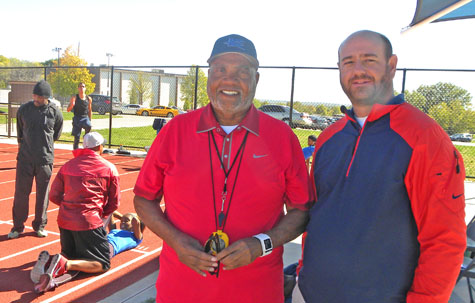
Off-season workouts under the direction of Kansas City Kansas Community College track coach Al Hobson, left, and athletic trainer Rodney Christensen were credited by Kansas City Royals star Lorenzo Cain with helping avoid injuries and improve his running. The Royals’ leading hitter this season, Cain hit .533 in being the MVP in the Royals’ sweep of the ALDS series. (KCKCC photo by Alan Hoskins)

by Alan Hoskins
KCKCC sports information director

While the entire Royals fandom reveled in the success of Lorenzo Cain in helping the Kansas City Royals win the American League Division Playoff, it was even more significant for Rodney Christensen and Al Hobson.

Christensen is in his 17th year as head athletic trainer at Kansas City Kansas Community College; Hobson is in his 18th year as head track coach and both played major roles in Cain getting healthy and becoming a much quicker and faster outfielder and base-runner – of which Cain gave credit during a national telecast of the Royals’ four-game sweep of the Baltimore Orioles in the ALDS.

Royals announcer Steve Physioc was the first to make note of Cain’s relationship with Hobson and KCKCC during a national telecast and two local television stations followed up with taped interviews on the college campus.

Following injury-plagued seasons of 2011 and 2012 in which he played a combined 67 games, Cain underwent three months of workouts under the direction of Christensen and Hobson at KCKCC and while it would be pure folly to suggest their rehabilitation was the main reason for his recent success, the facts are that he played in 133 regular season games this year, led the Royals in hitting with a .301average and was named the Most Valuable Player in the ALDS after hitting .533 and starring defensively.

“We use the same doctors as the Royals and specifically Dr. Vincent Key, who I’ve known for several years,” Christensen said. “Lorenzo had been having a series of nagging injuries, hamstrings, groin injuries and hip flexors so I asked Dr. Key to send videos of him. I must have watched 2-2½ hours of video.”

At the same time, Christensen referred Dr. Key and the Royals to Hobson, who has coached several Olympic sprinters, the most notable former Olympic 100 and 200-meter dash champion Maurice Greene. Coinicidentally, Dr. Key’s father-in-law was a teammate with Hobson at old Sumner High School.

For three months in the fall of 2012, Cain came monthly to KCKCC from his home in Oklahoma to work out with Christensen and Hobson.

“The first day he came I got in about 6 a.m. and he was sitting in the parking lot ready to work,” Christensen said. “I knew right then he was serious about getting better. Lorenzo is a great athlete but he just had some flaws.”

Cain came monthly for three months, working out four or five days each visit. Christensen designed a series of exercises and workouts to strengthen his legs to reduce the chance of injury. He also came up with specific warmup exercises for use before game.

“Sometimes between innings you’d see him doing them,” Christensen said. “We also gave him exercises to do at home and when he’d come back, we could tell the difference. You could tell he was doing his homework.”

Hobson, on the other hand, worked on improving his running.

“He told me he wanted to be the best and he wasn’t going to stop until he was the best,” Hobson said. “I don’t know what he considers the best but he’s sure getting there in a hurry.”

Hobson’s first step was to analyze the way Cain ran.

“I wanted to find out what was keeping him from running faster,” said Hobson, who focused on body position, how Cain’s feet touched down and how to get quicker starts. “His body position was not good at all. If you can eliminate as many negatives as you can, you can make a lot of progress”

He also worked with Cain to use strategic stretches to prevent injury and helped him get in “sprinter shape” with lunges and double leg bounds up and down steep hills near Wyandotte County Lake.

“I was hard on him, about killed him,” Hobson said. “But he wanted to learn and was willing to learn – the hardest working baseball player I’ve ever trained.”

Cain and Christensen continue to talk on a semi-regular basis and Hobson spent time with Lorenzo while watching batting practice from the Royals dugout prior to a late-season game.

“He’s going to be a superstar. He is a superstar,” Hobson said. “I’m just proud to see him doing so well and having the success he’s having. Every time he does something now, I’m pumped up. That’s the thrill I get, seeing him doing so well.”
KCKCC golfers place first, third in Blue Devil Classic

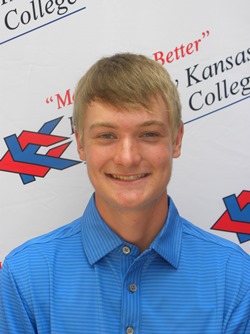
Charlie Rinehart (KCKCC photo)

by Alan Hoskins
Kansas City Kansas Community College golfers dominated the annual Blue Devil Classic played at soggy and wind-blown Dub’s Dread Tuesday, finishing first and third in the eight-team tournament.

Led by co-medalist Charlie Rinehart, a sophomore from Piper, Blue Devil golfers turned in five of the six low scores and eight of the low 12 in the tournament shortened to 18 holes by the day-long rain that wiped out Monday’s first round.

Rinehart and Eddie Doyle of Kirkwood Community County shared medalist honors at 3-over par 75 while Blue Devil sophomores Seve Sites of Shawnee Mission West and Lane Pauls of Newton and freshmen Marc McClain of Bonner Springs and Colton Allen of Shawnee Mission West all tied for third at 78.

Rinehart, Sites, Pauls and freshman Jeremy Dunham, who finished in a tie for 10th at 81, made up the KCKCC Blue team which took top honors at 312, three shots in front of Kirkwood and seven in front of the KCKCC Red team (319).

McClain and Allen were joined by Piper sophomore Montana, who tied for eighth with an 80; and freshman Matt Thyne of Hesston and sophomore Dalton Ayres of Newton on the KCKCC Red team that was third at 319. Thayne tied for 17th with an 83; Ayres shared 21st with a 74.

Haskell Purple took fourth at 332 followed by Allen County (333), Des Moines Area (336), Coffeyville (361) and Haskell Gold (370).

The Blue Devils will close out the fall season Monday and Tuesday when they compete in the Southwestern Invitational in Winfield.

KCKCC celebrates national White Cane Safety Day

by Kelly Rogge
Kansas City Kansas Community College is celebrating White Cane Safety Day Oct. 15 with a demonstration of its new crosswalk signal.

White Cane Safety Day is a national observance, celebrated on Oct. 15 of each year. The goal of the day is to celebrate the achievements of those who have visual impairments as well as the symbol of blindness, the white cane. President Lyndon B. Johnson was the first to sign a proclamation for White Cane Safety Day, which is also referred to as Blind Americans Equality Day.

This year, staff from the Kansas State School for the Blind, 1100 State Ave. in Kansas City, Kan. will be visiting KCKCC to demonstrate the new and improved intersection on the KCKCC campus, crossing Campus Blvd. from the main building to student housing. Cheryl Covell-Seaton, career education and mobility specialist at the Kansas State School for the Blind, said the crosswalk started with a simple email to Michael Burns, director of the Academic Resource Center at KCKCC, explaining the need for an accessible pedestrian signal at the crosswalk.

“Without it, it was not really safe for anyone, sketchy at best for someone with a visual impairment and impossible for someone who is both blind and hearing impaired,” she said.

The intersection has been retrofitted with Accessible Pedestrian Signals, channelized walkways and detectable warning strips, which provide information for individuals with visual impairments. The signals are activated by a cross walk button that continuously “chirps,” so blind or visually impaired students can find it to activate the stop lights. The APS system also provides information verbally, telling students when it is safe to cross as well as tactilely via vibrations for individuals who have dual sensory impairments-auditory and visual loss. The light at the cross walk turns solid red to stop cars, and then after a timed interval, flashes red to allow cars to pass if the intersection remains clear. After a time, the signal will go dark, allowing for vehicles to pass freely. The sidewalk has also been straightened extending it to the south side of the Fine Arts building and automated door openers have been installed at those doors.

The demonstration will take place at 4 p.m. Oct. 15 on the KCKCC campus. Blindfolds and white canes will be provided for those who would like to experience using the new APS signals without vision.

“This made crossing very difficult at busy times of the day. This strategy was also not completely full-proof when you consider how quiet hybrid vehicles are, background noise (such as construction, wind), etc.,” she said. “As you can understand, someone who cannot see or hear the vehicles would have no way to make a safe crossing without having a way to stop traffic.”

Previously, there was no formal traffic control at the crosswalk. Students and staff crossing the heavily traveled Campus Boulevard had to rely on drivers to stop on their own. Covell-Seaton said they would teach their blind students to only cross when it was completely silent (indicating that there is no traffic coming from either direction).

“The APS that was installed is state-of-the-art,” Covell-Seaton said. “It has made traveling between student housing and main campus safer for all students.”

For more information, contact Craig Phillips, certified orientation and mobility specialist and teacher of the blind and visually impaired at the Kansas State School for the Blind, at cphillips@kssdb.org or by calling 913-305-3044.