
In the space of a few minutes Thursday night, Gov. Laura Kelly announced the stay-at-home order in Kansas would end May 3, while Wyandotte County announced it would extend the stay-at-home order here through May 10.
Gov. Kelly said in a statewide broadcast that as the state’s order ends on May 3, the state would implement the first of three phases. That first phase in Kansas still restricts gatherings of people to 10 or fewer, plus it has many other restrictions.
The phase would last at least 14 days before a second phase might be implemented, according to the governor. The governor would evaluate various health measurements before deciding whether to move to the next phase.
“I am incredibly proud of how the people of Kansas met the moment and answered the call to hunker down,” Gov. Kelly said in her speech.
“It has been a difficult time that has taken a painful toll … financially, emotionally, physically, spiritually and professionally on Kansans,” Gov. Kelly said. “But because Kansans took this seriously, COVID-19 has inflicted far less devastation on Kansas than it did in other states.”
Dr. Allen Greiner, chief medical officer for Wyandotte County, said during a Unified Government Commission meeting tonight that Wyandotte County’s stay-at-home order through midnight May 10 has a lot in common with other areas of the Kansas City metropolitan area. Johnson County announced a similar stay-at-home order through May 10 earlier today. Kansas City, Missouri, has announced a stay-at-home order through May 15, but with a soft reopening of some businesses on May 6.
“Because there is no vaccine for COVID-19 at this time, and efforts to expand testing and contact tracing continue, we have developed a longer-term phased approach with prolonged intermittent levels of social distancing and surveillance in order to protect public health in Wyandotte County,” Dr. Greiner said. “The decision to extend the Stay-At-Home period by issuing a new order is based on what the virus is telling us. Wyandotte County has been hardest hit by COVID-19 in this region, so we must be especially cautious in order to protect the health and wellness of everyone in our community. We are making progress, but we are not in the clear yet.”
Dr. Greiner, who announced the extension of the stay-at-home order before the governor announced the end of the state’s order, said a Wyandotte County task force has been working hard on a reopening plan for the past week, meeting with community leaders and public health officials. About 10 days ago the Core4 group of local governments in the Kansas City area decided on May 15 as an end to the stay-at-home order, but also said if the data looked better, they might move the date up, he said.
The date was moved up to May 10 because they are not seeing large increases in hospitalizations nor in deaths, he said, although there has been a slight increase in some areas.
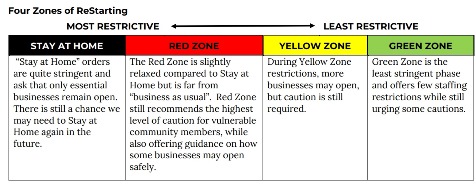
He said they are using an image of a stoplight with red, yellow and green to depict the next phases. On May 11, Wyandotte County will move to the “red zone,” he said, which will have requirements on all sorts of entities.
Wyandotte County will rely on the data to determine when to move on to the next phase, according to Dr. Greiner.
Wyandotte County’s COVID-19 positive cases are much higher than surrounding communities in the case per 100,000 population comparisons, according to Health Department officials. Currently, according to the UG Health Department, Wyandotte County has a 27 percent positive rate in its testing, and Dr. Greiner would like to see that rate decline before moving to the next stage.
Dr. Greiner mentioned four areas that were necessary to moving ahead, including rapid diagnostic capacity, adequate health care facilities, personal protective equipment and contact tracing.
UG Health Department officials estimated they needed $1.24 million for expenses including testing, PPE, contact tracing, project management, a COVID call line, communications and other expenses. Officials estimated that 85 percent of that amount could be reimbursable by federal and state funding.
The new Wyandotte County stay-at-home order will be similar to the state of Kansas stay-at-home order, with the same businesses that were essential under the state order continuing to be essential under the local order, according to the UG.
Under the stay-at-home local order, residents are to remain at home except to conduct essential activities, according to the UG. Those at high risk of severe illness from COVID-19 are urged to stay in their residence, except for medical appointments or health care. Those who are sick are asked to stay at home, unless seeking medical care.
The order includes a requirement to practice social distancing during essential activities, maintaining six feet of distance from everyone other than household members. Businesses and operations, except essential businesses, are required to cease activities, according to the UG. However, individuals are allowed to work at home in the nonessential businesses, not having in-person contact with others.
In answer to a question from Commissioner Tom Burroughs, UG Attorney Ken Moore said that violating the health orders, including the stay-at-home order, is a misdemeanor, with a possible $500 fine and 30 days in jail. Also, authorities said the local police have been providing education and guidance to residents on this most of the time, instead of fines.
The new local stay-at-home order will take precedence in Wyandotte County over the other orders once the state’s stay-at-home order expires at 11:59 p.m. May 3.
New state rules
The entire state, however, is moving on to Phase One of the recovery plan, where many restrictions are still in place. Gatherings of no more than 10 people are allowed; masks are strongly encouraged in public; persons must maintain 6 feet of social distance; working from home is strongly encourage; anyone with symptoms is required to stay home; nonessential travel is minimized; and individuals must follow state travel and quarantine guidelines for travel to high-risk areas.
In Phase One at the state level, activities not allowed to open include community centers, large entertainment venues of 2,000 and more; fairs, festivals, parades and graduations, public swimming pools; organized sports facilities and summer camps. Also, not allowed are bars and nightclubs, except for curbside and carryout; nontribal casinos; indoor leisure spaces; fitness centers and gyms; personal service businesses where close contact cannot be avoided.
Child care facilities and libraries are allowed to operate in Phase One at the state level.
However, Wyandotte County for now will remain under the “stay-at-home” order, which is more restrictive.
Numbers of cases increase in Kansas today
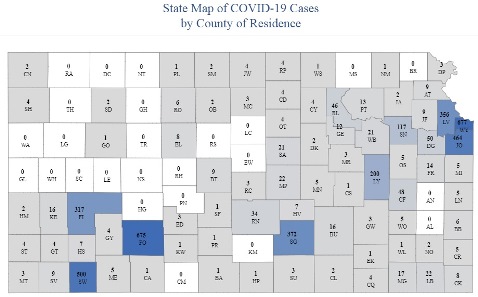
Today, the Kansas Department of Health and Environment reported 4,238 cases and 129 deaths from 80 counties. It was an increase of 500 cases and four deaths over Wednesday.
Wyandotte County reported 674 cases; Johnson County, 464 cases; and Leavenworth County, 356 cases. Wyandotte County had 677 cases on the KDHE list and 674 on the UG list.
In other areas of the state, Ford County had 675 cases; Seward County, 500 cases; Sedgwick County, 372 cases; Finney County, 317 cases; Lyon County, 200 cases; and Shawnee County, 117 cases.
To see the UG Commission meeting Thursday on COVID-19, visit https://www.youtube.com/watch?v=3bucOg3IQWU.
To view the Gov. Laura Kelly’s speech outlining the Kansas plan, visit https://www.facebook.com/GovLauraKelly/videos/367751797500343/
Dr. Greiner’s order on extending the stay-home order through May 10 in Wyandotte County is online at https://www.wycokck.org/WycoKCK/media/Health-Department/Documents/Communicable%20Disease/COVID19/LocalHealthOfficerOrderRegardingRESTARTWYCOAdoption043020.pdf.
To see a news release with more information on the Wyandotte County order, visit https://www.wycokck.org/WycoKCK/media/Health-Department/Documents/Communicable%20Disease/COVID19/LocalStayAtHomeReStartGuidancePressRelease043020.pdf.
The governor’s plan on reopening Kansas is at
https://covid.ks.gov/ad-astra-a-plan-to-reopen-kansas/.
The governor’s executive order implementing Phase One is at
https://governor.kansas.gov/wp-content/uploads/2020/04/EO-20-29-Implementing-Phase-One-of-Ad-Astra-Plan.pdf
The governor’s order reissuing and extending various orders is at
https://governor.kansas.gov/wp-content/uploads/2020/04/EO-20-28-Reissuing-and-Extending-Certain-EOs.pdf
The Kansas COVID-19 website is at https://covid.ks.gov/.
The Kansas COVID-19 resource page is at https://govstatus.egov.com/coronavirus
The UG’s COVID-19 webpage is at https://alpha.wycokck.org/Coronavirus-COVID-19-Information.
Information from the CDC is at https://www.cdc.gov/coronavirus/2019-nCoV/.