
Wyandotte County COVID-19 cases increase by 62; Kansas numbers up by 284

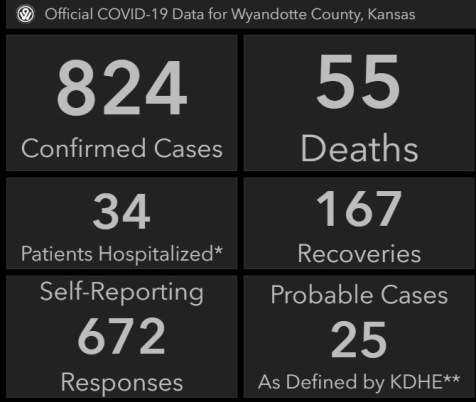
There were a total of 824 positive COVID-19 cases in Wyandotte County on Sunday, an increase of 62 cases since Saturday afternoon. The number of deaths and hospitalizations here remained the same. (UG COVID-19 webpage)
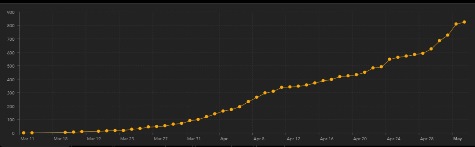
A chart showed the number of COVID-19 cases in Wyandotte County. (UG COVID-19 webpage)
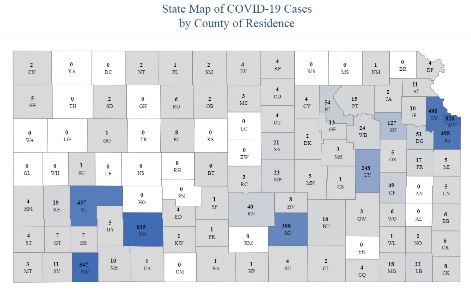
COVID-19 cases increased by 284 cases on Sunday, to a total of 5,030, according to the Kansas Department of Health and Environment. There were three more deaths reported Sunday, for a total of 134. (KDHE map)

Wyandotte County reported 824 positive COVID-19 cases on Sunday, an increase of 62 cases since 1:50 p.m. Saturday, according to the Unified Government’s COVID-19 webpage.

There were no increases in deaths and hospitalizations by Sunday afternoon in Wyandotte County, according to the report. Wyandotte County is continuing its stay-at-home order until May 11.

The state of Kansas reported 5,030 cases with 134 deaths on Sunday, according to the Kansas Department of Health and Environment. It was an increase of 284 cases since Saturday. There was an increase of three deaths since Saturday.

The KDHE stated there were cases in 80 counties on Sunday.

On Sunday, Leavenworth County increased 112 cases, totaling 498 cases. One hundred two of the new cases are inmates at Lansing Correctional Facility, according to a post on the Leavenworth County Health Department COVID-19 webpage.

Johnson County also reported 498 total cases, according to the KDHE.


Some of the other counties reporting large numbers of COVID-19 cases, according to KDHE, included: Ford County (Dodge City area), 815; Seward County (Liberal area), 547; Finney County (Garden City area), 457; Sedgwick County (Wichita area), 399; Lyon County (Emporia area), 248; and Shawnee County (Topeka area), 127.


Douglas County (Lawrence area) reported 51 cases, and Riley County (Manhattan area) reported 54 cases, according to the KDHE.

Two commissioners want testing on west side

On Thursday night, during a Unified Government Commission meeting, Commissioners Tom Burroughs and Mike Kane asked for more testing for western Wyandotte County.

They made their remarks during a report detailing new pop-up testing sites on the east side of Wyandotte County.

UG Health Department officials said they had been working with the health equity task force to offer more sites on the east side.

Providence to participate in plasma study

During the past week, Providence Medical Center in Kansas City, Kansas, announced it would participate in a nationwide Mayo Clinic study that looked at the use of convalescence plasma as a therapy for COVID-19.

According to a news release, a Providence patient would begin to receive convalescence plasma this past week.

Dr. Sabato Sisillo, Providence chief medical officer, who is a pulmonologist and critical care specialist, along with Dr. Samir Desai, infectious disease specialist, are the principal investigators for the medical center.  They will be collaborating with Mayo Clinic to identify and enroll possible patients into this study.

“We look forward to participating in this study as we all work towards aggressive steps in the fight against COVID-19 in our local community,” Dr. Sisillo said.

According to the Mayo Clinic, the treatment is based on the function of antibodies, proteins created by the immune system that combat invaders to the body in a variety of ways. Some are capable of neutralizing a virus, while others work by mobilizing a range of other immune cells that fight off disease. It’s not yet known by which mechanism COVID-19 antibodies might work, but the thinking is that an infusion of convalescent plasma may boost a generalized response, known as passive immunity, until a patient develops a strong, targeted ability to fight the virus.

The UG’s COVID-19 webpage is at https://alpha.wycokck.org/Coronavirus-COVID-19-Information.


The Wyandotte County reopening plan, a 41-page document, was posted Thursday night at https://www.wycokck.org/WycoKCK/media/Health-Department/Documents/Communicable%20Disease/COVID19/RestartWYCOGuidanceDocument043020.pdf
The Kansas COVID-19 website is at https://covid.ks.gov
/.

The Kansas COVID-19 resource page is at https://govstatus.egov.com/coronavirus

Information from the CDC is at https://www.cdc.gov/coronavirus/2019-nCoV/.

UG losses to be in the millions from COVID-19 pandemic; committee to meet on finances Monday

Unified Government budget revisions due to COVID-19 will be on the agenda for Monday evening’s UG Economic Development and Finance Committee meeting.

The meeting will begin after the end of the UG’s 5 p.m. NCD committee meeting. It will be a remote Zoom meeting.

At a budget update held on April 30, the UG Commission heard about the potential revenue impact on the UG from the COVID-19 pandemic.

UG Administrator Doug Bach said the UG has costs of more than $1 million, and revenues continued to go down.

Kathleen von Achen, UG chief financial officer, on Thursday gave “best case” and “worst case” estimates for UG revenues.

An estimate for two months of shelter in place in 2020 was $11 million in the UG general fund, $14 million in other funds and a total of $25 million

An estimate for three months of shelter in place, plus a fall wave in 2020, was $22 million in the general fund, $13 million in other funds and $35 million total.

For 2021, a “best case” estimate was that normal activity resumed gradually, with modest growth, for a $4 million impact to the general fund and $6 million impact to other funds and a $10 million total impact, she said.

The “worst case” impact for 2021, with no vaccine found until early June, and depressed retail activity, was a $10 million effect on the general fund, a $12 million effect on other funds and a $22 million total effect, she said.

“The revenue impact we have estimated is significant,” von Achen said. All the actions the UG and the state is taking is aimed at saving lives and that’s the most important thing, she added.

The $25 million to $35 million estimated loss in 2020, about 8.5 percent of the total UG budget, she said.

The anticipated loss in 2021 is from $10 million to $22 million, she added.

She said they’re hoping for the “best case,” but they need to prepare for the worst case.

Sales tax revenues will be deeply affected, she said, but they won’t have actual data until the end of June, because sales tax revenues aren’t received until a couple of months later. Their estimates were based on the prior year’s data, she added.

Sales tax revenue at The Legends is estimated to be down 37 percent, she said. Use tax revenues may increase because of greater online sales and deliveries, she added.

The UG has estimated less impact on property tax, while there may be anticipated delays in collections due to the unemployment rate, she said. The second half of property taxes is due on May 10. Property market values may be affected in 2021 and 2022, she said.

She also estimated less consumption of water and electricity, resulting in lower fees in the commercial class. The gas tax revenues also are expected to be half, as gas prices dropped 40 percent in March, and there has been a reduction in travel, she said.

Hotel occupancies were estimated to have dropped 60 percent here, she added, affecting the transient guest tax.

Von Achen said at the Thursday meeting that the UG has been reviewing the long-term financial plan of the UG, is identifying programs for business process reengineering through priority-based budgeting, is identifying grants and funding opportunities, is conducting cash flow analysis and is implementing near-term cash saving measures.

The UG has suspended the hiring of non-public safety positions, reduced operating expenses to 2019 spending levels in nonpersonnel and noncapital areas, reviewed cash capital funded improvement projects and equipment, and will use its emergency reserves.

The depth of the revenue losses is more than the UG can recover in one year, she said.

The two-month reserve policy was for an emergency such as this, she said. At the end of 2019, the UG’s reserves were at 20 percent of total expenditures, she added. That was almost 8.5 percent of total general fund revenues, she said.

The UG can’t totally rely on dipping into its reserves, so it will also rely on a process to review the organization to see how it can provide services more efficiently, she said. They want to diminish the impact to employees, she added.

Bach said at the Thursday meeting that the UG is trying not to reduce service delivery in certain areas, but may have to cut back in some service delivery areas.

After a question from Commissioner Harold Johnson, Bach said the assumption in the planning will be that the mill levy stays the same for 2021.

Mike Taylor, UG lobbyist, said on Thursday that there was some hope that there may be direct federal funds allotted for local governments and states. There was support for $1 trillion for states and cities from the House speaker, while not as much support from some in the Senate. He believed they would probably end up somewhere in the middle.

The state of Kansas is looking at a $1.2 billion revenue shortfall, and has received $736 million in federal funding, he said.

The UG EDF Committee, meeting Monday evening, also will consider:

Besides the fourth quarter budget revisions, on Monday evening the UG committee will look at the first quarter 2020 cash and investment report and the fourth quarter 2019 budget to actuals report.

Also on the EDF agenda Monday is an ordinance to remove Project Area B from the Mission Cliffs TIF redevelopment project. According to the agenda, it will allow for future development of the area.

Interested persons may watch the meeting on UGTV on Spectrum cable channel 2 and Google TV channel 41, also on YouTube, and may access the meeting through Zoom at https://zoom.us/j/98671994975?pwd=NHdmelBWemI5aFJBWmFxQUI0ZnFGQT09 Password: 682954.

Persons also may listen to the meeting through telephone lines, and the phone numbers are on the EDF committee agenda at https://wycokck.civicclerk.com/web/UserControls/DocPreview.aspx?p=1&aoid=1702.

Meeting at 5 p.m. Monday is the UG Neighborhood and Community Development committee.

The NCD committee will consider a Land Bank application for 509 N. 5th St. and has an update on the Land Bank rehab program on the agenda.

The NCD committee meeting will be on the UGTV Spectrum channel 2 on cable TV, on Google TV channel 141, and on YouTube, and also will be on Zoom at https://zoom.us/j/98671994975?pwd=NHdmelBWemI5aFJBWmFxQUI0ZnFGQT09
Password: 682954.

Also, interested persons may phone in to the NCD meeting, with instructions found on the agenda at https://wycokck.civicclerk.com/web/UserControls/DocPreview.aspx?p=1&aoid=1701.

To see the Thursday, April 30, UG Commission discussion, visit https://www.youtube.com/watch?v=3bucOg3IQWU.

Coronavirus compared to Spanish flu

by Murrel Bland

More than 100 years ago, in the fall of 1918, Kansas and Wyandotte County, along with the rest of the world, faced a severe challenge because of the Spanish Influenza.

Front page stories in The Kansas City Kansan, told of the pandemic with such headlines as “ALL STATE CLOSED,” “FLU SPREADS FAST” and “A FLU DEATH HERE.”

The present coronavirus pandemic has caused a comparison to the influenza illness in 1918. Many historians who have studied that illness agree that it had its origin in hog pens in Haskell County near Dodge City, Kansas, in early 1918. Young men from southwest Kansas joined the U.S. Army and were sent to Camp Funston which is now Ft. Riley at Junction City, Kansas.

Reports indicated that about 500 soldiers had the flu in early March of 1918 at Camp Funston. Many of these soldiers were sent to Europe to fight in World War I. It didn’t take long for the disease to spread across the globe. By the fall of 1918, the flu made its way back to Kansas.

Dr. Frederick Holmes, a professor of medicine emeritus at the University of Kansas, has researched and written about the disease and the larger role of KU professors had in training and assisting in World War I. He was a featured speaker at a quarterly meeting of the Wyandotte County Historical Society marking the centennial of the end of World War I in the fall of 2018.

The University of Kansas at Lawrence was closed during October 1918. A front page story in the University Daily Kansan told students not to go to class, but were forbidden to leave Lawrence. Students suffering from the flu were ordered to report to the University Hospital. The KU varsity football schedule was cut from eight to four games.

A review of records of the Kansas State Board of Health from 1918 indicated that 2,639 died of influenza. Of those, 298 were from Wyandotte County. Estimates are that more than 646,000 Americans died of the flu—more than twice the number of United States personnel that were killed or wounded in World War I. As many as 30 million persons may have died of the flu worldwide.

Looking at the numbers from the coronavirus, we see that more than 60,000 deaths in the United States have been recorded so far with more than 226,000 deaths worldwide. As of late April 2020, there have been 55 deaths in Wyandotte County, mostly in nursing homes.

The fact that it was called the “Spanish flu” was a misnomer. During World War I, Spain was neutral and therefore was not subject to censorship. It could report all the gory details of war. Its ruler, King Alfonso XIII, was afflicted with the flu. Some people in Spain refer to it as the “French flu.”

Information for this article was taken from history.com and the files of The Wyandotte County Museum and the Kansas State Historical Society.

Murrel Bland is the former editor of The Wyandotte West and The Piper Press. He is editor of History News.