Residents urged to be cautious as they gradually return to more activities

COVID-19 cases were up slightly on Tuesday morning in Wyandotte County; the number of deaths increased by one; the number of hospitalizations decreased by five. (From UG COVID-19 website)

As more people go out in public with the easing of some of the stay-at-home orders and as hospitalization and case numbers showed a slight decline Tuesday, doctors at the University of Kansas Health System said that people still will be susceptible to the COVID-19 virus, which is still here.

Dr. Dana Hawkinson, medical director of infection prevention and control at the University of Kansas Health Services. said as people are out in public, some of them may or may not be doing social distancing, wearing a mask and practicing good hygiene. People are very susceptible to the virus, and plans have to be made for more infections, as restrictions are lessening, he said.

On Tuesday morning, KU Health System reported 25 inpatients with COVID-19, with 10 of those patients in the intensive care unit, Dr. Hawkinson said. It was a decrease of three from Monday. The doctors hoped to keep those levels and not see a surge with the reopening.

Dr. Steve Stites, chief medical officer of the University of Kansas Health System, said it still comes down to personal responsibility, and people have to stay home when sick, wear a mask when they go out, socially distance, cough into their elbows, wash hands and practice good hygiene.

Dr. Hawkinson said people should wear a mask in public, especially when not able to be 6 feet away from each other, and for more than 10 minutes’ exposure to others.

Dr. Stites said that people should not be thinking that COVID-19 happens only to other people. “Those, they and them” are used to characterize others, but people have to be careful, he said. “COVID-19 does not care about ‘those-they,’ it’s a great equalizer,” he said.

COVID-19 is here, whether people realize it or not.

“Be cautious as you go back into the world and think it’s not there,” Dr. Stites said. “It is there.”

He said people are likely to see another surge in the numbers after reopening.

Dr. Hawkinson also reported the blood drive held at KU Health System last week for the Community Blood Center resulted in 266 units donated, over the 225-unit goal. He urged people to contact the Community Blood Center at https://savealifenow.org/ and give blood.

This week, residents were able to do a few more things than previously, as Wyandotte County currently is in the “red zone,” having come out of the “stay-at-home” order on Monday. The “red zone” is similar to the “stay-at-home” order, with a few restrictions lifted. The details of the WyCo ReStart plan are at https://wyandotte-county-covid-19-hub-unifiedgov.hub.arcgis.com/pages/restartwyco.

Wyandotte County gets a D-plus for distancing

Are people here still social distancing?

One website issues grades for counties and states on social distancing. The United States is getting an “F,” and Kansas also got an “F,” while Wyandotte County got a “D-plus” this week on Unacast.

The Unacast website uses cell phone data and other data to determine grades for areas. Johnson County received an “F” from Unacast, and Leavenworth County also received an “F.”

Testing continues

Testing for COVID-19 continues today in Wyandotte County, with a pop-up test scheduled from 10 a.m. to 2 p.m. at the Roswell Church of Christ, 2900 Roswell Ave., Kansas City, Kansas.

On Wednesday, testing will take place from 3 p.m. to 6 p.m. at the New Bethel Church and Forest Grove Baptist Church, 745 Walker Ave., Kansas City, Kansas.

Also, testing continues in the afternoons at the Health Department parking lot at 6th and Ann. For more testing sites and information on who may be tested, visit https://wyandotte-county-covid-19-hub-unifiedgov.hub.arcgis.com/pages/what-to-do-if-you-think-you-have-covid-19.

COVID-19 case numbers

Wyandotte County reported 1,083 positive COVID-19 cases at 11 a.m. Tuesday, May 12, an increase of five cases since Monday. The Kansas Department of Health and Environment reported Wyandotte County at 1,095 cases on Monday morning.

There was one new COVID-19 death since Monday morning in Wyandotte County, for a total of 65 deaths. Hospitalizations on Tuesday declined by five, to a total of 35, according to the Unified Government Health Department COVID-19 webpage.

The UG’s COVID-19 website identified a new outbreak site in Wyandotte County as the Legacy Warehouse, 233 S. 42nd St., Kansas City, Kansas, with five cases; the last known case was reported May 8, according to the website.

At 11 a.m. Tuesday, the Johnson County Health Department reported 607 positive cases, with 54 deaths and 162 inpatient hospitalizations, on its webpage. On Monday, the Kansas Department of Health and Environment reported 611 cases in Johnson County.

On Monday, Leavenworth County had 939 positive cases, according to the KDHE. Leavenworth County had two large clusters of cases, one at the Lansing Correctional Facility and one at the Grossman Residential facility. The Leavenworth County COVID-19 page stated that there were 737 LCF inmates who tested positive, and 42 Grossman Center positive cases. Positive COVID-19 inmates in other facilities in Kansas were brought to the Lansing Correctional Facility and placed in a positive COVID-19 ward there.

There were no statewide cases reports on Tuesday, as the Kansas Department of Health and Environment has shifted its epidemiologists’ time to working with local health departments, and will update cases on Mondays, Wednesdays and Fridays now, according to an announcement.

To see more of the doctors’ responses at the KU Health System news conference, visit https://www.facebook.com/watch/live/?v=2633261700266080&ref=watch_permalink.

More information about the “red zone” rules is online at the ReStart WyCo hub at https://wyandotte-county-covid-19-hub-unifiedgov.hub.arcgis.com/pages/restartwyco.

The ReStart WyCo plan is at https://www.wycokck.org/WycoKCK/media/Health-Department/Documents/Communicable%20Disease/COVID19/RestartWYCOGuidanceDocument043020.pdf.

Several Wyandotte County pop-up testing sites are listed at https://wyandotte-county-covid-19-hub-unifiedgov.hub.arcgis.com/pages/what-to-do-if-you-think-you-have-covid-19.


The UG’s COVID-19 webpage is at https://alpha.wycokck.org/Coronavirus-COVID-19-Information.

The Kansas COVID-19 website is at https://covid.ks.gov/.

The Kansas COVID-19 resource page is at https://govstatus.egov.com/coronavirus

Information from the CDC is at https://www.cdc.gov/coronavirus/2019-nCoV/.
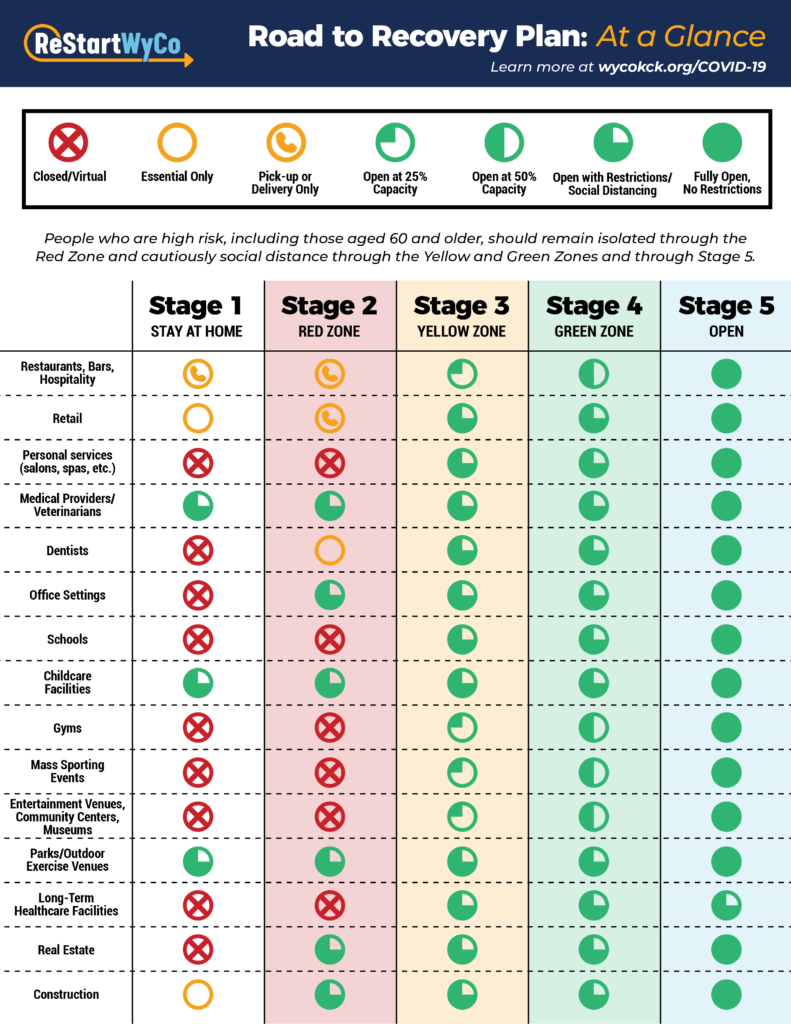
The ReStart WyCo plan includes a few more activities in the “red zone,” particularly the opening of offices and manufacturing. (Chart from UG Health Department)

$9 million in CDBG funds to become available for small businesses and meal programs in Kansas

New cases in Kansas are in blue and total cases are in yellow in this KDHE chart. (KDHE chart)
A 14-day rolling average of positive cases in Wyandotte County was shown in this graph online at the Unified Government Health Department’s COVID-19 page. (UG COVID-19 Hub)

An additional $9 million in Community Development Block Grant funds will be made available in Kansas at the local level for economic development and meal programs, Kansas Gov. Laura Kelly said today.

The money is being allocated through the federal CARES Act, and will be for local community areas affected by the coronavirus pandemic.

“We know COVID-19 has taken a toll on businesses across the state,” Gov. Kelly said at a news conference today. “These grant funds will cover critical investments, help small businesses keep their doors open, and keep Kansans employed.”

The federal grant funds may be used for working capital such as wages, rent, utilities and inventory purchases, she said. For example, out-of-work hairstylists at closed salons can be kept on the payroll, or a small catering business may receive funds to purchase food for reopening.

To qualify, a business must have 51 percent or more of the employees who meet low to moderate income standards as determined by U.S. Department of Housing and Urban Development.

Cities that apply for meal program grant must have a population that meet or exceeds 51 percent of low to moderate income guidelines. Examples of program that might qualify include food banks, Meals on Wheels programs for homebound seniors, or providing meals for schoolchildren who don’t have access to school nutrition programs.

Cities and counties may apply for up to $300,000 for economic development grants and up to $100,000 for meal programs, she said.

The program will allow decision-making to happen at the local level, she said. Applications for grants will open at 1 p.m. May 12 and will be accepted on a first-come, first-served basis until all funds have been disbursed, she said. More information is at kansascommerce.gov/cdbg-CV.

“The CDBG funding is just one piece of our state’s far-reaching recovery strategies,” Gov. Kelly said.

As the recovery unfolds, it’s important to remember to safe practice, she said. She thanks businesses that reopened with safe practices in place to keep customers and workers safe and healthy.

“I know it’s difficult, but we cannot let our guard down. We’re still a long way from beating COVID-19,” she said, so it’s important to continue being diligent.

Dr. Lee Norman, Kansas secretary of health, said there were 7,116 positive COVID-19 cases in Kansas today, an increase of 132 since Sunday, with 158 deaths, an increase of one since Sunday.

The state is monitoring 78 clusters, he said, including 29 in private companies with 427 cases and five deaths; 24 in long-term care facilities with 575 cases and 92 deaths; nine in church and other related gatherings with 114 cases and nine deaths; seven in meatpacking plants with 1,280 cases and two deaths; three in group living situations with 41 cases and zero deaths; three in correctional facilities, with 863 cases and three deaths; and three in health care settings, with 22 cases and no deaths.

Dr. Norman said the state will be moving some of the epidemiology staff into helping the counties more, and will be changing its data updates to three times a week instead of daily.

He encouraged people to call their health care provider to get tested if they have symptoms, as more tests are now available.

Wyandotte County reported 1,078 cases at 4:05 p.m. May 11, with 65 deaths, one more death than on Sunday, an increase of nine cases, and the same number of hospitalizations.

State case counts in other counties

On Monday, according to the KDHE, Leavenworth County reported a total of 939 confirmed and probable cases. Testing of inmates has been completed at Lansing Correctional Facility.

Johnson County reported 611 confirmed and probable cases, according to the KDHE.


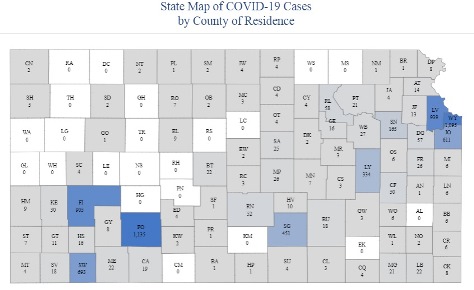
Eighty-three counties reported confirmed and probable positive cases on Monday, according to KDHE, and some of them included: Ford County (Dodge City area), 1,135; Seward County (Liberal area), 693; Finney County (Garden City area), 905; Sedgwick County (Wichita area), 451; Lyon County (Emporia area), 334; and Shawnee County (Topeka area), 165.


Douglas County (Lawrence area) reported 57 cases, and Riley County (Manhattan area) reported 58 cases, according to the KDHE.

To view the governor’s news conference, visit https://www.facebook.com/GovLauraKelly/videos/904749063357797/?v=904749063357797.

The Kansas COVID-19 website is at https://covid.ks.gov/.


The Kansas COVID-19 resource page is at https://govstatus.egov.com/coronavirus

Wyandotte County testing locations are online at https://wyandotte-county-covid-19-hub-unifiedgov.hub.arcgis.com/pages/what-to-do-if-you-think-you-have-covid-19

and also at https://wyandotteonline.com/task-force-expands-pop-up-testing-in-wyandotte-county/.

The UG’s COVID-19 webpage is at https://alpha.wycokck.org/Coronavirus-COVID-19-Information.

The Wyandotte County reopening plan, a 41-page document, was posted Thursday, April 30, at https://www.wycokck.org/WycoKCK/media/Health-Department/Documents/Communicable%20Disease/COVID19/RestartWYCOGuidanceDocument043020.pdf.

Information from the CDC is at https://www.cdc.gov/coronavirus/2019-nCoV/.

Tips for safety offered in reopening under ‘red zone’

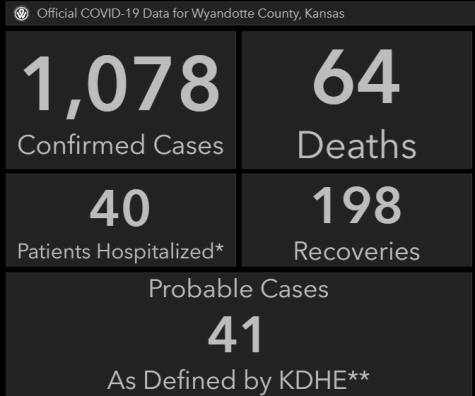
Wyandotte County reported 1,078 COVID-19 cases on Monday morning, an increase of nine since Sunday. (UG COVID-19 webpage)
Kansas reported 7,116 cases in 83 counties on Monday, an increase of 132 cases since Sunday, according to the Kansas Department of Health and Environment. There were 158 deaths, an increase of one since Sunday. (KDHE map)

As Wyandotte County reopened Monday under the “red zone,” doctors at the University of Kansas Health System offered some tips to residents to remain safe.

For Wyandotte County, one of the main changes under the “red zone” is that some offices, manufacturing plants and workplaces can reopen. They should maintain 6 feet of space between persons, and everyone must wear masks.

Restaurants in Wyandotte County still will be carryout only, and hair salons are still closed under Wyandotte County’s “red zone.” The restaurants will not reopen until the “yellow zone,” two weeks or more away, at 25 percent capacity.

Retail stores will be accepting phone and online orders, with pickup of ordered items allowed outside or inside.

Churches in Wyandotte County may reopen with 10 percent of the building’s capacity in the “red zone,” maintaining social distancing, avoiding close contact, wearing masks and other rules. Drive-in services still are allowed.

Residents should still stay at home as much as possible in the “red zone,” and should not congregate with others who are not members of their immediate household, according to the Wyandotte County plan. Outdoor activities with other people may involve up to 10 persons, maintaining social distancing.

Those businesses that were open under the “stay-at-home” orders will be able to remain open. Those persons who are older than 60, have underlying medical conditions or who are sick are still asked to stay home.

Wearing a mask is important when people are out in public and in the workplace, especially in areas where they cannot maintain a 6-foot distance, said Dr. Dana Hawkinson, medical director of infection prevention and control at the University of Kansas Health Services.

Amanda Gartner, RN, director of quality and safety at KU Health Services, said the masks provide source control, keeping the wearer’s droplets closer, so they don’t spread out and infect other people.

One office worker didn’t believe she needed to wear a mask, because she was just sitting at her desk, but Gartner advised her to wear a mask because people came over to her desk often and she couldn’t always maintain a 6-foot distance, Gartner said.

Dr. Hawkinson said it was also important to have hand sanitizer at work, avoid touching one’s face and wipe down surfaces.

Gartner said she carries hand sanitizer in her car at all times, and she wears a mask when going to the grocery store. Not everyone is currently wearing a mask at the grocery store, the doctors remarked, from their own personal experience.

The Wyandotte County “red zone” plan states that people should wear masks when they are at stores and in public.

The doctors stated they often wipe down cans, bottles and chip bags when they return home from the grocery store. Washing off vegetables and fruits as they normally do is probably OK, Dr. Hawkinson said.

Dr. Hawkinson said he is not aware of any cases of COVID-19 from bringing items home from a grocery store, while it is more likely to contract the virus while someone is at the store.

Dr. Hawkinson said fingertips and palms need to be washed frequently with soap and water, especially if people have itchy, dry eyes and tend to touch their faces. If possible, use sanitizer, he said.

“This is all about relative risk and not absolute safety,” Dr. Steve Stites, chief medical officer at the University of Kansas Health System, said. People, in general, can’t live in a bubble and will have to re-enter society at some time.

Each person has to determine his own level of risk and decide who’s in their bubble, he said.

According to Gartner, a group of eight friends sitting at the same table at a restaurant may be more likely to transmit the disease if not socially distancing, and that is fairly risky.

Dr. Hawkinson said it is possible to come into contact with droplets on inanimate objects such as a coffee creamer container or syrup container at restaurants.

As youth sports start to open up in some places, the doctors doubted whether it was good idea to start the youth leagues up yet. It’s hard to tell, but there is often some risk in the close contact of youth while playing sports, and also in carpooling back and forth to practices, according to the doctors.

The Wyandotte County plan’s outdoor activities section advises residents never to congregate with others who are not members of their own immediate household. For children, use of commonly touched items such as balls, sports equipment and toys is discouraged if the children are not in the same household.

The doctors do not believe there is any risk for “over-sanitizing.”

According to Dr. Hawkinson, people will still come into contact with antigens and pathogens every day in the air, and frequent hand-washing and sanitizing will not decrease that. Sanitizing will not hurt the immune system, he said.

Dr. Hawkinson said as other places around the world have started to open up, they have started to see more COVID-19 cases.

Dr. Stites said where people are congregating, the risk is still there and will still be around June 15, even if all the restrictions come off.

“The rules haven’t changed just because the calendar did,” he said. “What you still have to do is think about what is the personally responsible thing to do. It’s not up to the politicians to tell you what to do.”

“Even as life opens up, you still have to go about your life in a way that is personally responsible,” Dr. Stites said.

He said people who are wondering if it is safe to go to work have to evaluate their circumstances and personal risk and determine what they can do to make their environment safer. They should wear a mask, and if possible, a shield. They should continue washing their hands.

Dr. Hawkinson reported the number of positive COVID-19 inpatients increased a little over the weekend at KU Health System, and is at 28 today, with 11 patients in the intensive care unit. The number was 24 patients on Friday, when nine patients were in the ICU unit.

Wyandotte County reported 1,078 positive COVID-19 cases at 11:55 a.m. Monday, an increase of nine since Sunday afternoon. There were 40 patients hospitalized, and 64 deaths, the same number as Sunday.

Kansas reported 7,116 cases in 83 counties on Monday, an increase of 132 cases since Sunday, according to the Kansas Department of Health and Environment. There were 158 deaths, an increase of one since Sunday.

To see more of the doctors’ responses at the KU Health System news conference, visit https://www.facebook.com/kuhospital/videos/239218183956749/.

More information about the “red zone” rules is online at the ReStart WyCo hub at https://wyandotte-county-covid-19-hub-unifiedgov.hub.arcgis.com/pages/restartwyco.


The ReStart WyCo plan is at https://www.wycokck.org/WycoKCK/media/Health-Department/Documents/Communicable%20Disease/COVID19/RestartWYCOGuidanceDocument043020.pdf.


Several Wyandotte County pop-up testing sites are listed at https://wyandotte-county-covid-19-hub-unifiedgov.hub.arcgis.com/pages/what-to-do-if-you-think-you-have-covid-19.

The UG’s COVID-19 webpage is at https://alpha.wycokck.org/Coronavirus-COVID-19-Information.


The Kansas COVID-19 website is at https://covid.ks.gov/.


The Kansas COVID-19 resource page is at https://govstatus.egov.com/coronavirus


Information from the CDC is at
https://www.cdc.gov/coronavirus/2019-nCoV/.

A chart from the Unified Government Health Department shows what is opening in the “red zone,” which starts today. (UG Health Department graphic)