
Area enters less restrictive Phase 2 of reopening today; doctors advise maintaining social distancing and good hygiene

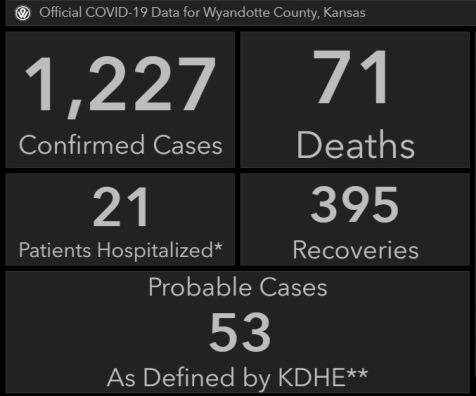
At 10:25 a.m. Friday, the Unified Government Health Department’s COVID-19 webpage reported 1,227 confirmed COVID-19 cases, up 16 cases from Thursday morning’s 11:40 a.m. report. There was no increase in deaths from Thursday.

Going into the Memorial Day weekend, doctors at the University of Kansas Health System on Friday discussed entering Phase 2 of the state’s Ad Astra reopening plan, celebrating Memorial Day virtually and the need for blood donations.

They made their remarks at a news conference this morning held by KU Health System.

Opening up society for some people means that others, such as the vulnerable and those with certain medical conditions, need to be careful.

Dr. Allen Greiner, chief medical officer of Wyandotte County, said at the news conference Friday morning that it is important for vulnerable, older populations to stay at home during the pandemic. He showed a table listing 69 deaths for those over age 85, and 39 deaths for the 75-84 age group. In addition, the 65 to 74 age group had 33 deaths in Wyandotte County, and 55-65 recorded 26 deaths.

Wyandotte County is still worried about the rate of 734 cases per 100,000 of positive cases and deaths, which is much higher than most surrounding communities and the state of Kansas, he said. Wyandotte County had the highest rate of deaths in the state, and ten times the hospitalization rate of, for example, Leavenworth County, which had a higher case count, Dr. Greiner said.

“We’ve got to be careful or we’re going to have more hospitalizations or deaths,” Dr. Greiner said.

Wyandotte County has seen some improvements in the number of hospitalizations, with the number of deaths now dropping as well. He said he is pleased that the Wyandotte County rolling average of case numbers and deaths has been declining recently.

He said he didn’t want people to think that COVID-19 was always fatal, and that people who get out and get tested early, with medical care, may be better able to keep it under control. Testing has increased in Wyandotte County at several sites.

It’s a good sign if the rate of positive cases out of total tests keeps declining, he said. It was formerly up to 50 percent at one point, then down to 30 to 40 percent, and has dropped in the past few weeks Some of that is due to the greater number of tests being performed at hospitals before peoplehave surgeries.

He said they also are concerned about COVID-19 death rates in Wyandotte County, that are disproportionately higher for blacks.

Wyandotte County moved today from the “red zone” of its own plan to Phase 2 of the governor’s plan. He said Wyandotte County is now consistent with Johnson County and most of Kansas on following the governor’s plan.

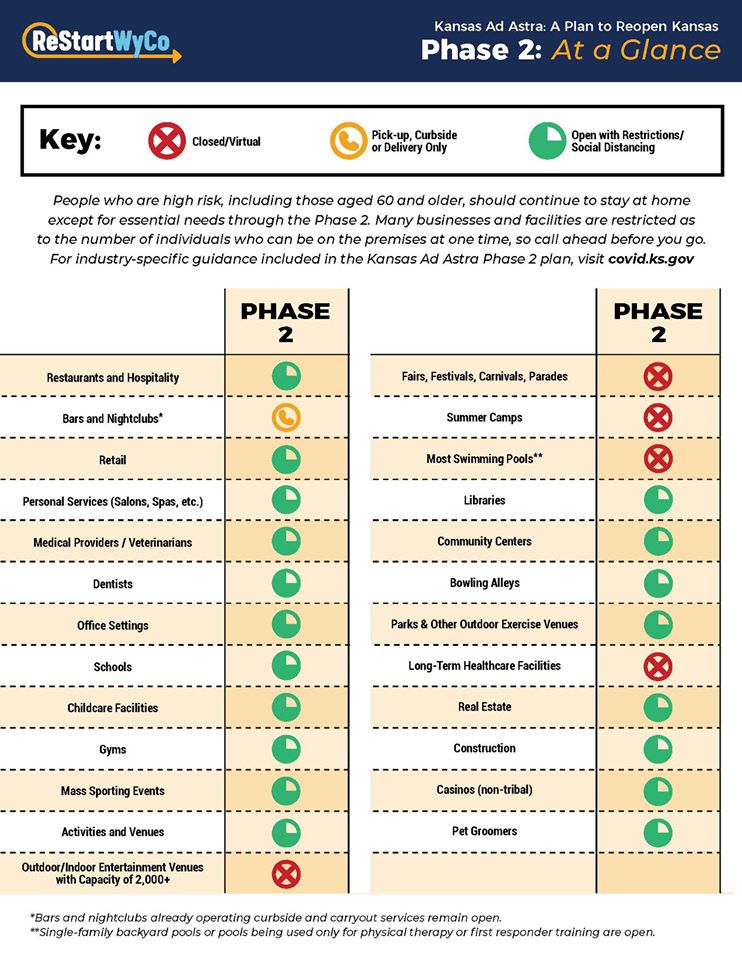
Dr. Greiner said moving to the state’s plan would help avoid confusion. The plan allows hair salons and personal services, fitness centers, restaurants, casinos and participatory sports to open, with certain requirements for each. No gatherings over 15 people are allowed. Masks should be worn when people are out in public, and social distancing is required.

Wyandotte County’s senior population made up most of the deaths here from COVID-19. A task force was appointed in Wyandotte County to study the issues involved, including standards and personal protective equipment.

U.S. Sen. Jerry Moran, who participated in the news conference, said the next phase of federal legislation includes support for nursing homes and senior care facilities.

According to information from Sen. Moran, $63 million will go to Kansas skilled nursing facilities to help combat the effects of COVID-19. The funding was through the federal CARES Act, through the Department of Health and Human Services. Each skilled nursing facility that is eligible will receive $50,000, plus $2,500 per bed.

The funding is intended to help prevent the virus from spreading to nursing homes that haven’t been infected, and will help provide resources to the facilities that are continuing to battle COVID-19, Sen. Moran said in a statement. The funding will have requirements for nursing homes, and can only be used for purposes that are stated.

Blood donations urgently needed

“We need blood now more than ever,” said Chelsey Smith, outreach and community coordinator with the Community Blood Center of Greater Kansas City, at the news conference this morning.

The blood center needs 600 units a day, and is currently down to a two-day supply, she said. Usually, they try to have a seven-day supply of blood on hand. With Memorial Day coming up, and the likelihood of traffic accidents increasing over the holidays, the blood center is trying to get more people to sign up to donate blood. Mobile blood drives have been stopped during the COVID-19 pandemic.

Smith said donating blood is safe, and safer than previously, as many precautions are being taken, including donors and health workers wearing face masks and protective gear. There are health checks at the door, and everything is disinfected after donors give blood, making sure the environment is safe for the next donor.

Currently, the blood center is scheduling appointments at its seven donation sites in Greater Kansas City, St. Joseph, Missouri, and Topeka, Kansas, she said. Donation centers are open seven days a week. Those who are sick should not donate blood. To sign up for an appointment to donate blood and to see eligibility rules, visit www.esavealifenow.org.

Sen. Moran plans to celebrate Memorial Day remotely

U.S. Sen. Jerry Moran, R-Kansas, said he is planning to celebrate Memorial Day remotely, participating in a couple of events including an online celebration for the World War I Museum, Liberty Memorial in Kansas City, Missouri. He also plans to participate in another memorial event at a cemetery, where individuals are separated by large distances.

Sen. Moran, who has chaired the Senate Veterans Committee, said he has been involved with health care efforts for veterans. He has worked for years to figure out how to get more veterans care closer to home across Kansas, he said.

He expressed gratitude to veterans who served the country and who are serving today. There are individuals serving in the National Guard today, working on tasks to fight COVID-19, he said.

“We’ve been successful in passing legislation to allow the GI bill to apply and be available to students who no longer can be in the classroom and are now being educated online,” he said.

He has also worked for greater connectivity so that veterans can do telehealth with the VA, he said.

He said disabled veterans needed legislation to make them eligible for economic impact funds, and that has been accomplished.

In the past week, the Senate passed a bill for a national 988 suicide hotline number, he said, which is aimed at better improving mental health services.

“I would use this Memorial Day weekend to express gratitude to veterans, to military men and women serving today, to honor those who died in service and to pay respects to their family,” Sen. Moran said.

He said this Memorial Day would be different, and he planned to participate in virtual events.

On Friday, Dr. Dana Hawkinson, medical director of infection prevention and control at KU Health System, reported 20 COVID-19 patients in the hospital, up from about 14 on Thursday. There were eight COVID-19 patients in the intensive care unit and four on ventilators.

At 10:25 a.m. Friday, the Unified Government Health Department’s COVID-19 webpage reported 1,227 confirmed COVID-19 cases, up 16 cases from Thursday morning’s 11:40 a.m. report. There was no increase in deaths from Thursday.

The KU doctors’ news conference is online at https://www.facebook.com/kuhospital/videos/2777352742551903/.

The UG’s COVID-19 information page is at https://alpha.wycokck.org/Coronavirus-COVID-19-Information.

Wyandotte County is under the state’s Phase 2 plan starting Friday at covid.ks.gov.

The state plan’s frequently asked questions page is at https://covid.ks.gov/wp-content/uploads/2020/05/Reopening-FAQ_5.19.2020_Final.pdf.

The state has an information page about what activities are safe on Memorial Day weekend, at https://covid.ks.gov/wp-content/uploads/2020/05/Safe-Memorial-Day-Guidance-5.19_Final.pdf.

Additional guidelines from the governor’s office about Phase 2 are at https://www.wycokck.org/WycoKCK/media/Health-Department/Documents/Communicable%20Disease/COVID19/AdAstraUpdate519.pdf.

Test sites are listed at https://wyandotte-county-covid-19-hub-unifiedgov.hub.arcgis.com/pages/what-to-do-if-you-think-you-have-covid-19.
The CDC’s COVID-19 web page is at https://www.cdc.gov/coronavirus/2019-nCoV/index.html.
Wyandotte County prepares to enter Phase 2 of state’s reopening plan on Friday

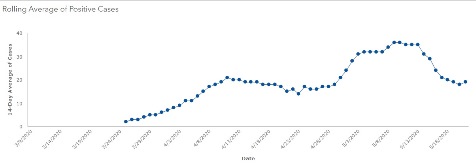
Wyandotte County health officials said on Thursday night that there has been improvement in the rolling average of positive cases in Wyandotte County. (UG COVID-19 hub webpage)
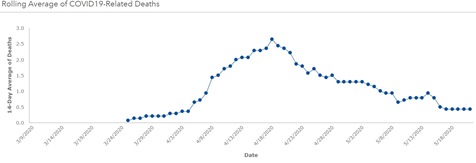
A decline in the rolling average of COVID-19 related deaths was shown in this graph. (UG COVID-19 hub webpage)

As Wyandotte County prepares to enter Phase 2 of the governor’s Ad Astra reopening plan on Friday, May 22, Wyandotte County health officials reported on the state of COVID-19 here.

The county and surrounding area recently has seen decreasing trends in the rolling averages of cases and deaths, according to officials.

Wyandotte County still has a higher positive case and death rate per 100,000 than most of the surrounding area, at 716 compared to Johnson County’s 113, Kansas City, Missouri’s 187 and the state of Kansas’ 293 rate, according to Juliann Van Liew, director of the Unified Government Health Department. She made her remarks at a UG Commission meeting at 5 p.m.

However, the 14-day rolling average here is now down to 18 new cases a day on average, down from the mid-30s a few weeks ago, she said. They may see occasional spikes on certain days, but the rolling averages gives a good longer-term picture of trends.

Also, the rolling average of deaths here is down to about .5 a day, down from about 2.5 a month ago, Van Liew said.

The positivity percentage continued to improve, she said. They are seeing increased testing at hospitals of patients who are being screened for additional procedures and surgeries, which is why they are seeing some of the decrease in the percentage of positive cases.

Dr. Erin Corriveau, deputy health officer for Wyandotte County, said the data is looking good and she feels confident they will be able to move safely into Phase 2 of the state’s Ad Astra reopening plan on Friday.

Originally, the UG was going to make the transition to its yellow zone on Monday, she said, but with the governor’s announcement about the start of Phase 2 on Friday, the health staff here felt that it would decrease confusion in the community to switch to the governor’s plan.

The state’s plan is broadly aligned with the UG’s “yellow zone” of its ReStart WyCo plan, she said. Businesses and individuals felt it was hard to understand why the county was going a different way, she said, so they decided to align with the state’s plan.

Dr. Allen Greiner, Wyandotte County chief medical officer, said the state originally had a plan with three phases, then a Phase 1.5 plan was enacted for a few short days. After seeing that numbers of high case counts in southwestern Kansas were not producing large numbers of hospitalizations, the governor moved into Phase 2, starting Friday, and Wyandotte County decided to do that as well.

Changes made to Phase 2 were that the mass gathering limit has been set at 15 individuals; previously it was going to be 30, he said. The change was made out of caution, so they can watch the data, he said.

Salons and personal services can now be open for Wyandotte County in Phase 2, with careful precautions and recommendations of mask-wearing and hygiene, he said.

Fitness centers, casinos and organized sports can open as well, with strong recommendations for social distancing, he said. Casinos will have specific plans in place with the state, he added, and the state is directing and reviewing everything in regard to the casinos.

Not allowed to open in Phase 2 are fairs, festivals, parade, swimming pools until June 8, bars and night clubs, and summer camps, he said.

Dr. Greiner said Phase 2 allows dine-in eating at restaurants, a big change for Wyandotte County, where it was previously just takeout.

The plan talks about preventing any groupings of more than 15 people in the interior environment, he said. Employees should not congregate in units of 15 in the kitchen, and patrons should not be in groups of more than 15 if 6-foot distancing cannot be maintained, he added. If 6-feet distancing can be maintained between individual groups of diners, there’s no restriction on how many people can be in the space, but the space will probably have to be adjusted in each restaurant to maintain that distance.

He said Mayor David Alvey has been working with the zoning staff and restaurants on how expansions might be put in place for outdoor dining at restaurants. The primary issue is maintaining the 6-foot spacing and preventing any groups of more than 15 in enclosed areas.

The reason to limit the numbers of people in restaurants is that people are there for a long time, whereas in a grocery store, for example, they are moving past someone who could have the virus, and are not exposed for as long a time, according to the mayor.

Dr. Greiner said the state’s plan has specific guidelines about church and faith-based gatherings.

He said they need to have 6 feet of distance maintained between individuals and groups of family members who live in the same household, but there are no number limits and no percentage limits. Previously Wyandotte County had a plan with percentages of people, according to the capacity of the building, but that is now off the table, he said.

He said the state’s plan relies on each church to take its own responsibility to promote social distancing and other recommendations such as use of masks, limiting the choir or singing in large groups, providing hand sanitation or other facilities for hand washing, and limiting things passed from person to person, such as collection plates, handouts, books and materials. There have been health studies that traced outbreaks to choir singing, he added.

These measures will be up to the individual facilities and organizations to make a decision about, but there is guidance and recommendations on how it ought to be done, Dr. Greiner said.

Wyandotte County will be under the state’s Phase 2 plan starting Friday at covid.ks.gov.


The state plan’s frequently asked questions page is at https://covid.ks.gov/wp-content/uploads/2020/05/Reopening-FAQ_5.19.2020_Final.pdf.


The state has an information page about what activities are safe on Memorial Day weekend, at https://covid.ks.gov/wp-content/uploads/2020/05/Safe-Memorial-Day-Guidance-5.19_Final.pdf.


Additional guidelines from the governor’s office about Phase 2 are at https://www.wycokck.org/WycoKCK/media/Health-Department/Documents/Communicable%20Disease/COVID19/AdAstraUpdate519.pdf.


The UG’s COVID-19 information page is at https://alpha.wycokck.org/Coronavirus-COVID-19-Information.

Test sites are listed at https://wyandotte-county-covid-19-hub-unifiedgov.hub.arcgis.com/pages/what-to-do-if-you-think-you-have-covid-19.

The CDC’s COVID-19 web page is at https://www.cdc.gov/coronavirus/2019-nCoV/index.html.
UG announces applications to open May 27 for relief loans for Wyandotte County small businesses

The Unified Government of Wyandotte County and Kansas City, Kansas, is contributing $175,000 in a partnership with financial firm AltCap to launch the KC COVID-19 Small Business Relief Loan Fund.

The funding was approved by the Board of Commissioners and will help support microloans in Wyandotte County for businesses affected by COVID-19. AltCap will begin accepting application Wednesday, May 27.

The contribution of $175,000 in loan loss reserve from the Unified Government will enable over $700,000 in loans for mom and pop sized businesses. The Unified Government enhancement will provide microloans of up to $25,000 for Wyandotte County-based small businesses (20 employees or less; $750,000 or less annual revenue) in industries experiencing significant loss of business due to COVID-19.

“The Unified Government of Wyandotte County and Kansas City, Kansas, have stepped forward to not only support local businesses, but also to encourage others to find ways large and small to do the same,” Mayor David Alvey said. “The small businesses that are the backbone of our communities need the lifeline this fund may provide during this difficult time, and every contribution made helps more owners and their employees see a possible path forward.”

The collaboration among local government, civic organizations, community leaders and businesses in Kansas City has uniquely allowed our region to respond to the unprecedented challenges the COVID-19 pandemic has caused.

While federal disaster assistance efforts, including the Payroll Protection Program (PPP), has been able to help many businesses, many of our small businesses have been left out and locally supported efforts are critical.

The KC COVID-19 Small Business Relief Loan Fund is administered by AltCap, a local Community Development Financial Institution (CDFI). CDFIs are often at the frontlines of disaster recovery efforts helping communities weather the effects of natural disasters, recessions, and other significant economic events.

Underwriting for the fund has prioritized sectors like retail, food service, personal services, arts, and hospitality, that were deemed “nonessential” during the pandemic but are vital to the overall health of our communities and economy.

The loan loss reserve provided by the Unified Government will further target those small businesses that have challenges when trying to take advantage of the State-wide and federal assistance programs.

The first round of funding saw unprecedented application volume from businesses across the region. One Wyandotte County business that has received a loan from the KC COVID-19 Small Business Relief Loan Fund because the federal programs did not fit their specific needs but the flexibility of the AltCap loan will allow them to pay rent and utilities until they open.

Mary Thurber of KC Bowl said, “l want to thank [the Unified Government] for helping small businesses in general, and specifically for helping us. We know that there are only so many dollars to give away and we are so grateful that UG had given them to a fund that helps businesses like ours. Everybody needs it right now, and we don’t know what we’d do without it.”

The next round of KC COVID-19 Small Business Relief Loan Funding opens on Wednesday, May 27. Wyandotte County small businesses will be prioritized due to the contribution by the UG. Interested small businesses should visit www.alt-cap.org for more information and to apply. The application and application assistance will be available in English and Spanish.

About the KC COVID-19 Small Business Relief Loan Fund

The KC COVID-19 Small Business Relief Loan Fund is a community-backed $5 million small business relief loan fund created to provide a financial lifeline to local small businesses experiencing extreme economic disruption and financial strain as a result of the necessary public health measures to combat the COVID-19 virus. The loan fund is administered by AltCap, and supported by the Ewing Marion Kauffman Foundation, the Civic Council of Great Kansas City, Port KC, the Kansas City Area Development Council, the Greater Kansas City Chamber of Commerce, KCSourceLink, and KC Rise Fund, with very generous donations from local business and civic leaders listed at www.alt-cap.org/covid-relief-fund.

  • Information from Unified Government