Wyandotte County orders two more weeks of Phase 3 reopening plan

This graph highlights 7-day rolling averages from March to mid-June of this year. There was a rise in cases seen in the green area. Between 1 p.m. Wednesday and 1 p.m. Thursday, there was an increase of 40 cases reported in Wyandotte County. On Thursday, the UG health officers ordered the county to remain in Phase 3 of the reopening plan for another two weeks, at least through July 6. (Graph from UG Health Department)

A recent rise in the number of positive COVID-19 cases in Wyandotte County resulted in an announcement today that Wyandotte County will remain in Phase 3 of the Ad Astra reopening plan through at least July 6.

“The numbers show that COVID-19 continues to be a threat in our community, and as we have begun reopening our businesses and our communities, it has begun to spread, although slowly, once again,” said Dr. Allen Greiner, chief medical officer with the Unified Government Health Department. “Out of an abundance of caution, we will remain in Phase 3 of our reopening plan, with some additional modifications and guidance.”

UG Health Department officials announced on June 16 that COVID-19 cases were on the rise in Wyandotte County.

“We look at 7-day rolling averages to track the spread of COVID-19, and make decisions on reopening,” Dr. Greiner said. “This gives us a better picture of what’s happening with the virus over time, versus looking at data from a single day. Unfortunately, the data is showing us that COVID-19 is spreading. By staying in Phase 3 for at least an additional two weeks, we can slow and contain this spread.”

“Wyandotte County residents have done a great job helping contain and slow the spread of COVID-19 in our community through shared sacrifice and working together,” Mayor David Alvey said. “While community health orders have been relaxed significantly in recent weeks, the latest health data shows a rise in cases in Wyandotte County, requiring public health officials to extend Phase 3 of the Ad Astra state plan instead of transitioning to a full Phase Out on June 22nd. The latest health data is disappointing. We must remember that the pathway out of this is in our hands if we continue practicing safe social distancing, wear face coverings whenever possible, and adhere to all public health guidelines. By doing so, we not only protect our most vulnerable, we preserve all that we’ve achieved over the last several months and expedite our community’s return to business as usual.”

“Wyandotte County residents have done a great job helping contain and slow the spread of COVID-19 in our community through shared sacrifice and working together,” Mayor David Alvey said. “While community health orders have been relaxed significantly in recent weeks, the latest health data shows a rise in cases in Wyandotte County, requiring public health officials to extend Phase 3 of the Ad Astra state plan instead of transitioning to a full Phase Out on June 22nd. The latest health data is disappointing. We must remember that the pathway out of this is in our hands if we continue practicing safe social distancing, wear face coverings whenever possible, and adhere to all public health guidelines. By doing so, we not only protect our most vulnerable, we preserve all that we’ve achieved over the last several months and expedite our community’s return to business as usual.”

Phase 3 continues; some changes to long-term care rules

Phase 3 of the Ad Astra reopening plan began in Wyandotte County on June 8. This phase of the reopening plan allows for further loosening of restrictions on individuals and businesses compared to Phase 2, but with some restrictions still in place, according to health department officials.

Most of the Phase 3 restrictions will remain the same as the phase is extended, with the exception of changes to restrictions for long-term care facilities.

Up to this point, visits to these facilities have been prohibited. Under the modified Phase 3 extension, long-term care and assisted living facilities may allow limited numbers of visitors in their facilities once they have developed a visitation plan, which must be approved by the Unified Government Health Department, a spokesman stated.

“After seeing a large long-term care facility outbreak in our community, the Wyandotte County Long-Term Care Facility Task Force has developed robust guidance, and has been in direct communication with each long-term care and assisted living facility in our county about this guidance,” said Dr. Erin Corriveau, deputy medical officer with the UG Health Department. “Our long-term care facilities are much more prepared now to respond if any cases arise at their site, and have worked diligently with the Health Department to address questions or concerns as soon as they arise.

“Social isolation has taken a serious toll on the residents of these facilities, and it’s important that we take that into account,” she stated. “We feel that it is appropriate to allow some visits to happen at these facilities, mostly outside and under very strict guidelines, and so long as the facility has their plan approved by the UG Public Health Department.”

Phase 3 will remain the same for other businesses and activities, the spokesman stated. All businesses may reopen, and all education, activities, venues and establishments can operate, as long as they follow guidelines:

• Gatherings of up to 45 people are allowed. Gatherings of more than 45 people should be avoided.
• Everyone is encouraged to wear masks or cloth face coverings in public settings.
• People should maintain at least six feet of distance between themselves and others in public (not including people who live together).
• For employers and business owners, encourage employees and customers to always wear masks in your place of business, and allow for proper social distancing in all business areas such as retail shopping areas, business office settings and restaurants.
• Swimming pools are allowed to open, with social distancing and no more than 45 people on site at a time. UG Parks and Recreation pools and spray parks will remain closed.
• Summer camps, fairs, festivals and outdoor activities can reopen as long as they can maintain at least six feet of distance between individuals or groups, beyond 45 individuals and at 50% or less of fire marshal approved capacity.

Businesses and individuals play roles in slowing spread of virus

According to Health Department officials, businesses and individuals play an important role in once again slowing and containing the spread of COVID-19 in Wyandotte County.

Rules for businesses

It is the responsibility of businesses reopening in Phase 3 to keep their employees and visitors as safe as possible from COVID-19, a Health Department spokesman stated.

Businesses need to:

• Ensure social distancing (at least six feet) between individuals and groups who do not share a household. This may include steps such as installing partitions between patrons or employees, modifying employee work areas or work schedules, or marking spots on the floor six feet apart where people will be waiting in line.
• Ask that employees wear masks or cloth face coverings and encourage customers to do the same.
• Educate employees on how to properly wear a mask (ensuring it covers both the nose and mouth at all times).
• If employees become sick, especially with COVID-19 symptoms, they should stay home except to get tested for COVID-19 at a local testing site.

Businesses can learn more in the Wyandotte County COVID-19 Business Toolkit, available at wycokck.org/COVID-19. They can get business-related COVID-19 questions answered by calling 3-1-1.

Recommendations for individuals

Wearing masks or cloth face coverings

The Health Department strongly recommends that anyone over the age of 2 wear a cloth face covering while in public, according to the spokesman. Health Department staff offered tips about masks and cloth face coverings:

• Wear a mask or cloth face covering appropriately (it must cover both your mouth and nose)
• Don’t touch your mask or your face. If you need to adjust your mask, clean your hands with soap and water or hand sanitizer before and after touching your mask.
• Cloth face coverings that you can make with items around your home are effective at helping reduce the spread of COVID-19. You do not need a surgical mask or other medical-grade mask, and it is best to reserve those supplies for health care workers.
• Learn about cloth face covering recommendations, including how to make your own mask at home, at cdc.gov/COVID19.
• The primary purpose of mask is to protect others in case you may be carrying the virus, even if you don’t have symptoms. If everyone wears masks, everyone helps protect one another, and especially protect those most vulnerable to serious illness.

Wearing a mask is not a substitute for social distancing or excellent hygiene, the spokesman stated. The combination of different safety precautions is how to best stop the spread of COVID-19.

Social distancing

• Maintain a distance of at least six feet between yourself and anyone who does not live in your household.
• You may need to modify aspects of your routine to do this, such as not carpooling with people outside of your household.
• Remember to wear a mask or cloth face covering for additional protection, even when six feet apart.

Social gatherings

• Under Phase 3, social gatherings are limited to no more than 45 people.
• In addition to keeping the number of people to no more than 45, social distancing of six feet or more should be maintained.

If sick or exposed to COVID-19, get tested

• You should get tested for COVID-19 if you develop any symptoms of COVID-19, such as:
o Fever
o Dry cough
o Shortness of breath/difficulty breathing
o Headache
o Chills
o Muscle or body aches
o Runny nose
o Sore throat
o Diarrhea
o New loss of taste or smell
o You have been exposed to COVID-19 through close contact (within six feet for at least 10 minutes) with someone who has tested positive or through association with a known outbreak

Testing is available for free to people who live or work in Wyandotte County at multiple community locations, including the at the UG Health Department and a rotating weekly schedule of “pop-up” sites coordinated by the Wyandotte County Health Equity Task Force. The latest testing schedule and locations are at wycokck.org/COVID-19 or call 3-1-1.

Those without symptoms can spread the virus

Local health officials reminded Wyandotte County residents that asymptomatic spread may be possible, and that safety precautions should be taken even if you do not have symptoms.

“Even if you don’t have symptoms right now, you may still be able to infect others,” said Dr. Erin Corriveau, deputy medical officer with the UG Health Department.

“Recently, someone from the World Health Organization mistakenly said that asymptomatic spread is unlikely, then quickly retracted the statement because there is not adequate scientific evidence to support that claim,” she said. “Unfortunately, this misinformation spread widely. In fact, we do see evidence that people who develop symptoms can be infectious up to two days before their symptoms start. This is why it is so important for everyone to wear masks and practice social distancing, even if they feel well.”

Additional data and resources on COVID-19 in Wyandotte County are at wycokck.org/COVID-19 or by calling 3-1-1.

  • Information from UG Health Department
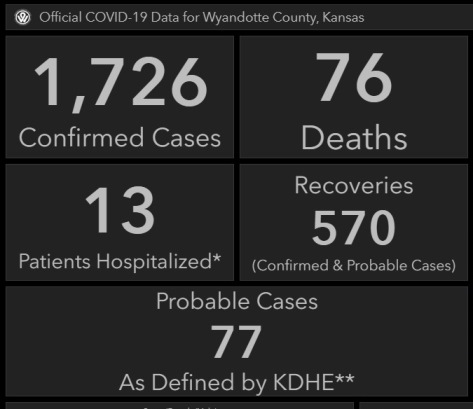
Wyandotte County reported 1,766 cumulative total positive cases on Thursday at 1 p.m., compared to 1,726 cases on Wednesday at 1 p.m., an increase of 40 cases. There was one more death, for a cumulative total of 77 deaths. (From UG COVID-19 website)
The Mid-America Regional Council’s COVID-19 website, the KC Region COVID-19 Resource Hub, showed there were more than 7,000 cumulative cases and 231 total cumulative deaths in the Greater Kansas City area on Thursday. (From MARC COVID-19 website at http://marc-gis.maps.arcgis.com/apps/opsdashboard/index.html#/1c93961075454558b3bf0dfad014feae)
Gov. Laura Kelly and KDHE Secretary Lee Norman showed this map of Kansas at a news conference on Monday. The map was dated Sunday, June 14, and showed case numbers declining in Wyandotte County. (KDHE map)

Urgent need for blood in KC area

Wyandotte County reported 1,766 cumulative total positive cases on Thursday at 1 p.m., compared to 1,726 cases on Wednesday at 1 p.m., an increase of 40 cases. There was one more death, for a cumulative total of 77 deaths. (From UG COVID-19 webpage)

The blood supply in the Kansas City area has dropped to less than a two-day supply, according to the Community Blood Center of Greater Kansas City.

Chelsey Smith, outreach and communications coordinator for the Community Blood Center, said at Thursday’s news conference at the University of Kansas Health System that the normal supply is about seven days.

“It’s not something we have words for,” Smith said. She hasn’t ever seen the blood supply this low, she said.

Smith said it is safe to donate blood at the Community Blood Center, and safety procedures have been added. They are checking temperatures at the door for staff and donors, she said. They have masks for donors and volunteers at all times. Spacing is at least 6 feet apart, she added. Extra cleaning and disinfecting is taking place. Everything a donor touches is cleaned as they leave, she said.

The blood center currently is operating on an appointment preferred schedule now, she added. The center is requesting donors to make appointments. Walk-ins are accepted as capacity allows, she said.

Prospective donors should check with their doctors or visit the donation guidelines online at https://savealifenow.org/ to see if a medication they are taking would affect their eligibility to donate, she added. Some people who are older than 60 or who have a medical condition could be eligible to donate.

Smith said it usually takes 45 minutes to an hour to donate blood.

Blood drives in the community are open Mondays through Fridays, while the seven CBC donor centers are open seven days a week, she said.

One of the upcoming blood drives will be held from 7 a.m. to 5 p.m. Wednesday, Thursday and Friday, June 24-26, at the KU Medical Center Health Education Building, she said.

Before COVID-19, the Community Blood Center was collecting 70 percent of the donation on blood drives, but many of the blood drives were canceled. They are very limited in the places they are allowed to go now, she said. The seven donor sites are open seven days a week for donations, she added.

“The need is incredibly urgent right now,” Smith said. “Blood donors literally save lives.”

Also at the news conference on Thursday were medical officers and executives from three institutions, Truman Medical Center, Advent Health and Liberty Health.

In general, the three saw a decline in the COVID-19 positive cases, followed by a small uptick in cases last week. The KU Health System also saw a similar pattern.

The three health medical officers, Dr. Mark Steele of Truman, Dr. Larry Botts of Advent, and Dr. Raghu Adiga of Liberty, also said they have noticed fewer people wearing masks in public recently.

Dr. Botts said people need to continue to be vigilant as COVID-19 isn’t going away. Less than 50 percent of the people he sees while out in the community are wearing masks, he said. Masks, hand-washing and social distancing need to be continued, he said.

Dr. Steele said when two infected hair stylists worked on about 140 clients in Springfield, Missouri, the disease didn’t spread because the stylists were wearing masks, which points to the importance of masks.

Dr. Dana Hawkinson, medical director of infection prevention and control with KU Health System, said some people are listening to unproven rumors on social media about COVID-19, while they are not paying as much attention to what the doctors know works, which is physical distancing, proper hygiene and mask wearing.

Dr. Adiga said the trend toward an increase in cases in America is concerning. The nation never flattened to where it wanted to be, he added.

KU Health System reported 19 COVID-19 patients at the hospital on Thursday morning, an increase of one from Wednesday. Seven of the COVID-19 patients were in the intensive care unit, and six were on ventilators. The hospital discharged three patients in the past day, while admitting some new patients.

Wyandotte County reported 1,766 total positive cumulative cases on Thursday at 1 p.m., compared to 1,726 cases on Wednesday at 1 p.m., an increase of 40 cases. There was one more death, for a cumulative total of 77 deaths.

To view the KU doctors’ news conference, visit https://www.facebook.com/kuhospital/videos/962736207507435/.

To see upcoming Community Blood Center blood drives and schedule an appointment, visit https://savealifenow.org/ or call 816-753-4040.

Test sites are listed on the Wyandotte County website at https://wyandotte-county-covid-19-hub-unifiedgov.hub.arcgis.com/pages/what-to-do-if-you-think-you-have-covid-19

The state’s COVID-19 test page is at https://www.coronavirus.kdheks.gov/280/COVID-19-Testing


The UG’s COVID-19 information page is at https://alpha.wycokck.org/Coronavirus-COVID-19-Information.

Wyandotte County is currently under Phase 3. See covid.ks.gov.


The state plan’s frequently asked questions page is at https://covid.ks.gov/wp-content/uploads/2020/05/Reopening-FAQ_5.19.2020_Final.pdf.


The CDC’s COVID-19 web page is at https://www.cdc.gov/coronavirus/2019-nCoV/index.html.

COVID-19 is a real risk, doctors say

Positive COVID-19 cases in Wyandotte County were up by 34 cases from 1 p.m. Tuesday to 1 p.m. Wednesday, according to the Unified Government’s COVID-19 webpage. (UG COVID-19 page)

Doctors at the University of Kansas Health System repeated at Wednesday’s news conference that COVID-19 is not a hoax.

In answer to a viewer’s question, Dr. Steve Stites, chief medical officer at the KU Health System, said that there have been more than 100,000 deaths in the United States from COVID-19, including 24 deaths at KU Health System.

If those 24 persons were alive today, they would tell you it’s not a hoax, Dr. Stites said.

Densely populated areas, such as New York, where people used a lot of mass transit and were indoors a lot, suffered worse from COVID-19, he said. Some communities where people spent more time outside than inside were not as affected, he added. The severity has depended upon how long a person was exposed to the virus, and how much of the virus they got at the time of exposure, he said.

Nursing homes, with a large number of vulnerable people, also had a high mortality rate, he said.

“It is most definitely not a hoax,” he said. He added that doctors from here who went to help in New York can tell them that, as well as doctors in other countries.

“Don’t believe that (statement that it is a hoax). That will only lead to your own challenges, because if you think it’s a hoax and you go out and act like life is normal, life will humble you,” Dr. Stites said.

Dr. Dana Hawkinson, medical director of infection prevention and control at KU Health System, noted a critical care doctor from KU Health System went to New York to help and saw the devastation first-hand. New York has had over 30,000 total COVID-19 deaths. “Look what has happened to our economy, and our world economy and our local economy,” he said. “That is not anything anybody would want.”

Influenza usually takes about 20,000 lives a year, and COVID-19 took more than 100,000 lives in about three months, Dr. Stites said.

Dr. Hawkinson reported 18 COVID-19 patients at KU Health System on Wednesday morning, a decrease of one from Tuesday. Six were in the intensive care unit and also were on ventilators. The number of COVID-19 ICU patients was down one from Tuesday and the number on ventilators was up one from Tuesday.

Wyandotte County recorded 34 new positive cases of COVID-19 as of 1 p.m. June 17, as compared to 1 p.m. June 16, according to the Unified Government’s COVID-19 website.

The Kansas Department of Health and Environment reported 11,681 total cumulative COVID-19 cases on Wednesday, June 17. It was an increase of 262 cases since Monday. There were 247 total cumulative deaths, an increase of two deaths since Monday.

According to the Johns Hopkins University of Medicine Coronavirus Resource Center, there were 445,993 cumulative total COVID-19 deaths on Wednesday in the world, and 8.2 million total confirmed cases. The United States had 2.15 million cumulative total COVID-19 cases, according to the website.

Dr. Hawkinson discussed news out of England that lower doses of a steroid medication, dexamethasone, has reduced the rate of deaths by about one-third among seriously ill hospitalized COVID-19 patients. Earlier, studies found that high-dose steroids were causing more mortality, he said. Now it has been found that low-dose steroids can help critically ill patients, reducing deaths by about one-third.

Dr. Hawkinson said KU Health System has had steroids as part of its treatment for some COVID-19 patients who qualify since it first started treating them. Steroids have tamped down inflammatory processes in general, he said. It’s important for doctors to know what drugs are given, how much, and when in the disease process the patient receives them.

COVID-19 has affected the homeless population in Greater Kansas City.

Bryan Meyer, founder and chief executive officer of the Veterans Community Project (https://www.veteranscommunityproject.org/), which has built 49 tiny transitional houses in Kansas City, Missouri, for homeless veterans, said it was difficult for some veterans to self-isolate in group shelter settings or in homeless camps in the woods. That adds more risk for them to catch COVID-19.

Meyer said one of the problems with testing the homeless is they may have a lot of underlying conditions. Health care workers aren’t always able to tell if the person is running a temperature for a different condition, or if it’s a new development, he said. It’s sometimes hard to locate a person after a test has been given, he added.

His organization has worked with Kansas City, Missouri, to secure hotel rooms for homeless persons with symptoms, until the test results come in, he said.

Dr. Nicole Yedlinksy, assistant professor with the KU Medical School Department of Family Medicine, who works with veterans, said there is now a delay between testing and results, and in the population of homeless persons it can be very difficult to determine the disease’s prevalence.

Dr. Stites said it is a challenge to figure out how many people are homeless and whether they have already had COVID-19. Some health departments have made an effort to test the homeless, he added.

Dr. Hawkinson said an easier, accurate and faster test for COVID-19 could help.

Dr. Yedlinsky said one of the struggles for the organizations that provide services for veterans is that they rely on social connections, and during the COVID-19 pandemic they can’t meet in person any more. Some veterans organizations don’t have access to technology and have had difficulty reaching veterans where they are, she said. In addition, a high number of veterans are unhoused and are unable to distance themselves, she added.

About half the population of veterans are 65 or older, and are at risk for complications to COVID-19, according to Dr. Yedlinsky.

“We can’t neglect the medical effects on our veteran population,” she said.

To view the KU doctors’ news conference, visit https://www.facebook.com/kuhospital/videos/290481152143034/

The state’s COVID-19 test page is at https://www.coronavirus.kdheks.gov/280/COVID-19-Testing

The UG’s COVID-19 information page is at https://alpha.wycokck.org/Coronavirus-COVID-19-Information.


Wyandotte County is currently under Phase 3. See covid.ks.gov.

The state plan’s frequently asked questions page is at https://covid.ks.gov/wp-content/uploads/2020/05/Reopening-FAQ_5.19.2020_Final.pdf.


Test sites are listed on the Wyandotte County website at https://wyandotte-county-covid-19-hub-unifiedgov.hub.arcgis.com/pages/what-to-do-if-you-think-you-have-covid-19

The CDC’s COVID-19 web page is at https://www.cdc.gov/coronavirus/2019-nCoV/index.html.