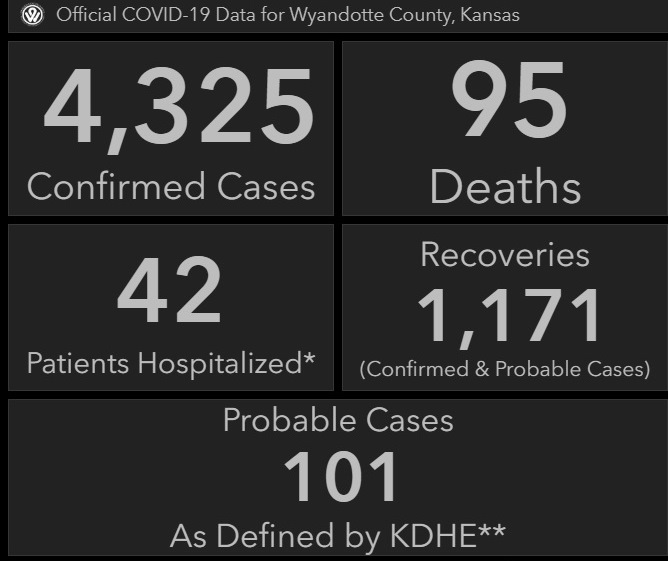
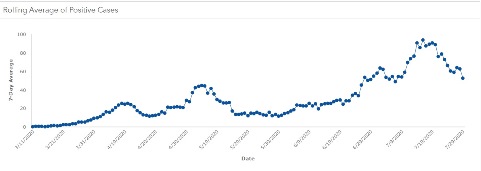
On Thursday, Wyandotte County reported an increase of 102 COVID-19 cases, a cumulative total of 4,325 cases at 1 p.m. There were 95 COVID-19 cumulative deaths, an increase of two since Wednesday. (From UG COVID-19 webpage)After hitting a spike in mid-July, the 7-day rolling average of positive COVID-19 cases has started trending down in Wyandotte County. (UG Health Department graphic)
Wyandotte County will continue in Phase 3 of the Ad Astra reopening plan, according to Dr. Allen Greiner, chief health officer of Wyandotte County.
Dr. Greiner made his remarks at the 5 p.m. July 30 meeting of the Unified Government, a remote meeting held on Zoom.
“The 7-day positive rolling average has come down in the past week,” Juliann Van Liew, Unified Government Health Department director, said about the COVID-19 positive rate.
The trend is very encouraging, she said. Jackson and Johnson counties are seeing different trends, with their rates not coming down like Wyandotte County’s has in the past few weeks, she said.
Dr. Greiner said it is possible that Wyandotte County’s downward trend came about because of the mask order that went into effect July 1 here. In Phase 3, gatherings cannot exceed 45 people where social distancing of 6 feet cannot be maintained.
While deaths in general have been declining over several weeks, Wyandotte County has had two COVID-19 deaths in the past day, Van Liew said. Some deaths recently have been related to outbreaks in long-term care facilities, she said. Overall, deaths remain relatively low, according to Dr. Greiner.
The percent positivity rate is still around 20 percent, which is higher than they want to see it, she added. Very few places here are doing testing on persons who don’t have symptoms, she added.
Van Liew also said COVID-19 case rates here among Hispanics are four times more than non-Hispanics, which is a concern for the Health Department. Testing has been increased in the Hispanic community through some outreach programs.
Also, Van Liew said the Health Department is significantly behind on contact tracing, lagging about 800 cases behind.
This is not unique, as almost every county in the metropolitan area is behind on contact tracing, she said.
In the past four to five weeks, the Health Department has hired two to three contact tracers every week, she said. It takes time for training, she added. About 15 people are now working full-time at contact tracing here, with about 10 to 15 volunteers helping, she added.
Being behind on contact tracing is a problem, since it’s only effective when it’s done soon, she said. The contacts of COVID-19 patients are likely to have been out in the community a while, if they are not contacted quickly.
Last week the UG Health Department held a contact tracing blitz, with 15 others from other UG departments joining in on July 14 to 15 to try to catch up with cases. Next week, they plan to do another contact tracing blitz from Aug. 3 to 7, she said.
Currently, the Health Department can do contact tracing of about 65 per day, she said. She said they don’t want to outsource the work because 40 percent of all traced cases report having a difficult time accessing food or cleaning supplies while quarantined, and the Health Department is helping people with this.
Dr. Greiner said the Health Department has found new pathways to get data abot hospitalizations. While some of the data sources from the federal level changed recently, the local hospitals are having regular meetings and are discussing their hospitalization rates, and have shared them with him. The Health Department is able to separate the Wyandotte County cases from the other cases for the statistical totals, he said.
It’s currently believed there is adequate hospital bed capacity right now, he said.
At the University of Kansas Health System, there were 35 COVID-19 patients on Thursday, up from 34 on Wednesday, with 11 patients in the intensive care unit, up from nine on Wednesday, and five patients on ventilators, the same as Wednesday, according to Dr. Dana Hawkinson, medical director of infection prevention and control at KU Health System.
He said it has been scientifically proven that masks work to stop the spread of the virus. Dr. Hawkinson noted that they are trying to change the culture at “warp speed.” He said that washing hands, wearing a mask and socially distancing work to prevent the spread of coronavirus.
Dr. Hawkinson said they are much better off than three or four months ago, with a vaccination in process, and clinical trials to begin in a few weeks here.
On Thursday, Wyandotte County reported an increase of 102 COVID-19 cases, a cumulative total of 4,325 cases at 1 p.m. There were 95 COVID-19 cumulative deaths, an increase of two since Wednesday.
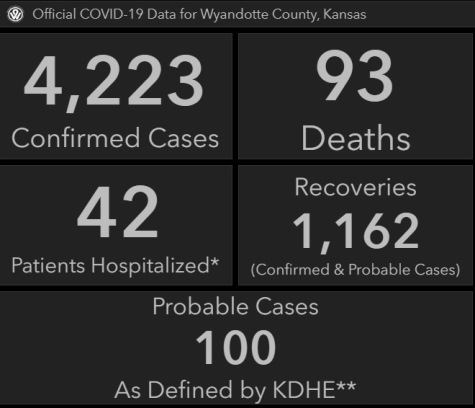
COVID-19 case numbers went up by 101 at 1 p.m. Wednesday in Wyandotte County, according to the UG COVID-19 website. There were 4,223 cumulative cases at 1 p.m., and 93 cumulative deaths, one more death since Tuesday. The number of hospitalizations was 42. (From UG COVID-19 website)
As school districts here discuss options for returning to school after Labor Day, anxiety levels have started to go up among parents, teachers and students.
And rightly so, some would say, as COVID-19 case numbers have been rising in Wyandotte County, the Kansas City area, Kansas and the nation.
While the governor has tried to spare local communities the burden of making the school reopening date decision, other state-level boards have passed the buck down to the local school districts and local communities to carry the responsibility and make all the decisions. The reason given was that situations are different in different parts of the state, so local boards should decide.
In Wyandotte County, the Unified Government Health Department issued an order that schools cannot open before Labor Day, taking some of the burden of decision-making off the local school boards.
Some school boards still are deciding how they are going to reopen, whether with in-person classes or remotely. The Kansas City, Kansas, school board has decided to reopen remotely for the first nine weeks after school starts. In the Piper school district, the board decided to go with the administration’s plan to offer parents an option of whether to choose at-home or in-school hybrid learning for their children. They added five minutes to the end of each school day.
Board inundated by parent questions
The KCK school board has been inundated by parent and teacher questions about the details of the plan. The community wants to know what’s going on, one board member said.
“All of our board members have received several emails, calls and conversations around what’s happening with the fall school year,” said Randy Lopez, KCK school board president, at the Tuesday evening, July 28, special board meeting. Staff has been receiving calls as well, he said. The staff is currently working on options, he said.
“I just want to acknowledge the challenges, the uncertainty, the anxiety that our staff have, and are facing the questions that still remain,” Lopez said at the board meeting. “I promise you we are reading your emails.”
They welcome patrons’ ideas, he added. He said they are taking into consideration everyone’s ideas, and that the administration is doing everything they can to have the conversations that are necessary to provide solutions and answers.
“There’s still a lot for us to consider and talk about,” Lopez said. “We hear you, and we’re reading and seeing your messages, and we’re doing what’s necessary so we can continue to move our district forward in a positive manner and provide different options and solutions for all of our staff, students and families to keep us all safe, but continue to provide high-quality education.”
He asked residents to give them a little grace, and they hope to have more answers later as they move forward.
The reopening plan is still being worked out, according to Superintendent Charles Foust, who said at the meeting that they are trying to get a large ship to make a wide turn, and it’s not easy. Earlier in the meeting, board members said that the administrators have been working extra hours trying to come up with changes for the school year in a short time.
There are some challenges in working with the negotiated agreement and school calendar, according to Dr. Foust. When the 168 days are up, they will still have three weeks left of school technically, he said. They will have to figure out what that will look like, he said. They are trying to make sure the budget will work out.
Dr. Foust said at the board meeting the administration wants to present several options to the board. He said the district has to make sure everyone is safe, and it also has to make sure they are being fiscally responsible. Also, according to officials, the school calendar already has been negotiated, so some details may have to be renegotiated.
Nutrition and transportation budget streams are involved, and at-risk dollars will be at risk, according to the superintendent. They will only present what’s fiscally sound, as well as what’s safe, he added.
“The board has some tough decisions to make,” he said, “but it’s in everyone’s best interest.”
Board members asked for some additional information, and did not want all the information first presented to them on the day that they are supposed to vote on it. The board is talking about having a special meeting on Wednesday, Aug. 5, to discuss some of the details of the plan.
Doctors fielding a lot of questions about schools
Doctors at the University of Kansas Health System are fielding questions about school reopening almost every day during their 8 a.m. news conferences in Kansas City, Kansas, indicating a lot of concern among parents and teachers about school reopening.
People come up with questions about reopening school where the answer isn’t always easy. On Wednesday morning, the doctors were asked a question about what to do if parents test positive – should they send their kids to school or notify the school?
Dr. Dana Hawkinson, medical director of infection prevention and control at The University of Kansas Health System, responded that as they move further into the topic, they would have to see the infection dynamic when school starts, and they will have to decide how to navigate it. The same question could be asked about what to do when a child is sick in school. Would all the students around him have to be out for 14 days? Would the teacher be out for 14 days, he asked.
“I don’t know that we have the answers to those questions yet,” he said. The quarantine would be important, isolating a sick person in the home, and wearing masks in the household would be important, he said.
Continuing to have in-person classes if this continues would be unsustainable, he said, because so many people would be out for two, three and four weeks, and then there would be nobody in class. “I don’t know that we know the answers to those yet.”
Dr. Steve Stites, chief medical officer at KU Health System, said it was similar to questions about workplaces. The rules may be different for children under 10, who could be at less risk than older children. If they start chasing second- and third-degree exposures, they would never have anyone going anywhere, he said. They should take a hard look at isolating first-degree exposures, he said.
Dr. Hawkinson said they should do contact tracing, and parents should be told that there has been an exposure to their child, and those are the only details needed. Schools will develop their own protocols, he said, and notifications will probably be happening at schools.
Teacher concerned about students’ mental health
At Rep. Sharice Davids’ “Call with Your Congresswoman” program at 7 p.m. Wednesday, July 29, a teacher called in to ask several questions, including one about how staying at home is is adversely affecting the emotional health of adolescents.
Rep. Davids said that increasing case numbers are very concerning to everyone who is in a decision-making position. She added her office has been focusing on providing mental health and behavioral health assistance for people who may be experiencing uncertainty and anxiety. They are providing information about access to mental and behavioral health services on their webpage at https://davids.house.gov/coronavirus.
Dr. Amol V. Purandare of Children’s Mercy Hospital, a guest on the program, said children are missing out on traditional interaction, and school is one of the main places where children get social interaction, get a nutritious meal and make friends. If they are able to get kids back to school in a safe and effective manner, he said, they can continue the ability to interact.
In reopening, they need to make sure they limit some of the risks of COVID-19, he said. Wearing a mask and social distancing are important in reducing the risk of COVID-19, he said.
How to reduce children’s anxiety over COVID-19
At a 4 p.m. Kansas Department of Health and Environment news conference on Wednesday, July 29, Dr. Susan Voorhees, psychologist, discussed ways that parents can reduce children’s anxieties over COVID-19 and going back to school.
Kids already know that COVID-19 is out there, Dr. Voorhees said.
“The best thing is to talk to kids,” she said.
Anxiety is like a monster under the bed, it hides in the dark, in areas where people don’t want to talk about, she said. People worry about what will happen tomorrow, and what they heard on the news, and anxiety can grow and grow, she said.
“The best thing for kids is to talk to them about what’s going on, and give a name for what they’re feeling,” she said. Let them know it’s OK to be anxious, she said.
Parents can let kids know that they can concentrate on what they are worried about right now, as opposed to what they might be worried about in a week or two, she said. The process helps “kids get a little bit more of the sense that they are strong agents in their lives, and they aren’t just dependent on other people. Kids love that power.”
She said kids are always resilient when they have to do something difficult. With the virus, kids have come to their own level of understanding of the need for changes in their lives, she said. They may not like it, but they come to understand that things are different than they used to be, she added.
Kids who are doing the best are the ones who can have an active conversation about what is different this time. She encouraged parents to talk now about what will be different about school than it was before, and how they will deal with it as a family, Dr. Voorhees said.
The conversation can include discussions about hybrid learning, with people sitting farther away, shields at desks or teachers wearing a face mask, she said. Parents can start now, and show children what a 6-foot distance is.
If a student is staying home all day and using remote devices for Zoom-style instruction, it can be very tiring, according to Dr. Voorhees, and is a different emotional experience.
“Parents are going to be asked, as they have all spring, to be much more available to their kids, much more involved in their kids’ education, more aware of it,” Dr. Voorhees said.
But no one expects a parent to become a high school biology teacher, she added. There are resources available and parents need to learn to look for them and ask for them, she added.
There can be anxiety when parents and students think about going back to school with high case numbers and cautions about wearing a mask. Dr. Voorhees said kids are altruistic and if you tell them they wear a mask to protect their friends, they get that and want to help other people, she said. Kids will carry the message for you, she said.
Not being able to go back to school and build relationships with other children is a big concern and anxiety for children, Dr. Voorhees said. There is a lot that goes on with interaction of peers in preschool, and older children learn to work with the community , resolve differences and how to share, she said.
“One of the places that causes stress for people who are trying to make big decisions is we know this is having an impact on children’s development, and how do we keep them safe and help them thrive as well,” she said.
Her advice for adults trying to handle stress and anxiety is about the same, she said. First is to think what they are anxious about, is it something they have any control over or not, she said. Can they do something about it or not? Do they have to be anxious about it right now? They can’t do anything about what happens three weeks from now, but what can they do now, she asked. They can make sure they have enough masks, a plan for how to keep track of it, and talk to them about the plan for their school, she said.
“You break down the worry into little steps,” she said. Also, parents can plan a little quiet time for themselves into their day, she added.
Dr. Lee Norman, Kansas secretary of health, said this will be a good time for parents to model social distancing, mask wearing and hygiene.
Dr. Voorhees said kids can have the role in the family to make sure everyone leaving for school has a mask.
Dr. Norman said it’s important to have conversations with kids right now for emotional health.
Case numbers up in Kansas and locally
COVID-19 case numbers went up by 101 on Wednesday in Wyandotte County, according to the UG COVID-19 website. There were 4,223 cumulative cases at 1 p.m., and 93 cumulative deaths, one more death since Tuesday. The number of hospitalizations was 42.
Dr. Hawkinson said there were 34 COVID-19 patients on Wednesday morning at KU Health System, down from 35 on Tuesday. There were nine patients in the intensive care unit, an increase of one since Tuesday, and five patients on ventilators, an increase of one since Tuesday.
Kansas reported an increase of 698 cases from Monday to Wednesday, according to Dr. Norman, with a total of 26,870 cumulative positive cases. There were 14 more deaths since Monday, for a cumulative total of 349. Hospitalizations in the state went up by 56.
Nearby Johnson County saw an increase of 170 cases from Monday to Wednesday, according to KDHE statistics, for a cumulative total of 4,813.
Leavenworth County reported 1,406 cases, an increase of 14 since Monday, according to KDHE.
Sedgwick County, the Wichita area, had 3,951 cumulative cases, an increase of 135 since Monday.
Shawnee County, the Topeka area, had 1,374 cumulative cases, an increase of 50 since Monday.
Douglas County reported 632 cumulative cases and Riley County had 412 cases, according to KDHE.
Testing available
A free pop-up test for COVID-19 is available from 10 a.m. to 1 p.m. Thursday, July 30, at Quindaro Community Center, 2627 Brown Ave., Kansas City, Kansas. The pop-up tests are through the Wyandotte County Health Equity Task Force.
Free testing is also being conducted from 9 a.m. to 3 p.m. on weekdays at the Health Department, 6th and Ann, in the parking lot in Kansas City, Kansas, weather permitting. Testing ended early on Wednesday because of lightning.
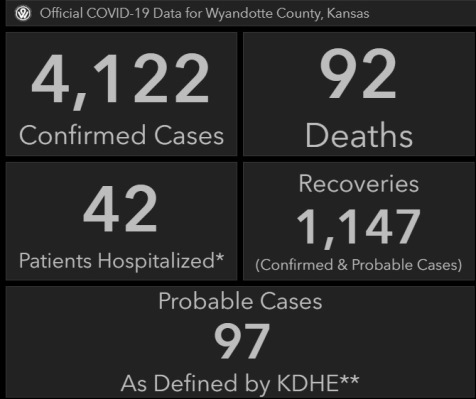
Wyandotte County reported an increase of 27 cases between Monday afternoon and 1:15 p.m. Tuesday, according to the Unified Government COVID-19 webpage. The cumulative total was 4,122. The cumulative deaths were the same at 92, with no new deaths. The number of hospitalizations increased by six, and totaled 42, according to the COVID-19 webpage.
The mask culture must grow, and local gatherings must be limited to reduce the spread of COVID-19, according to doctors at the University of Kansas Health System.
Dr. Steve Stites, chief medical officer at KU Health System, said at a news conference on Tuesday morning that it’s a “fool’s folly” to think that students should go back to school this fall without a mask.
Dr. Dana Hawkinson, medical director of infection control and prevention at KU Health System, said people need to wear masks and limit gatherings.
The doctors discussed some recent misinformation coming from other areas, and they tried to set the record straight on mask-wearing.
Mask-wearing needs to be continued and expanded throughout Kansas, and limiting gatherings will be important, Dr. Hawkinson said.
One recent news report showed a large religious gathering in Alabama, and it’s not just the bars that need to limit gatherings, Dr. Hawkinson said.
He said there is very good evidence about the way COVID-19 is spread and how to prevent it. He also said hydroxychloroquine does not work for COVID-19 patients, and can do more harm by making other drugs less effective.
COVID-19, expectant mothers and babies were discussed at the news conference. Dr. Carrie Wieneke, chair of obstetrics-gynecology, said the biggest misconception about going through pregnancy with COVID-19 was that the mom and baby would automatically be separated.
She’s heard that fear caused many to not seek pre-natal care and look at a home birth option. She said it’s not the case and there are many things the hospital does to keep the mom and baby together.
Dr. Wieneke said there have been quite a number of COVID-19 positive mothers giving birth during the pandemic, some in the last 24 hours. The biggest concern for moms is staying healthy, and she said that is the same today as before the pandemic.
Where the mother is positive for COVID-19, the babies may stay in the mother’s room, if the mother is well enough to care for the baby, she said. Mothers wear a mask when they are feeding the baby.
Dr. Whitney Pressler, medical director of the newborn nursery, said the number one question she gets from families is how to keep a baby safe in a pandemic. She said she spends time with families telling them what they know at this time and what they don’t know, trying to make the best decision for the family.
Dr. Pressler said COVID-19 antibodies can’t be passed to a baby through breast milk.
Also, limited hospital visitor policies have made it hard for siblings who can’t visit the new baby in the hospital, she said.
She also discussed isolating some grandparents before a first-time home visit, depending on their activities.
Dr. Pressler said it’s good for schools to offer parents options this fall, but those in the kindergarten through third grade level, emerging readers, could suffer more harm by not being in class where they can develop reading skills.
She advised that children should practice wearing a mask at home, so they could be used to it when school starts.
At the University of Kansas Health System, the number of COVID-19 patients was up Tuesday. There were 35 patients, an increase of two since Monday, according to Dr. Dana Hawkinson, medical director of infection prevention and control at the KU Health System, Eight of the patients were in the intensive care unit and four on ventilators. There was a decrease of three in patients in the ICU, while the number on ventilators was the same as Monday.
Wyandotte County reported an increase of 27 cases between Monday afternoon and 1:15 p.m. Tuesday, according to the Unified Government COVID-19 webpage. The number of cumulative deaths was the same at 92, with no new deaths. The number of hospitalizations increased by six, and totaled 42, according to the COVID-19 webpage.
Topeka Correctional Facility staff member dies from COVID-19 complications
Kansas Department of Corrections Secretary Jeff Zmuda announced Tuesday that one staff member at the Topeka Correctional Facility died on Saturday, July 25, due to complications from COVID-19. This is the third staff death related to the virus with the first two being at the Lansing Correctional Facility.
Richard Rose, 74, had more than 17 years of dedicated service to the KDOC. He served as a facility maintenance supervisor, spending most of his time offsite.
“We extend our deepest sympathy to Richard’s family and to those who served alongside him for so many years,” Zmuda said. “The KDOC family is a tight-knit group and these deaths, and those of our residents, have been extremely difficult.”
The KDOC Peer Support Team will be available for any staff members who need additional support in dealing with this loss.
“The COVID-19 pandemic has claimed the lives of too many hard-working Kansans,” Gov. Laura Kelly said. “Richard was a dedicated public servant and I extend my condolences to both his family, friends, and those who worked alongside him.”
The Topeka Correctional Facility is Kansas’ only all-female prison with a capacity of 948. The facility houses minimum, medium, special management and maximum custody residents.
Testing available
A free pop-up test for COVID-19 is available from 8 a.m. to 11 a.m. Wednesday, July 29, at Zotung Christian Church, 5010 Parallel Parkway, Kansas City, Kansas.
The pop-up tests are through the Wyandotte County Health Equity Task Force. Free testing is also being conducted from 9 a.m. to 3 p.m. on weekdays at the Health Department, 6th and Ann, in the parking lot in Kansas City, Kansas, weather permitting.